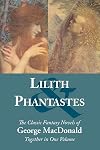
Phantastes / Lilith
by George MacDonald
On This Page
Description
The classic fantasy that influenced C. S. Lewis and Tolkien, considered one of George MacDonald s most important works, is the story of the young man, Anodos, and his adventures in fairyland which ultimately reveal the human condition. I write, not for children, wrote George MacDonald, but for the child-like, whether they be of five, or fifty, or seventy-five. All-at-once written with an innocent whimsy and soulful yearning, the heart of Anodos journey through fairyland reveals a spiritual show more quest that requires a surrender of the self. MacDonald s fantasy novel as well as his other works have had major influence on many authors who considered him their mentor: C. S. Lewis said, I have never concealed the fact that I regarded him as my master; indeed I fancy I have never written a book in which I did not quote from him. J. R. R. Tolkien called his fairy tales stories of power and beauty. Madeleine L Engle said, Surely, George MacDonald is the grandfather of us all all of us who struggle to come to terms with truth through fantasy. The classic fantasy that influenced C. S. Lewis and Tolkien, considered one of George MacDonald s most important works, is the story of the young man, Anodos, and his adventures in fairyland which ultimately reveal the human condition. I write, not for children, wrote George MacDonald, but for the child-like, whether they be of five, or fifty, or seventy-five. All-at-once written with an innocent whimsy and soulful yearning, the heart of Anodos journey through fairyland reveals a spiritual quest that requires a surrender of the self. MacDonald s fantasy novel as well as his other works have had major influence on many authors who considered him their mentor. George MacDonald (1824 1905) is well known for writing fantasy and fairy tales that have inspired notable authors such as J. R. R. Tolkien, W. H. Auden, Madeleine L Engle, G. K. Chesterton, Elizabeth Yates, Mark Twain and C. S. Lewis. The Scottish author once served as pastor of Trinity Congregational Church, Arundel, and later was also engaged in ministerial work in Manchester. He eventually settled in London and taught at the University of London, and lectured successfully in the United States during 1872 1873. MacDonald was also editor of "Good Words for the Young" for a time.". show lessTags
Recommendations




















Member Reviews
Having read somewhere that the work of such beloved authors as C.S. Lewis and Madeleine L’Engle had been influenced by having read George MacDonald, I procured this book. I have long enjoyed their work and was interested in reading something that might have been inspirational for them.
Phantastes, the first novel, follows Anodos as he traverses through the Fairy Land, experiencing quite a bit, and accomplishing almost nothing. The tale meandered as Anodos did, never threatening to have a plot or a message, just flowery script and imaginative characters, who were nonetheless quite one-dimensional. I had to put this down and read something else several times because I was so bored with it. I did not find Anodos a terribly likable show more character, either. Several times along his excursion, various denizens of Fairly Land give him a warning not to do something or other. Every time, Anodos does it anyway, most times even thinking, ‘Hey, I was told not to do this, but I just can’t help myself.’ Most of the conflict in the story comes as a result of Anodos ignoring or flagrantly defying the advice he has been given. However, I shudder to think how much more tiresome I would have found this tale had he taken heed and avoided peril. Upon returning from Fairy Land, Anodos finds that he has been missing from our world for 21 days and remarks that it felt like 21 years. To me, reading about the journey seemed to take 21 months.
The second novel, Lilith, begins a bit better; Mr. Vane meets a ghost who is also a raven, and a librarian and a sexton. This individual, Mr. Raven, escorts Mr. Vane to an alternate world, attempts to explain that in order to lead a more fulfilling life, Mr. Vane must ‘wake up’ and ‘go home’ (not, of course, meaning at all the general and obvious interpretation of these two concepts) and bids him take a nap. Mr. Vane, however, does not like the look of those sleeping nearby, and decides to run away. He soon finds himself on the same kind of journey Anodos undertook, encountering odd things that have little meaning or interest, but that the author seemed to have gotten a hold of some particularly hallucinatory drug and then decided to write a book about ‘life’ and ‘meaning,’ man. MacDonald also frequently insists that his narrator is having a lot of trouble describing the things he encounters, as everything was so very different and unique from his Earth-centric worldview that words fail him. This reinforces my theory that the writer was definitely trying to describe his own drug-induced visions. Otherwise, why even write a book like that?
At one point on his incredibly pointless journey, Mr. Vane decries his former preference for being alone with book or pen, musing, “Any man…is more than the greatest of books!" I strongly disagree with this statement and almost gave up reading the book. It seems to me an author with so little regard for books has not written anything worthy of my regard.
Scarcely 100 pages after I almost gave up, I did indeed give up. Mr. Vane was urged by one he trusted completely not to do something, and that if he were to do so someone he loved would suffer. At the point Mr. Vane fails to heed this most emphatic warning, I threw the book at the wall and decried the time I spent reading both tales. What a giant waste. show less
Phantastes, the first novel, follows Anodos as he traverses through the Fairy Land, experiencing quite a bit, and accomplishing almost nothing. The tale meandered as Anodos did, never threatening to have a plot or a message, just flowery script and imaginative characters, who were nonetheless quite one-dimensional. I had to put this down and read something else several times because I was so bored with it. I did not find Anodos a terribly likable show more character, either. Several times along his excursion, various denizens of Fairly Land give him a warning not to do something or other. Every time, Anodos does it anyway, most times even thinking, ‘Hey, I was told not to do this, but I just can’t help myself.’ Most of the conflict in the story comes as a result of Anodos ignoring or flagrantly defying the advice he has been given. However, I shudder to think how much more tiresome I would have found this tale had he taken heed and avoided peril. Upon returning from Fairy Land, Anodos finds that he has been missing from our world for 21 days and remarks that it felt like 21 years. To me, reading about the journey seemed to take 21 months.
The second novel, Lilith, begins a bit better; Mr. Vane meets a ghost who is also a raven, and a librarian and a sexton. This individual, Mr. Raven, escorts Mr. Vane to an alternate world, attempts to explain that in order to lead a more fulfilling life, Mr. Vane must ‘wake up’ and ‘go home’ (not, of course, meaning at all the general and obvious interpretation of these two concepts) and bids him take a nap. Mr. Vane, however, does not like the look of those sleeping nearby, and decides to run away. He soon finds himself on the same kind of journey Anodos undertook, encountering odd things that have little meaning or interest, but that the author seemed to have gotten a hold of some particularly hallucinatory drug and then decided to write a book about ‘life’ and ‘meaning,’ man. MacDonald also frequently insists that his narrator is having a lot of trouble describing the things he encounters, as everything was so very different and unique from his Earth-centric worldview that words fail him. This reinforces my theory that the writer was definitely trying to describe his own drug-induced visions. Otherwise, why even write a book like that?
At one point on his incredibly pointless journey, Mr. Vane decries his former preference for being alone with book or pen, musing, “Any man…is more than the greatest of books!" I strongly disagree with this statement and almost gave up reading the book. It seems to me an author with so little regard for books has not written anything worthy of my regard.
Scarcely 100 pages after I almost gave up, I did indeed give up. Mr. Vane was urged by one he trusted completely not to do something, and that if he were to do so someone he loved would suffer. At the point Mr. Vane fails to heed this most emphatic warning, I threw the book at the wall and decried the time I spent reading both tales. What a giant waste. show less
Ratings
Members
- Recently Added By
Published Reviews
ThingScore 75
Though Macdonald's style has some of the glaring defects of Victorian Gothic, few writers have so fascinatingly portrayed a man pursued by the hound of heaven and a pack of his own neuroses.
added by Shortride
Talk Discussions
Past Discussions
Phantastes & Lilith by George MacDonald (reviewd by lilyfyrestorm) in Reviews reviewed (June 2011)
Author Information

384+ Works 38,928 Members
George MacDonald was born on December 10, 1824 in Huntley, Aberdeenshire, Scotland. He attended University in Aberdeen in 1840 and then went on to Highbury College in 1848 where he studied to be a Congregational Minister, receiving his M. A. After being a minister for several years, he became a lecturer in English literature at Kings College in show more London before becoming a full-time writer. He wrote fiction, non-fiction, and poetry. In 1955, he wrote his first important original work, a long religious poem entitled Within and Without. He is best known for his fantasy novels Phantastes, The Princess and the Goblin, At the Back of the North Wind, and Lilith and fairy tales including The Light Princess, The Golden Key, and The Wise Woman. In 1863, he published David Eiginbrod, the first of a dozen novels that were set in Scotland and based on the lives of rural Scots. He died on September 18. 1905. (Bowker Author Biography) show less
Work Relationships
Common Knowledge
- Canonical title
- Phantastes / Lilith
Classifications
Statistics
- Members
- 231
- Popularity
- 140,874
- Reviews
- 1
- Rating
- (3.71)
- Languages
- English
- Media
- Paper, Audiobook, Ebook
- ISBNs
- 6
- ASINs
- 6