The Poems of Gerard Manley Hopkins
by Gerard Manley Hopkins
On This Page
Description
Relatively unknown in his own lifetime, Gerard Manley Hopkins is the now accredited as the author of some of the finest and most complex poems in the English language. As a Victorian poet, Roman Catholic convert, and Jesuit priest, Hopkins pioneered a revolutionary form of meter he termed "sprung rhythm" in his first major work, "The Wreck of the Deutschland." This poem, like most of Hopkins' work, reflects both his belief in the doctrine that human beings were created to praise God as well show more as his commitment to the Jesuit practices of meditation and spiritual self-examination. Hopkins' poetry is unconventional in its sensitivity to alliteration, assonance and consonance, as well as its characteristic diction and phrasing. This volume includes some of his most famous works: "Spring," "Pied Beauty," "God's Grandeur," "The Starlight Night," "Spelt from Sibyl's Leaves," and his most famous sonnet, "The Windhover.". show lessTags
Recommendations




















Member Reviews
Mackenzie in his introduction names "The Wreck of the Deutschland" as a key work for Hopkins. Upon first reading it left less of an impression than poems as "Inversnaid", their idiosyncratic locution like smooth marbles in the mouth: "His rollrock highroad roaring down", an instance.
My first reading of Hopkins, apart from possible exposure to one or two poems in high school. I heard an echo of Elisabeth Frasier's lyric in more than one place, but did not mark them. Will be curious to see if they recur when reading another time.
My first encounter with Sprung Rhythm, reason enough to revisit this slim volume. Mackenzie from his introduction:
The essence of Sprung Rhythm is, firstly, that the length of a line is gauged by stresses, not show more syllables; and secondly, that each foot may contain in addition to its stress whatever number of light or medium syllables the artists needs to balance the weight of the stress -- varying from as many as five or six down to none at all. [16-17]
Unsurprising to find Shakespeare used it; more immediately, Dylan does. Its description is more complicated than the sound of it; Hopkins was inspired by common speech to fix the rhythm in his mind, and use it in verse. Common enough in daily experience if tricky to write. I'm not yet confident I can read it correctly, either, though Hopkins took pains to provide stress marks in several poems.
//
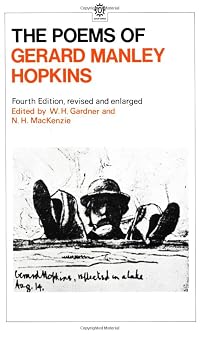
No essays or sermons in this edition, unadorned apart from the frontispiece image of Hopkins, and coloured ink (a fern green used in page numbers and poem titles). show less
My first reading of Hopkins, apart from possible exposure to one or two poems in high school. I heard an echo of Elisabeth Frasier's lyric in more than one place, but did not mark them. Will be curious to see if they recur when reading another time.
My first encounter with Sprung Rhythm, reason enough to revisit this slim volume. Mackenzie from his introduction:
The essence of Sprung Rhythm is, firstly, that the length of a line is gauged by stresses, not show more syllables; and secondly, that each foot may contain in addition to its stress whatever number of light or medium syllables the artists needs to balance the weight of the stress -- varying from as many as five or six down to none at all. [16-17]
Unsurprising to find Shakespeare used it; more immediately, Dylan does. Its description is more complicated than the sound of it; Hopkins was inspired by common speech to fix the rhythm in his mind, and use it in verse. Common enough in daily experience if tricky to write. I'm not yet confident I can read it correctly, either, though Hopkins took pains to provide stress marks in several poems.
//
No essays or sermons in this edition, unadorned apart from the frontispiece image of Hopkins, and coloured ink (a fern green used in page numbers and poem titles). show less
3rd Ed. - DJ has age wear, tape repairs and other minor issues, but book in VG cond. overall
01/00/00
pbs wishlist
zounds - what sounds!
Ratings
Members
- Recently Added By
Lists

University literature
145 works; 5 members

Trinity College Booklist (1951): Class Ten, English Literature
358 works; 5 members

Books That Made Us Cry
278 works; 145 members

The Well-Educated Mind, Susan Wise Bauer, 2016
179 works; 3 members
Author Information

140+ Works 5,001 Members
Gerard M. Hopkins was born on July 28, 1844 in England, into a large and talented family. He attended Oxford, and entered the Jesuits in 1868. He later studied theology and, after destroying much of his youthful poetry, took up writing. In 1877, Hopkins was ordained as a priest. He was assigned to several churches and continued to write poetry, show more none of which was published until after his death. Hopkins's poems are noted for their intricate rhythm, which he labeled sprung rhythm. The poems are exemplified by their clever puns, wordplay and imaginative phrasing. His works include several series of sonnets, such as Pied Beauty and The Windhover, as well as "terrible" sonnets that explore the conflict between his sexual longing and his devotion to God. Gerard M. Hopkins died of typhoid fever on June 8, 1889, in Ireland. (Bowker Author Biography) show less
All Editions
Awards and Honors
Series
Belongs to Publisher Series
Work Relationships
Has as a student's study guide
Common Knowledge
- Canonical title
- The Poems of Gerard Manley Hopkins
- Original publication date
- 1918
- Disambiguation notice
- This is the version edited by WH Gardner and NH MacKenzie and should not be combined with other collections.
Classifications
Statistics
- Members
- 637
- Popularity
- 45,554
- Reviews
- 5
- Rating
- (4.44)
- Languages
- English, French
- Media
- Paper, Audiobook, Ebook
- ISBNs
- 23
- ASINs
- 28