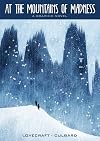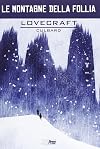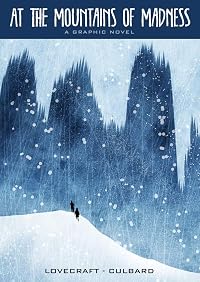
At the Mountains of Madness: A Graphic Novel
by H. P. Lovecraft
Illustrated Classics Graphic Novels (Lovecraft)
On This Page
Description
Immerse yourself in the chilling depths of cosmic horror with the At the Mountains of Madness audiobook. Crafted by the legendary H.P. Lovecraft, this atmospheric masterpiece will transport you to a world teetering on the edge of madness. As you listen to this captivating audiobook, be prepared to journey into the heart of horror itself. Lovecraft's evocative storytelling and vivid descriptions will send shivers down your spine, making every hair stand on end. With each word, he weaves a web show more of suspense and terror that will leave you breathless. The At the Mountains of Madness audiobook delves into the darkest corners of our universe, unearthing ancient secrets and unfathomable terrors. Lovecraft's unique blend of science fiction and horror creates a narrative that is both unsettling and mesmerizing. You'll find yourself lost in his world, unable to tear yourself away from the mounting sense of dread. Featuring an expertly narrated performance, this audiobook brings Lovecraft's chilling words to life. The narrator's haunting voice captures the essence of the story, immersing you in its eerie atmosphere. Close your eyes and let their voice guide you through the haunting landscapes and mind-bending horrors that await. With its cosmic horror theme, At the Mountains of Madness stands out among other horror audiobooks. It offers a fresh perspective on fear and the unknown, leaving an indelible mark on your imagination long after you've finished listening. Unlock the secrets of cosmic horror with the At the Mountains of Madness audiobook. Let Lovecraft's masterful storytelling transport you to a realm where fear reigns supreme and sanity hangs by a thread. Experience true terror with each word spoken in this bone-chilling masterpiece. show lessTags
Recommendations



Member Reviews
http://nwhyte.livejournal.com/1874607.html
this takes Lovecraft's classic novella and puts it into a stark graphic novel adaptation, beautifully suited to the tale. The original story is a masterpiece of horror, ratcheting up the tension and dread with each sentence; Culbard's adaptation must play with the text a little, but keeps many of the best lines. The drawing style is generally restrained, which makes the one or two moments of horrific revelation (particularly the gruesome fate of the advance party and the first sight of the hidden city) all the more effective. Dyer's increasingly horror is conveyed very economically with subtle changes to the shading of his face, especially the bags under his eyes.
The graphic medium does mean a show more certain attenuation of atmosphere. In Lovecraft's text, we are taken into Dyer's mind, and he admits that he is a slightly unreliable narrator, partly unhinged by the horrors he has witnessed. As a drawn character, even as the narrator, he becomes someone who we readers watch along with the other members of the expedition (and the monsters); he may still be the central character, but his perspective is no longer as privileged as it is in the original text, and that's probably unavoidable. (Dave Sim, for all his many faults, actually had some great moments in Cerebus where we could appreciate the points of view of particular characters, but I think that needs a different kind of story-telling than is really possible here.)
Anyway, a must-have for anyone who is even a mild Lovecraft fan, or indeed for anyone who hasn't yet tried him but is wondering what the fuss is about. show less
this takes Lovecraft's classic novella and puts it into a stark graphic novel adaptation, beautifully suited to the tale. The original story is a masterpiece of horror, ratcheting up the tension and dread with each sentence; Culbard's adaptation must play with the text a little, but keeps many of the best lines. The drawing style is generally restrained, which makes the one or two moments of horrific revelation (particularly the gruesome fate of the advance party and the first sight of the hidden city) all the more effective. Dyer's increasingly horror is conveyed very economically with subtle changes to the shading of his face, especially the bags under his eyes.
The graphic medium does mean a show more certain attenuation of atmosphere. In Lovecraft's text, we are taken into Dyer's mind, and he admits that he is a slightly unreliable narrator, partly unhinged by the horrors he has witnessed. As a drawn character, even as the narrator, he becomes someone who we readers watch along with the other members of the expedition (and the monsters); he may still be the central character, but his perspective is no longer as privileged as it is in the original text, and that's probably unavoidable. (Dave Sim, for all his many faults, actually had some great moments in Cerebus where we could appreciate the points of view of particular characters, but I think that needs a different kind of story-telling than is really possible here.)
Anyway, a must-have for anyone who is even a mild Lovecraft fan, or indeed for anyone who hasn't yet tried him but is wondering what the fuss is about. show less
Evocative artwork that feels right for the period, without simply imitating it. Culbard has done a good job adapting the story, with minor alterations to better fit the medium, and the slight expansion of the framing device works well. Really enjoyed this.
Lovecraft has been a bit hit or miss for me but this one, despite a fairly predictable climax, was oddly mesmerizing. Not much actually happens, but the slow reveal of the Dreadful Truth is very nicely done, and, well, not only does this offer a generous sampling of classic Lovecraftian gods and monsters, but there are six foot tall monster penguins!
I read several comic adaptations of Lovecraft's stories, manga adaptation of "At the Mountain of Madness" being one of the very good ones, but this series of books by I.N.J. Cullbard are just wonderful.
Presented in the wonderful drawings, this story was truly augmented and presented in the most cinematic way possible. Story itself follows the original Lovecraft's novel but manages to create the pressure of unseen terror, always that something lurking from within shadows without making the visual presentation difficult to the eyes.
Excellent adaptations, highly recommended to all fans of horor and especially Lovecraft.
Presented in the wonderful drawings, this story was truly augmented and presented in the most cinematic way possible. Story itself follows the original Lovecraft's novel but manages to create the pressure of unseen terror, always that something lurking from within shadows without making the visual presentation difficult to the eyes.
Excellent adaptations, highly recommended to all fans of horor and especially Lovecraft.
I bought this on the recommendation of Dave Morris of Fabled Lands. It is a very tight rendition of HP Lovecraft's 'At the Mountains of Madness', with artwork somewhat resembling Hergé's Tintin, though a bit more comic-y. I particularly liked the increasing darkness of the panels as Danforth and the Professor descended deeper into the alien city in the ice. The brevity of the graphic novel form is both a strength and a weakness here. You *see* the Elder Thing in the ice, without the pages of description. There is certainly some creepy buildup, especially during the plane trip over the mountains, but something of the slowly growing horror of the wordy original is lost. This is by no means the fault of the artist, who has done a superb show more job, but is inherent in the adaptation of a novella to graphical form. A very good adaptation of one of Lovecraft's best stories. show less
A graphic novel is perhaps a better format for this particular story then the original. Some of Lovecraft is masterful in its use of inference and suspense, like The Case of Charles Dexter Ward. Nut the horror of the Elder things can be truly grasped from illustrations. It would be interesting to see other titles brought to life in the GN genre.
Pretty good graphic novelization. Culbard lets the pictures do their thousand word thing and leaves out most of Lovecraft's purple prose for just the spare dialog. Almost anti-Lovecraft which is refreshing for a Lovecraft novelization. After building the suspense, a little weak on the payoff; I would have liked to have seen more of the chase by the shoggoths. Unless you've read the story by Lovecraft, which I assume almost all readers have, the menace of the shoggoths is a little vague. Why exactly are they so scary? I guess we presume they are the perpetrators for what happened to the others.
Members
- Recently Added By
Published Reviews
ThingScore 100
It is not only that Culbard has so cunningly boiled down Lovecraft's rather weighty novel, leaving its exciting plot free to breathe; it's also that his superb ligne claire drawings so effortlessly evoke both the world of Tintin, and the Edwardian science fiction of HG Wells and Sir Arthur Conan Doyle.
added by melonbrawl
Lists

Unshelved Book Clubs
579 works; 5 members

Graphic Novels Adapted from Other Books
206 works; 1 member
Author Information

1,917+ Works 73,693 Members
Howard Phillips Lovecraft, 1890 - 1937 H. P. Lovecraft was born on August 20, 1890 in Providence, Rhode Island. His mother was Sarah Susan Phillips Lovecraft and his father was Winfield Scott Lovecraft, a traveling salesman for Gorham & Co. Silversmtihs. Lovecraft was reciting poetry at the age of two and when he was three years old, his father show more suffered a mental breakdown and was admitted to Butler Hospital. He spent five years there before dying on July 19, 1898 of paresis, a form of neurosyphillis. During those five years, Lovecraft was told that his father was paralyzed and in a coma, which was not the case. His mother, two aunts and grandfather were now bringing up Lovecraft. He suffered from frequent illnesses as a boy, many of which were psychological. He began writing between the ages of six and seven and, at about the age of eight, he discovered science. He began to produce the hectographed journals, "The Scientific Gazette" (1899-1907) and "The Rhode Island Journal of Astronomy" (1903-07). His first appearance in print happened, in 1906, when he wrote a letter on an astronomical matter to The Providence Sunday Journal. A short time later, he began writing a monthly astronomy column for The Pawtuxet Valley Gleaner - a rural paper. He also wrote columns for The Providence Tribune (1906-08), The Providence Evening News (1914-18), The Asheville (N.C.) Gazette-News (1915). In 1904, his grandfather died and the family suffered severe financial difficulties, which forced him and his mother to move out of their Victorian home. Devastated by this, he apparently contemplated suicide. In 1908, before graduating from high school, he suffered a nervous breakdown. He didn't receive a diploma and failed to get into Brown University, both of which caused him great shame. Lovecraft was not heard from for five years, re-emerging because of a letter he wrote in protest to Fred Jackson's love story in The Argosy. His letter was published in 1913 and caused great controversy, which was noted by Edward F. Daas, President of the United Amateur Press Association (UAPA). Daas invited Lovecraft to join the UAPA, which he did in early 1914. He eventually became President and Official Editor of the UAPA and served briefly as President of the rival National Amateur Press Association (NAPA). He published thirteen issues of his own paper, The Conservative (1915-23) and contributed poetry and essays to other journals. He also wrote some fiction which titles include "The Beast in the Cave" (1905), "The Alchemist" (1908), "The Tomb" and "Dagon" (1917). In 1919, Lovecraft's mother was deteriorating, mentally and physically, and was admitted to Butler Hospital. On May 24, 1921, his mother died from a gall bladder operation. While attending an amateur journalism convention in Boston, Lovecraft met his future wife Sonia Haft Greene, a Russian Jew. They were married on March 3, 1924 and Lovecraft moved to her apartment in Brooklyn. Sonia had a shop on Fifth Avenue that went bankrupt. In 1925, Sonia went to Cleveland for a job and Lovecraft moved to a smaller apartment in the Red Hook district of Brooklyn. In 1926, he decided to move back to Providence. Lovecraft had his aunts bar his wife, Sonia, from going to Providence to start a business because he couldn't have the stigma of a tradeswoman wife. They were divorced in 1929. After his return to Providence, he wrote his greatest fiction, which included the titles "The Call of Cthulhu" (1926), "At the Mountains of Madness" (1931), and "The Shadow Out of Time" (1934-35). In 1932, his aunt, Mrs. Clark, died; and he moved in with his other aunt, Mrs. Gamwell, in 1933. Suffering from cancer of the intestine, Lovecraft was admitted to Jane Brown Memorial Hospital and on March 15, 1937 he died. (Bowker Author Biography) show less
All Editions
Awards and Honors
Awards
Series

Work Relationships
Common Knowledge
- Canonical title
- At the Mountains of Madness: A Graphic Novel
- Important places
- Antarctica
- Disambiguation notice
- This is a graphic novel adaptation of Lovecraft's At The Mountains of Madness. Please do not combine with main work.
Classifications
- Genres
- Horror, Graphic Novels & Comics, Fiction and Literature
- DDC/MDS
- 741.5 — Arts & recreation Drawing & decorative arts Drawing Comic books, graphic novels, fotonovelas, cartoons, caricatures, comic strips
- LCC
- PN6737 .C85 .A8 — Language and Literature Literature (General) Literature (General) Collections of general literature Comic books, strips, etc.
- BISAC
Statistics
- Members
- 286
- Popularity
- 112,294
- Reviews
- 20
- Rating
- (3.66)
- Languages
- 5 — English, French, Italian, Croatian, Spanish
- Media
- Paper, Audiobook, Ebook
- ISBNs
- 10
- ASINs
- 1