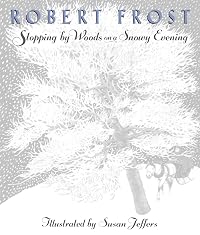
Stopping by Woods on a Snowy Evening
by Robert Frost
On This Page
Description
Illustrations of wintry scenes accompany each line of the well-known poem.Tags
Recommendations


Member Reviews
Stopping by Woods on a Snowy Evening, illustrated by P.J. Lynch.
The words of the classic poem from Robert Frost, Stopping by Woods on a Snowy Evening, written in 1922 and first published in the poet's 1923 New Hampshire collection, are paired in this gorgeous picture book with the watercolor and gouache artwork of Irish illustrator P.J. Lynch. Here the narrator of the poem is a young woman, riding her horse through a snowbound world, and briefly stopping to gaze at a beautiful wood...
I have loved this poem since childhood, when I first encountered it in a volume of Frost's poetry taken from my father's shelves, and I have also loved the picture book made of it in 1978 by American artist Susan Jeffers, whose illustrations are a thing of show more beauty, amplifying the mystery and wonder of these words. That said, I am also a great admirer of P.J. Lynch's work, so when I heard that he had also recently produced a new picture book presentation of this poem, I immediately set out to track it down. I am so glad I did, as I found this new presentation just as (if not slightly more) beautiful than the Jeffers—which is quite an achievement! I think the two artists do something rather different, in their visual interpretations, and I appreciate that difference. Whereas the Jeffers has a rather cheerful "dashing through the snow" feeling, complete with a figure that looks suspiciously like Santa Claus, the Lynch captures an individual who, save for her horse, is truly along in a frozen world. One gets the sense, in some of these illustrations, of the feeling of being frozen, not just in the landscape, but in the young woman, who is momentarily transfixed by the deep and dark beauty of the woods. Recommended to anyone looking for picture book presentations of this poem—I recommend reading both it and the Jeffers—as well as to fellow fans of P.J. Lynch. show less
The words of the classic poem from Robert Frost, Stopping by Woods on a Snowy Evening, written in 1922 and first published in the poet's 1923 New Hampshire collection, are paired in this gorgeous picture book with the watercolor and gouache artwork of Irish illustrator P.J. Lynch. Here the narrator of the poem is a young woman, riding her horse through a snowbound world, and briefly stopping to gaze at a beautiful wood...
I have loved this poem since childhood, when I first encountered it in a volume of Frost's poetry taken from my father's shelves, and I have also loved the picture book made of it in 1978 by American artist Susan Jeffers, whose illustrations are a thing of show more beauty, amplifying the mystery and wonder of these words. That said, I am also a great admirer of P.J. Lynch's work, so when I heard that he had also recently produced a new picture book presentation of this poem, I immediately set out to track it down. I am so glad I did, as I found this new presentation just as (if not slightly more) beautiful than the Jeffers—which is quite an achievement! I think the two artists do something rather different, in their visual interpretations, and I appreciate that difference. Whereas the Jeffers has a rather cheerful "dashing through the snow" feeling, complete with a figure that looks suspiciously like Santa Claus, the Lynch captures an individual who, save for her horse, is truly along in a frozen world. One gets the sense, in some of these illustrations, of the feeling of being frozen, not just in the landscape, but in the young woman, who is momentarily transfixed by the deep and dark beauty of the woods. Recommended to anyone looking for picture book presentations of this poem—I recommend reading both it and the Jeffers—as well as to fellow fans of P.J. Lynch. show less
Stopping by Woods on a Snowy Evening, illustrated by Susan Jeffers.
Robert Frost's classic winter poem, Stopping By Woods On a Snowy Evening, which was composed in 1922 and first published in 1923 as part of his New Hampshire volume, provides the text for this beautiful picture-book. His evocative words are paired with Susan Jeffers' beautiful artwork, which amplifies the story to be found in the poem, depicting the travelling narrator as a kindly soul who leaves good things for the forest residents as he passes through.
As someone who has loved this poem since the day I first encountered it, as a young girl reading through the collected works of Robert Frost to be found on my father's shelves, I was pretty much guaranteed to enjoy this show more book, but I found that I was unexpectedly moved by Jeffers' artwork. The illustrations, which capture both the pale beauty of a snow-covered world, as well as the more colorful elements brought into that world by the man in his snow-drawn carriage, have quite a few surprises hidden in them. From the hares hiding in the brush on one page, to the deer watching as the man lays down the food he has brought for the woodland animals, there is plenty going on in the illustrations that add to the 'basic' story-line of the poem. Highly recommended to anyone looking for picture-book presentations of classic poems intended for children, as well as to fans of Ms. Jeffers' artwork. show less
Robert Frost's classic winter poem, Stopping By Woods On a Snowy Evening, which was composed in 1922 and first published in 1923 as part of his New Hampshire volume, provides the text for this beautiful picture-book. His evocative words are paired with Susan Jeffers' beautiful artwork, which amplifies the story to be found in the poem, depicting the travelling narrator as a kindly soul who leaves good things for the forest residents as he passes through.
As someone who has loved this poem since the day I first encountered it, as a young girl reading through the collected works of Robert Frost to be found on my father's shelves, I was pretty much guaranteed to enjoy this show more book, but I found that I was unexpectedly moved by Jeffers' artwork. The illustrations, which capture both the pale beauty of a snow-covered world, as well as the more colorful elements brought into that world by the man in his snow-drawn carriage, have quite a few surprises hidden in them. From the hares hiding in the brush on one page, to the deer watching as the man lays down the food he has brought for the woodland animals, there is plenty going on in the illustrations that add to the 'basic' story-line of the poem. Highly recommended to anyone looking for picture-book presentations of classic poems intended for children, as well as to fans of Ms. Jeffers' artwork. show less
“Stopping by Woods on a Snowy Evening,” illustrated by Vivian Mineker, brings a new visual dimension to Robert Frost’s classic poem. Known for her illustrations of “The Road Not Taken,” Mineker continues her exploration of Frost’s poetry with a style that is both approachable and quietly elegant.
The illustrations are a fitting complement to Frost’s contemplative words, offering a gentle, almost understated interpretation. Mineker’s artwork, with its blend of old-style charm and modern simplicity, adds a fresh layer to the poem, making it more relatable to young readers without overshadowing the original text’s intent.
Her depiction of the snowy woods and the characters that subtly appear throughout the narrative adds a show more nice touch, providing visual anchors to Frost’s themes of solitude and the pull of obligations. While not groundbreaking, the art is effective in conveying the poem’s mood and setting.
The book’s storyline stays true to the essence of Frost’s poem. The narrative, focusing on the narrator’s quiet pause in a snowy wood, is rendered with a simplicity that mirrors the poem’s understated elegance. This approach works well, making the book an accessible introduction to classic poetry for children.
Overall, “Stopping by Woods on a Snowy Evening” is a commendable adaptation. It’s a book that respects the integrity of the original poem while offering a new way to experience it. Mineker’s illustrations provide a pleasant and thoughtful backdrop to Frost’s words, making this book a good choice for those looking to introduce young readers to the world of classic poetry. show less
The illustrations are a fitting complement to Frost’s contemplative words, offering a gentle, almost understated interpretation. Mineker’s artwork, with its blend of old-style charm and modern simplicity, adds a fresh layer to the poem, making it more relatable to young readers without overshadowing the original text’s intent.
Her depiction of the snowy woods and the characters that subtly appear throughout the narrative adds a show more nice touch, providing visual anchors to Frost’s themes of solitude and the pull of obligations. While not groundbreaking, the art is effective in conveying the poem’s mood and setting.
The book’s storyline stays true to the essence of Frost’s poem. The narrative, focusing on the narrator’s quiet pause in a snowy wood, is rendered with a simplicity that mirrors the poem’s understated elegance. This approach works well, making the book an accessible introduction to classic poetry for children.
Overall, “Stopping by Woods on a Snowy Evening” is a commendable adaptation. It’s a book that respects the integrity of the original poem while offering a new way to experience it. Mineker’s illustrations provide a pleasant and thoughtful backdrop to Frost’s words, making this book a good choice for those looking to introduce young readers to the world of classic poetry. show less
Stopping By Woods on a Snowy Evening is a staple in any K-12 class that's started their poetry section. Robert Frost's poem gets a new lease on life when combined with Susan Jeffers' impressive, clever and beautiful illustrations. The man in Frost's poem is the only speck of color in this beautiful monochrome landscape that's filled with camouflaged winter animals like the snow owl and white rabbits and even the occasional deer. At the end he reunites with his equally colorful family and I finally understand just how great this poem really is.
Please read the poem to your children out loud if they're old enough to follow it. Allow them the intense pleasure of visualizing the scene on their own before sharing another person's visualization with them. By all means, share this book, a beautiful, atmospheric slice of winter with them. Susan Jeffers has done such a splendid job on the illustrations. They are a hushed, crunchy-cold excursion into the dark solstice night in the deep woods. The only bits of color come from the living beings, the colorful man and his grandchildren and the shy forest animals he comes to feed. The stark, snow covered tree branches are illuminated to perfection and the big feathery snowflakes float down about you as you read. My favorite picture is the show more second to last one but I won't spoil it by telling you about it, except to say, see if it doesn't perfectly capture the reality you remember. show less
The beloved American poet Robert Frost was a four-time recipient of the Pulitzer Prize for Poetry, and was nominated thirty-one times for the Nobel Prize in Literature. But it is probably this simple poem about a snowy evening written in 1922 at his home in Shaftsbury, Vermont that is his best known work. It has been memorized by countless school children (including me) and recited at countless funerals, such as those of former US President John F. Kennedy and former Canadian prime minister Pierre Trudeau.
P.J. Lynch has chosen to illustrate the poem with a female rider of the horse that goes into the woods, setting the outing on a night in which the moon’s light is reflected on the snow. This allows readers to visualize her journey in show more spite of it taking place on the “darkest evening of the year.” The art is cinematic and rich in sensory details; you can sense the utter quiet of the woods in these dramatic pictures, as well as the isolation and the cold.
Most of the double page spreads feature a couplet of the poem, but sometimes just one line is given for dramatic effect. For example, at the end of the poem, when the narrator says, “But I have promises to keep,” it is the only line shown and yet the double-page spread is full of meaning and innuendo.
P.J. Lynch, Ireland’s laureate for children’s literature 2017 and winner of multiple awards including two Kate Greenaway Medals and three Christopher Awards, has a distinctive, realistic style. He has reported that he loved the Narnia books by C. S. Lewis, and you can see a reflection of that influence in this book, with the magical and fairy-tale like paintings done in watercolor and gouache.
Evaluation: This gorgeous book adds so much dimension to Frost’s poem, and is bound to enchant readers 5 and over. It would make a perfect gift for the winter season. show less
P.J. Lynch has chosen to illustrate the poem with a female rider of the horse that goes into the woods, setting the outing on a night in which the moon’s light is reflected on the snow. This allows readers to visualize her journey in show more spite of it taking place on the “darkest evening of the year.” The art is cinematic and rich in sensory details; you can sense the utter quiet of the woods in these dramatic pictures, as well as the isolation and the cold.
Most of the double page spreads feature a couplet of the poem, but sometimes just one line is given for dramatic effect. For example, at the end of the poem, when the narrator says, “But I have promises to keep,” it is the only line shown and yet the double-page spread is full of meaning and innuendo.
P.J. Lynch, Ireland’s laureate for children’s literature 2017 and winner of multiple awards including two Kate Greenaway Medals and three Christopher Awards, has a distinctive, realistic style. He has reported that he loved the Narnia books by C. S. Lewis, and you can see a reflection of that influence in this book, with the magical and fairy-tale like paintings done in watercolor and gouache.
Evaluation: This gorgeous book adds so much dimension to Frost’s poem, and is bound to enchant readers 5 and over. It would make a perfect gift for the winter season. show less
I love Robert Frost’s poem Stopping By Woods on a Snowy Evening, and even if you are in the minority that doesn’t feel the same way, you’re no doubt familiar with some of the lines.
I was very pleased to see this book on a sale table and snapped it up, looking forward to reading the poem again.
But the artist Susan Jeffers has used only the first and last stanzas of Frost’s poem, along with a couple of stray phrases from the third verse to accompany her drawings of snowy woods. To me, the original rhythm of the piece was lost and despite the art, I was disappointed.
In addition, the rotund figure with the white beard in the horse-drawn sleigh suspiciously styled after Santa’s disturbed me. I don’t believe this was ever intended show more to be a Christmas poem and I resent that Jeffers seems to have appropriated it for that purpose.
I might have forgiven that if the poem had been intact. The artwork deserves 3 stars.
Written by: Robert Frost 1923
Illustrated by: Susan Jeffers 1978
Published by: Dutton’s Children’s Books, NY 1978 show less
I was very pleased to see this book on a sale table and snapped it up, looking forward to reading the poem again.
But the artist Susan Jeffers has used only the first and last stanzas of Frost’s poem, along with a couple of stray phrases from the third verse to accompany her drawings of snowy woods. To me, the original rhythm of the piece was lost and despite the art, I was disappointed.
In addition, the rotund figure with the white beard in the horse-drawn sleigh suspiciously styled after Santa’s disturbed me. I don’t believe this was ever intended show more to be a Christmas poem and I resent that Jeffers seems to have appropriated it for that purpose.
I might have forgiven that if the poem had been intact. The artwork deserves 3 stars.
Written by: Robert Frost 1923
Illustrated by: Susan Jeffers 1978
Published by: Dutton’s Children’s Books, NY 1978 show less
Members
- Recently Added By
Lists

1001 Children's Books You Must Read Before You Grow Up
774 works; 101 members

Best children's picture books
377 works; 85 members

Five in a Row
144 works; 8 members

Reading Rainbow
193 works; 10 members

Early Picture Books
467 works; 9 members

Five in a Row
174 works; 2 members

Favorite Picture Books
479 works; 160 members

Favorite Picture and Board Books
480 works; 1 member
Author Information

292+ Works 26,571 Members
Robert Frost, the quintessential poet of New England, was born in San Francisco in 1874. He was educated at Dartmouth College and Harvard University. Although he managed to support himself working solely as a poet for most of his life and holding various posts with a number of universities, as a young man he was employed as a bobbin boy in a mill, show more a cobbler, a schoolteacher, and a farmer. Frost, whose poetry focuses on natural images of New England, received the Pulitzer Prize for Poetry four times for: New Hampshire, Collected Poems, A Further Range, and A Witness Tree. His works are noted for combining characteristics of both romanticism and modernism. He also wrote A Boy's Will, North of Boston, Mountain Interval, and The Gift Outright, among others. Frost married Elinor Miriam White in 1895, and they had six children--Elliott, Lesley, Carol, Irma, Marjorie, and Elinor Bettina. He died in Boston in 1963. (Bowker Author Biography) show less
Some Editions
Awards and Honors
Awards
Work Relationships
Is contained in
Has as a student's study guide
Common Knowledge
- Canonical title
- Stopping by Woods on a Snowy Evening
- Original title
- Stopping by Woods on a Snowy Evening
- Original publication date
- 1923
- Dedication
- for Judes, the jewel
- First words
- Whose woods these are I think I know.
- Last words
- (Click to show. Warning: May contain spoilers.)And miles to go before I sleep.
Classifications
Statistics
- Members
- 3,101
- Popularity
- 5,702
- Reviews
- 60
- Rating
- (4.40)
- Languages
- Chinese, English, Russian
- Media
- Paper, Ebook
- ISBNs
- 16
- ASINs
- 12