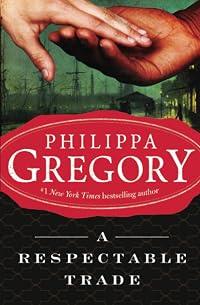
A Respectable Trade
by Philippa Gregory
On This Page
Description
Bristol in 1787 is booming, a city where power beckons those who dare to take risks. Josiah Cole, a small dockside trader, is prepared to gamble everything to join the big players of the city. But he needs capital and a well-connected wife. Marriage to Frances Scott is a mutually convenient solution. Trading her social contacts for Josiah's protection, Frances finds her life and fortune dependent on the respectable trade of sugar, rum, and slaves. Into her new world comes Mehuru, once a show more priest in the ancient African kingdom of Yoruba, now a slave in England. From opposite ends of the earth, despite the difference in status, Mehuru and Frances confront each other and their need for love and liberty.--Publisher description. show lessTags
Recommendations










Member Recommendations
Member Reviews
Accepting that she doesn’t have any better prospects at the age of 34, Frances Scott enters into a marriage of convenience with a Bristol trader. She is soon after presented with a shipload of African slaves and instructed to school them in English and domestic duties so that they may be sold as servants to wealthy English households. With time, Frances begins to doubt the common assertion of the time that the slaves are animals and cannot be educated. One in particular, Mehuru, challenges everything she has been taught about the slave trade.
Gregory’s prose is once again breathtaking and meticulous. Unfortunately, the story itself was lacking in some areas. Frances is not much of a heroine; she isn’t particularly likable and never show more seems to have an opinion of her own. I wasn’t convinced of Frances’ and Mehuru’s love, having observed them seemingly going from distaste to affection with nothing in between.
Mehuru was by far the most interesting character, and I regret that we are not allowed to get to know him better. The most entertaining parts of the story involved his acclimatization to English society. Amusing are the scenes in which he is demonstrated comparing inferior aspects of English culture to those of his homeland (and the reader is forced to agree), and his descriptions of how ghastly the pale English people look. My favorite quote: “She is a white woman,” he said, trying to reassure himself, discounting his insight. “They all look sick to me.” show less
Gregory’s prose is once again breathtaking and meticulous. Unfortunately, the story itself was lacking in some areas. Frances is not much of a heroine; she isn’t particularly likable and never show more seems to have an opinion of her own. I wasn’t convinced of Frances’ and Mehuru’s love, having observed them seemingly going from distaste to affection with nothing in between.
Mehuru was by far the most interesting character, and I regret that we are not allowed to get to know him better. The most entertaining parts of the story involved his acclimatization to English society. Amusing are the scenes in which he is demonstrated comparing inferior aspects of English culture to those of his homeland (and the reader is forced to agree), and his descriptions of how ghastly the pale English people look. My favorite quote: “She is a white woman,” he said, trying to reassure himself, discounting his insight. “They all look sick to me.” show less
I can accept the romance, I can even almost accept the difficult character of the Frances. But that in such a short time Mehuru could learn to speak nearly perfect English, and teach himself to read, and that while talking his mother tongue frequently, I do not believe.
On the other hand, once making the decision to suspend belief it is a good read.
On the other hand, once making the decision to suspend belief it is a good read.
A very well written book set in late 18th century England. A cautionary tale of getting above your station in life -- reaching for the next social and business rung only to have the entire ladder collapse. Interesting insight into the slave trade and the shipping business of the era. Josiah and Sarah Cole are the owners of a modest fleet of three ships trading small goods. They then bring back some slaves for Josiah's new wife Frances to teach English and turn them into English servants. Would have been better if several of them were sold off, while somehow maintaining Mehuru. Mehuru and Frances become the focal point, with the conclusion of the book being that Frances dies while giving birth to Mehuru's son after they had one night show more together that got her pregnant. show less
Words can't describe how annoying this book was (although I'm willing to try). I like Philippa Gregory a lot - she reminds me of a historical Jackie Collins. In general, her books are smutty and fun. (Although I'm glad she got the incest out of her system early in her career, 'cause that was a tad creepy.)
If this book was JUST historical fiction, it would've been trashy, a bit melodramatic and pretty dang fun to read. However, Ms. Gregory had to make it a romance too, which ruined it.
I wasn't surprised by the plot since the romance was featured prominently on the back cover blurb. I just felt if Frances (the slave trader's wife) was going to go against her society norms and shake off every prejudice she had ever been taught, she show more needed a little wooing from the object of her affection! At least have him wear some skintight pants and sweat a lot while doing a manly task like woodchopping. (That's how Harlequins do it.) Instead, Mehuru (the slave) walked in the room for about the 7th time in the book and the two were suddenly deeply in love.
It was so abrupt (and so odd) I kept checking the page numbers to make sure I hadn't missed some important clue as to what the heck was going on. show less
If this book was JUST historical fiction, it would've been trashy, a bit melodramatic and pretty dang fun to read. However, Ms. Gregory had to make it a romance too, which ruined it.
I wasn't surprised by the plot since the romance was featured prominently on the back cover blurb. I just felt if Frances (the slave trader's wife) was going to go against her society norms and shake off every prejudice she had ever been taught, she show more needed a little wooing from the object of her affection! At least have him wear some skintight pants and sweat a lot while doing a manly task like woodchopping. (That's how Harlequins do it.) Instead, Mehuru (the slave) walked in the room for about the 7th time in the book and the two were suddenly deeply in love.
It was so abrupt (and so odd) I kept checking the page numbers to make sure I hadn't missed some important clue as to what the heck was going on. show less
"He did not know that for the first time and painfully, Frances was feeling emotions stir and warm into life."
Josiah Cole needs cash and a socially connected wife. Frances Scott needs a husband. Once married, they find themselves dependent on sustaining a particular sort of lifestyle in order to keep moving upwards. They overpay for a house, over-furnish the house, all under the resentful eye of Josiah's maiden sister.
I know very little about slavery, at any point or place, really. Only after watching Amazing Grace did I know anything about William Wilberforce and the abolitionist movement here in the UK; only after watching and reading The Help did I really know anything about racial politics in 1960s southern USA, plus drawing on show more reading To Kill a Mockingbird at school (and I'll admit to still not knowing very much). And I know even less about 1780s Bristol, the sugar trade or rum.
But I abandoned this after 370 pages out of 500 - so close to the end and yet I did not want to spend more time wasted on these insipid, fearful characters so bent on destroying their own lives.
I wanted to like this; I know very little of the topic and feel that I should know more. But I found the characters too irritating and undeserving of more of my time. show less
Josiah Cole needs cash and a socially connected wife. Frances Scott needs a husband. Once married, they find themselves dependent on sustaining a particular sort of lifestyle in order to keep moving upwards. They overpay for a house, over-furnish the house, all under the resentful eye of Josiah's maiden sister.
I know very little about slavery, at any point or place, really. Only after watching Amazing Grace did I know anything about William Wilberforce and the abolitionist movement here in the UK; only after watching and reading The Help did I really know anything about racial politics in 1960s southern USA, plus drawing on show more reading To Kill a Mockingbird at school (and I'll admit to still not knowing very much). And I know even less about 1780s Bristol, the sugar trade or rum.
But I abandoned this after 370 pages out of 500 - so close to the end and yet I did not want to spend more time wasted on these insipid, fearful characters so bent on destroying their own lives.
I wanted to like this; I know very little of the topic and feel that I should know more. But I found the characters too irritating and undeserving of more of my time. show less
In the past I’ve enjoyed quite a few of Philippa Gregory’s novels, but though I found the premise of A Respectable Trade interesting, how the African slave trade impacted upon the lives of an African priest, a small-time Bristol merchant, his spinster sister and a destitute gentlewoman; I wasn’t too enthralled with the execution. On the whole, it’s well-written, and I felt a large amount of empathy for all the main characters; the research put into it was quite obviously formidable, and Gregory has a talent for bringing history to life.
However I had trouble swallowing certain aspects of the novel; it starts out great, but about halfway through I found it harder and harder to suspend my disbelief. The very end was a huge show more disappointment to me, in fact I may have to reread the novel and make sure I understood the end correctly; because if I did, I think it’s an awfully convenient ending to an otherwise enjoyable read. show less
However I had trouble swallowing certain aspects of the novel; it starts out great, but about halfway through I found it harder and harder to suspend my disbelief. The very end was a huge show more disappointment to me, in fact I may have to reread the novel and make sure I understood the end correctly; because if I did, I think it’s an awfully convenient ending to an otherwise enjoyable read. show less
While I love Philippa Gregory's storytelling, this was my least favorite of her books. The story is compelling, but I found it to be a little overdone. The ending leaves too much unfinished, almost as if a sequel had been planned but never written. I was never able to sympathize with the main character; she went from uncaring to passionate in what seemed a very artificial way, without much insight into what caused the change. Even though I tore through the book in just two days, I was disappointed when I reached the last page.
Members
- Recently Added By
Lists

Historical Fiction Lovers
88 works; 4 members

Authors from England
147 works; 4 members
Author Information

129+ Works 86,534 Members
Philippa Gregory was born in Nairobi, Kenya on January 9, 1954. She received a B.A. in history at Sussex University in 1982 and a Ph.D. in 18th-century literature from the University of Edinburgh in 1984. She has taught at numerous universities and was made a fellow of Kingston University in 1994. Her historical novels include: Wideacre, The show more Queen's Fool, The Virgin's Lover, The Constant Princess, The Boleyn Inheritance, The Other Queen, The White Queen, The Red Queen, The Lady of the Rivers and The White Princess. She has also written several contemporary fiction works including Perfectly Correct, The Little House and Zelda's Cut. She adapted her novel A Respectable Trade, about the slave trade in England, into a four-part series for BBC television. Her script won an award from the Committee for Racial Equality. She won the Feminist Book Fortnight Award in 1990 and the Romantic Novelist of the Year Award in 2002. Her book, The Other Boleyn Girl, won the Parker Romantic Novel of the Year award and was adapted into a major feature film in 2008 starring Natalie Portman and Scarlett Johansson. The White Queen was adapted into an original cable series on the Starz nertwork in 2013 starring Max Irons and Rebecca Ferguson. Her title The Kings Curse made the New York Times bestseller list in 2014. Her title, The Taming of the Queen, made the New York Times bestseller list in 2015. Her latest bestseller is Three Sisters, Three Queens. Gregory also writes children's books, is a regular contributor to newspapers and magazines, a frequent broadcaster for radio and television, and runs a small charity that builds wells in schoolyards in Gambia. (Bowker Author Biography) show less
Some Editions
Awards and Honors
Notable Lists
Work Relationships
Is abridged in
Common Knowledge
- Canonical title*
- Die Farben der Liebe
- Original title
- A Respectable Trade
- Original publication date
- 1995
- People/Characters
- Frances Scott; Mehuru; Josiah Cole
- Important places
- Africa; Bristol, England, UK
- Important events
- slave trade
- Related movies
- A Respectable Trade (1998 | IMDb)
- Dedication
- .. to the children of Sika village, in The Gambia, and to all the peoples of Africa, wherever they are today.
- First words
- Mehuru woke at dawn with the air cool on his out-stretched body.
- Last words
- (Click to show. Warning: May contain spoilers.)I am sorry, I am sorry. Perhaps one day we can learn to live together in Love and Respect?
- Original language
- English
*Some information comes from Common Knowledge in other languages. Click "Edit" for more information.
Classifications
Statistics
- Members
- 1,005
- Popularity
- 25,833
- Reviews
- 14
- Rating
- (3.54)
- Languages
- 5 — English, French, German, Portuguese, Swedish
- Media
- Paper, Audiobook, Ebook
- ISBNs
- 36
- ASINs
- 9