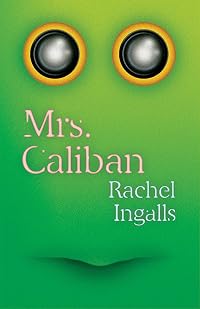
Mrs. Caliban
by Rachel Ingalls
On This Page
Description
It all starts with the radio. Dorothy's husband, Fred, has left for work, and she is at the kitchen sink washing the dishes, listening to classical music. Suddenly, the music fades out and a soft, close, dreamy voice says, "Don't worry, Dorothy." A couple weeks later, there is a special interruption in regular programming. The announcer warns all listeners of an escaped sea monster. Giant, spotted, and froglike, the beast-who was captured six months earlier by a team of scientists-is said to show more possess incredible strength and to be considered extremely dangerous. That afternoon, the seven-foot-tall lizard man walks through Dorothy's kitchen door. She is frightened at first, but there is something attractive about the monster. The two begin a tender, clandestine affair, and no one, not even Dorothy's husband or her best friend, seems to notice. Mrs. Caliban is a story of passion and loneliness, love and loss. Wryly subversive, it brilliantly combines surrealism, satire, and the female perspective. show lessTags
Recommendations



























Member Recommendations
Member Reviews
A brief, beautiful, impossibly dense novel that deserves to be much better known than it is. Sure, it's plot is silly -- lonely California housewife falls in love with the creature from the black lagoon -- and its surfaces are shiny and new-wave cheerful. But it's also delightfully skewed, a British writer imagining sunny California while refusing to alter her diction one bit. And there's a profound melancholy just underneath the prosperous, glitzy surface that goes way beyond any familiar "bored suburbanite wife" tropes that you might be familiar with -- this little book contains more betrayals than the average Shakespeare tragedy.
The book's center, though, is the romance between Dorothy and Larry, the sea monster who unexpectedly show more enters her life and wins her heart. It sounds like a gag, but Ingalls portrays their relationship as remarkably sensual -- her descriptions of Larry's large, lean, muscled frame are a wonderful evocation of female desire. Even better is the fragile, heartfelt interplay that Ingalls describes between the two main characters as they leave their preconceptions behind and explore each other's mindsets, demonstrating how a particularly deep connection with someone else allows you not only to explore them but also to question the things you'd thought immutable about your own life. As Dorothy, our suburban heroine learns of all the betrayals that have caused her life to come undone, Larry's alien nature comes to represent a sort of hope: while humans may be self-seeking backstabbers, Larry's disarmingly honest, markedly non-human, and unabashedly sensual worldview holds out a sort of hope that living beings might learn to relate to each other in a better, kinder way. It doesn't quite work out, of course, but, scales and fins aside, "Mrs. Caliban" is an unforgettable love story of the strangest sort.
"Mrs. Caliban" is also a remarkably multifaceted little book, and especially so because it barely breaks the hundred-page mark. In this sense, it reminded me of Muriel Spark's "The Prime of Miss Jean Brodie," whose text revealed its different aspects of itself like a finely cut prism. "Mrs. Caliban" isn't quite as perfect a novel, but readers may nevertheless detect some feminist critique, a discourse on the lure of the exotic, a criticism of the modern media landscape, and a heartbreaking case study in humankind's tendency to shun and destroy those it considers too different from itself. Still, the question remains: why did Dorothy take in, shelter, and, ultimately, love Larry, while others shunned and feared him? Where did her empathy and identification with him spring from? The answer may be complex, or as simple as simple understanding. Anyway, this one is highly recommended to everyone. I knew when I was only halfway through it that I'd have to read it again. And maybe a third time, too. show less
The book's center, though, is the romance between Dorothy and Larry, the sea monster who unexpectedly show more enters her life and wins her heart. It sounds like a gag, but Ingalls portrays their relationship as remarkably sensual -- her descriptions of Larry's large, lean, muscled frame are a wonderful evocation of female desire. Even better is the fragile, heartfelt interplay that Ingalls describes between the two main characters as they leave their preconceptions behind and explore each other's mindsets, demonstrating how a particularly deep connection with someone else allows you not only to explore them but also to question the things you'd thought immutable about your own life. As Dorothy, our suburban heroine learns of all the betrayals that have caused her life to come undone, Larry's alien nature comes to represent a sort of hope: while humans may be self-seeking backstabbers, Larry's disarmingly honest, markedly non-human, and unabashedly sensual worldview holds out a sort of hope that living beings might learn to relate to each other in a better, kinder way. It doesn't quite work out, of course, but, scales and fins aside, "Mrs. Caliban" is an unforgettable love story of the strangest sort.
"Mrs. Caliban" is also a remarkably multifaceted little book, and especially so because it barely breaks the hundred-page mark. In this sense, it reminded me of Muriel Spark's "The Prime of Miss Jean Brodie," whose text revealed its different aspects of itself like a finely cut prism. "Mrs. Caliban" isn't quite as perfect a novel, but readers may nevertheless detect some feminist critique, a discourse on the lure of the exotic, a criticism of the modern media landscape, and a heartbreaking case study in humankind's tendency to shun and destroy those it considers too different from itself. Still, the question remains: why did Dorothy take in, shelter, and, ultimately, love Larry, while others shunned and feared him? Where did her empathy and identification with him spring from? The answer may be complex, or as simple as simple understanding. Anyway, this one is highly recommended to everyone. I knew when I was only halfway through it that I'd have to read it again. And maybe a third time, too. show less
An odd but very enjoyable novella in which a housewife whose marriage is failing falls in love with a frogman escaped from a government facility that had captured him. Weird, but sharp social commentary. I'm not quite sure what to do with it, but I'm still thinking about it.
Mrs. Caliban by Rachel Ingalls is a peculiar story whose plot concerns a lonely housewife who finds comfort and companionship with an amphibious sea monster named Larry. I was surprised to find that the story was originally published in 1982 and has been re-issued as it certainly felt and read as being very current.
Dorothy and Fred are a miserable couple, they have suffered through the loss of their child and Fred’s infidelities. Dorothy feels very cut off from everyone and is now starting to hear “special” messages directed at her from the radio. When a giant frog-like male creature wanders into her kitchen she finds comfort, love and sexual fulfillment. She decides to help Larry to return to his home as he has been terribly show more mistreated at the research institute that he escaped from.
I puzzled over how to classify this surreal and compelling book. Magical realism? An Allegory? A fantasy? I settled on satire as it’s themes and issues were a tongue-in-cheek look at gender politics, mental health issues, and what it means to be human. I can’t say that I totally loved Mrs. Caliban as I found it to be quite melodramatic and over-the-top, but at a little over a hundred pages this is a quick, witty and intriguing story. show less
Dorothy and Fred are a miserable couple, they have suffered through the loss of their child and Fred’s infidelities. Dorothy feels very cut off from everyone and is now starting to hear “special” messages directed at her from the radio. When a giant frog-like male creature wanders into her kitchen she finds comfort, love and sexual fulfillment. She decides to help Larry to return to his home as he has been terribly show more mistreated at the research institute that he escaped from.
I puzzled over how to classify this surreal and compelling book. Magical realism? An Allegory? A fantasy? I settled on satire as it’s themes and issues were a tongue-in-cheek look at gender politics, mental health issues, and what it means to be human. I can’t say that I totally loved Mrs. Caliban as I found it to be quite melodramatic and over-the-top, but at a little over a hundred pages this is a quick, witty and intriguing story. show less
I read this slender volume in an evening while my spouse was watching a Hallmark Christmas movie.
Really.
While he was vegging out to a feel-good wish fulfillment movie, I was reading a feel good wish fulfillment novel about a housewife estranged from her husband after the loss of two kids and a dog and his series of affairs, which housewife meets a frog man named Larry who escaped from a science lab where he underwent cruel tests and learned English with the help of electric shocks, so that Larry killed the scientists to escape, and the sad wife and Larry commence an affair that includes her hiding him in the guest room and serving him avocado salad and their enjoying night time swims and walks in other people's gardens, then some show more punks attack Larry and he has to defend himself and, well, the kids don't make it...
Really.
And the housewife's best friend is dating two men and her kids are troubled and the ending is very convoluted with the philandering husband meeting an appropriate end.
Did I wish I had watched the Hallmark movie instead of reading about a frogman creature learning about human experience and a housewife telling her story of alienation and loss and loneliness?
Heck, no.
Mrs. Caliban was first published in 1982, which explains the use of the phrase "pontificating" because I remember people did that back then, and author Rachel Ingalls had a flash of fame before people forgot her novel. But it was noticed by some very important writers such as Ursula la Guin and Joyce Carol Oates and John Updike and Eleanor Cotton (The Luminaries) and New Directions said it knocked their socks off and so they republished it this year and I am sure it will make connections with readers today.
Is Larry real or an alienated housewife's fantasy? Who cares. Just read it.
I received a free book from the publisher in exchange for a fair and unbiased review. show less
Really.
While he was vegging out to a feel-good wish fulfillment movie, I was reading a feel good wish fulfillment novel about a housewife estranged from her husband after the loss of two kids and a dog and his series of affairs, which housewife meets a frog man named Larry who escaped from a science lab where he underwent cruel tests and learned English with the help of electric shocks, so that Larry killed the scientists to escape, and the sad wife and Larry commence an affair that includes her hiding him in the guest room and serving him avocado salad and their enjoying night time swims and walks in other people's gardens, then some show more punks attack Larry and he has to defend himself and, well, the kids don't make it...
Really.
And the housewife's best friend is dating two men and her kids are troubled and the ending is very convoluted with the philandering husband meeting an appropriate end.
Did I wish I had watched the Hallmark movie instead of reading about a frogman creature learning about human experience and a housewife telling her story of alienation and loss and loneliness?
Heck, no.
Mrs. Caliban was first published in 1982, which explains the use of the phrase "pontificating" because I remember people did that back then, and author Rachel Ingalls had a flash of fame before people forgot her novel. But it was noticed by some very important writers such as Ursula la Guin and Joyce Carol Oates and John Updike and Eleanor Cotton (The Luminaries) and New Directions said it knocked their socks off and so they republished it this year and I am sure it will make connections with readers today.
Is Larry real or an alienated housewife's fantasy? Who cares. Just read it.
I received a free book from the publisher in exchange for a fair and unbiased review. show less
This book is not monster erotica. The sex scenes are devoid of nervous systems and are presented as objective events without a single nerve end sparking, not a single drop of sweat: “They went swimming together and then made love on the beach” (59). Why?
The story begins with Dorothy (the central character) hearing “special voices [that] . . . had a soft, close, dreamlike quality” (6). We learn of her recent trauma and soon the monster appears: “She was as surprised and shocked as if she had heard an explosion and seen her own shattered legs go flying across the floor” (19). This surreal image characterizes the reality portrayed throughout the novel. What’s fascinating is Ingalls’ narrative point of view. Pulling just show more back from full omniscience, the reader is left to discern Dorothy’s reality and how trauma has pushed her into a protracted nerve-deadening delusion show less
The story begins with Dorothy (the central character) hearing “special voices [that] . . . had a soft, close, dreamlike quality” (6). We learn of her recent trauma and soon the monster appears: “She was as surprised and shocked as if she had heard an explosion and seen her own shattered legs go flying across the floor” (19). This surreal image characterizes the reality portrayed throughout the novel. What’s fascinating is Ingalls’ narrative point of view. Pulling just show more back from full omniscience, the reader is left to discern Dorothy’s reality and how trauma has pushed her into a protracted nerve-deadening delusion show less
Here we have a book about an unhappy housewife in a miserable marriage who finds passion and purpose when she has an affair. But let's break that down a bit... This unhappy housewife, Dorothy, is unhappy because she's married to, but estranged from, a serial philanderer who largely ignores her and takes her for granted. She has lost a child and a dog. She lives a beige existence where nothing particularly interesting ever really happens. Her best friend is a me-monster who leans heavily and gives little.
And then Larry walks into her life, literally. He wanders into her home and stands before her... A towering frogman with overwhelming sex appeal who has escaped from a science lab where he was being experimented on and is on the run for show more the murder of two abusive lab employees.
Well, of course she takes Larry in. She hides Larry away in her guest room and feeds him amazing salads and a LOT of avocados. He helps around the house and is a caring and generous friend.
They commence an affair and spend time together screwing in every room of the house and under the cloak of night go swimming at the beach, frolicking through rich people's gardens, holding hands, dressing Larry up in wigs and glasses, and teaching him to drive. Dorothy's life changes overnight and she is finally alive and energised.
Other stuff happens, too, but it is all written so matter of factly despite the fantastical nature of the story that it feels perfectly normal.
Is Larry the amphibious man real or a necessary figment of her imagination created to soothe the desperate loneliness and pointlessness of her bland existence? Who gives a shit? This is a marvellous, wondrous story of love, revenge, and validation. show less
And then Larry walks into her life, literally. He wanders into her home and stands before her... A towering frogman with overwhelming sex appeal who has escaped from a science lab where he was being experimented on and is on the run for show more the murder of two abusive lab employees.
Well, of course she takes Larry in. She hides Larry away in her guest room and feeds him amazing salads and a LOT of avocados. He helps around the house and is a caring and generous friend.
They commence an affair and spend time together screwing in every room of the house and under the cloak of night go swimming at the beach, frolicking through rich people's gardens, holding hands, dressing Larry up in wigs and glasses, and teaching him to drive. Dorothy's life changes overnight and she is finally alive and energised.
Other stuff happens, too, but it is all written so matter of factly despite the fantastical nature of the story that it feels perfectly normal.
Is Larry the amphibious man real or a necessary figment of her imagination created to soothe the desperate loneliness and pointlessness of her bland existence? Who gives a shit? This is a marvellous, wondrous story of love, revenge, and validation. show less
How do you feel about parables? How do you feel about large green men from the sea, and radios talking to you as you chop carrots for a salad? How do you feel about avocados?
I think this novella is close to perfect.
I think this novella is close to perfect.
Members
- Recently Added By
Lists

Top Five Books of 2020
982 works; 350 members

Mythical Monsters of the World
199 works; 79 members

Lithub: The 50 Best Contemporary Novels Under 200 Pages
50 works; 4 members

Overdue Podcast
806 works; 9 members

Schwob Nederland
207 works; 2 members

Kirkus Starred Fiction Reviews of Books Published in 2017
412 works; 7 members
Author Information

25+ Works 1,553 Members
Rachel Holmes Ingalls was born in Boston, Massachusetts on May 13, 1940. She received a bachelor's degree in languages from Radcliffe in 1962. She moved to London in 1965. Her first book, Theft, was published in 1970 and received the Authors' Club First Novel Award. Her other books included Mrs. Caliban and Binstead's Safari. She died from myeloma show more on March 6, 2019 at the age of 78. (Bowker Author Biography) show less
Some Editions
Awards and Honors
Awards
Notable Lists
Series
Belongs to Publisher Series
Common Knowledge
- Original publication date
- 1983
- People/Characters
- Dorothy; Estelle; Larry; Fred
- Important places
- California, USA
- First words
- Fred forgot three things in a row before he reached the front door on the way to work. Then he remembered that he wanted to take the paper with him. Dorothy didn't bother to say that she hadn't finished it yet herself. She ju... (show all)st went back and brought it to him.
- Quotations
- Without actually saying so, the presenters of the programme were managing to suggest that Larry had remained in the area because of the opportunities for eating people. Not one of the men interviewed thought it might be possi... (show all)ble that Larry remained so well hidden because he had made friends with someone. That question was never raised.
- Last words
- (Click to show. Warning: May contain spoilers.)But he never came.
- Blurbers
- Atwood, Margaret; Lockwood, Patricia; Updike, John
- Original language
- English US
- Canonical DDC/MDS
- 813.54
- Canonical LCC
- PS3559.N38 M7
Classifications
Statistics
- Members
- 941
- Popularity
- 28,322
- Reviews
- 43
- Rating
- (3.80)
- Languages
- 10 — Albanian, Danish, Dutch, English, French, German, Italian, Portuguese, Spanish, Turkish
- Media
- Paper, Audiobook, Ebook
- ISBNs
- 24
- ASINs
- 14