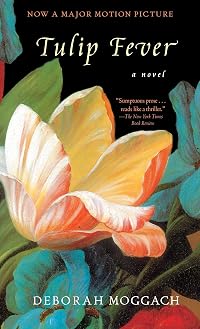
Tulip Fever
by Deborah Moggach
On This Page
Description
A sensual tale of art, lust, and deception—now a major motion pictureIn 1630s Amsterdam, tulipomania has seized the populace. Everywhere men are seduced by the fantastic exotic flower. But for wealthy merchant Cornelis Sandvoort, it is his young and beautiful wife, Sophia, who stirs his soul. She is the prize he desires, the woman he hopes will bring him the joy that not even his considerable fortune can buy.
Cornelis yearns for an heir, but so far he and Sophia have failed to produce show more one. In a bid for immortality, he commissions a portrait of them both by the talented young painter Jan van Loos. But as Van Loos begins to capture Sophia's likeness on canvas, a slow passion begins to burn between the beautiful young wife and the talented artist.
As the portrait unfolds, so a slow dance is begun among the household’s inhabitants. Ambitions, desires, and dreams breed a grand deception—and as the lies multiply, events move toward a thrilling and tragic climax.
In this richly imagined international bestseller, Deborah Moggach has created the rarest of novels—a lush, lyrical work of fiction that is also compulsively readable. Seldom has a novel so vividly evoked a time, a place, and a passion.
Praise for Tulip Fever
“Sumptuous prose . . . reads like a thriller.”—The New York Times Book Review
“An artful novel in every sense of the word . . . deftly evokes seventeenth-century Amsterdam’s vibrant atmosphere.”—Los Angeles Times
“Need a brief escape into a beautiful and faraway world? Deborah Moggach’s wonderful Tulip Fever can offer you that.”—New York Post
“Taut with suspense and unexpected revelations.”—Entertainment Weekly
“Elegantly absorbing.”—The Philadelphia Inquirer. show less
Tags
Recommendations

























Member Recommendations
cransell Another novel based in Holland - this time centered around the coffee, rather than the tulip craze.
janerawoof More about tulipmania.
Member Reviews
The basic plot: at the height of Holland's tulip-mania, a young wife is attracted to the painter her elderly husband commissions to paint their family portrait.
The writing is very atmospheric:
"She stands there, motionless. She is suspended, caught between past and present. She is colour, waiting to be mixed; a painting, ready to be brushed into life. She is a moment, waiting to be fixed for ever under a shiny varnish. Is this a moment of decision? Will she tear up the letter or will she steal away, through the silent rooms, and slip out of the house? Her face, caught in profile, betrays nothing." (p. 46)
It is good, but it's not great. As well as a sound (if somewhat depressing) plot, a strong sense of time and place and fairly strong show more characters, there are some comic moments and some excellent writing. The characters consistently exhibit flawed judgement, and as a study of the stupid things people do it's quite interesting. show less
The writing is very atmospheric:
"She stands there, motionless. She is suspended, caught between past and present. She is colour, waiting to be mixed; a painting, ready to be brushed into life. She is a moment, waiting to be fixed for ever under a shiny varnish. Is this a moment of decision? Will she tear up the letter or will she steal away, through the silent rooms, and slip out of the house? Her face, caught in profile, betrays nothing." (p. 46)
It is good, but it's not great. As well as a sound (if somewhat depressing) plot, a strong sense of time and place and fairly strong show more characters, there are some comic moments and some excellent writing. The characters consistently exhibit flawed judgement, and as a study of the stupid things people do it's quite interesting. show less
A classic case of not being what I expected, Tulip Fever by Deborah Moggach in turns both intrigued and irritated me. I thought I was going to be reading a straight forward historical fiction story set in Amsterdam during the mid-1600’s. Instead I found myself reading a slightly melodramatic love story. But then the story took a twist and I was reading about some of the great Dutch masters of the day, then another turn and I was enveloped in a complicated plan to dupe an elderly husband. The story unfolded through the viewpoint of several characters and, in the end, I couldn’t put it down until I knew what was finally going to happen.
Unfortunately I couldn’t sympathize with any of the characters and I found their behavior totally show more unbelievable. The writing was in turns overly dramatic or abrasive and rushed. This is not a book to savour or linger over, I just wanted to get it finished and see who was still standing at the end. One bonus to the book was the inclusion of copies of paintings by some of the Dutch Masters, but that hardly made up for the depressing story that I struggled through.
Considering this was a book about passion, illicit love and the frenzy that surrounded the tulip market, I was left feeling rather flat. Obviously not a book for me. show less
Unfortunately I couldn’t sympathize with any of the characters and I found their behavior totally show more unbelievable. The writing was in turns overly dramatic or abrasive and rushed. This is not a book to savour or linger over, I just wanted to get it finished and see who was still standing at the end. One bonus to the book was the inclusion of copies of paintings by some of the Dutch Masters, but that hardly made up for the depressing story that I struggled through.
Considering this was a book about passion, illicit love and the frenzy that surrounded the tulip market, I was left feeling rather flat. Obviously not a book for me. show less
Tulip Fever is an absolutely engrossing book. Deborah Moggach doesn't simply weave a fascinating tale but does so in a manner that also piqued my curiosity about the time period. Good historical fiction allows the reader to feel comfortable in an entirely different culture and society. Great historical fiction, such as this, stirs both the passion (for the story) as well as the intellect (for the history) which leads to a desire to learn more.
I would readily recommend this to lovers of historical fiction as well as anyone who simply loves a good story told in beautiful prose.
I would readily recommend this to lovers of historical fiction as well as anyone who simply loves a good story told in beautiful prose.
Amsterdam in the 17th century was a time when commerce was king and the sale of tulip bulbs made some people very rich and others bankrupt. This is the setting for ‘Tulip Fever’ by Deborah Moggach, when Rembrandt and Vermeer painted some of the most-recognised art of our time. Sophia’s husband Cornelis is rich, thanks to tulips, and he celebrates his wealth by commissioning a joint portrait to be painted. It is a decision which changes their lives.
The deft switching of viewpoints – and each chapter is a single voice, Sophia, Cornelis, Jan [the painter], Maria [their servant] and Willem [Maria’s lover] – allows for a new take on each situation. The plot moves quickly, things are hinted at and passed over but relevant later. show more It is the sort of novel which seems simple but has hidden depths. The language can be so sensual. “Jacob van Loos is not painting the old man’s mouth. He is painting Sophia’s lips. He mixes pink on his palette – ochre, grey and carmine – and strokes the paint lovingly on the canvas. She is gazing at him. For a moment, when the old man was talking, her lips curved into a smile – a smile of complicity. He paints the ghost of this, though it is now gone.”
The reader must remain vigilant to catch everything. After four chapters I realised the significance of the quotation at the head of each chapter, and went back to the beginning again. They shed fresh light on the story being told. For example, “‘Trust not to appearances.’ Jacob Cats, ‘Moral Emblems’, 1632.” And, another chapter heading, by the same author, ‘Stolen waters are sweet, and bread eaten in secret places is pleasant.’
In places, Moggach’s description echoes Dutch paintings of the period: “Sophia stands at the window. She is reading the letter. Through the glass, sunlight streams on to her face. Her hair is pulled back from her brow. Tiny pearls nestle in her headband; they catch the light, winking at the severity of her coiffure. She wears a black bodice, shot with lines of velvet and silver. Her dress is violet silk; its pewtery sheen catches the light.” Certainly an understanding of art of the period will help a reader get more from the text.
Read more of my book reviews at http://www.sandradanby.com/book-reviews-a-z/ show less
The deft switching of viewpoints – and each chapter is a single voice, Sophia, Cornelis, Jan [the painter], Maria [their servant] and Willem [Maria’s lover] – allows for a new take on each situation. The plot moves quickly, things are hinted at and passed over but relevant later. show more It is the sort of novel which seems simple but has hidden depths. The language can be so sensual. “Jacob van Loos is not painting the old man’s mouth. He is painting Sophia’s lips. He mixes pink on his palette – ochre, grey and carmine – and strokes the paint lovingly on the canvas. She is gazing at him. For a moment, when the old man was talking, her lips curved into a smile – a smile of complicity. He paints the ghost of this, though it is now gone.”
The reader must remain vigilant to catch everything. After four chapters I realised the significance of the quotation at the head of each chapter, and went back to the beginning again. They shed fresh light on the story being told. For example, “‘Trust not to appearances.’ Jacob Cats, ‘Moral Emblems’, 1632.” And, another chapter heading, by the same author, ‘Stolen waters are sweet, and bread eaten in secret places is pleasant.’
In places, Moggach’s description echoes Dutch paintings of the period: “Sophia stands at the window. She is reading the letter. Through the glass, sunlight streams on to her face. Her hair is pulled back from her brow. Tiny pearls nestle in her headband; they catch the light, winking at the severity of her coiffure. She wears a black bodice, shot with lines of velvet and silver. Her dress is violet silk; its pewtery sheen catches the light.” Certainly an understanding of art of the period will help a reader get more from the text.
Read more of my book reviews at http://www.sandradanby.com/book-reviews-a-z/ show less
I read Tulip Fever years ago en route to a holiday in the Netherlands. I wanted learn about the tulip frenzy of the 1630's, when bulb prices soared beyond anyone's imagined riches. I also wanted to read about the golden age of the Dutch masters. What I wasn't expecting was that I would be treated to a rollicking great story... complete with a sprinkling of sex and a bit of a mystery.
Set in 1636 Amsterdam, Tulip Fever is a novel of passion and deception. It is the time of the tulip craze and the Dutch were enjoying great wealth. Sophia is the young wife of Cornelis Sandvoort, a prosperous older merchant. She agreed to the marriage only because he funded her poor family's immigration to America. Their marriage has not produced a child, so show more Cornelis decides to immortalize themselves by having their portrait painted. He hires Jan van Loos, an up and coming young artist. Not only does the portrait sitting bring some excitement into their dull household routine, it brings a secret love affair for Sophia and Jan. Their relationship is carried on with the complicity of the household maid, Maria who has her own secrets.
Ms. Moggach intertwines the story and her characters with the 17th century Amsterdam tulip mania and it's eventual crash (can we say dot.com folks?). There are lies, secrets, betrayals, and plot twists that keep the reader totally immersed. Then, if you're like me, you'll gasp as the consequences reverberate into the various characters fates, positions, wealth, and lives.
Tulip Fever has been recently adapted into a film, which I saw recently. I have to admit I really enjoyed the film and thought it was actually a very good adaptation of the book.
See all my book reviews at http://www.bookbarmy.com show less
Set in 1636 Amsterdam, Tulip Fever is a novel of passion and deception. It is the time of the tulip craze and the Dutch were enjoying great wealth. Sophia is the young wife of Cornelis Sandvoort, a prosperous older merchant. She agreed to the marriage only because he funded her poor family's immigration to America. Their marriage has not produced a child, so show more Cornelis decides to immortalize themselves by having their portrait painted. He hires Jan van Loos, an up and coming young artist. Not only does the portrait sitting bring some excitement into their dull household routine, it brings a secret love affair for Sophia and Jan. Their relationship is carried on with the complicity of the household maid, Maria who has her own secrets.
Ms. Moggach intertwines the story and her characters with the 17th century Amsterdam tulip mania and it's eventual crash (can we say dot.com folks?). There are lies, secrets, betrayals, and plot twists that keep the reader totally immersed. Then, if you're like me, you'll gasp as the consequences reverberate into the various characters fates, positions, wealth, and lives.
Tulip Fever has been recently adapted into a film, which I saw recently. I have to admit I really enjoyed the film and thought it was actually a very good adaptation of the book.
See all my book reviews at http://www.bookbarmy.com show less
This author, Deborah Moggach, clearly has a love for art and the 17th century Dutch painters in particular. Unusually, there are colour plates among the pages of the novel that illustrate the story and I found these interesting and they helped to create the atmosphere of the novel.
However, I found the story Deborah Moggach told unsatisfying. I felt sympathy for Sophia in a marriage with an older man because she felt she had no choice and her husband Cornelis is a successful merchant who clearly cares for her but is lacking in many respects. I found the character of Jan, the portrait painter, difficult to grasp and understand. Deborah Moggach tells us he was truly in love. Maria, Sophia's maid, is a lively character whose dreams come show more true. As others have mentioned there are plot twists in this novel that feel clumsy and seem unlikely. Even given the limited options available to women in the 17th century the choices made seem strange. In addition, the structure of the novel, with short chapters each following the action of a particular character, it is only Sophia that is in the first person, all the others are told in the third person. This allows the reader to find out about action that doesn't involve Sophia. However, it also means that the narrative feels very broken and lacks depth. The day to day life of characters is shown and the domesticity is revealing but the novel does lack atmosphere. It is a readable novel that is interesting in the information it provides about the life of a painter in 17th century Netherlands and the fever around the futures market in Amsterdam. show less
However, I found the story Deborah Moggach told unsatisfying. I felt sympathy for Sophia in a marriage with an older man because she felt she had no choice and her husband Cornelis is a successful merchant who clearly cares for her but is lacking in many respects. I found the character of Jan, the portrait painter, difficult to grasp and understand. Deborah Moggach tells us he was truly in love. Maria, Sophia's maid, is a lively character whose dreams come show more true. As others have mentioned there are plot twists in this novel that feel clumsy and seem unlikely. Even given the limited options available to women in the 17th century the choices made seem strange. In addition, the structure of the novel, with short chapters each following the action of a particular character, it is only Sophia that is in the first person, all the others are told in the third person. This allows the reader to find out about action that doesn't involve Sophia. However, it also means that the narrative feels very broken and lacks depth. The day to day life of characters is shown and the domesticity is revealing but the novel does lack atmosphere. It is a readable novel that is interesting in the information it provides about the life of a painter in 17th century Netherlands and the fever around the futures market in Amsterdam. show less
Set in Amsterdam in 1636, Tulip Fever is a novel of passion and deception in Amsterdam, right as the craze for tulips occurs, at a time when the Dutch were some of the wealthiest people in the early modern world. Sophia is the wife of Cornelis Sandvoort, a prosperous merchant who commissions a portrait to be painted of him and his wife. In the process, Sophia falls in love with the painter, Jan van Loos. Their relationship is carried on with the complicity of the maid, Maria, and has consequences for everyone, both in the house and outside it.
I was a little put off by the present-tense narration, and the fact that the point of view kept changing so often. But the more I read, the more I enjoyed this book. The book is sad in tone, and show more skimps on characterization. But the books excels in terms of plot and setting—every little nuance of 17th-century Amsterdam is described in deep detail. It’s a well-written novel, but the story is simply told at the same time.
There are a few unlikely coincidences and ironic plot twists in this novel, which I won’t go into for fear of spoiling the plot. Suffice it to say that I didn’t really believe it as a plot device. And the metaphors sometimes got a bit out of control (comparing a lute hanging on the wall to a pregnant woman, for example). And the author didn’t really delve all that deeply into the tulip madness—though I know this is a nvel, and she probably didn’t have time or space for that kind of exposition. But I actually did, in a strange way, enjoy this novel of passion that proves that greed corrupts us all. An excellent work of nonfiction about the tulip obsession is Tulipomania, by Mike Dash. show less
I was a little put off by the present-tense narration, and the fact that the point of view kept changing so often. But the more I read, the more I enjoyed this book. The book is sad in tone, and show more skimps on characterization. But the books excels in terms of plot and setting—every little nuance of 17th-century Amsterdam is described in deep detail. It’s a well-written novel, but the story is simply told at the same time.
There are a few unlikely coincidences and ironic plot twists in this novel, which I won’t go into for fear of spoiling the plot. Suffice it to say that I didn’t really believe it as a plot device. And the metaphors sometimes got a bit out of control (comparing a lute hanging on the wall to a pregnant woman, for example). And the author didn’t really delve all that deeply into the tulip madness—though I know this is a nvel, and she probably didn’t have time or space for that kind of exposition. But I actually did, in a strange way, enjoy this novel of passion that proves that greed corrupts us all. An excellent work of nonfiction about the tulip obsession is Tulipomania, by Mike Dash. show less
Members
- Recently Added By
Lists

Historical Fiction
889 works; 91 members

BBC Radio 4 Bookclub
341 works; 13 members

History novels (not too romancey)
37 works; 5 members

for you little gardener and lover of trees
14 works; 2 members

Authors from England
147 works; 4 members

BBC World Book Club
267 works; 5 members

World Book Club (BBC World Service)
212 works; 1 member
Talk Discussions
Past Discussions
Found: Historical fiction about tulips bulbs fetching huge prices in Name that Book (January 2023)
Author Information

Some Editions
Awards and Honors
Notable Lists
Work Relationships
Has the adaptation
Common Knowledge
- Canonical title
- Tulip Fever
- Original publication date
- 1999
- People/Characters
- Cornelis Sandvoort; Sophia Sandvoort; Jan van Loos; Maria; Willem
- Important places
- Amsterdam, North Holland, Netherlands; The Netherlands; North Holland, Netherlands
- Important events
- Tulip Mania/Tulipomania
- Related movies
- Tulip Fever (2016 | IMDb)
- Epigraph
- It is the people who live on top, restfully and staidly underneath it is their shadows which move...I should not wonder if the surface of the grachts still reflected the shadows of people from bygone centuries, men in broad r... (show all)uffs and women in mob caps...The towns appear to be standing, not on the earth, but on their own reflections; these gighly respectable streets appear to emerge from from bottomless depths of dreams...Karel Capek, Letters from Holland, 1933.
Yes, I know well the world of poverty and ugliness, but I painted the skin, the glittering surface, the appearance of things: the silky ladies, and gentlemen in irreproachable black. I admired how fiercely the fought for a life slightly longer than the one for which they were destined. They protected themselves with fashion, tailors' accessories, a fancy ruffle, ingenious cuffs...any detail that would allow them to last a little longer before they - and we as well - are engulfed by the black background - S. Herbert, Still Life With a Bridle
Our task is not to solve enigmas, but to be aware of them, to bow our heas before them and also to prepare the eyes for never-ending delight and wonder. If you absolutley require discoveries, hoever, I will tell you that I am proud to have succeeded in combining a certain particularly intensive cobalt with a luminous lemonlike yellow, as well as recording the reflection of southern light that strikes thick glass on to a grey wall...Allows us to continue our archaic procedure, to tell the world words of reconiliation and to speak of joy from recovered harmony, of the eternal desire for reciprocated love. - Letter attributed to Jan Vermeer - Dedication*
- Anche questo, di nuovo, è per Casaba.
- First words
- We are eating dinner, my husband and I.
- Last words
- (Click to show. Warning: May contain spoilers.)This gray, hooded figure--a ghost, in her final disguise--she has disappeared, as if she is simply a figment of his imagination.
*Some information comes from Common Knowledge in other languages. Click "Edit" for more information.
Classifications
Statistics
- Members
- 1,269
- Popularity
- 19,347
- Reviews
- 47
- Rating
- (3.39)
- Languages
- 9 — Dutch, English, Estonian, Finnish, French, German, Italian, Portuguese, Swedish
- Media
- Paper, Audiobook, Ebook
- ISBNs
- 51
- ASINs
- 8