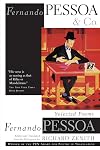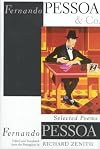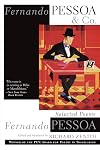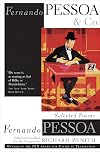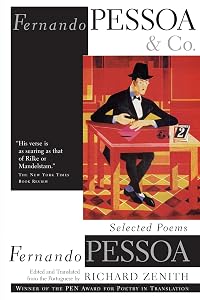
Fernando Pessoa & Co.: Selected Poems
by Fernando Pessoa
On This Page
Description
Fernando Pessoa (1888-1935) - a poet who lived most of his life in a furnished room in Lisbon, Portugal, and who died in obscurity there - has in recent years gained international recognition as one of the greatest writers of the twentieth century. Pessoa was as much a creator of personas as he was of poetry, prose, and criticism. He wrote under numerous "heteronyms," or literary alter egos, and invented fully fleshed biographies for all of them. In the voices of these heteronyms, who show more supported and criticized each other's work in the margins of his drafts and in the literary journals of the time, Pessoa ranged widely over the possibilities of language. His poetry contains echoes of symbolist verse, Portuguese folk song, and futurist manifesto; it evokes both the breathtaking minimalism of the theory of relativity and the revolutionary exuberance of Leaves of Grass. show lessTags
Recommendations





Member Reviews
If I could do in verses
What she does with laundry
Perhaps I would lose
My surfeit of fates.
This particular volume boasts a fifty page introduction to Pessoa's verse, his construction of heteronmyns, separate literary identities along with biographies to purse different methods of verse. It sounds fascinating - or almost perverse. The thematics range from the pastoral to the paradoxical. Inspiration appears to extend from Horace to Whitman. The idea that these predate much of Borges is extremely interesting.
The author-in-itself Pessoa lived an odd life, largely alone, often drunk, staring out windows with a cigarette and a scrap of a paper awaiting inspiration. There is a mocking sensibility to these poems. The disdain is a source of show more humor, a rare source apparently. It is fascinating to consider the range exhibited here. I look forward to further explorations into the verse as well as prose of this enigmatic soul. show less
What she does with laundry
Perhaps I would lose
My surfeit of fates.
This particular volume boasts a fifty page introduction to Pessoa's verse, his construction of heteronmyns, separate literary identities along with biographies to purse different methods of verse. It sounds fascinating - or almost perverse. The thematics range from the pastoral to the paradoxical. Inspiration appears to extend from Horace to Whitman. The idea that these predate much of Borges is extremely interesting.
The author-in-itself Pessoa lived an odd life, largely alone, often drunk, staring out windows with a cigarette and a scrap of a paper awaiting inspiration. There is a mocking sensibility to these poems. The disdain is a source of show more humor, a rare source apparently. It is fascinating to consider the range exhibited here. I look forward to further explorations into the verse as well as prose of this enigmatic soul. show less
Though respected by many and thought by Harold Bloom to be "Whitman reborn", Pessoa leaves me cold and unfeeling. His poems are certainly easy to read and soft to the eye, but my indifference to his work has never faltered. It is proof positive to me at least that all of us are affected differently, that one size does not fit all, and that each of us brings a personal life experience to the pages we read that at times has so much of nothing to do with the world's countless others that the feeling is poignantly alien and frightful in its realization that for once being truly all alone. If that is what Pessoa was after then he is a genius. If not, then he is the run-of-the-mill poet I have previously branded him as.
This poem demonstrates Pessoa's art better than any words I may conjure.
Where There Are Roses
We Plant Doubt
Where there are roses we plant doubt.
Most of the meaning we glean is our own,
And forever not knowing, we ponder.
Foreign to us, capacious nature
Unrolls fields, open flowers, ripens
Fruits, and death arrives.
I'll only be right, if anyone is right,
When death at last confounds my mind
And I no longer see,
For we cannot find and should not find
The remote and profound explanation
For why it is we live.
from the Odes
Where There Are Roses
We Plant Doubt
Where there are roses we plant doubt.
Most of the meaning we glean is our own,
And forever not knowing, we ponder.
Foreign to us, capacious nature
Unrolls fields, open flowers, ripens
Fruits, and death arrives.
I'll only be right, if anyone is right,
When death at last confounds my mind
And I no longer see,
For we cannot find and should not find
The remote and profound explanation
For why it is we live.
from the Odes
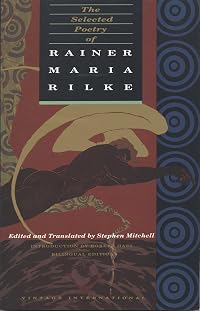
A more accessible Rilke -and deeper.
Ratings
Members
- Recently Added By
Lists

Fakes, Forgeries, and Fictitious Authors
112 works; 4 members
Author Information

965+ Works 16,214 Members
Fernando Pessoa, 1888 - 1935 Portuguese poet Fernando Pessoa was born in Lisbon. His father died when he was young and his mother married the Portuguese consul in Durban in South Africa where they lived from 1896 to 1951. During this time, Pessoa became fluent in English and was educated in Cape Town and Lisbon. Pessoa was employed as a business show more correspondent and also as a commercial translator. The bulk of his work was published in literary magazines, especially in his own Athena. His first book, "Antinous," appeared in 1918 and was followed by two other collection of poems, all written in English. In 1933, he published "Mensagem" his first book in Portuguese. "Livro Do Dessossogego (The Book of Disquiet)" the "factless autobiography" was written under the name of Bernardo Soares and appeared for the first time in 1982, almost fifty years after his death. After the republican revolution, in 1910, and consequent patriotic atmosphera, Pessoa created an alter ego, a heteronym, named Álvaro de Campos, supposedly a Portuguese naval engineer, born in Tavira and graduated in Glasgow. Translator Richard Zenith notes that Pessoa eventually established at least seventy-two heteronyms. According to Pessoa himself, there were three main heteronyms: Alberto Caeiro, Álvaro de Campos and Ricardo Reis. The heteronyms possess distinct biographies, temperaments, philosophies, appearances and writing styles. Pessoa died on November 30, 1935 in Lisbon. Other writings that were published posthumously and translated into several languages include "Poesias de Fernando Pessoa" (1942), Poesias de Alvaro de Campos" (1944), Poemas de Alberto Caeiro" (1946), and "Odes de Ricardo Reis" (1946). (Bowker Author Biography) show less
All Editions
Awards and Honors
Awards
Common Knowledge
- Canonical title
- Fernando Pessoa & Co.: Selected Poems
- Disambiguation notice
- Fernando Pessoa & Co.: Selected Poems contains a discrete selection of Fernando Pessoa's work, and differs substantially from other anthologies of his writings. Please distinguish among the various editions available,... (show all) and ensure that any other title includes substantially the same selection before combining it with this LT Work. Thank you.
Classifications
- Genres
- Poetry, Fiction and Literature
- DDC/MDS
- 869.1 — Literature & rhetoric Spanish Literature Literatures of Portuguese and Galician languages Portuguese poetry
- LCC
- PQ9261 .P417 .A288 — Language and Literature French, Italian, Spanish and Portuguese literatures Portuguese literature Individual authors, 1701-1960
- BISAC
Statistics
- Members
- 297
- Popularity
- 108,357
- Reviews
- 4
- Rating
- (4.19)
- Languages
- English
- Media
- Paper, Ebook
- ISBNs
- 4
- ASINs
- 1