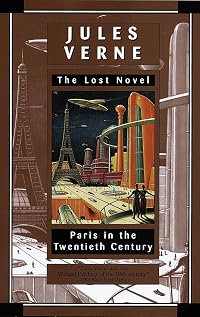
Paris in the Twentieth Century
by Jules Verne
On This Page
Description
A futuristic novel, written in the 1860s, describing the Paris of the 1960s, a city of cars, computers, even fax machines. The rulers are corporations, technology is god and people are expected to accept material profit as the reason for living. The novel was rejected by the publisher of the day as unrealistic.Tags
Recommendations


















Member Recommendations

News from Nowhere; or, An Epoch of Rest: Being Some Chapters from a Utopian Romance by William Morris
CGlanovsky A utopian antithesis to Verne's dystopia, in which art and the pastoral flourish.
Member Reviews
Si tratta di un'opera "riscoperta" recentemente in una vecchia cassaforte, un libro rifiutato dall'editore come "eccessivamente pessimista".
Il romanzo è anni luce lontano dal Verne avventuroso e visionario che immaginiamo. Si tratta più di una speculazione, ardita, su come sarebbe dovuto essere il futuro 100 anni dopo la scrittura del romanzo. Ma più che sulla tecnologia e la scienza, Verne si concentra sulla società. Retrospettivamente, la scienza ha fatti molti meno passi avanti di quello che effettivamente sono avvenuti, anche rispetto le ciò che Verne stesso aveva immaginato: Dalla Terra alla Luna si è avverato di lì a pochi anni, 20.000 leghe sotto i mari era una realtà da qualche decennio, e via così. L'elettronica non show more esiste, figurarsi l'informatica! Ma ammettiamolo, l'accelerazione che la scienza ha subito a partire dal 1900 era inconcepibile per chiunque nel 1870!
Dunque, poca scienza, poca tecnologia, in verità moltissima azzeccata con precisione, vedi il canale di Panama; ma soprattutto la società. E la società del XX secolo, vista da Verne, è una società ben peggiore di quella che conosciamo: l'arte è scomparsa, la tecnologia ha vinto su tutto, gli uomini sono diventati insensibili tra loro, la famiglia distrutta. Cosa che puntualmente non si è verificata, nonostante lo stracciarsi di vesti dei più critici. Ma la società di Verne è anche statalista e burocratizzata, tanto che gli stessi artisti che realizzano commedie e tragedie per il teatro (la televisione non c'è) sono dipendenti pubblici. E ahimè questo aspetto si sta concretizzando, almeno in alcuni luoghi (tra cui la Francia stessa).
Al di là di questo, il pessimismo di Verne è soprattutto verso l'impossibilità di uscire dal sistema, l'individuo "libero" e "diverso" (l'artista) non ha alcuna possibilità di salvarsi.
In un certo senso quest'opera ha anticipato più che la scienza e l'evolversi della storia, il malessere della società del '900, poi portato all'estremo da artisti successivi, sia nella letteratura che nell'arte in generale.
Quindi, più che un romanzo di fantascienza, quello che ci ha regalato Verne è un romanzo anticipatore della società e dei suoi malesseri.
Comunque, molto bello. show less
Il romanzo è anni luce lontano dal Verne avventuroso e visionario che immaginiamo. Si tratta più di una speculazione, ardita, su come sarebbe dovuto essere il futuro 100 anni dopo la scrittura del romanzo. Ma più che sulla tecnologia e la scienza, Verne si concentra sulla società. Retrospettivamente, la scienza ha fatti molti meno passi avanti di quello che effettivamente sono avvenuti, anche rispetto le ciò che Verne stesso aveva immaginato: Dalla Terra alla Luna si è avverato di lì a pochi anni, 20.000 leghe sotto i mari era una realtà da qualche decennio, e via così. L'elettronica non show more esiste, figurarsi l'informatica! Ma ammettiamolo, l'accelerazione che la scienza ha subito a partire dal 1900 era inconcepibile per chiunque nel 1870!
Dunque, poca scienza, poca tecnologia, in verità moltissima azzeccata con precisione, vedi il canale di Panama; ma soprattutto la società. E la società del XX secolo, vista da Verne, è una società ben peggiore di quella che conosciamo: l'arte è scomparsa, la tecnologia ha vinto su tutto, gli uomini sono diventati insensibili tra loro, la famiglia distrutta. Cosa che puntualmente non si è verificata, nonostante lo stracciarsi di vesti dei più critici. Ma la società di Verne è anche statalista e burocratizzata, tanto che gli stessi artisti che realizzano commedie e tragedie per il teatro (la televisione non c'è) sono dipendenti pubblici. E ahimè questo aspetto si sta concretizzando, almeno in alcuni luoghi (tra cui la Francia stessa).
Al di là di questo, il pessimismo di Verne è soprattutto verso l'impossibilità di uscire dal sistema, l'individuo "libero" e "diverso" (l'artista) non ha alcuna possibilità di salvarsi.
In un certo senso quest'opera ha anticipato più che la scienza e l'evolversi della storia, il malessere della società del '900, poi portato all'estremo da artisti successivi, sia nella letteratura che nell'arte in generale.
Quindi, più che un romanzo di fantascienza, quello che ci ha regalato Verne è un romanzo anticipatore della società e dei suoi malesseri.
Comunque, molto bello. show less
Do mine eyes deceive me or is this an actual good Verne story, i was beginning to think they were a myth (except for 20,000) but no this is actually really good.
A view of the far dystopian future of 1960, at least dystopian from the protagonists point of view but he specializes in latin poetry so its a little hard to sympathize ;) .
People these days are more interested in science and making money than wars or poetry, and the music just sounds like noise, not like the music we had in my day etc. etc.
Its quite a funny book, a dark comedy almost. The protagonist is only 16 and he's a poet so its not surprising he's having a hard time dealing with the real world. I really liked the dystopian view of literature, its not that books are show more banned however its just that the classics are wanted by so few people that nobody sells them anymore, they've died out naturally unlike in most dystopia's like Farhenheit-451.
There's a lot to like about this and its not too long and has just the right mix of story to scientific vision. show less
A view of the far dystopian future of 1960, at least dystopian from the protagonists point of view but he specializes in latin poetry so its a little hard to sympathize ;) .
People these days are more interested in science and making money than wars or poetry, and the music just sounds like noise, not like the music we had in my day etc. etc.
Its quite a funny book, a dark comedy almost. The protagonist is only 16 and he's a poet so its not surprising he's having a hard time dealing with the real world. I really liked the dystopian view of literature, its not that books are show more banned however its just that the classics are wanted by so few people that nobody sells them anymore, they've died out naturally unlike in most dystopia's like Farhenheit-451.
There's a lot to like about this and its not too long and has just the right mix of story to scientific vision. show less
This has been on my bucket list for some time. "Paris in the Twentieth Century" by Jules Verne is a dystopian view of the future Paris. It is set in the 1960s and describes a world where art, culture and things of beauty have been replaced by mechanics, practicalities and order. It is a fascinating look at the possible development of the industrialised world. Some of his predictions were right (at least in part) and others mercifully, yet to pass (hopefully never). Worth a read.
Paris au XXe siècle (Paris in the Twentieth Century, written around 1860, first published 1994) (1 volume) 38K words
Like "Backwards to Britain", Verne wrote this around 1860, when he still had not published any novels (although he had published some plays and stories). Again like "Backwards to Britain", the editor Hetzel rejected it, calling it lackluster and lifeless, so Verne set it aside and forgot about it, until it was rediscovered and published in 1994, close to a century after the author's death. Therefore, it's not part of the Extraordinary Voyages, and it lacks the editing and polishing that a novel would normally go through before publication.
While "Backwards to Britain" was a travelogue, "Paris in the Twentieth Century" is show more science fiction. It tells the story of a young man called Michel, who is finishing his studies in the year 1960, in a futuristic version of Paris (well, futuristic since the novel was written a century before that date). Being an orphan, he is poor and depends on the charity of unsympathetic relatives. Additionally, he possesses an artistic temperament, at a time when art is despised as unproductive, and only numbers, technology, commerce and profit are appreciated.
The premise reminded me of Verne's short story "In the Twenty-ninth Century: A Day in the Life of an American Journalist in 2889", included in the collection "Yesterday and Tomorrow". That short story showed us a day in the life of a far-future newspaper magnate. It was short on plot, and mostly a pretext to show us some technological and scientific wonders. In the case of "Paris in the Twentieth Century", the situation is somewhat similar: there is not much plot, and Verne's objective is showing us a possible future society. We see some important technological advances, but the emphasis in this case is sociological. Basically this 20th century society has completely abandoned the arts and humanities in favor of productivity.
This disregard about the arts goes to extremes that make this a distopia. Michel wins a prize for Latin poetry, but he is mocked and jeered at when he receives the award. Then he starts working in a bank, doing a job he hates. He meets some like-minded people, but ultimately this is a story of alienation and despair.
The conventional wisdom is that, as a young writer, Verne was optimistic about technological progress, and during the last part of his life he became more cautious and disillusioned. However, the fact that Verne wrote this at the very beginning of his career as a novelist goes to show the limitations of that conventional wisdom. This novel shows that a certain weariness about technological progress was already there. Perhaps the reason we do not see more of it in his works at this point is the influence of his editor, Hetzel, and, in general, commercial pressures.
So how good is this story? I found it interesting, at least most of it, but at the same time I can understand why Hetzel rejected it. It is very short for a novel (the only other Verne novel that can be compared in terms of length is "A Floating City"). However, the lack of a clear plot made me feel that it would have worked better as a novelette. There are some long dialogues about literature and the arts that may be a bit pretentious, and descriptions of the future Paris that went on for too long.
I liked reading it, and seeing Verne's ideas about the future, but it is not a thrilling story. A lot of his cultural concerns still seem relevant today. I was amused by the situation of the dramatic arts, where there was a public institute devoted to remaking and adapting classic works, while sucking all the individuality out of them... not that different from modern Hollywood, maybe? Some of the technology he describes is not that different from what was really available in 1960. It's not where I would advice you to start if you are new to Verne, however.
Read all my Verne reviews here: https://www.sffworld.com/forum/threads/reading-vernes-voyages-extraordinaires.58... show less
Like "Backwards to Britain", Verne wrote this around 1860, when he still had not published any novels (although he had published some plays and stories). Again like "Backwards to Britain", the editor Hetzel rejected it, calling it lackluster and lifeless, so Verne set it aside and forgot about it, until it was rediscovered and published in 1994, close to a century after the author's death. Therefore, it's not part of the Extraordinary Voyages, and it lacks the editing and polishing that a novel would normally go through before publication.
While "Backwards to Britain" was a travelogue, "Paris in the Twentieth Century" is show more science fiction. It tells the story of a young man called Michel, who is finishing his studies in the year 1960, in a futuristic version of Paris (well, futuristic since the novel was written a century before that date). Being an orphan, he is poor and depends on the charity of unsympathetic relatives. Additionally, he possesses an artistic temperament, at a time when art is despised as unproductive, and only numbers, technology, commerce and profit are appreciated.
The premise reminded me of Verne's short story "In the Twenty-ninth Century: A Day in the Life of an American Journalist in 2889", included in the collection "Yesterday and Tomorrow". That short story showed us a day in the life of a far-future newspaper magnate. It was short on plot, and mostly a pretext to show us some technological and scientific wonders. In the case of "Paris in the Twentieth Century", the situation is somewhat similar: there is not much plot, and Verne's objective is showing us a possible future society. We see some important technological advances, but the emphasis in this case is sociological. Basically this 20th century society has completely abandoned the arts and humanities in favor of productivity.
This disregard about the arts goes to extremes that make this a distopia. Michel wins a prize for Latin poetry, but he is mocked and jeered at when he receives the award. Then he starts working in a bank, doing a job he hates. He meets some like-minded people, but ultimately this is a story of alienation and despair.
The conventional wisdom is that, as a young writer, Verne was optimistic about technological progress, and during the last part of his life he became more cautious and disillusioned. However, the fact that Verne wrote this at the very beginning of his career as a novelist goes to show the limitations of that conventional wisdom. This novel shows that a certain weariness about technological progress was already there. Perhaps the reason we do not see more of it in his works at this point is the influence of his editor, Hetzel, and, in general, commercial pressures.
So how good is this story? I found it interesting, at least most of it, but at the same time I can understand why Hetzel rejected it. It is very short for a novel (the only other Verne novel that can be compared in terms of length is "A Floating City"). However, the lack of a clear plot made me feel that it would have worked better as a novelette. There are some long dialogues about literature and the arts that may be a bit pretentious, and descriptions of the future Paris that went on for too long.
I liked reading it, and seeing Verne's ideas about the future, but it is not a thrilling story. A lot of his cultural concerns still seem relevant today. I was amused by the situation of the dramatic arts, where there was a public institute devoted to remaking and adapting classic works, while sucking all the individuality out of them... not that different from modern Hollywood, maybe? Some of the technology he describes is not that different from what was really available in 1960. It's not where I would advice you to start if you are new to Verne, however.
Read all my Verne reviews here: https://www.sffworld.com/forum/threads/reading-vernes-voyages-extraordinaires.58... show less
This is a highly significant novel because of its discovery nearly a century after the author's death by his great-grandson. It makes very accurate technological predictions based by extrapolation on developments up to the 1860s. However, in other fields, the predictions are very much less accurate, for example in this reality most of the major states (France, England, Russia and Italy are mentioned, but not Prussia/Germany) have disarmed due to "perfection of engines of warfare" and have done away with the armed forces and the whole military state, implying that there has been world peace throughout the 20th century. Interestingly, the only weapons mentioned are swords and sabres, whereas in reality this was written only a few years show more before the mass shootings and shellings of the Franco-Prussian war and the siege of Paris. Another difference is that British landowners have been buying up large tracts of land in France to the extent that the French fear for the very ownership of their own country.
The society depicted here, while based on accurately predicted technology, goes to the extreme of having science and technology completely vanquish literature and the arts in a way that mercifully has not happened in reality, such that, for example, Victor Hugo is totally unheard of in the Paris of 1960.
These interesting facets aside, there is little room left for actual plot in a novel of 200 pages printed in a large and well-spaced font (with a few line drawings), and the actual story is mediocre, the characters flat and one-dimensional, though the ending is sad and poignant.
Overall, this book is really for Verne completists, or those with an interest in predictive fiction, or lost novel curiosities. Those new to Verne should definitely first read one of his famous classics. show less
The society depicted here, while based on accurately predicted technology, goes to the extreme of having science and technology completely vanquish literature and the arts in a way that mercifully has not happened in reality, such that, for example, Victor Hugo is totally unheard of in the Paris of 1960.
These interesting facets aside, there is little room left for actual plot in a novel of 200 pages printed in a large and well-spaced font (with a few line drawings), and the actual story is mediocre, the characters flat and one-dimensional, though the ending is sad and poignant.
Overall, this book is really for Verne completists, or those with an interest in predictive fiction, or lost novel curiosities. Those new to Verne should definitely first read one of his famous classics. show less
This is the first book I have read by early science-fiction author Jules Verne, and it’s a fairly odd book to first be inducted into Verne’s writings. The first aspect of the book that deserves mention is it’s publication history. The book was originally written in 1863, just after Verne penned his original novel “Five Weeks in a Balloon”, but a few years before Verne wrote his science-fiction works. However, Verne’s publisher did not want to publish the book, as the publisher believed that the book was not an accurate enough depiction of the future. The manuscript was rediscovered, and published, in 1994.
It’s always odd reading older SF books like this – they were written in the past to make predictions about the show more future, but the future predicted is still in your past. I always feel the need to try and compare the world depicted in the book to my knowledge of what the world was like at that time, constantly asking myself whether this invention, and this depicted society occurred in this manner or not. That said, my lack of detailed knowledge about Parisian life in the 1960’s takes this away from me. The prelude of the book claims that the predictions are startlingly accurate, and my superficial knowledge of the world at the time seems to support this assertion – there are electric lights, facsimiles, an underground rail system, gas-powered automobiles, and other inventions that I am certain were not invented in the 1860’s, but not knowing a lot about France or Paris, I will have to defer to someone else’s knowledge on the makeup of the city, it’s development and history.
In spite of the prelude of the book discussing the accuracy of the predictions, I think that the most accurate prediction by far is the basis of the plot itself. “Paris in the Twentieth Century” is the story of Michel Jérome, a young man living in 1960’s France, which has become a centre of industry and development, and is a paragon of capitalism. All efforts and industry are directed towards earning money, and the world has no place for classical writing, far less for a man like Michel, whom wishes to produce his own original works of literature. For those whom wish to work in the arts, society demands deriviative plays, poems and stories, produced solely to make money. It’s quite a pertinent story – a genuine case could be made that a similar situation occurs today, with writers for a myriad of mediums and genres paid to produce deriviative and unchallenging works. Although I am only a consumer of writing, I sympathise with Michel in his plight.
For anyone who decides to attempt this book, it needs to be said that there are a lot of references to France that are going to go over the heads of those whom have not made an effort in studying the French culture, particularly it’s literature prior to the 20th century - a group in which I include myself. However, unlike some science-fiction novels that I have read that reference classic authors in some contrived manner in order to look more sophisticated, in this case, the references are there because they are necessary to depict the characters themselves, to show that they understand and appreciate their French literature, and does not seem like simple name-dropping. The characters appreciation of the authors and their works provides a contrast to the dreary poems that “celebrate the wonders of industry” that feature in the novel. In any case, the references are not overbearing, and the book can be read and appreciated even with my meagre (read as none) knowledge of French literature.
In short, although I would have gotten more out of “Paris in the Twentieth Century” should I have more knowledge of France, it’s culture and history, the novel is written in such a way that a lack of knowledge in this regard does not detract too greatly from the story, and I cannot ignore the relevance of a story where a man wishing to write original works in a society that fails to reward those that do so. show less
It’s always odd reading older SF books like this – they were written in the past to make predictions about the show more future, but the future predicted is still in your past. I always feel the need to try and compare the world depicted in the book to my knowledge of what the world was like at that time, constantly asking myself whether this invention, and this depicted society occurred in this manner or not. That said, my lack of detailed knowledge about Parisian life in the 1960’s takes this away from me. The prelude of the book claims that the predictions are startlingly accurate, and my superficial knowledge of the world at the time seems to support this assertion – there are electric lights, facsimiles, an underground rail system, gas-powered automobiles, and other inventions that I am certain were not invented in the 1860’s, but not knowing a lot about France or Paris, I will have to defer to someone else’s knowledge on the makeup of the city, it’s development and history.
In spite of the prelude of the book discussing the accuracy of the predictions, I think that the most accurate prediction by far is the basis of the plot itself. “Paris in the Twentieth Century” is the story of Michel Jérome, a young man living in 1960’s France, which has become a centre of industry and development, and is a paragon of capitalism. All efforts and industry are directed towards earning money, and the world has no place for classical writing, far less for a man like Michel, whom wishes to produce his own original works of literature. For those whom wish to work in the arts, society demands deriviative plays, poems and stories, produced solely to make money. It’s quite a pertinent story – a genuine case could be made that a similar situation occurs today, with writers for a myriad of mediums and genres paid to produce deriviative and unchallenging works. Although I am only a consumer of writing, I sympathise with Michel in his plight.
For anyone who decides to attempt this book, it needs to be said that there are a lot of references to France that are going to go over the heads of those whom have not made an effort in studying the French culture, particularly it’s literature prior to the 20th century - a group in which I include myself. However, unlike some science-fiction novels that I have read that reference classic authors in some contrived manner in order to look more sophisticated, in this case, the references are there because they are necessary to depict the characters themselves, to show that they understand and appreciate their French literature, and does not seem like simple name-dropping. The characters appreciation of the authors and their works provides a contrast to the dreary poems that “celebrate the wonders of industry” that feature in the novel. In any case, the references are not overbearing, and the book can be read and appreciated even with my meagre (read as none) knowledge of French literature.
In short, although I would have gotten more out of “Paris in the Twentieth Century” should I have more knowledge of France, it’s culture and history, the novel is written in such a way that a lack of knowledge in this regard does not detract too greatly from the story, and I cannot ignore the relevance of a story where a man wishing to write original works in a society that fails to reward those that do so. show less
Definitely the work of an early writer, but very interesting, surprisingly funny at times, and you can draw a clear line from this to Farenheit 451.
Members
- Recently Added By
Lists

KayStJ's to-read list
1,616 works; 11 members
Author Information

Jules Verne was born on February 8, 1828 in Nantes, France. He wrote for the theater and worked briefly as a stockbroker. He is considered by many to be the father of science fiction. His most popular novels included Journey to the Center of the Earth, Twenty Thousand Leagues Under the Sea, and Around the World in Eighty Days. Several of his works show more have been adapted into movies and TV mini-series. In 1892, he was made a Chevalier of the Legion of Honor in France. He died on March 24, 1905 at the age of 77. (Bowker Author Biography) Jules Verne (1828-1905) is the author of numerous adventure stories grounded in popularizations of science. (Publisher Provided) show less
Some Editions
Series
Belongs to Publisher Series
Centopaginemillelire (226)
Work Relationships
Is contained in
Has as a concordance
Common Knowledge
- Canonical title
- Paris in the Twentieth Century
- Original title
- Paris au XXe siècle
- Original publication date
- 1994; 1994, Hachette Livre, Paris
- People/Characters
- Michel Dufrénoy; Huguenin; Quinsonnas; Richelot; Lucy Richelot
- Important places
- Paris, France
- Epigraph
- O terrible influence of this race which serves neither god nor king, given over to the mundane sciences, to base mechanical professions! Pernicious breed! What will you not attempt, left to your own devices, abandoned without... (show all) restraint to that fatal spirit of knowledge, of invention, of progress. – Paul-Louis Courier (1772–1825) (from Lettres au Redacteur du Censeur)
- First words
- On August 13, 1960, a portion of the Parisian populace headed for the many Metro stations from which various local trains would take them to what had once been the Champ-de-Mars.
- Last words
- (Click to show. Warning: May contain spoilers.)"O Lucy!" he murmured, falling unconscious on the snow.
- Blurbers
- Bradbury, Ray
- Original language
- French
Classifications
Statistics
- Members
- 1,011
- Popularity
- 25,839
- Reviews
- 19
- Rating
- (3.46)
- Languages
- 18 — Catalan, Czech, Danish, Dutch, English, Finnish, French, German, Hungarian, Italian, Polish, Portuguese, Romanian, Russian, Spanish, Swedish, Turkish, Ukrainian
- Media
- Paper, Ebook
- ISBNs
- 41
- ASINs
- 6