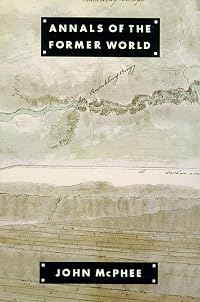
Annals of the Former World
by John McPhee
Annals of the Former World (Collections and Selections — 5-volume set)
On This Page
Description
"Twenty years ago, when John McPhee began his journeys back and forth across the United States, he planned to describe a cross-section of North America at about the fortieth parallel and, in the process, come to an understanding not only of the science but of the style of the geologists he traveled with." "Like the terrain it covers, Annals of the Former World tells a many-layered tale, and the reader may choose one of many paths through it, guided by twenty-five new maps and the "Narrative show more Table of Contents" (an essay outlining the history and structure of the project). Read sequentially, the book is an organic succession of set pieces, flashbacks, biographical sketches, and histories of the human and lithic kind; approached systematically, it can be a North American geology primer, an exploration of plate tectonics, or a study of geologic time and the development of the time scale."--Jacket. show lessTags
Recommendations











Member Recommendations
Member Reviews
Read the Assembling California section: in 1994 there was 67% chance that there would be a big quake in the Bay Area before 2020...but we seem to have passed that marker. Now what? As he points out, time as humans experience it and geological time are almost incommensurable, probably because we have occupied so little of the latter.
Too much geology lingo without a glossary, but what a writer he is! Such clean, precise, quietly suggestive description, such sharp metaphors, whether it's geological, topographical, or human interest. To return to at will.
Too much geology lingo without a glossary, but what a writer he is! Such clean, precise, quietly suggestive description, such sharp metaphors, whether it's geological, topographical, or human interest. To return to at will.
For starters, do not be intimidated by the subject matter: geology. McPhee writes with a folksy tone. Right away he is calling the reader "friend." This is not to say the content of "Crossing the Craton" has been dumbed down. It hasn't. McPhee doesn't spare the reader from words like brachiopods, samarain, neodymium and nautiloids and his timelines are a confusing mess. It takes some getting used to but I have to say this, reading about the oldest rock (35 billion years old) from the Minnesota River Valley is pretty fascinating. "Crossing the Craton" is the last chapter in his behemoth book, Annals of the Former World and probably the shortest.
Staggering, and almost staggeringly long. Turns out this is a McPhee masterwork, as he complements his profound knowledge of geology by criss-crossing the United States in the company of assorted eminent geologists, figuring out how the continent came to be the way it is now. Particularly enjoyed the chapter about how California has been formed by island chains running up against the continent, and how the faults at the joins allowed the gold to dissolve out and get deposited, eventually leading to the rush of the mid 1800's which kept the Union afloat during the civil war.
The strongest impression I am left with is the staggering part - the vast scales of geological time which can push up vast mountain ranges, have them worn down by show more rain and wind and ice, creating yet new landscapes from the immense quantities of runoff, and all of this be just a minor episode in the grand scheme of things. show less
The strongest impression I am left with is the staggering part - the vast scales of geological time which can push up vast mountain ranges, have them worn down by show more rain and wind and ice, creating yet new landscapes from the immense quantities of runoff, and all of this be just a minor episode in the grand scheme of things. show less
Like a long hard hike, but so well worth it. John Mc Phee does his very best to keep you engaged with a description of US geology adjacent to I-80. Your mind is stretched by the staggering time scale and the effort to imagine geologic processes in four dimensions. You need to plough on over some of the technical geologic terminology but it does not detract from the book.
The human element is provided by the geologists who accompany McPhee. These people are as fascinating as the subject they love. Their devotion to geology is illustrated in a tribute to Dr. David Love, from pioneer stock in Wyoming, who became a legend in his science.
The Fourth Book, "Assembling California" resonates here in New Zealand with our gold rush of the 1860's show more and the presence of the Alpine Fault. The accounts from the Loma Prieta Earthquake (1989) make sobering reading.
You feel as if you've achieved something worthwhile when you come to the end. show less
The human element is provided by the geologists who accompany McPhee. These people are as fascinating as the subject they love. Their devotion to geology is illustrated in a tribute to Dr. David Love, from pioneer stock in Wyoming, who became a legend in his science.
The Fourth Book, "Assembling California" resonates here in New Zealand with our gold rush of the 1860's show more and the presence of the Alpine Fault. The accounts from the Loma Prieta Earthquake (1989) make sobering reading.
You feel as if you've achieved something worthwhile when you come to the end. show less
Forget your textbooks, this is the best intro to geology you will find. Readable, informative, enlightening... I love how he attacks geology, not as a lesson, but through geologists. This is wonderful because geology is such a frustrating science, where newer ideas constantly make the ideas of older great geologists irrelevant. Even in this book, one geologist is uncomfortable with plate tectonics (well, I mean they don't think it's totally correct as currently laid out) partially based on the ideas they carried over from before plate tectonics was generally accepted. Anyway, the point is, geology as just given facts can be quite dull (unless you are actually looking at the rocks!). Geology as a composition of keen observations in a show more battle to interpret the poor rock record is fascinating. show less
McPhee Travels Interstate 80 from the east to the west coast accompanied by a succession of experts in the geology of the regions along the way. He writes in a chatty and engaging style for a book about geology. It reads like a travelogue of an intelligent fellow and good writer curious to find out what he can about the landmass of the United States without too much technicality.
The author leavens the science with just the right amount of associated information: backgrounds and anecdotes about the various geologists (all are interesting), histories of geological discoveries, and human history as related to local geological features.
Jargon is avoided. The author names dozens of minerals (out of about 4,000 yet discovered on earth) he show more comes across but details only the few most important. He takes you on many side trips off the interstate and to other places in the world where the formations and processes there shed light on what we find here.
The book seems organized as well as possible for portraying such a messy science: the earth's crust has been churned for four billion years, and in different ways, times and depths for each region. What amazes is that so much has been discovered and understood.
This is not a book for anyone without some interest in geology. Conversely, I believe most geologists would read it with interest and learn something.
The few simple maps and diagrams are useful, and more would have been welcome. Scales of mileage would have been helpful.
It took a while to read this, yet I was sorry that it had to end. show less
The author leavens the science with just the right amount of associated information: backgrounds and anecdotes about the various geologists (all are interesting), histories of geological discoveries, and human history as related to local geological features.
Jargon is avoided. The author names dozens of minerals (out of about 4,000 yet discovered on earth) he show more comes across but details only the few most important. He takes you on many side trips off the interstate and to other places in the world where the formations and processes there shed light on what we find here.
The book seems organized as well as possible for portraying such a messy science: the earth's crust has been churned for four billion years, and in different ways, times and depths for each region. What amazes is that so much has been discovered and understood.
This is not a book for anyone without some interest in geology. Conversely, I believe most geologists would read it with interest and learn something.
The few simple maps and diagrams are useful, and more would have been welcome. Scales of mileage would have been helpful.
It took a while to read this, yet I was sorry that it had to end. show less
What a splendid way to learn some geology! I have driven I-80 across most of the USA so much of the landscape discussed here is quite familiar to me. But I sure learned a lot about the processes that brought that landscape into being!
It was a great help that all the geological ages - Devonian etc. - are mapped out on the end papers. But I gave up looking for them and just let the detailed chronologies wash over me. I may not become a geologist in this life! There is an awful lot of information in this book. Could it have been better with fewer details and more structure? In a way though part of the book is about what geologists don't know. Sometimes the data fit the theory quite nicely. Sometimes there is a fair amount of show more interpretation and story-telling required to see how the theory can plausibly explain the data. Sometimes it's quite a stretch. And sometimes the data is just thumbing its nose at the poor scientist. The deluge of information that McPhee presents helps show the problem of the scientist trying to make sense of all that. show less
It was a great help that all the geological ages - Devonian etc. - are mapped out on the end papers. But I gave up looking for them and just let the detailed chronologies wash over me. I may not become a geologist in this life! There is an awful lot of information in this book. Could it have been better with fewer details and more structure? In a way though part of the book is about what geologists don't know. Sometimes the data fit the theory quite nicely. Sometimes there is a fair amount of show more interpretation and story-telling required to see how the theory can plausibly explain the data. Sometimes it's quite a stretch. And sometimes the data is just thumbing its nose at the poor scientist. The deluge of information that McPhee presents helps show the problem of the scientist trying to make sense of all that. show less
Members
- Recently Added By
Lists

Recommend the 20 best books you've read in the last five years
2,168 works; 603 members

Non-Fiction Worth Reading
1,016 works; 255 members

Geology
24 works; 2 members

The r/AskScience Reading List
159 works; 3 members

Books to Read
95 works; 2 members

el
1,139 works; 1 member
Author Information

59+ Works 21,095 Members
McPhee was born in Princeton, New Jersey, and educated at Princeton University and Cambridge University. His writing career began at Time magazine and led to his long association with the New Yorker, where he has been a staff writer since 1965. That same year he published his first book, A Sense of Where You Are, with FSG, and soon followed with show more The Headmaster (1966), Oranges (1967), The Pine Barrens (1968), A Roomful of Hovings and Other Profiles (collection, 1969), The Crofter and the Laird (1969), Levels of the Game (1970), Encounters with the Archdruid (1972), The Deltoid Pumpkin Seed (1973), The Curve of Binding Energy (1974), Pieces of the Frame (collection, 1975), and The Survival of the Bark Canoe (1975). Both Encounters with the Archdruid and The Curve of Binding Energy were nominated for National Book Awards in the category of science Since 1977, the year in which McPhee received the Award in Literature from the American Academy of Arts and Letters and The John McPhee Reader and the bestselling Coming into the Country appeared in print, Farrar, Straus and Giroux has published Giving Good Weight (collection, 1979), Basin and Range (1981), In Suspect Terrain (1983), La Place de la Concorde Suisse (1984), Table of Contents (collection, 1985), Rising from the Plains (1986), Heirs of General Practice (in a paperback edition, 1986), The Control of Nature (1989), Looking for a Ship (1990), Assembling California (1993), The Ransom of Russian Art (1994), The Second John McPhee Reader (1996), and Irons in the Fire (1997). Annals of the Former World was published in 1998 and was awarded the Pulitzer Prize in 1999. McPhee has taught at Princeton as Ferris Professor since 1975. (Bowker Author Biography) show less
Some Editions
Awards and Honors
Awards
Notable Lists
Series

Work Relationships
Common Knowledge
- Canonical title
- Annals of the Former World
- Original title
- Annals of the Former World
- Original publication date
- 1998
- Important places
- USA
Classifications
Statistics
- Members
- 1,847
- Popularity
- 11,768
- Reviews
- 25
- Rating
- (4.22)
- Languages
- English
- Media
- Paper, Ebook
- ISBNs
- 5
- ASINs
- 10