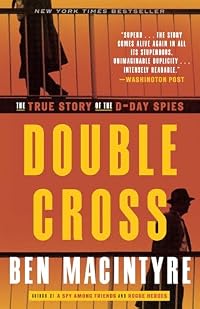
Double Cross : The True Story of the D-Day Spies
by Ben Macintyre
On This Page
Description
In Double Cross, New York Times bestselling author Ben Macintyre returns with the untold story of one of the greatest deceptions of World War II, and of the extraordinary spies who achieved it.On June 6, 1944, 150,000 Allied troops landed on the beaches of Normandy and suffered an astonishingly low rate of casualties. D-Day was a stunning military accomplishment, but it was also a masterpiece of trickery. Operation Fortitude, which protected and enabled the invasion, and the Double Cross show more system, which specialized in turning German spies into double agents, deceived the Nazis into believing that the Allies would attack at Calais and Norway rather than Normandy. It was the most sophisticated and successful deception operation ever carried out, ensuring Allied victory at the most pivotal point in the war.
This epic event has never before been told from the perspective of the key individuals in the Double Cross system, until now. These include its director (a brilliant, urbane intelligence officer), a colorful assortment of MI5 handlers (as well as their counterparts in Nazi intelligence), and the five spies who formed Double Cross’s nucleus: a dashing Serbian playboy, a Polish fighter-pilot, a bisexual Peruvian party girl, a deeply eccentric Spaniard, and a volatile Frenchwoman. The D-Day spies were, without question, one of the oddest military units ever assembled, and their success depended on the delicate, dubious relationship between spy and spymaster, both German and British. Their enterprise was saved from catastrophe by a shadowy sixth spy whose heroic sacrifice is revealed here for the first time.
With the same depth of research, eye for the absurd and masterful storytelling that have made Ben Macintyre an international bestseller, Double Cross is a captivating narrative of the spies who wove a web so intricate it ensnared Hitler’s army and carried thousands of D-Day troops across the Channel in safety. show less
Tags
Recommendations










Member Reviews
When the Allied forces landed on the beaches of Normandy on June 6, 1944, it was the culmination of a magnificent intelligence coup: thanks to the Double Cross system, all of Germany's secret agents in Britain were actually being run as double agents by MI5, and their deceptions ensured that the German army stayed away from Normandy for as long as possible, and thus saved thousands of Allied soldiers' lives. In this book, Macintyre tells the story of the five main Double Cross agents and how the system came to be developed.
This book is a natural follow-up to Macintyre's previous WW2 books, Agent Zigzag and Operation Mincemeat, and I devoured it so fast as to be left breathless by the end. The only thing slowing me down was the constant show more pausing to write down quotes. Macintyre is said to have an "eye for the absurd", and with the eccentric Double Cross agents, his talents are put to very good use. Agent Garbo in particular is a marvel to read about as he concocts his elaborate and entirely fictional network of agents and sub-agents. Bronx will make you proud as she surpasses all expectations, Tricycle will remind you of James Bond, and Treasure and Brutus will have you cheering and then gritting your teeth as their mercurial personalities threaten to derail the whole operation. Everything in this book is true (or at least as true as MI5's declassified material will permit!), but it reads like a thriller and as such is very difficult to put down. I can't recommend it highly enough if you have an interest in the Second World War. Run, don't walk, to pick up a copy of this book. Then go get Macintyre's other two WW2 books if you haven't read them already. You won't be disappointed (except when they end). show less
This book is a natural follow-up to Macintyre's previous WW2 books, Agent Zigzag and Operation Mincemeat, and I devoured it so fast as to be left breathless by the end. The only thing slowing me down was the constant show more pausing to write down quotes. Macintyre is said to have an "eye for the absurd", and with the eccentric Double Cross agents, his talents are put to very good use. Agent Garbo in particular is a marvel to read about as he concocts his elaborate and entirely fictional network of agents and sub-agents. Bronx will make you proud as she surpasses all expectations, Tricycle will remind you of James Bond, and Treasure and Brutus will have you cheering and then gritting your teeth as their mercurial personalities threaten to derail the whole operation. Everything in this book is true (or at least as true as MI5's declassified material will permit!), but it reads like a thriller and as such is very difficult to put down. I can't recommend it highly enough if you have an interest in the Second World War. Run, don't walk, to pick up a copy of this book. Then go get Macintyre's other two WW2 books if you haven't read them already. You won't be disappointed (except when they end). show less
Seventy years ago, the Allies stormed the beaches of Normandy and began the campaign to liberate Nazi-occupied Europe. Many circumstances contributed to the success of the D-Day invasion, but one of the most important factors was the campaign of disinformation being fed to the Germans by a network of double agents whose sole purpose was to convince the Abwehr that the Allies would be landing at Calais rather than Normandy. Had these agents failed, the Germans would have concentrated their forces at Normandy, most likely stopping the Allied invasion in its tracks. This book tells the stories of the individual double agents involved in this task, including Serbian playboy Dusko Popov ("Tricycle"), Peruvian socialite Elvira Chaudoir show more ("Bronx"), and Polish nationalist Roman Czerniawski ("Valentine"). Ultimately, Macintyre makes a convincing case for the proposition that the Allies would never have won the war on the battlefields had they not already won the intelligence war.
This book gives a wealth of fascinating detail about the six men and women who acted as double agents in Britain, allegedly spying for Germany but really working for the Allies. I was shocked to learn that British intelligence had actually discovered and turned every German agent in Britain at the time! Because of this, the Allies were able to present a unified message to the Germans, subtlely directing their attention away from Normandy and toward other possible invasion sites. Some of the specific stories in the book prove once again that truth is stranger than fiction: for example, Dusko Popov thrived on creating networks of sub-agents that were entirely fictional, yet he retained the Abwehr's complete trust. I also loved the fact that these double agents were handled in Britain by the Twenty Committee, so named because the Roman numeral for 20 is XX, or "double cross." In short, if you're interested in true stories of WWII-era espionage, Ben Macintyre is your man! show less
This book gives a wealth of fascinating detail about the six men and women who acted as double agents in Britain, allegedly spying for Germany but really working for the Allies. I was shocked to learn that British intelligence had actually discovered and turned every German agent in Britain at the time! Because of this, the Allies were able to present a unified message to the Germans, subtlely directing their attention away from Normandy and toward other possible invasion sites. Some of the specific stories in the book prove once again that truth is stranger than fiction: for example, Dusko Popov thrived on creating networks of sub-agents that were entirely fictional, yet he retained the Abwehr's complete trust. I also loved the fact that these double agents were handled in Britain by the Twenty Committee, so named because the Roman numeral for 20 is XX, or "double cross." In short, if you're interested in true stories of WWII-era espionage, Ben Macintyre is your man! show less
Feeling at a remove from the world of WWII-era black-and-white photos, kids these days might complacently feel the results of that vast conflict were a foregone conclusion. In truth, the Allied victory was not certain. Those same kids (if their forebears were not annihilated) came very close to speaking German and celebrating Adolph Hitler Day. To win the war, the Allied forces had to land in Northern Europe. We knew it and the Germans knew it. The big question was where the assault would take place. If the Germans guessed right, they could mass their forces in the right place and hold off the Allies. If not, the Allies would gain a foothold to work their way to Berlin.
Ben McIntyre's Double Cross recounts the remarkable stories of a show more group of double agents working out of England. The Germans believed they were spying for them. In reality, they were part of an imaginative and calculated espionage effort out of England. This motley group of men and women busily provided disinformation, harmless true information and true yet untimely intelligence -- all in the effort to confuse the Axis powers. Their supreme efforts convinced Germany the Northern European assault would take place far from the beaches of Normandy.
Who were these people? What motivated them to become double agents? How did they pull off this enormous hoax? Based upon newly declassified and released records McIntyre tells a walloping good tale about a little known yet critically important part of the war effort. show less
Ben McIntyre's Double Cross recounts the remarkable stories of a show more group of double agents working out of England. The Germans believed they were spying for them. In reality, they were part of an imaginative and calculated espionage effort out of England. This motley group of men and women busily provided disinformation, harmless true information and true yet untimely intelligence -- all in the effort to confuse the Axis powers. Their supreme efforts convinced Germany the Northern European assault would take place far from the beaches of Normandy.
Who were these people? What motivated them to become double agents? How did they pull off this enormous hoax? Based upon newly declassified and released records McIntyre tells a walloping good tale about a little known yet critically important part of the war effort. show less
A Serbian playboy, a melodramatic Pole, a bisexual Peruvian heiress to a guano fortune that was still insufficient to keep up with her gambling habit, a failed Spanish chicken farmer and a Frenchwoman of Russian heritage who would place her little white dog, Babs, above any other loyalty. What is this, an espionage team or a cast list for a Monty Python sketch? Ben MacIntyre does it again; unearths the story of a highly improbable, but true, high-stakes World War II espionage caper, carried out by a team of supremely eccentric characters.
These five agents were the key players in Britain's Operation Double Cross. By March, 1943, Britain had captured 126 spies and had turned several into double agents. Some other German agents volunteered show more themselves to work for Britain. At first, the British used the double agents to give the Germans "chicken feed," but once British intelligence became convinced that they controlled every German spy in the country, they decided the network could be used to mislead the Germans on a large scale and affect the outcome of the war.
The plan was to use the Double Cross agents as part of a massive and elaborate plan to persuade the Germans that the D-Day invasion would take place, not at Normandy, but at Pas de Calais and via Norway. The espionage operation was carried out over many months, and involved all kinds of fakery to persuade Germany that vast armies were massing at the best spots in England and Scotland to invade at the false invasion points. The Double Cross agents passed on thousands of messages to advance this fakery, and other tidbits of false intelligence to further the plot.
The Germans wholeheartedly believed in "their" agents, showering them with fulsome praise, money, and even an Iron Cross in one case. It seems that though the Germans had a good deal of success capturing spies and resistance operatives in occupied territories, they were terrible at spotting double agents. I had to wonder if it had something to do with key differences in their culture and national psyche versus those of the British.
British intelligence reveled in the gamesmanship and double-dealing required for Double Cross. The war was, of course, deadly serious, but the British intelligence services almost gleefully embraced the most elaborate and absurd trickery in pursuit of its strategic goals. They hatched wild ploys, like breaking up Germany's homing pigeon communication network by infiltrating it with British pigeons, and spending weeks training an actor to impersonate the colorful Field Marshall Montgomery and appear in Gibraltar as the D-Day invasion approached, so that the Germans would be lulled into complacency.
The British intelligence services were filled with old school chums who played cricket at Eton and Harrow, Oxford and Cambridge, and enjoyed the Times crossword puzzle. All that practice learning to disguise the curve of a googly pitch and understand a cryptic crossword seems to have come in a lot more handy than the Germans' tradition of giving each other dueling scars.
Kudos to Ben MacIntyre, author of Agent Zigzag: A True Story of Nazi Espionage, Love, and Betrayal and Operation Mincemeat: How a Dead Man and a Bizarre Plan Fooled the Nazis and Assured an Allied Victory, for bringing us another unique and stranger-than-fiction tale of the sometimes farcical, but always riveting, intelligence agents and operations that helped win World War II.
DISCLOSURE: I received a free review copy of this book. show less
These five agents were the key players in Britain's Operation Double Cross. By March, 1943, Britain had captured 126 spies and had turned several into double agents. Some other German agents volunteered show more themselves to work for Britain. At first, the British used the double agents to give the Germans "chicken feed," but once British intelligence became convinced that they controlled every German spy in the country, they decided the network could be used to mislead the Germans on a large scale and affect the outcome of the war.
The plan was to use the Double Cross agents as part of a massive and elaborate plan to persuade the Germans that the D-Day invasion would take place, not at Normandy, but at Pas de Calais and via Norway. The espionage operation was carried out over many months, and involved all kinds of fakery to persuade Germany that vast armies were massing at the best spots in England and Scotland to invade at the false invasion points. The Double Cross agents passed on thousands of messages to advance this fakery, and other tidbits of false intelligence to further the plot.
The Germans wholeheartedly believed in "their" agents, showering them with fulsome praise, money, and even an Iron Cross in one case. It seems that though the Germans had a good deal of success capturing spies and resistance operatives in occupied territories, they were terrible at spotting double agents. I had to wonder if it had something to do with key differences in their culture and national psyche versus those of the British.
British intelligence reveled in the gamesmanship and double-dealing required for Double Cross. The war was, of course, deadly serious, but the British intelligence services almost gleefully embraced the most elaborate and absurd trickery in pursuit of its strategic goals. They hatched wild ploys, like breaking up Germany's homing pigeon communication network by infiltrating it with British pigeons, and spending weeks training an actor to impersonate the colorful Field Marshall Montgomery and appear in Gibraltar as the D-Day invasion approached, so that the Germans would be lulled into complacency.
The British intelligence services were filled with old school chums who played cricket at Eton and Harrow, Oxford and Cambridge, and enjoyed the Times crossword puzzle. All that practice learning to disguise the curve of a googly pitch and understand a cryptic crossword seems to have come in a lot more handy than the Germans' tradition of giving each other dueling scars.
Kudos to Ben MacIntyre, author of Agent Zigzag: A True Story of Nazi Espionage, Love, and Betrayal and Operation Mincemeat: How a Dead Man and a Bizarre Plan Fooled the Nazis and Assured an Allied Victory, for bringing us another unique and stranger-than-fiction tale of the sometimes farcical, but always riveting, intelligence agents and operations that helped win World War II.
DISCLOSURE: I received a free review copy of this book. show less
D Day. The beginning of the end of the Second World War. But for this massive operation to succeed the Allies had to do every trick in the book to convince the Nazis that the invasion was going to take place in a different location.
So was conceived Operation Fortitude, an audacious plan of lies, deception and misinformation to persuade the military that the invasion was going to take place in Norway and Calais. This team of double agents, Bronx, Brutus, Treasure, Tricycle and Garbo fed back to their German masters this picture of troop movements and build of arms and materiel. Even though there were some doubters in the German echelons, this story dreamt up by a team in London was swallowed hook line and sinker.
But it so nearly wasn't. show more Macintyre brings alive the tension as the web of deceit was spun, from the near misses as agents were arrested, to the appalling handling of agent Treasure, over petty amounts of money. He describes their character, flaws and ultimately courage of the job that they performed. Macintyre must have sifted through hundreds of secret documents to shine a light on these people, and their handlers, who probably saved thousands of lives on both sides as the allies got a foothold in France.
As will all of his history books he reveals the lives of those who lived in the shadows and smoke of the espionage game, people who most would have never heard of, and the key roles they played in changing European and World history. Well written as usual, there are points where it reads like a spy thriller, even though it was really life. show less
So was conceived Operation Fortitude, an audacious plan of lies, deception and misinformation to persuade the military that the invasion was going to take place in Norway and Calais. This team of double agents, Bronx, Brutus, Treasure, Tricycle and Garbo fed back to their German masters this picture of troop movements and build of arms and materiel. Even though there were some doubters in the German echelons, this story dreamt up by a team in London was swallowed hook line and sinker.
But it so nearly wasn't. show more Macintyre brings alive the tension as the web of deceit was spun, from the near misses as agents were arrested, to the appalling handling of agent Treasure, over petty amounts of money. He describes their character, flaws and ultimately courage of the job that they performed. Macintyre must have sifted through hundreds of secret documents to shine a light on these people, and their handlers, who probably saved thousands of lives on both sides as the allies got a foothold in France.
As will all of his history books he reveals the lives of those who lived in the shadows and smoke of the espionage game, people who most would have never heard of, and the key roles they played in changing European and World history. Well written as usual, there are points where it reads like a spy thriller, even though it was really life. show less
Contemplating the stirs and eddies of history, it's easy to assume inevitable the currents that carried events one way or another. That Hitler's reach exceeded his grasp seems obvious now but had he been afforded a little more time, advancements in his nuclear program and the implementation of his V-2 rockets might have dramatically changed the course of things. Time is largely why the D-Day landing at Normandy became the hinge upon which the history of the 20th century swung. Should it have failed, the Allied cause might have been stalled for years. Among the many factors that contributed to the ultimate success of the landings was the use of spies to pepper the German intelligence command with half-truths and outright deceit. show more Virtually every spy the Germans sent to England was either killed, captured or turned. It is those who were turned who are the focus Ben Macintyre's DOUBLE CROSS a very well done real life spy thriller that I enjoyed more for the spies than the thrills. The origins, motivations and dubious characters of the central group of spies is all unfolded quite well and captivated me for the first half of the book. Each uniquely skilled and monstrously flawed double agent was so self absorbed that the thought of actually being caught was unimaginable. Recreated here with a deft hand for detail, I was quite often surprised by the turns each spy's life took. The book balances the stories of the spies with their British MI5 handlers who on good days had to satisfy diva spies and on bad days had to worry about being triple crossed and all their work vanishing in a sudden flash. As much as I enjoyed the first half of the book, there is a significant portion just past midway where the book seems to be treading water--as if the author were determined to get every bit of research into the book at the expense of momentum. The pace picks up again once the D-Day landing is underway and all the double agent's efforts are aimed in the same direction. As with any spy story, it is often difficult to directly link cause A with effect B, which does make some of the payoff from the spies activities a tad tepid, but generally there seems to be enough justification to credit the double agents with at least making the D-Day landing easier and possibly with making the landing possible at all. show less
"In wartime, the truth is so precious that she should always be attended by a bodyguard of lies." Winston Churchill
Double Cross centres on the murky world of espionage during WWII and in particular recounts the tale of a quintet of double agents and their handlers attempts to fool the German High Command into believing that the D-Day landings of 1944 would take place along the coastline around Pas de Calais and by the fictitious “First United States Army Group”, , far away from than the real objectives of Normandy. The quintet of double agents were an unlikely bunch and comprised of “a bisexual Peruvian playgirl, a tiny Polish fighter pilot, a mercurial Frenchwoman, a Serbian seducer and a Spaniard with a diploma in chicken show more farming.” If they were successful, they would delay the arrival of crack reinforcements in Normandy potentially saving thousands of Allied lives. Fortunately, for the Allies at least, the Germans were totally taken in by the ruse and Operation Fortitude proved a complete success.
Now I must admit that I rather enjoyed reading about an aspect of WWII that I know very little about but ultimately struggled to see quite what genre and target audience that this book was aimed at. There were too many facts to make it feel fictional but too little real depth to make it truly historical. In the end I couldn't help feel that perhaps the author had ultimately been taken in by these spies tales of bravado as much as the Germans were. Personally I find it very hard to believe that the Germans were as gullible or the British so smart as the author would have us believe. Whilst I have little doubt that Operation Fortitude did save Allied lives and that its success certainly led to the beginning of the end of the war, the reality is that the Germans had lost the war in the air, were having to commit ever larger numbers to the Eastern Front to fight Russian forces, Britain and her allies had had a massive influx of combatants join them from America all meant that even the German hierarchy believed that they had lost the war, as evidenced by the plot to assassinate Hitler. Added all together I struggled to believe that the success of the plan was as pivotal as the author would have the reader believe.
Overall I found this an interesting but rather fluffy, flawed read that may give its readers a very distorted view of the ongoing events of the time and perhaps underplay the deeds of those who actually did the fighting on both sides of the battle. show less
Double Cross centres on the murky world of espionage during WWII and in particular recounts the tale of a quintet of double agents and their handlers attempts to fool the German High Command into believing that the D-Day landings of 1944 would take place along the coastline around Pas de Calais and by the fictitious “First United States Army Group”, , far away from than the real objectives of Normandy. The quintet of double agents were an unlikely bunch and comprised of “a bisexual Peruvian playgirl, a tiny Polish fighter pilot, a mercurial Frenchwoman, a Serbian seducer and a Spaniard with a diploma in chicken show more farming.” If they were successful, they would delay the arrival of crack reinforcements in Normandy potentially saving thousands of Allied lives. Fortunately, for the Allies at least, the Germans were totally taken in by the ruse and Operation Fortitude proved a complete success.
Now I must admit that I rather enjoyed reading about an aspect of WWII that I know very little about but ultimately struggled to see quite what genre and target audience that this book was aimed at. There were too many facts to make it feel fictional but too little real depth to make it truly historical. In the end I couldn't help feel that perhaps the author had ultimately been taken in by these spies tales of bravado as much as the Germans were. Personally I find it very hard to believe that the Germans were as gullible or the British so smart as the author would have us believe. Whilst I have little doubt that Operation Fortitude did save Allied lives and that its success certainly led to the beginning of the end of the war, the reality is that the Germans had lost the war in the air, were having to commit ever larger numbers to the Eastern Front to fight Russian forces, Britain and her allies had had a massive influx of combatants join them from America all meant that even the German hierarchy believed that they had lost the war, as evidenced by the plot to assassinate Hitler. Added all together I struggled to believe that the success of the plan was as pivotal as the author would have the reader believe.
Overall I found this an interesting but rather fluffy, flawed read that may give its readers a very distorted view of the ongoing events of the time and perhaps underplay the deeds of those who actually did the fighting on both sides of the battle. show less
Members
- Recently Added By
Lists

Best Espionage (Non-Fiction)
32 works; 6 members

BEST BOOKS TO UNDERSTAND XX CENTURY'S HISTORY
63 works; 3 members

All Things Great Britain
66 works; 1 member

Books about World War II
241 works; 22 members

Europe
205 works; 5 members

Books Read in 2022
5,164 works; 113 members

Best Spy Fiction
156 works; 102 members

Books About World War II
102 works; 29 members

THE WAR ROOM
813 works; 24 members
Author Information

30+ Works 14,184 Members
Some Editions
Awards and Honors
Awards
Work Relationships
Common Knowledge
- Canonical title
- Double Cross : The True Story of the D-Day Spies
- Original title
- Double Cross : The True Story of the D-Day Spies
- Original publication date
- 2012
- People/Characters
- Dušan Popov; Juan Pujol Garcia; Elvira Chaudoir; Roman Czerniawski; Lily Sergeyev; Mathilde Carré (show all 71); Hugo Bleicher; John Cecil Masterman; Thomas Argyll Robertson; Arthur Owens; Major Karl-Erich Kühlenthal; Guy Liddell; Gösta Caroli; Wulf Schmidt; Wilhelm Franz Canaris; Hans Oster; Johann-Nielsen Jebsen; Hans Brandes; Wilhelm Kuebart; Charles de Salis; Colonel Georg Alexander Hansen; John Moe; Tor Glad; Anthony Frederick Blunt; Paul Fidrmuc; Helmut Bleil; Major Christopher Harmer; Hugh Astor; Colonel Oscar Reile; Frano de Bona; Gisela Ashley; Kenneth Benton; Renée Borni; Winston Churchill; Bernard Law Montgomery; Claude Dansey; Yvonne Delidaise; Dwight D. Eisenhower; Friedl Gaertner; Lily Grass; Baroness Marie von Gronau; Mabel Harbottle; Tomás Joseph Harris; Victor Rothschild, 3rd Baron Rothschild; Heinrich Himmler; Adolf Hitler; Meyrick Edward Clifton James; Hans Friedrich Karl Franz Kammler; Ludovico von Karsthoff; Major Emile Kliemann; Otto Kurrer; William Luke; John Marriott; Major Roger Michael; Maritza Mihailovic; Heinz Paul Moldenhauer; Ignacio Perez Molina; Ewen Montagu; Heinrich Müller (Gestapo); Hiroshi Oshima; George S. Patton; Kim Philby; Ivo Popov; Alexis Freiherr von Roenne; Walter Schellenberg; Aloys Schreiber; Mary Sherer; Richard Melville Walker; Ian David Wilson; P. G. Wodehouse; Erich Vermehren
- Important places
- Paris, Île-de-France, France; Berlin, Germany; London, England, UK; Lisbon, Portugal; Madrid, Spain
- Important events
- World War II (1939 | 1945); Operation Fortitude (1943-12 | 1944-03); Operation Overlord (1944-06-06 | 1944-08-30); D-Day (1944-06-06); Operation Dora; Operation Cockade (show all 8); Operation Copperhead; Operation Torch
- Epigraph
- Tangle within tangle, plot and counter-plot, ruse and treachery, cross and double-cross, true agent, false agent, double agent, gold and steel, the bomb, the dagger and the firing party, were interwoven in many a texture so i... (show all)ntricate as to be incredible and yet true. - Winston Churchill
The enemy must not know where I intend to give battle. For if he does not know where I intend to give battle he must prepare in a great many places. And when he prepares in a great many places, those I have to fight in any ... (show all)one place will be few. And when he prepares everywhere he will be weak everywhere. - Sun Tzu - Dedication
- For Callum, Pablo, Minnie, and Wilf
- First words
- (Preface) In the summer of 1943, a genteel and soft-spoken intelligence officer wearing tartan trousers and smoking a pipe put the finishing touches to a secret weapon he had been working on for more than three years.
Dusko and Johnny were friends. - Last words
- (Click to show. Warning: May contain spoilers.)Agent Garbo accepted the Iron Cross on behalf of them all.
(Click to show. Warning: May contain spoilers.)(Aftermath) Agent Artist was not a conventional D-Day hero, but he was a hero nonetheless. - Publisher's editor
- Fishwick, Michael
- Blurbers
- Millard, Candice; Furst, Alan; Forsyth, Frederick; Nagorski, Andrew; Higgins, Jack
- Original language
- English
- Canonical DDC/MDS
- 940.5421421
Classifications
- Genres
- History, General Nonfiction, Nonfiction
- DDC/MDS
- 940.5421421 — History & geography History of Europe History of Europe 1918- Military history of World War II Campaigns and battles by theatre European theatre France
- LCC
- D810 .S8 .M237 — History of Europe, Asia, Africa and Oceania History (General) World War II (1939-1945)
- BISAC
Statistics
- Members
- 1,233
- Popularity
- 19,881
- Reviews
- 46
- Rating
- (3.87)
- Languages
- 6 — Danish, English, Finnish, Hebrew, Spanish, Swedish
- Media
- Paper, Audiobook, Ebook
- ISBNs
- 31
- ASINs
- 14