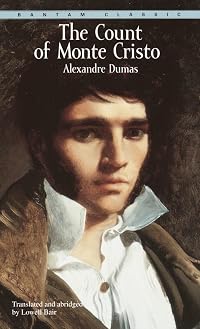
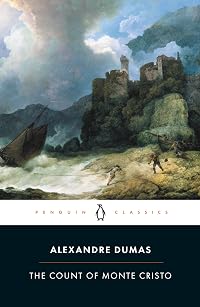
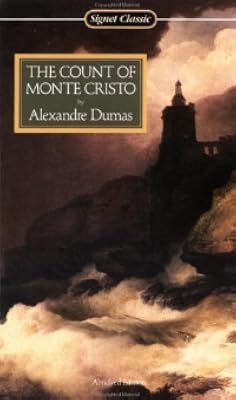
The Count of Monte Cristo (abridged ∙ Bantam Classic)
by Alexandre Dumas
On This Page
Description
After escaping from the island where he has been in prison, Dantes plots his revenge on the people responsible for his imprisonment.Tags
Recommendations









Member Recommendations

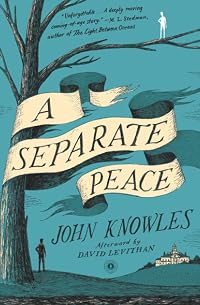
TomWaitsTables Jay Gatsby is Edmund Dantes rewritten for the American dream. And no, I'm not high.

caimanjosh This might seem a little odd, but bear with me here. Both are stories of a character who starts out in chains, manages to free himself, then works his way up into high society, with an agenda hidden those those around him. One's fantasy, one's historical fiction, and both are enjoyable.
Member Reviews
I read and enjoyed The Three Musketeers last month, and I enjoyed The Count of Monte Cristo even more. Dumas created an action-packed tale of betrayal and calculated revenge; this is a classic that well deserves to be read and enjoyed, almost two centuries on. I do wish the women characters had been as strong and nuanced as in Musketeers (Haydee never had an opportunity to develop, and she had so much potential) and I had some issues keeping characters straight because the cast was so huge. Still, great fun. I hope I can read more Dumas this year!
So, we all know the basic premise: a promising young man is betrayed by his rivals and locked up in a prison. While there, he inherits an enormous treasure from a scholarly abbé (oh, and he is taught the entirety of human knowledge), flees the prison and seeks out revenge. And what a revenge it is.
I can’t give this book credit for being realistic, because, let’s be honest, the reach and extent of the count’s influence was just ridiculous. His plan had way too many uncertainties and risks to be executed so flawlessly. Knowing exactly when and how the dapple-greys would go crazy, predicting so impossibly accurately how people react… always. For example him meeting Madame du Villefort years before and finding out she is interested show more in chemistry and the like, learning that she wants an inheritance for her son, and just assuming that given the chance, she would poison anyone who stands in her way. How was he sure she would do it? Did he have a backup plan in case that didn’t work? We were never given many details as to his plan (even though the book is 1200+ pages long), and sometimes that made the whole thing far too contrived and improbably perfect to be real. But it was whimsically fantastical, and over the course of the story I just got used to it. It also added to the mystery, and personally, the way revenge was executed was, for the most part, a surprise – I didn’t feel the story was predictable at all. Especially in the part with Franz and Albert in Rome, I had no idea what was going on, but it was fun to go with the flow and watch how things slowly unfold. I never really knew what the count was up to until following his actions for a considerable amount of time, and the clever, roundabout way that he brought his enemies to ruin was a pleasure to observe.
But like I said, not knowing the details of the plan was sometimes annoying, just like the fact the count was so shrouded in mystery for a great part of the book. He was such a wonderful character and could have been developed so much more than he was. It was only towards the end of the book that we really saw him beginning to doubt that he was doing the right thing, that he really was an agent of Providence. We needed more of that. We needed his plan to go awry earlier on. That’s the stuff I wanted to hear about. I wanted to know exactly how much of Edmond Dantes was left inside of the Count of Monte Cristo.
Character development was just generally sacrificed for the sake of an incredibly well-paced plot in this novel. The only section that was slow, in my opinion, was the part in Rome. Otherwise, I was never bored. Almost all the subplots had me hooked, and I felt like no part of the book was unnecessary. Everything was there for a reason, and there were no loose ends. Which has its negative side as well, because, for me, everything tied up a bit too well, every story we heard was somehow related to ours in an improbable way, and I didn’t necessarily like that. But the fast, rollicking pace of the story was phenomenal; it’s been a long time since I read something so expertly plotted. (And while Dumas gets a bad rap for bloating his books for money, I, at least, feel that he does it so masterfully that I don’t care one bit!)
The beginning of the book was entertaining for me, but a bit shallow. I like philosophical books, so it really picked up for me when the characters began musing upon death and revenge, justice and providence. I felt like these themes were developed really well, but the one thing that felt rushed and weird was the redemption story. It just happened really quickly after Eduard’s death, and it didn’t feel real to me. I felt like that process should have begun a lot earlier to be more realistic and impressive.
Like I said, character development wasn’t one of this book’s strong points, but I felt there were some intriguing and real characters nonetheless. Albert’s character underwent a big development, as did for example Mercedes. The Danglars’ were great (Eugenie!), as were the Villeforts. I loved grandpa Nourtier and the way he could influence events so radically while only being able to blink. I had sympathy for Monsieur du Villefort, and I actually felt the count was too cruel on some occasions. However, some of the “good” characters were pretty bland. Maximilian and his family were a tad bit too pious and perfect to be likable, but it wasn’t a great problem.
I also loved the symbolism in the Dantes’ different identities. Abbé Busoni was the judge, Lord Wilmore the generous philanthropist, and Monte Cristo the avenging angel. It also showed his inner identity crisis, like he didn’t know who he was or who he wanted to be. He lost himself in his insane obsession with revenge.
I also really loved the theme of justice. I mean, what is justice? This book really made me think about that. We’re confronted with human justice in the face of Villefort, but we see quickly that it’s not potent, it’s fallible. Then we have MC’s “divine” justice, an eye for an eye, a tooth for a tooth – it’s cruel and has unexpected consequences. In the end we find out that it, too, is just human justice in another form. In the end the count truly leaves justice in the hands of God. We also have the interesting aspect of self-ruin. Du Morcerf was ruined by his own betrayal, really, as was Villefort by his own sins. The past caught up with them and the facts were laid bare… but did the really deserve their fate? And what about their children? Should they really suffer for the sins of their fathers? Is it inevitable? Andrea Cavalcanti claimed it was. And did the count’s revenge really give him peace? Not really. In the end he learned, I guess, that forgiveness is the better way (Danglars really got away easily, dangit!), but this is an exceptional revenge story nonetheless. It ends pretty openly, with MC getting together with Haydee and sailing off into the sunset. A fairly happy ending for pretty much everyone still alive… except Mercedes. She really got the worst of this whole ordeal, and I didn’t feel she deserved it. The irony is also that MC’s revenge was really about her… but in the end they were two very different people than the young lovers they used to be, and Mercedes never really found happiness again. But I guess that’s life, and I guess that’s why the revenge really wasn’t worth it in the end. Even though it was epicly awesome.
So even while this is a book replete with flaws, it deserves, in my humble opinion, a 4-5 rating. It’s a story that really stayed with me; once I finished it, I couldn’t stop thinking about or reading discussions and reviews about different aspects of it. It really haunted me and gave that transcendent feeling in the end, and not a lot of books can do that lately. And come on, it only took me two weeks to read a 1200+ book. That’s something. show less
I can’t give this book credit for being realistic, because, let’s be honest, the reach and extent of the count’s influence was just ridiculous. His plan had way too many uncertainties and risks to be executed so flawlessly. Knowing exactly when and how the dapple-greys would go crazy, predicting so impossibly accurately how people react… always. For example him meeting Madame du Villefort years before and finding out she is interested show more in chemistry and the like, learning that she wants an inheritance for her son, and just assuming that given the chance, she would poison anyone who stands in her way. How was he sure she would do it? Did he have a backup plan in case that didn’t work? We were never given many details as to his plan (even though the book is 1200+ pages long), and sometimes that made the whole thing far too contrived and improbably perfect to be real. But it was whimsically fantastical, and over the course of the story I just got used to it. It also added to the mystery, and personally, the way revenge was executed was, for the most part, a surprise – I didn’t feel the story was predictable at all. Especially in the part with Franz and Albert in Rome, I had no idea what was going on, but it was fun to go with the flow and watch how things slowly unfold. I never really knew what the count was up to until following his actions for a considerable amount of time, and the clever, roundabout way that he brought his enemies to ruin was a pleasure to observe.
But like I said, not knowing the details of the plan was sometimes annoying, just like the fact the count was so shrouded in mystery for a great part of the book. He was such a wonderful character and could have been developed so much more than he was. It was only towards the end of the book that we really saw him beginning to doubt that he was doing the right thing, that he really was an agent of Providence. We needed more of that. We needed his plan to go awry earlier on. That’s the stuff I wanted to hear about. I wanted to know exactly how much of Edmond Dantes was left inside of the Count of Monte Cristo.
Character development was just generally sacrificed for the sake of an incredibly well-paced plot in this novel. The only section that was slow, in my opinion, was the part in Rome. Otherwise, I was never bored. Almost all the subplots had me hooked, and I felt like no part of the book was unnecessary. Everything was there for a reason, and there were no loose ends. Which has its negative side as well, because, for me, everything tied up a bit too well, every story we heard was somehow related to ours in an improbable way, and I didn’t necessarily like that. But the fast, rollicking pace of the story was phenomenal; it’s been a long time since I read something so expertly plotted. (And while Dumas gets a bad rap for bloating his books for money, I, at least, feel that he does it so masterfully that I don’t care one bit!)
The beginning of the book was entertaining for me, but a bit shallow. I like philosophical books, so it really picked up for me when the characters began musing upon death and revenge, justice and providence. I felt like these themes were developed really well, but the one thing that felt rushed and weird was the redemption story. It just happened really quickly after Eduard’s death, and it didn’t feel real to me. I felt like that process should have begun a lot earlier to be more realistic and impressive.
Like I said, character development wasn’t one of this book’s strong points, but I felt there were some intriguing and real characters nonetheless. Albert’s character underwent a big development, as did for example Mercedes. The Danglars’ were great (Eugenie!), as were the Villeforts. I loved grandpa Nourtier and the way he could influence events so radically while only being able to blink. I had sympathy for Monsieur du Villefort, and I actually felt the count was too cruel on some occasions. However, some of the “good” characters were pretty bland. Maximilian and his family were a tad bit too pious and perfect to be likable, but it wasn’t a great problem.
I also loved the symbolism in the Dantes’ different identities. Abbé Busoni was the judge, Lord Wilmore the generous philanthropist, and Monte Cristo the avenging angel. It also showed his inner identity crisis, like he didn’t know who he was or who he wanted to be. He lost himself in his insane obsession with revenge.
I also really loved the theme of justice. I mean, what is justice? This book really made me think about that. We’re confronted with human justice in the face of Villefort, but we see quickly that it’s not potent, it’s fallible. Then we have MC’s “divine” justice, an eye for an eye, a tooth for a tooth – it’s cruel and has unexpected consequences. In the end we find out that it, too, is just human justice in another form. In the end the count truly leaves justice in the hands of God. We also have the interesting aspect of self-ruin. Du Morcerf was ruined by his own betrayal, really, as was Villefort by his own sins. The past caught up with them and the facts were laid bare… but did the really deserve their fate? And what about their children? Should they really suffer for the sins of their fathers? Is it inevitable? Andrea Cavalcanti claimed it was. And did the count’s revenge really give him peace? Not really. In the end he learned, I guess, that forgiveness is the better way (Danglars really got away easily, dangit!), but this is an exceptional revenge story nonetheless. It ends pretty openly, with MC getting together with Haydee and sailing off into the sunset. A fairly happy ending for pretty much everyone still alive… except Mercedes. She really got the worst of this whole ordeal, and I didn’t feel she deserved it. The irony is also that MC’s revenge was really about her… but in the end they were two very different people than the young lovers they used to be, and Mercedes never really found happiness again. But I guess that’s life, and I guess that’s why the revenge really wasn’t worth it in the end. Even though it was epicly awesome.
So even while this is a book replete with flaws, it deserves, in my humble opinion, a 4-5 rating. It’s a story that really stayed with me; once I finished it, I couldn’t stop thinking about or reading discussions and reviews about different aspects of it. It really haunted me and gave that transcendent feeling in the end, and not a lot of books can do that lately. And come on, it only took me two weeks to read a 1200+ book. That’s something. show less
Where the novel succeeded was transporting me to Dumas's vision of a lush, romantic Europe: full of carnivals and operas, noble scoundrels and dirty nobles, of duels and murder, of revolution and love, hidden treasures and secret identities. The problem is that the story doesn't really go anywhere with these elements. Its original publication as a serial really shows- even in my abridged Bantam edition it often drags for long stretches- partially due to a frequent lack of sympathetic protagonist.
Edmond Dantes, the hard-working and ambitious young man we meet at the introduction of the novel transforms himself into the Count of Monte Cristo in order to gain the power to wreak vengeance upon his betrayers. But this Count merely is a show more petty, obsessed man- he flaunts and wastes his wealth on narrow-minded hate. And thus, for much of the novel, his complicated machinations came off not as masterful but rather arbitrarily convoluted.
It was not until the love story of Valentine and Maximilien is introduced that I somewhat regained an emotional connection to the plot clogs. The real hero for the couple here, though, is the magnificent Monsieur Nortier and not the Count. Despite being unable to do much more than blink his eyes, he still able to mastermind the situation to do the heavy lifting in ensuring Valentine's happiness and freedom.
The Count does eventually seen how much he's gone too far in his obsession with revenge. Rather than exploring his guilt, however, Dumas very quickly exonerates Edmond as righteous with a cheap invocation of religion. As a reader, I felt really cheated of a true resolution for a man as guilty as his tormentors.
Maybe the storytelling 'canon' I was raised on is too different from the one being invoked here; there is values dissonance. Vengeance owns you- your attachment to it seals your fate, ties you up into the same end as your victims/tormentors. Edmond Dantes took it upon himself to be a god, or maybe rather judge, jury, and executioner. To leave the story thus I felt a bitter disappointment, and ultimately the whole exercise seemed like a romp rather than an epic/classic tale of revenge. show less
Edmond Dantes, the hard-working and ambitious young man we meet at the introduction of the novel transforms himself into the Count of Monte Cristo in order to gain the power to wreak vengeance upon his betrayers. But this Count merely is a show more petty, obsessed man- he flaunts and wastes his wealth on narrow-minded hate. And thus, for much of the novel, his complicated machinations came off not as masterful but rather arbitrarily convoluted.
It was not until the love story of Valentine and Maximilien is introduced that I somewhat regained an emotional connection to the plot clogs. The real hero for the couple here, though, is the magnificent Monsieur Nortier and not the Count. Despite being unable to do much more than blink his eyes, he still able to mastermind the situation to do the heavy lifting in ensuring Valentine's happiness and freedom.
The Count does eventually seen how much he's gone too far in his obsession with revenge. Rather than exploring his guilt, however, Dumas very quickly exonerates Edmond as righteous with a cheap invocation of religion. As a reader, I felt really cheated of a true resolution for a man as guilty as his tormentors.
Maybe the storytelling 'canon' I was raised on is too different from the one being invoked here; there is values dissonance. Vengeance owns you- your attachment to it seals your fate, ties you up into the same end as your victims/tormentors. Edmond Dantes took it upon himself to be a god, or maybe rather judge, jury, and executioner. To leave the story thus I felt a bitter disappointment, and ultimately the whole exercise seemed like a romp rather than an epic/classic tale of revenge. show less
The Count of Monte Cristo is one of those books you hear an awful lot about, think "yeah, maybe I should read this" and never really work up the motivation. Or perhaps you're forcibly exposed to it through some Honors English teacher. The reason that you're forcibly exposed to it, or that people won't stop talking about it? This book is truly excellent. From the outset, what's not to love about a bunch of French guys getting revenge on each other? The degree of forethought and subtlety in all of the plots, as wrought by both Dumas and his characters, is spectacular.
Some of the side stories are less interesting than the main plot--this is both necessary to keep us wanting to come back to the main plot, and a sign that Dumas is indeed show more human--and some of the character relationships become a little confusing as the book snowballs on. I might have appreciated a few family trees, a la George R. R. Martin. that told me the given name, the title, and the family name of any given character. (As is common with nobility, at some point, people stop going by their given names and just take on their titular identities.) And I find Dumas' continuous restatement of his thesis, that you must experience sorrow to experience true happiness, toward the end of the book a little heavy-handed. Perhaps I find it heavy-handed because I disagree with it.
But that's not enough to prevent enjoyment of the book, by any means. This book literally "has it all"--intrigue, action, romance, and the religious commentary that's practically required of the Romantic era. Redemption, vindication, treachery, and of course vengeance. Dumas works wonders with character development, both in terms of perceived character development as plots come to light, and in the characters' real development in response to events in the story. The highest praise I can give, though is this: for its daunting volume, most of it clips by at a surprisingly quick speed. Definitely recommended. show less
Some of the side stories are less interesting than the main plot--this is both necessary to keep us wanting to come back to the main plot, and a sign that Dumas is indeed show more human--and some of the character relationships become a little confusing as the book snowballs on. I might have appreciated a few family trees, a la George R. R. Martin. that told me the given name, the title, and the family name of any given character. (As is common with nobility, at some point, people stop going by their given names and just take on their titular identities.) And I find Dumas' continuous restatement of his thesis, that you must experience sorrow to experience true happiness, toward the end of the book a little heavy-handed. Perhaps I find it heavy-handed because I disagree with it.
But that's not enough to prevent enjoyment of the book, by any means. This book literally "has it all"--intrigue, action, romance, and the religious commentary that's practically required of the Romantic era. Redemption, vindication, treachery, and of course vengeance. Dumas works wonders with character development, both in terms of perceived character development as plots come to light, and in the characters' real development in response to events in the story. The highest praise I can give, though is this: for its daunting volume, most of it clips by at a surprisingly quick speed. Definitely recommended. show less
Borrowing from a Timbuk 3's song, Edmond Dantès' future is so bright, he needs to wear shades. He has recently been promoted to captain of his own ship and he is about to marry his beloved, Mercedes. However, not everyone shares in his good fortune. Three of Edmond's acquaintances, envious of his good fortune, conspire to frame him with a crime of sedition. When arrested, he provides evidence to the prosecutor which frees him of any culpability. However, the evidence alleges a similar charge against the prosecutor's father. Fearing the exposure would jeopardize the his future, he destroys the evidence. Dantès is imprisoned for a crime he did not commit. While in prison, he befriends a priest, a "father figure" whose jailers believe to show more be mad for claiming to have a vast hidden fortune. Before the priest dies, he bequeaths his fortune, located on Monte Cristo island, to Dantès.
The years spent in prison has changed Dantès from a loving, optimistic man to a bitter and vengeful man. When he escapes from prison and acquires his inheritance, he is transformed into the Count of Monte Cristo. He compares himself to a capricious god bestowing good fortune to those he chooses to and destruction on others; he especially wants revenge for the conspirators who sent him to prison.
Although I enjoyed this thriller and learning about the intricacies Dantès planned for his revenge, I found the 1400+ pages daunting. I have no problem reading lengthy novel if the plot is tight. Dumas' prose seem to meander with no benefit to the plot. Reading that the author was paid by the word, I now know why what I believe to be superfluous words. After a third read, I began reading an abridged copy and enjoyed the book much, much better. show less
The years spent in prison has changed Dantès from a loving, optimistic man to a bitter and vengeful man. When he escapes from prison and acquires his inheritance, he is transformed into the Count of Monte Cristo. He compares himself to a capricious god bestowing good fortune to those he chooses to and destruction on others; he especially wants revenge for the conspirators who sent him to prison.
Although I enjoyed this thriller and learning about the intricacies Dantès planned for his revenge, I found the 1400+ pages daunting. I have no problem reading lengthy novel if the plot is tight. Dumas' prose seem to meander with no benefit to the plot. Reading that the author was paid by the word, I now know why what I believe to be superfluous words. After a third read, I began reading an abridged copy and enjoyed the book much, much better. show less
This is a horrible version of this masterpiece. Abridged versions of classic lit are an abomination. This book is not even a tenth of the actual story. The argument that abridged versions of classics are justified so students can read them and pump out their essays and reports is hogwash. How are you going to write a meaningful account of a story when you only know a fraction of it? Someone please convince me otherwise. NOPE...I do not see it happening.
Here's a book that I both want to put on my shelf and throw into the Elbe River. Why? Because I was really enjoying the book until I discovered that the copy I had purchased and was reading was an abridged version of Mr. Dumas' classic tale. I felt cheated, I felt shame at reading a lesser version rather than delving into a (reported) big, fat, honking, 19th Century novel. So if you are at the book store and see the 441 page Bantam Classic version--don't buy it! Hold out for the real deal. Accept no version that you can easily carry with one hand.
Unless, of course, that's the only version you can find. Even though I was a victim of poor packaging, I had to finish reading the book--puny as it was. The Count of Monte Cristo is the tale of show more Edmond Dantès, a young man facing a bright future. Even though he is barely twenty, the young sailor is looking forward to rapid promotion in his job and a joyous marriage to the love of his life. Unfortunately Edmond has rivals for each and these men conspire to get him out of the way. Through their actions, Edmond is falsely accused of conspiracy and imprisoned. Years pass and life passes Edmond by. Eventually people assume that he is dead. The truth however, is that Edmond eventually escapes imprisonment and finds the means in which to prepare an elaborate revenge. I truly enjoyed the story, though it was a bit disillusioning to discover that Batman, the Shadow and Captain Christopher Pike weren't quite as original as I thought.
--J. show less
Unless, of course, that's the only version you can find. Even though I was a victim of poor packaging, I had to finish reading the book--puny as it was. The Count of Monte Cristo is the tale of show more Edmond Dantès, a young man facing a bright future. Even though he is barely twenty, the young sailor is looking forward to rapid promotion in his job and a joyous marriage to the love of his life. Unfortunately Edmond has rivals for each and these men conspire to get him out of the way. Through their actions, Edmond is falsely accused of conspiracy and imprisoned. Years pass and life passes Edmond by. Eventually people assume that he is dead. The truth however, is that Edmond eventually escapes imprisonment and finds the means in which to prepare an elaborate revenge. I truly enjoyed the story, though it was a bit disillusioning to discover that Batman, the Shadow and Captain Christopher Pike weren't quite as original as I thought.
--J. show less
Members
- Recently Added By
Author Information

1,609+ Works 98,567 Members
Some Editions
Awards and Honors
Notable Lists
Series
Belongs to Publisher Series
Work Relationships
Is an abridged version of
Common Knowledge
- Canonical title
- The Count of Monte Cristo (abridged ∙ Bantam Classic) (abridged ∙ Bantam Classic)
- Original title
- Le Comte de Monte-Cristo
- Original publication date
- 1844-08-28
- People/Characters
- Edmond Dantes; Jacopo; Abbe Faria; Giovanni Bertuccio; Mercédès Mondego; Fernand Mondego (show all 7); Albert de Morcerf
- Important places
- France; Italy; Mediterranean Sea
- Important events
- Bourbon Restoration
- Quotations
- [H]e felt he had passed beyond the bounds of vengeance, and that he could no longer say, “God is for and with me.”
- Original language
- French
Classifications
Statistics
- Members
- 2,332
- Popularity
- 8,486
- Reviews
- 17
- Rating
- (4.32)
- Languages
- English, Greek
- Media
- Paper, Ebook
- ISBNs
- 3
- ASINs
- 2