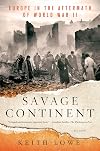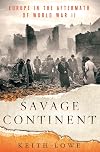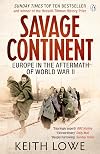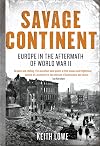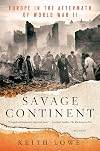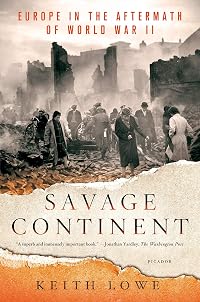
Savage continent : Europe in the aftermath of World War II
by Keith Lowe
On This Page
Description
Recounts the disorder in Europe after World War II, describing the brutal acts against Germans and collaborators, the anti-Semitic beliefs that reemerged, and the Allied-tolerated expulsions of citizens from their ancestral homelands.Tags
Recommendations

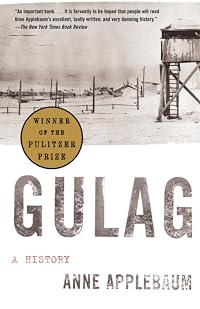
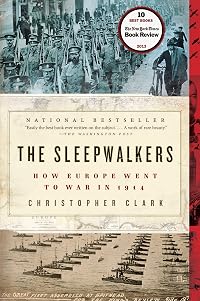
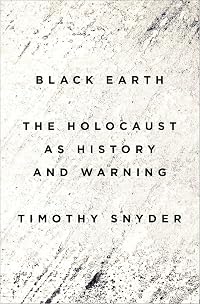
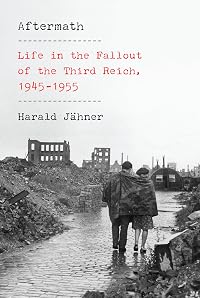




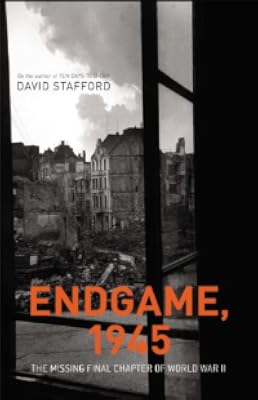
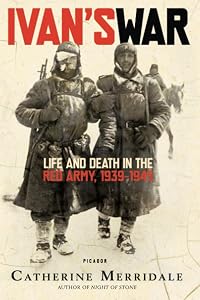
Member Recommendations

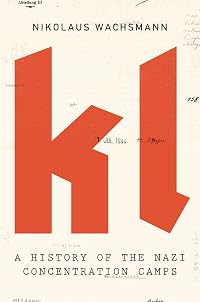
meggyweg This memoir by a woman who founded a Jewish orphanage in Poland immediately after the war shows quite a lot of the violence, tension and problems Lowe's book describes.
Member Reviews
World War II didn't end cleanly in 1945. The defeat of the Nazis occurred piecemeal in liberated territories from 1943 onwards, and stuttered forwards in civil war and internal purges for years after Hitler's death. While the Allied armies settled the key political question that fascism would not rule Europe, everything else was up in the air. So of course, after the war Europe came together as a community to ensure human rights and equality for all.
LOL, Nope. Europe faced massive challenges of rebuilding its shattered infrastructure, healing a traumatized population, and re-homing millions of displaced people. The refugee crisis was perhaps the first and largest problem. Most European cities had been wrecked by a combination of the show more combined bomber offensive and the Red Army. Millions of foreigners had been taken to Germany as forced laborers, and millions had fled their homes to escape the worst of war. Holocaust survivors found that they had no home to return to. Ethnic Germans had to flee areas where they had lived for centuries in Poland and Czechoslovakia. With agriculture and transit destroyed, famine ran rampant. In particularly grim comedy, gangs of orphans played with disused munitions, firing panzerfausts to see the bang. With millions on the move, and the economy and political system smashed, crime was omnipresent. Theft, sexual assault, and murder were so common as to be entirely unremarkable.
Occupied territory had to deal with a legacy of collaboration, and no one managed both a comprehensive and legally valid de-Nazification program. Nazi race laws had made Europeans newly aware of their mixed ethnicities, and particularly in Poland, Ukraine, and Yugoslavia, ethnic militias embarked on new programs of ethnic cleansing. Civil wars between Communists and rightist groups broke out in Greece and Italy, while Stalinist repression crushed Eastern Europe, particularly Romania and the Baltic states.
Lowe's thesis is that pretty much everybody was victim and perpetrator, often simultaneously. National mythmaking has served to cover up the ugly truths that most people collaborated, that ardent resistance fighters carried out crude and often deadly attacks on collaborators after the war, with women who slept with Germans suffering special abuse, and that these resistance fighters were then punished by the new governments as threats to resurgent state power. An accurate count of the dead is impossible, and revisionists on all sides have created outlandish figures of the dead, with right-wing parties who have uneasy ties to 1930s and 1940s fascist movements being at the forefront.
This is a heavy book, and as a continent-wide survey Lowe can't afford to dive too deeply in any moment. But he has a strong analytical frame, and manages to keep the grim material moving quickly. show less
LOL, Nope. Europe faced massive challenges of rebuilding its shattered infrastructure, healing a traumatized population, and re-homing millions of displaced people. The refugee crisis was perhaps the first and largest problem. Most European cities had been wrecked by a combination of the show more combined bomber offensive and the Red Army. Millions of foreigners had been taken to Germany as forced laborers, and millions had fled their homes to escape the worst of war. Holocaust survivors found that they had no home to return to. Ethnic Germans had to flee areas where they had lived for centuries in Poland and Czechoslovakia. With agriculture and transit destroyed, famine ran rampant. In particularly grim comedy, gangs of orphans played with disused munitions, firing panzerfausts to see the bang. With millions on the move, and the economy and political system smashed, crime was omnipresent. Theft, sexual assault, and murder were so common as to be entirely unremarkable.
Occupied territory had to deal with a legacy of collaboration, and no one managed both a comprehensive and legally valid de-Nazification program. Nazi race laws had made Europeans newly aware of their mixed ethnicities, and particularly in Poland, Ukraine, and Yugoslavia, ethnic militias embarked on new programs of ethnic cleansing. Civil wars between Communists and rightist groups broke out in Greece and Italy, while Stalinist repression crushed Eastern Europe, particularly Romania and the Baltic states.
Lowe's thesis is that pretty much everybody was victim and perpetrator, often simultaneously. National mythmaking has served to cover up the ugly truths that most people collaborated, that ardent resistance fighters carried out crude and often deadly attacks on collaborators after the war, with women who slept with Germans suffering special abuse, and that these resistance fighters were then punished by the new governments as threats to resurgent state power. An accurate count of the dead is impossible, and revisionists on all sides have created outlandish figures of the dead, with right-wing parties who have uneasy ties to 1930s and 1940s fascist movements being at the forefront.
This is a heavy book, and as a continent-wide survey Lowe can't afford to dive too deeply in any moment. But he has a strong analytical frame, and manages to keep the grim material moving quickly. show less
A difficult read, but an important one especially as Europe once again is at war - I write this in March 2022. This book painstakingly lays out the manner in which, for much of Europe, the surrender of Nazi Germany was only the cessation of part of the conflicts between peoples and ideologies. The hatreds and prejudices that helped give rise to fascism, communism, anti semitism, and ultra nationalism did not end with the end of the third reich. Their echoes resulted in almost unimaginable suffering for many years after the war and in many ways they are still reverberating today. One must be clear eyed about this - and this book is a good start even if I may have a few moral quibbles here and there. Recommended.
This book should be required reading for serious WWII historians. Lowe deals with a subject that is often glossed over....what happened (and how it has been mythologized) in the immediate aftermath of the war. "The story of Europe in the immediate postwar period is therefore not primarily one of reconstruction and rehabilitation - it is firstly a story of the descent into anarchy." Further, Lowe opens our eyes to how the story was not simply one of a local person supporting their state against the Nazi occupiers. That local person could also have been fighting wars against people of different religions, different ethnicities, against the government of the state, against other neighbors who might be of different political persuasions, show more etc. "The sheer variety of grievances that existed in 1945 demonstrates not only how universal the war had been, but also how inadequate is our traditional way of understanding it." This _IS_ a difficult book to read....both because of the subject matter and keeping track of the particular conflict Lowe is focusing on at the moment, and how that conflict relates to other conflicts. But that doesn't make it unreadable or not worth the time it takes to read it. Can't recommend highly enough. show less
”Imagine a world without institutions. It is a world where borders between countries seem to have dissolved, leaving a single, endless landscape over which people travel in search of communities that no longer exist. There are no governments any more, on either a national scale or even a local one. There are no schools or universities, no libraries or archives, no access to any information whatsoever. There is no cinema or theatre, and certainly no television. The radio occasionally works, but the signal is distant, and almost always in a foreign language. No one has seen a newspaper for weeks. There are no railways or motor vehicles, no telephones, or telegrams, no post office, no communication at all except what is passed through show more word of mouth. There are no banks, but that is no great hardship because money no longer has any worth. There are no shops, because no one has anything to sell… There is no food…Law and order are virtually non-existent, because there is no police force and no judiciary…Goods belong only to those who are strong enough to hold on to them…There is no shame. There is no morality. There is only survival.”
This is part of the introductory paragraph of Keith Lowe’s masterful book…wait, are you trying to guess? Is it a book about a dire apocalyptic future? Or maybe a book set on another planet in another galaxy? No, far from it. What Lowe is describing are the conditions in Europe at the end of World War II. This is an era that I never gave much thought to. I’ve read plenty of books, both fiction and non-fiction, that are set during World War II but practically nothing dealing with the conditions in Europe when the war ended. I found out that conditions were bleak, to say the least. Chaos reigned.
This book takes you step by step, from one country to another, through the city streets and countryside and describes in detail the prevailing conditions, how governments from near and from very far away, tried to right the sinking ship that was Europe in 1944-1950. Highlights include:
Entire generations of women were doomed to spinsterhood because there just weren’t enough men, most having been killed in the war.
Vagrant children presented a serious problem. In 1946 there were some 180,000 vagrant children living in Rome, Naples and Milan.
The need for revenge was great and women in Norway, France, Holland and other European countries, who had slept with German men, were treated especially harshly. They were rounded up into the village square, stripped and had their heads shaved so that everyone would know what their crime was. If they were unfortunate enough to have become pregnant, the village people would try to have the children taken away, except no other country would take them either.
As word of the end of the war spread, people came off of farms and out of factories and headed home, creating a veritable log jam on roads that had been decimated by bombs and artillery. “Swarms of refugees, speaking twenty different languages, were obliged to negotiate a transport network that had been bombed, mined, and neglected through six years of war.”
The displaced persons presented unique problems for those charged with repatriation. Because the war made the idea of uprooting individuals and transplanting them somewhere else the norm, this same model was used in the postwar years to move whole sections of the population as frail governments negotiated for borders that seemed to change with no regard for the people involved.
The book is only 400 pages long with lots of notes and source material at the end, but it is crammed with information about things that happened right after the war. Famine, looting and theft, the black market, rape (so much rape that it is unfathomable), slave laborers, the Jewish flight and the establishment of Israel, ethnic cleansing in Poland, Czechoslovakia and the Ukraine, civil war in Greece and the rise of Communism throughout Europe and the Cold War. The last hundred pages or so were fairly dry and I ended up skimming them but most of the book is very compelling and I haven’t learned so much from a book in a long time. Highly recommended. show less
This is part of the introductory paragraph of Keith Lowe’s masterful book…wait, are you trying to guess? Is it a book about a dire apocalyptic future? Or maybe a book set on another planet in another galaxy? No, far from it. What Lowe is describing are the conditions in Europe at the end of World War II. This is an era that I never gave much thought to. I’ve read plenty of books, both fiction and non-fiction, that are set during World War II but practically nothing dealing with the conditions in Europe when the war ended. I found out that conditions were bleak, to say the least. Chaos reigned.
This book takes you step by step, from one country to another, through the city streets and countryside and describes in detail the prevailing conditions, how governments from near and from very far away, tried to right the sinking ship that was Europe in 1944-1950. Highlights include:
Entire generations of women were doomed to spinsterhood because there just weren’t enough men, most having been killed in the war.
Vagrant children presented a serious problem. In 1946 there were some 180,000 vagrant children living in Rome, Naples and Milan.
The need for revenge was great and women in Norway, France, Holland and other European countries, who had slept with German men, were treated especially harshly. They were rounded up into the village square, stripped and had their heads shaved so that everyone would know what their crime was. If they were unfortunate enough to have become pregnant, the village people would try to have the children taken away, except no other country would take them either.
As word of the end of the war spread, people came off of farms and out of factories and headed home, creating a veritable log jam on roads that had been decimated by bombs and artillery. “Swarms of refugees, speaking twenty different languages, were obliged to negotiate a transport network that had been bombed, mined, and neglected through six years of war.”
The displaced persons presented unique problems for those charged with repatriation. Because the war made the idea of uprooting individuals and transplanting them somewhere else the norm, this same model was used in the postwar years to move whole sections of the population as frail governments negotiated for borders that seemed to change with no regard for the people involved.
The book is only 400 pages long with lots of notes and source material at the end, but it is crammed with information about things that happened right after the war. Famine, looting and theft, the black market, rape (so much rape that it is unfathomable), slave laborers, the Jewish flight and the establishment of Israel, ethnic cleansing in Poland, Czechoslovakia and the Ukraine, civil war in Greece and the rise of Communism throughout Europe and the Cold War. The last hundred pages or so were fairly dry and I ended up skimming them but most of the book is very compelling and I haven’t learned so much from a book in a long time. Highly recommended. show less
The immediate aftermath of WWII is an oft-glossed over historical moment that deserves much more attention. Lowe does a very thorough job of not only exploring how WWII was more than just the Axis v. Allies, Good v. Evil but instead a tangled chaotic mess of conflicts regarding nations, ethnicities, territory, and ideologies and these conflicts didn't end with V-E Day.
The importance of Lowe's work is in portraying how these little-known conflicts can be used by ideologues to "prove" historical culpability of those they oppose. When the numbers are removed from historical context and myths are allowed to become accepted fact, right-wing nationalists are able to encourage further prejudice against their targets. Lowe's use of statistics show more and narrative to explain how no one came out of WWII without blood on their hands is an important way history can be employed to fight back against extremism. show less
The importance of Lowe's work is in portraying how these little-known conflicts can be used by ideologues to "prove" historical culpability of those they oppose. When the numbers are removed from historical context and myths are allowed to become accepted fact, right-wing nationalists are able to encourage further prejudice against their targets. Lowe's use of statistics show more and narrative to explain how no one came out of WWII without blood on their hands is an important way history can be employed to fight back against extremism. show less
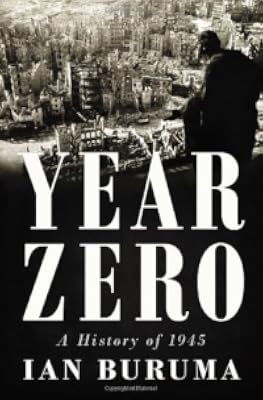
After the horror, more horrors still -- Keith Lowe's compelling book about Europe in the aftermath of WWII shows just how devastated the continent was, and how the devastation continued for months and years. His graphic descriptions make clear the extent to which physical and social structures were totally eradicated by VE Day. This left survivors without food, shelter, or any protection from other, stronger survivors -- women, being less likely to be armed, were prime targets. I found particularly telling his story of British observers who expected the sort of devastation they saw at home when they went to the continent, but saw something far, far worse -- unimaginably worse. And his narrative of events after the war shows the extent show more to which conflict persisted, in waves of crime, in civil wars, in ethnic cleansing, and all manner of violence in between. He buttresses the narrative with statistics, which he makes a serious attempt to evaluate, illustrating that claims of victimhood multiplied through and after the period. Eventually, the stories and numbers of expulsions, battles, and killings have a numbing effect. One might criticize Lowe's book for the absence of individual experiences of the horror, which might prevent the numbing: Ian Buruma's "Year Zero" does show the experiences of individuals, which may be why it is a more affecting read. But Lowe's book is intended to be general, not particular. It an attempt to show as accurately as possible the devastation that was Europe in 1945, and it succeeds. The only wonder is that most Europeans who lived through the war and the immediate postwar went on to rebuild societies, to have children, and to live what looked like normal lives. show less
For a person well read in the history of WW2 this book really exposed a huge gap in my own knowledge about the aftermath. In many ways it was worse for more people than the war itself. Who needs to read about the zombie apocalypse? Europe was the apocalypse defined and it was not pretty. The numbers in every realm of human suffering are more or less mind-blowing and hard to 'appreciate' (not that you really want to). Credit to the author for trying to humanize the story with little vignettes to illustrate the nature of the suffering but no one can describe the thousands, millions of lives ended, ruined or damaged without losing the reader completely. It seems he struck a good balance between overview and detail. The book could have show more easily been twice as long just trying to catalog the litany of suffering and vengeance but again there was enough to tell the 'story' while retaining readability. A fairly nice bibliography will allow readers to delve deeper if so interested. I emerged with more questions on the Greek Civil War. At the end you marvel that Europe was able to recover as it did which is a testimony itself to human resilience. show less
Members
- Recently Added By
Lists

Top Five Books of 2020
982 works; 350 members

Non-Fiction Worth Reading
1,016 works; 262 members

r/History Recommended Reading List
603 works; 12 members
Author Information

17 Works 1,542 Members
Keith Lowe was born in London in 1970. After travelling around the world for several years, he studies English Literature at Manchester University. He now works as a nonfiction editor in a UK publishing house. (Bowker Author Biography)
Some Editions
Awards and Honors
Awards
Distinctions
Notable Lists
Series
Belongs to Publisher Series
Work Relationships
Has as a student's study guide
Common Knowledge
- Canonical title
- Savage continent : Europe in the aftermath of World War II
- Original title
- Savage continent : Europe in the aftermath of World War II
- Original publication date
- 2012
- Important places
- European Theater of World War II
- Important events
- World War II
- Epigraph*
- Première partie
« Je pensais que vous seriez là, à m’attendre […]. Au lieu de quoi, j’ai été accueilli par la puanteur tenace des cendres et les trous béants de notre maison en ruine. »
Samuel Pute... (show all)rman, à son retour à Varsovie, en 1945
Première partie
« Nous pouvions constater la destruction matérielle, mais les effets des perturbations économiques, politiques et sociales à grande échelle et des ravages psychologiques de cinq années de refonte... (show all) de l’Europe en machine de guerre, sous la férule de Hitler, nous ont complètement échappé. »
Dean Acheson, sous-secrétaire d’État américain, 1947 - Dedication
- To Vera
- First words*
- Introduction
Imaginez un monde sans institutions. Un monde où les frontières entre pays semblent s’être dissoutes, en ne laissant qu’un paysage unique, infini, où les individus déambulent à la recherche de commun... (show all)autés disparues. Il n’existe plus de gouvernements, ni à l’échelle nationale ni même à l’échelon local. [...]
Première partie
L’héritage de la guerre
1
La destruction matérielle
En 1943, Karl Baedeker, l’éditeur de guides de voyage, publia un guide du Generalgouvernement – cette petite partie de la Polog... (show all)ne qui s’était vu accorder un semblant d’autonomie sous domination nazie. [...] - Original language*
- Anglais (Royaume-Uni) (Royaume-Uni)
*Some information comes from Common Knowledge in other languages. Click "Edit" for more information.
Classifications
Statistics
- Members
- 887
- Popularity
- 30,519
- Reviews
- 33
- Rating
- (4.14)
- Languages
- 12 — Czech, Dutch, English, Estonian, French, German, Greek, Italian, Norwegian (Bokmål), Polish, Portuguese (Portugal), Spanish
- Media
- Paper, Audiobook, Ebook
- ISBNs
- 35
- ASINs
- 11