
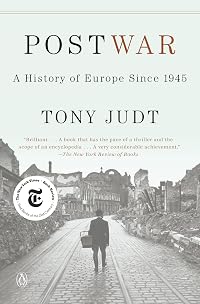
Postwar: A History of Europe Since 1945
by Tony Judt
On This Page
Description
The first truly European history of contemporary Europe, from Lisbon to Leningrad, based on research in six languages, covering 34 countries across 60 years, using a great deal of material from newly available sources. The book integrates international relations, domestic politics, ideas, social change, economic development, and culture--high and low--into a single grand narrative. Every country has its chance to play the lead, and although the big themes are handled--including the cold war, show more the love/hate relationship with America, cultural and economic malaise and rebirth, and the myth and reality of unification--none of them is allowed to overshadow the rich pageant that is the whole.--From publisher description. show lessTags
Recommendations




Member Recommendations


Member Reviews
Really great pacing, and maintains the difficult balance of emotional horror of various genocides and massacres while maintaining a journalistic gloss remove. Absolutely not a single good person in the whole 960 pages except for the people of Missouri who hated Winston Churchill's Iron Curtain speech and whatever writer managed to get the bare minimum of anti colonial language attached to the Marshall Plan. England comes out looking especially bad. Worse than I thought, if that is possible.
‘Postwar’ is one of those books that merits the term magisterial. It certainly demands commitment from the reader. A mere glance conveys its length, but I didn’t notice until I began reading that the text is also in an unusually small font. Thus my usual reading speed was much reduced, provoking the usual fears of forgetting how to read properly, brain decay, etc. The time it demands is nonetheless richly rewarded. Judt is a consummate synoptic writer. He covers a vast amount of ground and commands a huge array of material, synthesising a coherent narrative that nonetheless avoids becoming simplistic or reductive. I learned a great deal of substance from this history, while also finding his choices of focus fascinating.
As I am show more British and was taught history in the UK school system, my view of European history is highly Western-centric. Judt avoids this and achieves an excellent balance between East and West, while conceding the ambiguous and debatable limits of continental Europe. This is first and foremost a political history, with secondary economic and socio-cultural considerations. Thus it traces how the Iron Curtain came to divide Europe, the differences either side of it, the circumstances of its fall, and what succeeded it. I don’t think I’ve read such a detailed account before. Judt is admirably wary of generalisations and thus explains the differences in experiences of communism across different Eastern European countries, something I previously knew practically nothing about. Britain comes off as marginal and largely unimportant which, of course, it is. If only our political culture could begin to accept that. There were some resonances with a book I dismissed as ridiculous while reading it years ago: [b:Going South: Why Britain will have a Third World Economy by 2014|13721647|Going South Why Britain will have a Third World Economy by 2014|Larry Elliott|https://i.gr-assets.com/images/S/compressed.photo.goodreads.com/books/1344317052l/13721647._SY75_.jpg|19354448]. That argued Britain has been in economic decline since the 1870s which, despite the title’s hyperbole, does have some plausibility.
'Postwar' begins, of course, with the state of Europe immediately after the end of the Second World War. The portrait of a continent in ruins is vivid and horrifying. Some surprising paradoxes emerge: a vast amount of housing was destroyed, requiring decades of rebuilding. Yet Germany lost hardly any industrial machinery, facilitating an impressively swift economic recovery. Of the European countries (and Russia), only Britain and Germany suffered more military than civilian casualties. I’m sure that the British (English?) nostalgia for the ‘Blitz Spirit’ is influenced by this fact, which is also linked our not being invaded. One thing that stuck with me amongst the litany of disaster was the sheer number of refugees moving between European countries after the end of the war, numbering in the millions. And the fact that Germany’s currency was cigarettes, allowing American GIs to profit from arbitrage. Of course, it was also American money that helped Europe come back from complete collapse.
The broad structure of ‘Postwar’ is intriguing in itself. The four parts cover 1945-1953, 1953-1971, 1971-1989, and 1989-2005. I was surprised to find Judt much more interested in the 1970s than the 1960s. In general, he treats the 60s as a time of comfortable prosperity and cultural change in Europe, while not considering the 1968 upheavals as particularly transformative. He does not dispute that they had impacts, but devotes much more attention to the growing political and social cynicism of the 70s. I got the impression of Europe being complacent in the 60s, then losing its confidence in the 70s, both in the East and West. The subsequent account of how the USSR collapsed from within in 1989 is really moving. As in the rest of the book, Judt’s writing is clear, specific, and humane.
Two areas of history that I was particularly glad to learn more about were the Irish Troubles (which I shamefully have never read a whole book about) and the wars in Yugoslavia. Both had a vague and distant familiarity from the TV news during my childhood, yet I was too young and unaffected by them to understand what was actually happening. Judt provides elegant and thorough summaries, a reminder that postwar Europe has not been entirely peaceful. He also compares the sectarian violence in Ireland with that of ETA and German paramilitary organisations during the same period, something I hadn’t come across before. The complexity of Yugoslavia’s descent into multiple wars is difficult to explain given the web of historical, linguistic, and religious dynamics involved. I feel better informed, albeit probably not able to describe the conflicts to someone else.
While reading ‘Postwar’, my mind often strayed to the issue currently consuming UK politics in a collective nervous breakdown: Brexit. The genesis and somewhat erratic evolution of the EU is woven throughout the book, with the relationship between France and Germany presented as the greatest influence. It’s very ironic to read that Britain’s original interest in joining the European Community was purely economic, as it began as a customs union. Now the UK has a hopelessly fanatical government that refuses to contemplate Northern Ireland remaining in the European customs union, let alone Great Britain. Indeed, the government has just spent millions on an advertising campaign stating authoritatively that the UK will leave the EU in just over two weeks. On what terms? Who the fuck knows!
As ‘Postwar’ ends in 2005, it does not cover the financial crisis or its legacy of austerity across Europe. Searching for evidence of how it all came to this, however, still turned up highly relevant insights. On the EU as an institution:
This is striking to read in 2019. During the aftermath of the financial crisis, the European Central Bank definitely no longer relied entirely upon consent when it came to heavily indebted member states. I recall both Greece and Italy having their governments essentially replaced at the ECB’s behest. Both countries are more closely linked to the EU, and thus limited in their economic policy options, by the euro. Still, the UK is the only country to apparently think that leaving the EU would solve more problems than the myriad it would cause. I find it notable how rarely the idea is raised in British politics that we need to be in the EU whether we like it or not. On the continent, as Judt writes, this is taken for granted. Flawed as it is, the EU cannot be ignored and interacting with it somehow forms the only viable economic option on offer in the vicinity.
This passage also reads very differently now than it would have in 2005. It's rather bittersweet:
When the ECB subsequently wielded debt relief as an instrument of coercion, I think it demonstrated the continuing strength of Germany as the heart of the EU. National government remained instrumental, albeit in penalising other such governments.
By the time ‘Postwar’ was published, nationalist and neo-fascist parties with no policies beyond hysterical opposition were already rising in Western Europe, among them UKIP and the National Front in France. Judt presents these as in part the political heirs of communist parties before the fall of the USSR, while also linking them with growing wealth inequality and anti-immigrant and islamophobic racism. He points out that far-right parties have been able to wield influence disproportionate to their electoral support, which is how the UK ended up with the bloody referendum on EU membership in the first place. On Blair’s restriction of access to social security for immigrants:
Although this was not dissimilar to events across Western Europe, I think in the UK case at least part of the blame should be placed on the Murdoch-owned tabloid newspapers. Judt also comments on the EU’s encouragement of regionalism, which he explicitly links to the rise of Welsh and Scottish nationalist identification.
Perhaps the most immediately relevant part, though, reflects upon Britain’s toxic nostalgia, which I consider a major influence on Brexit:
While these quotations are all to be found in the last hundred pages of the book, the continuity with previous decades is shown beautifully. The final chapter is a stand alone essay on the centrality to European identity of remembering and memorialising the Holocaust. This implies that the English tendency to nostalgic forgetting represents a philosophical schism with the rest of Europe. When observing British politics in Autumn 2019, what’s in evidence from the government is this tendency at its most extreme, manifesting as Boris Johnson’s constant lies and contradictions or denials of previous statements. I found reading ‘Postwar’ much more enlightening as to what’s happening than following the livetweeted mayhem in real time. Judt recounts not just the legacy of the Second World War but how it has been remembered very differently across Europe, sometimes with destructive consequences. show less
As I am show more British and was taught history in the UK school system, my view of European history is highly Western-centric. Judt avoids this and achieves an excellent balance between East and West, while conceding the ambiguous and debatable limits of continental Europe. This is first and foremost a political history, with secondary economic and socio-cultural considerations. Thus it traces how the Iron Curtain came to divide Europe, the differences either side of it, the circumstances of its fall, and what succeeded it. I don’t think I’ve read such a detailed account before. Judt is admirably wary of generalisations and thus explains the differences in experiences of communism across different Eastern European countries, something I previously knew practically nothing about. Britain comes off as marginal and largely unimportant which, of course, it is. If only our political culture could begin to accept that. There were some resonances with a book I dismissed as ridiculous while reading it years ago: [b:Going South: Why Britain will have a Third World Economy by 2014|13721647|Going South Why Britain will have a Third World Economy by 2014|Larry Elliott|https://i.gr-assets.com/images/S/compressed.photo.goodreads.com/books/1344317052l/13721647._SY75_.jpg|19354448]. That argued Britain has been in economic decline since the 1870s which, despite the title’s hyperbole, does have some plausibility.
'Postwar' begins, of course, with the state of Europe immediately after the end of the Second World War. The portrait of a continent in ruins is vivid and horrifying. Some surprising paradoxes emerge: a vast amount of housing was destroyed, requiring decades of rebuilding. Yet Germany lost hardly any industrial machinery, facilitating an impressively swift economic recovery. Of the European countries (and Russia), only Britain and Germany suffered more military than civilian casualties. I’m sure that the British (English?) nostalgia for the ‘Blitz Spirit’ is influenced by this fact, which is also linked our not being invaded. One thing that stuck with me amongst the litany of disaster was the sheer number of refugees moving between European countries after the end of the war, numbering in the millions. And the fact that Germany’s currency was cigarettes, allowing American GIs to profit from arbitrage. Of course, it was also American money that helped Europe come back from complete collapse.
The broad structure of ‘Postwar’ is intriguing in itself. The four parts cover 1945-1953, 1953-1971, 1971-1989, and 1989-2005. I was surprised to find Judt much more interested in the 1970s than the 1960s. In general, he treats the 60s as a time of comfortable prosperity and cultural change in Europe, while not considering the 1968 upheavals as particularly transformative. He does not dispute that they had impacts, but devotes much more attention to the growing political and social cynicism of the 70s. I got the impression of Europe being complacent in the 60s, then losing its confidence in the 70s, both in the East and West. The subsequent account of how the USSR collapsed from within in 1989 is really moving. As in the rest of the book, Judt’s writing is clear, specific, and humane.
Two areas of history that I was particularly glad to learn more about were the Irish Troubles (which I shamefully have never read a whole book about) and the wars in Yugoslavia. Both had a vague and distant familiarity from the TV news during my childhood, yet I was too young and unaffected by them to understand what was actually happening. Judt provides elegant and thorough summaries, a reminder that postwar Europe has not been entirely peaceful. He also compares the sectarian violence in Ireland with that of ETA and German paramilitary organisations during the same period, something I hadn’t come across before. The complexity of Yugoslavia’s descent into multiple wars is difficult to explain given the web of historical, linguistic, and religious dynamics involved. I feel better informed, albeit probably not able to describe the conflicts to someone else.
While reading ‘Postwar’, my mind often strayed to the issue currently consuming UK politics in a collective nervous breakdown: Brexit. The genesis and somewhat erratic evolution of the EU is woven throughout the book, with the relationship between France and Germany presented as the greatest influence. It’s very ironic to read that Britain’s original interest in joining the European Community was purely economic, as it began as a customs union. Now the UK has a hopelessly fanatical government that refuses to contemplate Northern Ireland remaining in the European customs union, let alone Great Britain. Indeed, the government has just spent millions on an advertising campaign stating authoritatively that the UK will leave the EU in just over two weeks. On what terms? Who the fuck knows!
As ‘Postwar’ ends in 2005, it does not cover the financial crisis or its legacy of austerity across Europe. Searching for evidence of how it all came to this, however, still turned up highly relevant insights. On the EU as an institution:
The levers of the Union’s economic machinery depend for their efficiency upon the consent of all constituent parts. Where everyone more or less concurs on the principle and benefits of a given policy - on open internal borders, or unrestricted markets for goods and services - the EU has made remarkable progress. Where there is real dissent from a handful of members (or even just one, particularly if it is a major contributor), policy stalls: tax harmonisation, like the reduction in agricultural supports, has been on the agenda for decades.
This is striking to read in 2019. During the aftermath of the financial crisis, the European Central Bank definitely no longer relied entirely upon consent when it came to heavily indebted member states. I recall both Greece and Italy having their governments essentially replaced at the ECB’s behest. Both countries are more closely linked to the EU, and thus limited in their economic policy options, by the euro. Still, the UK is the only country to apparently think that leaving the EU would solve more problems than the myriad it would cause. I find it notable how rarely the idea is raised in British politics that we need to be in the EU whether we like it or not. On the continent, as Judt writes, this is taken for granted. Flawed as it is, the EU cannot be ignored and interacting with it somehow forms the only viable economic option on offer in the vicinity.
This passage also reads very differently now than it would have in 2005. It's rather bittersweet:
If a clearly articulated ‘European project’, describing the goals and institutions of the Union as they later evolved, had ever been put to the separate voters of the states of Western Europe it would surely have been rejected.
The advantage of the European project in the decades following World War Two had thus lain precisely in its imprecision. Like ‘growth’ or ‘peace’ - with both of which it was closely associated in the minds of its proponents - ‘Europe’ was too benign to attract effective opposition. [...]
For all its faults as a system of indirect government, the Union has certain interesting and original attributes. Decisions and laws may be passed at a transgovernmental level, but they are implemented by and through national authorities. Everything has to be undertaken by agreement, since there are no instruments of coercion: no EU tax collectors, no EU policemen. The European Union thus represents an unusual compromise: international governance undertaken by national governments.
When the ECB subsequently wielded debt relief as an instrument of coercion, I think it demonstrated the continuing strength of Germany as the heart of the EU. National government remained instrumental, albeit in penalising other such governments.
By the time ‘Postwar’ was published, nationalist and neo-fascist parties with no policies beyond hysterical opposition were already rising in Western Europe, among them UKIP and the National Front in France. Judt presents these as in part the political heirs of communist parties before the fall of the USSR, while also linking them with growing wealth inequality and anti-immigrant and islamophobic racism. He points out that far-right parties have been able to wield influence disproportionate to their electoral support, which is how the UK ended up with the bloody referendum on EU membership in the first place. On Blair’s restriction of access to social security for immigrants:
It says something about the mood of the time that a New Labour government with an overwhelming parliamentary majority and nearly 11 million voters in the 2001 election should nonetheless have been moved to respond in this was to the propaganda of a neo-Fascist clique [the BNP] which attracted the support of just 48,000 electors in the country at large.
Although this was not dissimilar to events across Western Europe, I think in the UK case at least part of the blame should be placed on the Murdoch-owned tabloid newspapers. Judt also comments on the EU’s encouragement of regionalism, which he explicitly links to the rise of Welsh and Scottish nationalist identification.
Perhaps the most immediately relevant part, though, reflects upon Britain’s toxic nostalgia, which I consider a major influence on Brexit:
In its place there emerged a country incapable of relating to its immediate past except through the unintentional irony of denial, or else as a sort of disinfected, disembodied ‘heritage’. [...] Thus the real, existing British railways were an acknowledged national scandal; but by the year 2000 Great Britain had more steam railways and steam-railway museums than all the rest of Europe combined: one hundred and twenty of them, ninety-one in England alone. Most of the trains don’t go anywhere, and even those that do manage to interweave reality and fantasy with a certain marvellous insouciance [...]
In contemporary England, then, history and fiction blend seamlessly. Industry, poverty, and class conflict have been officially forgotten and paved over. Deep social contrasts are denied or homogenised. And even the most recent and contested past is available only in nostalgic plastic reproduction. [...] The English capacity to plant and tend a Garden of Forgetting, fondly invoking the past while strenuously denying it, is unique.
While these quotations are all to be found in the last hundred pages of the book, the continuity with previous decades is shown beautifully. The final chapter is a stand alone essay on the centrality to European identity of remembering and memorialising the Holocaust. This implies that the English tendency to nostalgic forgetting represents a philosophical schism with the rest of Europe. When observing British politics in Autumn 2019, what’s in evidence from the government is this tendency at its most extreme, manifesting as Boris Johnson’s constant lies and contradictions or denials of previous statements. I found reading ‘Postwar’ much more enlightening as to what’s happening than following the livetweeted mayhem in real time. Judt recounts not just the legacy of the Second World War but how it has been remembered very differently across Europe, sometimes with destructive consequences. show less
If you ever wanted to understand today's Europe better, read this book. It is not a superficial history of postwar Western Europe, but covers all of Europe in some depth (as much as 900 pages will allow). Nor is it a simple political history, Judt covers cultural and social movements and changes as well.
But, beyond these things, the book is a joy to read. Judt is a wonderful writer with a sharp wit and deft wryness. Combined with his encyclopedic knowledge of European history, the resulting book is not one you will want to put down nor to end.
But, beyond these things, the book is a joy to read. Judt is a wonderful writer with a sharp wit and deft wryness. Combined with his encyclopedic knowledge of European history, the resulting book is not one you will want to put down nor to end.
Tony Judt's detailed monumental work (at over 800 pages) is well-written and well-organized. He begins by documenting the devastation in Europe following World War II. Post-war planning for Europe was informed by the knowledge that both Fascism and Communism thrived on social despair; ergo "the physical and moral condition of the citizenry [became] a matter of common interest [for both the victors and the vanquished] and therefore part of the responsibility of the state." Economic recovery was essential. A brutal winter in 1947 exacerbated the urgency. U.S. Secretary of State George C. Marshall's plan for a European Recovery program, proposed in the summer of 1947, helped avert a political crisis in Europe. It's real benefit, however, show more was psychological: "[The infusion of money and aid] helped [Europeans] break decisively with a legacy of chauvinism, depression and authoritarian solutions."
There was a continuing interest in Communism as a promising ideology throughout the world, especially until Krushchev's "secret speech" denouncing Stalin in February 1956. But as Judt observes, "enthusiasm for Communism in theory was characteristically present in inverse proportion to direct experience of it in practice." Moreover, the invasion of tanks into Hungary in November, 1956 "dispelled any illusions about this new, 'reformed' Soviet model." After 1956, Judt laments, "the Communist states of Eastern Europe, like the Soviet Union itself, began their descent into a decades-long twilight of stagnation, corruption and cynicism."
Judt adduces evidence to support his claim that when Communism fell in 1989 it was "Mr. Gorbachev's revolution." Not only did Gorbachev liberalize his own country, but he let it be known that he would not intervene in the internal politics of his colonies. Without the threat of military action from Moscow, there wasn't much to keep them in their antiquated inefficient systems. Much of the book is devoted to a detailed explanation of how each of the Eastern European countries went through the process of liberation.
Another helpful section outlines the concerns of the European Union, and just what membership means for both members and non-members. In a discussion of the culture of today's Europe, Judt speculates on the future of identity in Europe, with nationalism competing with Europeanism and now even with Islam.
His final chapter explores the nature of memory itself in Europe; in particular, how the different nations have negotiated the rocky shoals of Holocaust memory. As he emphasizes, "A nation has first to have remembered something before it can begin to forget it." For many nations, their complicity in Fascism is something they prefer not to acknowledge. He ends on a note of caution. "History," he believes, "does need to learned - and periodically re-learned. In a popular Soviet-era joke, a listener calls up 'Armenian Radio' with a question: 'Is it possible', he asks, 'to foretell the future?' Answer: 'Yes, no problem. We know exactly what the future will be. Our problem is with the past: that keeps changing.'" Therein, he writes, lies the challenge: we must keep renewing Europe's recent history: "If in years to come we are to remember why it seemed so important to build a certain sort of Europe out of the crematoria of Auschwitz, only history can help us."
(JAF) show less
There was a continuing interest in Communism as a promising ideology throughout the world, especially until Krushchev's "secret speech" denouncing Stalin in February 1956. But as Judt observes, "enthusiasm for Communism in theory was characteristically present in inverse proportion to direct experience of it in practice." Moreover, the invasion of tanks into Hungary in November, 1956 "dispelled any illusions about this new, 'reformed' Soviet model." After 1956, Judt laments, "the Communist states of Eastern Europe, like the Soviet Union itself, began their descent into a decades-long twilight of stagnation, corruption and cynicism."
Judt adduces evidence to support his claim that when Communism fell in 1989 it was "Mr. Gorbachev's revolution." Not only did Gorbachev liberalize his own country, but he let it be known that he would not intervene in the internal politics of his colonies. Without the threat of military action from Moscow, there wasn't much to keep them in their antiquated inefficient systems. Much of the book is devoted to a detailed explanation of how each of the Eastern European countries went through the process of liberation.
Another helpful section outlines the concerns of the European Union, and just what membership means for both members and non-members. In a discussion of the culture of today's Europe, Judt speculates on the future of identity in Europe, with nationalism competing with Europeanism and now even with Islam.
His final chapter explores the nature of memory itself in Europe; in particular, how the different nations have negotiated the rocky shoals of Holocaust memory. As he emphasizes, "A nation has first to have remembered something before it can begin to forget it." For many nations, their complicity in Fascism is something they prefer not to acknowledge. He ends on a note of caution. "History," he believes, "does need to learned - and periodically re-learned. In a popular Soviet-era joke, a listener calls up 'Armenian Radio' with a question: 'Is it possible', he asks, 'to foretell the future?' Answer: 'Yes, no problem. We know exactly what the future will be. Our problem is with the past: that keeps changing.'" Therein, he writes, lies the challenge: we must keep renewing Europe's recent history: "If in years to come we are to remember why it seemed so important to build a certain sort of Europe out of the crematoria of Auschwitz, only history can help us."
(JAF) show less
It is hard for words to do justice to the magisterial, comprehensive, insightful, and penetratingly insightful narrative of European history from 1945 to 2005 contained in this work.
It's a long book, full of detail, but yet highly readable. The author does well at contextualizing the history of Europe at that time in light of what had come before. The whole of Europe throughout this whole period is discussed.
The opening section on the immediate postwar events is extremely illuminating in order to understand all that happened since. It's hard to resist the author's conclusion that European peace was secured because the people were made to fit the borders (since there was mutually agreed upon ethnic cleansing, forcing minority groups to show more move across central and eastern Europe) after making borders around different people had failed (the attempted solution of 1919); this seems all the more prescient in light of the events of the past decade which have only reinforced the thesis.
The postwar boom period is also well contextualized, and again, recent events probably reinforce the thesis that it was a one-time flourishing in order to return to the level of wealth and status which existed before the 40 years of war and unrest.
The collapse of Communism is well detailed. Discussions of life after Communism in both West and East were fruitful, as was the emphasis on the European project. One acutely feels the loss of the author: one wishes to hear what he would have to say about how the European project has fared with the economic crash and the resurgence of nationalism of late.
The epilogue is an absolute must read, using the way the Holocaust was or wasn't remembered in Europe in different countries at different times as a way of discussing the difficulties of remembering and forgetting, and the times in which it is necessary to do either or both. We Americans can profit from that kind of exploration in light of our own heritage and how we remember and forget it.
An extremely valuable read. show less
It's a long book, full of detail, but yet highly readable. The author does well at contextualizing the history of Europe at that time in light of what had come before. The whole of Europe throughout this whole period is discussed.
The opening section on the immediate postwar events is extremely illuminating in order to understand all that happened since. It's hard to resist the author's conclusion that European peace was secured because the people were made to fit the borders (since there was mutually agreed upon ethnic cleansing, forcing minority groups to show more move across central and eastern Europe) after making borders around different people had failed (the attempted solution of 1919); this seems all the more prescient in light of the events of the past decade which have only reinforced the thesis.
The postwar boom period is also well contextualized, and again, recent events probably reinforce the thesis that it was a one-time flourishing in order to return to the level of wealth and status which existed before the 40 years of war and unrest.
The collapse of Communism is well detailed. Discussions of life after Communism in both West and East were fruitful, as was the emphasis on the European project. One acutely feels the loss of the author: one wishes to hear what he would have to say about how the European project has fared with the economic crash and the resurgence of nationalism of late.
The epilogue is an absolute must read, using the way the Holocaust was or wasn't remembered in Europe in different countries at different times as a way of discussing the difficulties of remembering and forgetting, and the times in which it is necessary to do either or both. We Americans can profit from that kind of exploration in light of our own heritage and how we remember and forget it.
An extremely valuable read. show less
Audaciously detailed. Tony Judt's eye for a plethora of social, economic and political indicators can be quite overwhelming when viewed in its entirety. I was tempted to constantly compare this book with works on contemporary history in India (a place I am more familiar with). Think Guha, (maybe Khilnani) et al. Guha's "India after Gandhi" - impressive as it is - tends to follow the political leadership a little too closely and this is something that Judt carefully avoids. For a book of this size, you'd think that there are bound to be some dull sections, but I couldn't find any. Judt is relentless in his effort to get under the skin of every major turn in Europe and just this keeps the narrative engaging.
Took me forever to read. At least 70 years…quite an amazing book. Thorough, detailed, insightful. The journey from the moving of borders after WW1 to the mass moving of people post WW2, the fall of communism, the rise of Europe, the long denial of the holocaust and the defeat of fascism always tenuous (now sadly born out) just an amazing book. It could only take it in small chunks. Much of it does not stick in my porous brain. But what does. Wow.
Members
- Recently Added By
Published Reviews
Tony Judt, Postwar: A History of Europe Since 1945 (2005). Judt’s epic history of postwar Europe reviews the political, social, and economic forces that shaped the continent’s evolution in the aftermath of World War II. The distinctive feature of Postwar is that it tells the story on both sides of the Iron Curtain, highlighting how Europe was caught between two superpowers. Postwar was a show more Pulitzer Prize finalist and received CFR’s Arthur Ross Book Award in 2006. show less
added by jasbro
Lists

The Guardian's 100 best books of the 21st century
100 works; 21 members

r/History Recommended Reading List
603 works; 12 members

r/AskHistorians' Recommended Books
1,068 works; 17 members

My List
302 works; 1 member

NYT 100 best books of 21st C
100 works; 31 members

.
184 works; 1 member
Author Information

Tony Judt was born in London, England on January 2, 1948. He was educated at King's College, Cambridge University and the École Normale Supérieure, Paris. He taught at numerous colleges and universities including Cambridge University; St. Anne's College, Oxford; the University of California, Berkeley and New York University. He was the author or show more editor off over fifteen books including Ill Fares the Land, Reappraisals: Reflections on the Forgotten Twentieth Century, and Postwar: A History of Europe Since 1945, which won the Council on Foreign Relations Arthur Ross Book Award. He was also a frequent contributor to numerous journals including The New York Review of Books, the Times Literary Supplement, The New Republic, and The New York Times. He was diagnosed with ALS in 2008. He died on August 6, 2010 at the age of 62. (Bowker Author Biography) show less
Some Editions
Awards and Honors
Awards
Distinctions
Notable Lists
Series
Belongs to Publisher Series
Work Relationships
Contains
Has as a commentary on the text
Common Knowledge
- Canonical title*
- Après guerre. Une histoire de l'Europe depuis 1945
- Original title
- Postwar: A History of Europe since 1945
- Original publication date
- 2005
- People/Characters
- Clement Attlee
- Important places
- Europe; Germany; United Kingdom
- Important events
- World War II; Cold War
- Epigraph*
- (Introduction)
« Toute époque est un sphinx qui plonge dans l’abîme sitôt l’énigme résolue. »
Heinrich Heine
(Introduction)
« Toute époque est un sphinx qui plonge dans l’abîme sitôt l’énigme résolue. »
Heinrich Heine
(Introduction)
« Les événements, mon cher, les événements. »
Harold Macmillan
(Introduction)
« L’histoire universelle n’est pas le lieu de la félicité.
Les périodes de bonheur y sont ses pages blanches. »
Georg Wilhelm Friedrich Hegel
(I)
(L’Héritage de la guerre)
« Ce n’est pas une lente décadence que le monde européanisé a connue ; d’autres civilisations ont chancelé et se sont effondrées ; la civilisation européenne... (show all) a été, pour ainsi dire, soufflée. »
H.G. Wells, War in the Air (1908)
(I)
(L’Héritage de la guerre)
« Personne n’a encore imaginé, encore moins regardé en face le problème humain que laissera la guerre derrière elle. Il n’y a jamais eu de telle destruction, d... (show all)e telle désintégration de la structure de la vie. »
Anne O’Hare McCormick
(I)
(L’Héritage de la guerre)
« Partout règne un désir ardent de miracles et de guérisons. La guerre a ramené les Napolitains au Moyen Âge. »
Norman Lewis, Naples’ 4... (show all)4 - Dedication*
- /
- First words*
- Préface et remerciements
L’Europe est le plus petit des continents. En vérité, elle n’est pas même un continent : un simple appendice sous-continental de l’Asie. L’Europe entière, à l’exclusion d... (show all)e la Russie et de la Turquie, comprend juste 5,5 millions de km2 : moins des deux tiers de la superficie du Brésil, à peine plus que la moitié de la Chine ou des États-Unis. [...]
Introduction
J’ai pris la décision d’écrire ce livre en changeant de train à la Westbahnhof, le principal terminus ferroviaire de Vienne. C’était en décembre 1989, un moment propice. Je rentrais de Pr... (show all)ague, où les dramaturges et historiens du Forum civique de Václav Havel délogeaient un État policier communiste et jetaient dans les poubelles de l’histoire quarante années de « socialisme réellement existant ». [...]
PREMIÈRE PARTIE
Après-guerre : 1945-1953
L’Europe, au lendemain de la Seconde Guerre mondiale, offrait un tableau de misère et de désolation absolues. Les photographies et les documentaires de lâ... (show all)€™époque montrent de pitoyables flots de civils démunis se traînant à travers un paysage dévasté de villes éventrées et de champs stériles. [...] - Original language
- English
- Canonical DDC/MDS
- 940.55
- Canonical LCC
- D1051
*Some information comes from Common Knowledge in other languages. Click "Edit" for more information.
Classifications
Statistics
- Members
- 3,510
- Popularity
- 4,693
- Reviews
- 49
- Rating
- (4.31)
- Languages
- 14 — Chinese, Czech, Dutch, English, Estonian, French, German, Hebrew, Italian, Polish, Portuguese, Slovak, Spanish, Turkish
- Media
- Paper, Audiobook, Ebook
- ISBNs
- 53
- ASINs
- 19