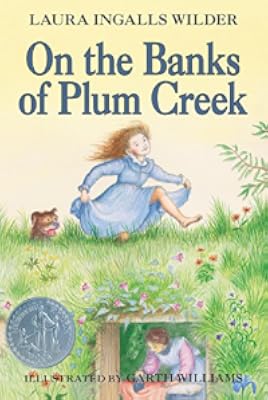
On the Banks of Plum Creek
by Laura Ingalls Wilder
Little House: The Laura Years (4), Little House Novels, Chronological Order (The Laura Years — book 19)
On This Page
Description
Laura and her family move to Minnesota where they live in a dugout until a new house is built and face misfortunes caused by flood, blizzard, and grasshoppers.Tags
Recommendations

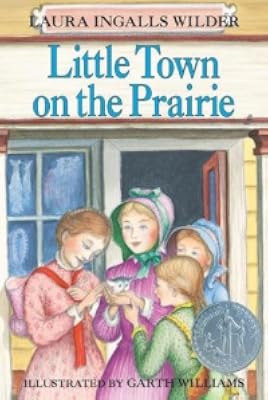
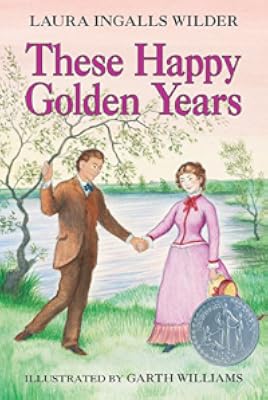
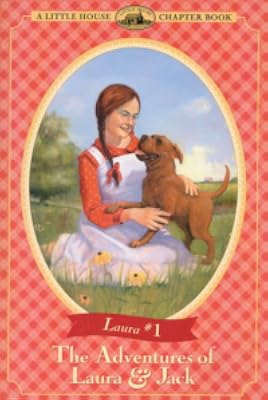
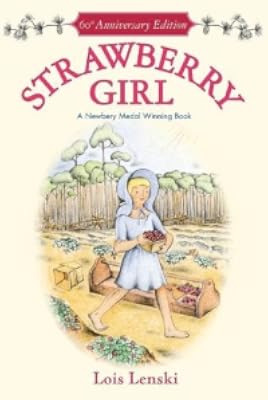
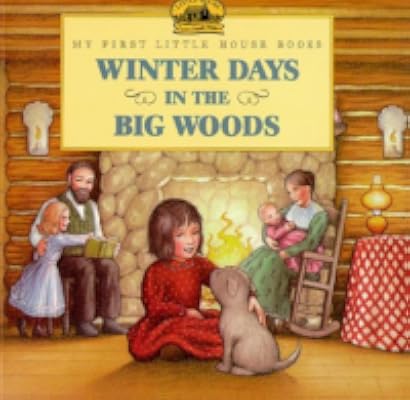



Member Recommendations

aspirit Tells of similar struggles in the same setting but from an Ojibwe perspective.
Member Reviews
I think I am getting into these now. Maybe it is because Laura is older and so has more detailed memories to draw on? Or maybe it is because they were somewhere with more other people to interact with? Or perhaps it is just that I am more numbed to prairie life than I was at the start, and instead of hitting ‘this is terrible’ I just hit ‘oh yes, another disaster that almost kills them all and leaves them destitute, but Laura has a nice fur muff.’
Pa continues to be infuriating. He is so full of love and charm and cleverness, singing and playing his fiddle, crafting things for the farm out of nothing. But really! ‘Yes, I will give you my entire farm for that wagon and two ponies’ ‘yay, great!’? It was foreshadowed very show more heavily by the author (‘yes, of course we can buy an entire new house on credit, living in a dugout is tedious, and we’ll be rich come the wheat harvest!’), but even without that it would hardly have been a great surprise that they are living somewhere where farming is Just A Bit Doomed. Ah, Pa.
They are nearer a town now, so we see Laura and Mary going to church and school. It was interesting to realise that even their contemporary Americans thought they were living a hard and miserable life - the town gets sent the equivalent of Christmas shoeboxes, by missionaries, for the ‘poor people’.
Laura is a bit less angelic with a bit more personality in this one. In fact, to my modern ears ‘this child is slightly greedy and snobbish, so it’s ok to trick her into getting covered in leeches’ is a bit awful!
I think this is the first time I’ve been keen to get to the next one. show less
Pa continues to be infuriating. He is so full of love and charm and cleverness, singing and playing his fiddle, crafting things for the farm out of nothing. But really! ‘Yes, I will give you my entire farm for that wagon and two ponies’ ‘yay, great!’? It was foreshadowed very show more heavily by the author (‘yes, of course we can buy an entire new house on credit, living in a dugout is tedious, and we’ll be rich come the wheat harvest!’), but even without that it would hardly have been a great surprise that they are living somewhere where farming is Just A Bit Doomed. Ah, Pa.
They are nearer a town now, so we see Laura and Mary going to church and school. It was interesting to realise that even their contemporary Americans thought they were living a hard and miserable life - the town gets sent the equivalent of Christmas shoeboxes, by missionaries, for the ‘poor people’.
Laura is a bit less angelic with a bit more personality in this one. In fact, to my modern ears ‘this child is slightly greedy and snobbish, so it’s ok to trick her into getting covered in leeches’ is a bit awful!
I think this is the first time I’ve been keen to get to the next one. show less
Another solid, unexpectedly enjoyable book in the series.
I got started on these late in life and did not expect to like them as much as I do.
Pa continues to be incredibly handy and thoughtful. How did he know that smoke was the way to combat a swarm of grasshoppers? It doesn't seem to have done him much good, but it seems that even air dropping DDT would not have saved his wheat once the hoppers showed up.
Ma shows more chops in this book, keeping the kids calm and the farm running when Pa was away working and then buried in snow for a few days.
Laura spends a lot of words on what Pa and Ma do, and describe her play, study, and some girl drama with Nellie Olson. She doesn't spend much time talking about her chores, though she must show more have had some and spend a fair bit of time on them.
Pioneers might have been tougher than we are, or they just had fewer options? I think a lot of my contemporaries would spiral into despair after the hoppers ate their wheat, leaving them broke, in debt, and with no immediate prospects for salvation. show less
I got started on these late in life and did not expect to like them as much as I do.
Pa continues to be incredibly handy and thoughtful. How did he know that smoke was the way to combat a swarm of grasshoppers? It doesn't seem to have done him much good, but it seems that even air dropping DDT would not have saved his wheat once the hoppers showed up.
Ma shows more chops in this book, keeping the kids calm and the farm running when Pa was away working and then buried in snow for a few days.
Laura spends a lot of words on what Pa and Ma do, and describe her play, study, and some girl drama with Nellie Olson. She doesn't spend much time talking about her chores, though she must show more have had some and spend a fair bit of time on them.
Pioneers might have been tougher than we are, or they just had fewer options? I think a lot of my contemporaries would spiral into despair after the hoppers ate their wheat, leaving them broke, in debt, and with no immediate prospects for salvation. show less
Ma, Pa, Laura, Mary, Carrie, and their bulldog Jack move to Minnesota this time, live in a sod house for a bit, then move into a new home built by Pa and a friendly neighbor. They live through a swarm of grasshoppers and several blizzards this time around, and Laura discovers leeches in a stagnant pond (*cringe*).
This is the book in the series that introduces us to the setting for the classic tv show, complete with Nellie Oleson and her bratty curls. I'm fascinated by how much more I can see in the story reading it as an adult. As a kid, I blindly loved the whole family (although Mary always struck me as too goody-goody), but now it's clear that Pa was probably always just a half step ahead of creditors and his poor life choices would show more be comical if they weren't so tragic. But Laura is still a girl I hugely identify with, just as I did as a kid, and I'm happy that Charlie is enjoying the series (although he's a much more sophisticated reader than I was and has few illusions about the wisdom of some of Pa's choices). show less
This is the book in the series that introduces us to the setting for the classic tv show, complete with Nellie Oleson and her bratty curls. I'm fascinated by how much more I can see in the story reading it as an adult. As a kid, I blindly loved the whole family (although Mary always struck me as too goody-goody), but now it's clear that Pa was probably always just a half step ahead of creditors and his poor life choices would show more be comical if they weren't so tragic. But Laura is still a girl I hugely identify with, just as I did as a kid, and I'm happy that Charlie is enjoying the series (although he's a much more sophisticated reader than I was and has few illusions about the wisdom of some of Pa's choices). show less
This one for me will always be The One With the Grasshoppers.
Said grasshoppers destroy the Ingalls’ wheat crop and smother their farm like a Biblical visitation. Worse, they stay. And lay millions of eggs.
Then one day they start marching on the ground, robotically, toward the west, finally taking their bows without so much as a by your leave.
Another bit that stamps itself in memory is the prairie fire that brings the “wheels of fire”, or burning tumbleweeds, that also beset the Ingalls home.
“On the Banks of Plum Creek” recounts hardships like the fires in “Little House On the Prairie” and the blizzards in “The Long Winter”, but it’s funnier than those books. This is never more so than when Pa comes out of his den show more within shouting distance of the house; also when the girls bring in too much firewood; and when Laura, having attended church, stops feeling wickedness for Nellie Oleson and feels merely a “little bit of mean gladness”.
The book also has the child-eye perspective that is so prominent in “Little House On Big Woods”. But in that book Laura saw things that, though they were brand new to her, she could at least name, like a lake, or a town. In this book she’s constantly seeing things she has no name for, as when she first sees a belfry (“a tiny room with no walls and nothing in it”), or a rug carpet (the “whole floor was covered with some kind of heavy cloth that felt rough under Laura’s bare feet”).
And a blackboard, chalk and eraser: "On the wall behind Teacher’s desk there was a smooth space of boards painted black. Under it was a little trough. Some kind of short, white sticks lay in the trough, and a block of wood with a woolly bit of sheepskin pulled tightly around it and nailed down. Laura wondered what those things were."
All of this would have been ruined if the adult author, leaving the child’s perspective, had named these things before Laura could work them out herself.
The book is constantly playing like this with perspective. We are never told what something is until we’re shown what it looked like to Laura – whether it’s the leeches that she finds on her legs after taking a swim, or the burning, spinning tumbleweeds, or that visiting swarm of locusts: "The cloud was hailing grasshoppers. The cloud was grasshoppers. Their bodies hid the sun and made darkness. Their thin, large wings gleamed and glittered. The rasping whirring of their wings filled the whole air and they hit the ground and the house with the noise of a hailstorm."
I read the last 170 pages of this book in one day, and I’m a slow reader.
One of the most enjoyable, and startling, reads I can remember.
This book has a few unique stamps on it, and I could have dubbed it The One With Walnut Grove; or The One With the Hobbit Hole; or The One Where Pa Hibernates Like a Bear.
But nothing beats those grasshoppers. show less
Said grasshoppers destroy the Ingalls’ wheat crop and smother their farm like a Biblical visitation. Worse, they stay. And lay millions of eggs.
Then one day they start marching on the ground, robotically, toward the west, finally taking their bows without so much as a by your leave.
Another bit that stamps itself in memory is the prairie fire that brings the “wheels of fire”, or burning tumbleweeds, that also beset the Ingalls home.
“On the Banks of Plum Creek” recounts hardships like the fires in “Little House On the Prairie” and the blizzards in “The Long Winter”, but it’s funnier than those books. This is never more so than when Pa comes out of his den show more within shouting distance of the house; also when the girls bring in too much firewood; and when Laura, having attended church, stops feeling wickedness for Nellie Oleson and feels merely a “little bit of mean gladness”.
The book also has the child-eye perspective that is so prominent in “Little House On Big Woods”. But in that book Laura saw things that, though they were brand new to her, she could at least name, like a lake, or a town. In this book she’s constantly seeing things she has no name for, as when she first sees a belfry (“a tiny room with no walls and nothing in it”), or a rug carpet (the “whole floor was covered with some kind of heavy cloth that felt rough under Laura’s bare feet”).
And a blackboard, chalk and eraser: "On the wall behind Teacher’s desk there was a smooth space of boards painted black. Under it was a little trough. Some kind of short, white sticks lay in the trough, and a block of wood with a woolly bit of sheepskin pulled tightly around it and nailed down. Laura wondered what those things were."
All of this would have been ruined if the adult author, leaving the child’s perspective, had named these things before Laura could work them out herself.
The book is constantly playing like this with perspective. We are never told what something is until we’re shown what it looked like to Laura – whether it’s the leeches that she finds on her legs after taking a swim, or the burning, spinning tumbleweeds, or that visiting swarm of locusts: "The cloud was hailing grasshoppers. The cloud was grasshoppers. Their bodies hid the sun and made darkness. Their thin, large wings gleamed and glittered. The rasping whirring of their wings filled the whole air and they hit the ground and the house with the noise of a hailstorm."
I read the last 170 pages of this book in one day, and I’m a slow reader.
One of the most enjoyable, and startling, reads I can remember.
This book has a few unique stamps on it, and I could have dubbed it The One With Walnut Grove; or The One With the Hobbit Hole; or The One Where Pa Hibernates Like a Bear.
But nothing beats those grasshoppers. show less
Pa Ingalls, you are a starry-eyed optimist. Always looking on the bright side. Grasshoppers destroy your wheat? No problem. Holes worn through your boots? No problem. Deadly blizzards nearly kill you? Still no problem.
How Caroline Ingalls kept from choking this man to death is beyond me. And she moved AGAIN when she didn't want to. Also, a baby pops up out of nowhere with barely a mention. However, this is one of my favorite books in the series because I fell in love with the idea of living in a dugout. In fact, I would go move into one right now. That's right, I'm a prairie gal. Sue me. I was sad when they moved into the real house. Plus, this book kills me because of everyone in this series, I love Jack the most.
To this day, I am show more terrified of a grasshopper plague and have thought through what I would do. Burn them. Burn them with fire. Thanks, Laura. 4 stars. show less
How Caroline Ingalls kept from choking this man to death is beyond me. And she moved AGAIN when she didn't want to. Also, a baby pops up out of nowhere with barely a mention. However, this is one of my favorite books in the series because I fell in love with the idea of living in a dugout. In fact, I would go move into one right now. That's right, I'm a prairie gal. Sue me. I was sad when they moved into the real house. Plus, this book kills me because of everyone in this series, I love Jack the most.
To this day, I am show more terrified of a grasshopper plague and have thought through what I would do. Burn them. Burn them with fire. Thanks, Laura. 4 stars. show less
This one for me will always be The One With the Grasshoppers.
Said grasshoppers destroy the Ingalls’ wheat crop and smother their farm like a Biblical visitation. Worse, they stay. And lay millions of eggs.
Then one day they start marching on the ground, robotically, toward the west, finally taking their bows without so much as a by your leave.
Another bit that stamps itself in memory is the prairie fire that brings the “wheels of fire”, or burning tumbleweeds, that also beset the Ingalls home.
“On the Banks of Plum Creek” recounts hardships like the fires in “Little House On the Prairie” and the blizzards in “The Long Winter”, but it’s funnier than those books. This is never more so than when Pa comes out of his den show more within shouting distance of the house; also when the girls bring in too much firewood; and when Laura, having attended church, stops feeling wickedness for Nellie Oleson and feels merely a “little bit of mean gladness”.
The book also has the child-eye perspective that is so prominent in “Little House On Big Woods”. But in that book Laura saw things that, though they were brand new to her, she could at least name, like a lake, or a town. In this book she’s constantly seeing things she has no name for, as when she first sees a belfry (“a tiny room with no walls and nothing in it”), or a rug carpet (the “whole floor was covered with some kind of heavy cloth that felt rough under Laura’s bare feet”).
And a blackboard, chalk and eraser: "On the wall behind Teacher’s desk there was a smooth space of boards painted black. Under it was a little trough. Some kind of short, white sticks lay in the trough, and a block of wood with a woolly bit of sheepskin pulled tightly around it and nailed down. Laura wondered what those things were."
All of this would have been ruined if the adult author, leaving the child’s perspective, had named these things before Laura could work them out herself.
The book is constantly playing like this with perspective. We are never told what something is until we’re shown what it looked like to Laura – whether it’s the leeches that she finds on her legs after taking a swim, or the burning, spinning tumbleweeds, or that visiting swarm of locusts: "The cloud was hailing grasshoppers. The cloud was grasshoppers. Their bodies hid the sun and made darkness. Their thin, large wings gleamed and glittered. The rasping whirring of their wings filled the whole air and they hit the ground and the house with the noise of a hailstorm."
I read the last 170 pages of this book in one day, and I’m a slow reader.
One of the most enjoyable, and startling, reads I can remember.
This book has a few unique stamps on it, and I could have dubbed it The One With Walnut Grove; or The One With the Hobbit Hole; or The One Where Pa Hibernates Like a Bear.
But nothing beats those grasshoppers. show less
Said grasshoppers destroy the Ingalls’ wheat crop and smother their farm like a Biblical visitation. Worse, they stay. And lay millions of eggs.
Then one day they start marching on the ground, robotically, toward the west, finally taking their bows without so much as a by your leave.
Another bit that stamps itself in memory is the prairie fire that brings the “wheels of fire”, or burning tumbleweeds, that also beset the Ingalls home.
“On the Banks of Plum Creek” recounts hardships like the fires in “Little House On the Prairie” and the blizzards in “The Long Winter”, but it’s funnier than those books. This is never more so than when Pa comes out of his den show more within shouting distance of the house; also when the girls bring in too much firewood; and when Laura, having attended church, stops feeling wickedness for Nellie Oleson and feels merely a “little bit of mean gladness”.
The book also has the child-eye perspective that is so prominent in “Little House On Big Woods”. But in that book Laura saw things that, though they were brand new to her, she could at least name, like a lake, or a town. In this book she’s constantly seeing things she has no name for, as when she first sees a belfry (“a tiny room with no walls and nothing in it”), or a rug carpet (the “whole floor was covered with some kind of heavy cloth that felt rough under Laura’s bare feet”).
And a blackboard, chalk and eraser: "On the wall behind Teacher’s desk there was a smooth space of boards painted black. Under it was a little trough. Some kind of short, white sticks lay in the trough, and a block of wood with a woolly bit of sheepskin pulled tightly around it and nailed down. Laura wondered what those things were."
All of this would have been ruined if the adult author, leaving the child’s perspective, had named these things before Laura could work them out herself.
The book is constantly playing like this with perspective. We are never told what something is until we’re shown what it looked like to Laura – whether it’s the leeches that she finds on her legs after taking a swim, or the burning, spinning tumbleweeds, or that visiting swarm of locusts: "The cloud was hailing grasshoppers. The cloud was grasshoppers. Their bodies hid the sun and made darkness. Their thin, large wings gleamed and glittered. The rasping whirring of their wings filled the whole air and they hit the ground and the house with the noise of a hailstorm."
I read the last 170 pages of this book in one day, and I’m a slow reader.
One of the most enjoyable, and startling, reads I can remember.
This book has a few unique stamps on it, and I could have dubbed it The One With Walnut Grove; or The One With the Hobbit Hole; or The One Where Pa Hibernates Like a Bear.
But nothing beats those grasshoppers. show less
It's easy to get so stuck on the subject matter of the stories Wilder tells that we fail to notice her brilliant, deceptively quiet writing. Her descriptions of scenery are gorgeous, of course; but I love the tiny sentences that tell so much, like this one when eight-year-old Mary and seven-year-old Laura are confronted by a wild herd of cattle:
Mary was too scared to move. Laura was too scared to stand still.
Or similarly simple descriptions of the girls waiting for their mother to come home:
The house was empty and still, with Ma gone. Ma was so quiet and gentle that she never made any noise, but now the whole house was listening for her.
Wilder understood that the impersonal forces of nature are far more frightening than any imagined show more monsters, because nature doesn't care and so it can't be pleaded with or placated. When it destroys life, it's not being cruel or even indifferent. It simply is. As Laura learns when she thinks she can play safely in the creek after a strong rain:
The coldness soaked into her. This was not like wolves or cattle. The creek was not alive. It was only strong and terrible and never stopping. It would pull her down and whirl her away, rolling and tossing her like a willow branch. It would not care.
Later, safe at home, Laura reflects:
The creek would go down. It would be a gentle, pleasant place to play in again. But nobody could make it do that. Nobody could make it do anything. Laura knew now that there were things stronger than anybody. But the creek had not got her. It had not made her scream and it could not make her cry.
I hate it when people think that writing for children is limiting and limited. Laura Ingalls Wilder wrote for the entire world, or at least those members of the world who enjoy being captured and held willing prisoner by a story. She just happened to remember that children are an integral part of that group. show less
Mary was too scared to move. Laura was too scared to stand still.
Or similarly simple descriptions of the girls waiting for their mother to come home:
The house was empty and still, with Ma gone. Ma was so quiet and gentle that she never made any noise, but now the whole house was listening for her.
Wilder understood that the impersonal forces of nature are far more frightening than any imagined show more monsters, because nature doesn't care and so it can't be pleaded with or placated. When it destroys life, it's not being cruel or even indifferent. It simply is. As Laura learns when she thinks she can play safely in the creek after a strong rain:
The coldness soaked into her. This was not like wolves or cattle. The creek was not alive. It was only strong and terrible and never stopping. It would pull her down and whirl her away, rolling and tossing her like a willow branch. It would not care.
Later, safe at home, Laura reflects:
The creek would go down. It would be a gentle, pleasant place to play in again. But nobody could make it do that. Nobody could make it do anything. Laura knew now that there were things stronger than anybody. But the creek had not got her. It had not made her scream and it could not make her cry.
I hate it when people think that writing for children is limiting and limited. Laura Ingalls Wilder wrote for the entire world, or at least those members of the world who enjoy being captured and held willing prisoner by a story. She just happened to remember that children are an integral part of that group. show less
Members
- Recently Added By
Lists

Favorite Childhood Books
1,651 works; 515 members
1001 Children's Books You Must Read Before You Grow Up
774 works; 101 members

Best Newbery Honor Books
257 works; 31 members
NPRs Ultimate Backseat Bookshelf: 100 Must-Reads for kids 9-14
222 works; 30 members

Best Family Stories
241 works; 22 members

Childhood Favorites
427 works; 23 members
Honey For a Child's Heart
1,152 works; 25 members

Sonlight Books
1,487 works; 25 members

Books About Girls
219 works; 17 members

Books about Frontier Life and Pioneers
55 works; 7 members

Elevenses
316 works; 88 members
Ambleside Books
459 works; 18 members

Female Protagonist
1,056 works; 57 members

Bibliography for How to be a Heroine
148 works; 12 members

Literature of Honor for Boys
91 works; 3 members

4th Grade Books
312 works; 5 members

Newbery Honor Books By Year - I - 1922-1980
199 works; 3 members
One-room schools -- children's/young adult fiction
52 works; 5 members

Romalda Spalding's Writing Road To Reading
213 works; 3 members

Books We Loved As Children
603 works; 252 members

Books Read in 2023
5,638 works; 145 members

HMS: Make Your Child a Lover of Books, Ages 7-9
52 works; 2 members

The Playful Pioneers
166 works; 1 member

Ambleside Year 3
47 works; 1 member
Our Favorite Banned Books
138 works; 122 members

Books I've Read More Than Once
602 works; 49 members
Children's Literature 1900 - 1950 in order
413 works; 8 members

American Lit for Eng 11 Research Project
368 works; 6 members

A Rainbow of Books: Colors in the Title
570 works; 24 members

Ambleside Y3
36 works; 1 member

Books With Water Words in the Title
186 works; 12 members

1930s
262 works; 5 members

In or About the 1930s
198 works; 27 members
Female Author
1,234 works; 64 members
Historical Fiction
889 works; 91 members

Allie's Favourite 150 Books
145 works; 3 members
The Five Books That Represent Us
391 works; 148 members
Author Information

189+ Works 152,725 Members
Wilder was born near Pepin, Wisconsin; attended school in DeSmet, South Dakota; and became a teacher before she was 16, teaching for seven years in Dakota Territory schools. She and her husband, Almanzo Wilder, farmed near DeSmet for about nine years and then moved to Mansfield, Missouri, where they lived out the rest of their days. Wilder did not show more write her first book, Little House in the Big Woods, about her early years in Wisconsin, until late in life, on the urging of her daughter, Rose Wilder Lane. It was first published in 1932. She followed this with Farmer Boy (1933), a book about her husband's childhood in New York State. She then completed a series of books about her life as she and her family moved westward along the frontier. Little House on the Prairie (1935) records the family's move to Kansas. On the Banks of Plum Creek (1937) describes the family's move to Minnesota. By the Shores of Silver Lake (1939) records the family's move to South Dakota, as do the final three books in the series: The Long Winter, Little Town on the Prairie (1941), and These Happy Golden Years (1943), which ends with her marriage to Almanzo Wilder. Three of Wilder's books were published posthumously: On the Way Home, a diary of her trip to Mansfield; The First Four Years, an unfinished book about her first four years of marriage; and West from Home, letters she wrote on a visit to her daughter in San Francisco, none of them up to the quality of her earlier books. At her best, Wilder employs a clear, simple style, a wealth of fascinating detail, and a straightforward narrative style. Her tales of a strong, traditional frontier family that endures the hardships of the late eighteenth century are seen through the eyes of a child, which endears them to young readers. Her work is possibly the best example of historical realistic fiction for children. (Bowker Author Biography) show less
Some Editions
Awards and Honors
Awards
Notable Lists
Series

Little House: The Laura Years
9 works (4)

Little House Novels, Chronological Order
4 works (The Laura Years — book 19)
Belongs to Publisher Series
Work Relationships
Is contained in
La petite maison de la prairie : Coffret 3 volumes : Tome 1, La petite maison de la prairie ; Tome 2, Au bord du ruisseau ; Tome 3, Sur les rives du lac by Laura Ingalls Wilder
By the Shores of Silver Lake/Farmer Boy/The First Four Years/Little House in the Big Woods/Little Town on the Prairie/The Long Winter/On the Banks of Plum Creek/These Happy Golden Years by Laura Ingalls Wilder
Common Knowledge
- Canonical title
- On the Banks of Plum Creek
- Original title
- On the Banks of Plum Creek
- Original publication date
- 1937 (1e édition originale américaine, Harper & Row) (1e édition originale américaine, Harper & Row); 1978 (1e traduction et édition français, Bibliothèque du Chat Perché, Flammarion) (1e traduction et édition français, Bibliothèque du Chat Perché, Flammarion)
- People/Characters
- Carrie Ingalls; Mary Ingalls; Charles Ingalls; Caroline Quiner Ingalls; Laura Ingalls Wilder; Eva Beadle (show all 7); Nellie Oleson
- Important places
- Plum Creek, Minnesota, USA
- First words
- The dim wagon track went no farther on the prairie, and Pa stopped the Horses.
- Last words
- (Click to show. Warning: May contain spoilers.)"Look, Caroline," he said, "how Laura's eyes are shining."
- Original language
- English
Classifications
- Genres
- Children's Books, Fiction and Literature
- DDC/MDS
- 813.52 — Literature & rhetoric American literature in English American fiction in English 1900-1999 1900-1945
- LCC
- PZ7 .W6461 .O — Language and Literature Fiction and juvenile belles lettres Fiction and juvenile belles lettres Juvenile belles lettres
- BISAC
Statistics
- Members
- 13,367
- Popularity
- 581
- Reviews
- 112
- Rating
- (4.13)
- Languages
- 16 — Chinese, Czech, Danish, Dutch, English, Finnish, French, German, Indonesian, Italian, Japanese, Norwegian (Bokmål), Norwegian, Portuguese, Spanish, Swedish
- Media
- Paper, Audiobook, Ebook
- ISBNs
- 104
- UPCs
- 2
- ASINs
- 76