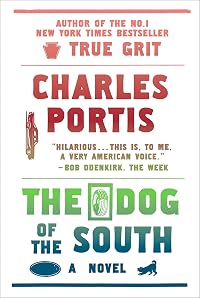
The Dog of the South
by Charles Portis
On This Page
Description
Charles Portis has drawn widespread critical acclaim for his inventive prose. In The Dog of the South, Ray Midge is on the trail of his wife Norma, who's headed for Mexico with her ex-husband. On the way Ray meets the eccentric Dr. Reo Symes, a man with more get-rich-quick schemes than common sense. Together, they'll have to overcome tropical storms, grifters, and plenty of car trouble en route to their destination-wherever that may be.Tags
Recommendations































Member Reviews
I love this book. This is my second time reading it and it's one of the oddest, funniest books I have ever read. Ray Midge's wife has run off with Dupree, Ray's former friend and coworker. Ray uses his American Express statements to track them down, mostly because they have his car and they have left him with Dupree's vastly inferior car. Along the way, Ray meets Dr. Reo Symes, a quack doctor whose mother, "so old she is starting to walk sideways", runs a Christian mission in Belize.I think the secret to this book is that Ray, the narrator, is annoying and pedantic and it's no surprise that Norma would leave him, but Ray is the least annoying person in the book, so he becomes a hero by default.
Often I read a book that I've owned for years and then, because it's so good, I wonder why I waited so long to read it. One such book is “The Dog of the South” (1979) by Charles Portis.
Portis is best known for “True Grit,” his only western as far as I know. There are certain similarities. Both are journey novels about one person's search for another. Both are filled with colorful characters and incidents so wild and improbable that they ring true.
“The Dog of the South” is narrated by Ray Midge, a 26-year-old college student from Arkansas with a passion for military history, especially Civil War battles, but not much ambition. When Norma, his wife, runs off with another man and, perhaps worse, his prized car, Midge takes off show more in pursuit by following the credit card receipts. (She also took his credit cards.)
The chase eventually leads through Mexico to Belize, but as with life itself, it's all about the journey. He travels most of the way with Dr. Symes, a talkative, opinionated man also bound for Belize. The doctor, who lost his medical license years before, has a million get-rich-quick schemes, but to pull any of them off he needs control of an island owned by his mother, who runs a mission for children in Belize. The main focus of this mission seems to be showing old movies featuring Tarzan or whomever to those children. She and the woman who lives with her turn out to be as talkative and opinionated as Dr. Symes.
All this is hilarious as Midge describes it. And in the end, it all seems pointless. And yet one gathers this may be the highlight of his life. He chose to write it all down, after all. It's about the journey, not the destination — the searching more than the finding. show less
Portis is best known for “True Grit,” his only western as far as I know. There are certain similarities. Both are journey novels about one person's search for another. Both are filled with colorful characters and incidents so wild and improbable that they ring true.
“The Dog of the South” is narrated by Ray Midge, a 26-year-old college student from Arkansas with a passion for military history, especially Civil War battles, but not much ambition. When Norma, his wife, runs off with another man and, perhaps worse, his prized car, Midge takes off show more in pursuit by following the credit card receipts. (She also took his credit cards.)
The chase eventually leads through Mexico to Belize, but as with life itself, it's all about the journey. He travels most of the way with Dr. Symes, a talkative, opinionated man also bound for Belize. The doctor, who lost his medical license years before, has a million get-rich-quick schemes, but to pull any of them off he needs control of an island owned by his mother, who runs a mission for children in Belize. The main focus of this mission seems to be showing old movies featuring Tarzan or whomever to those children. She and the woman who lives with her turn out to be as talkative and opinionated as Dr. Symes.
All this is hilarious as Midge describes it. And in the end, it all seems pointless. And yet one gathers this may be the highlight of his life. He chose to write it all down, after all. It's about the journey, not the destination — the searching more than the finding. show less
This is one of those books that will make you shake your head in wonder at how much contemporary fiction is dull, lifeless trash, just because it's so subtle and hilarious that to admire its virtues is to bring the flaws of others into sharp contrast by implication. Portis is really clever about a lot of the things he does in this book, from the dialogue to the characters to the plot, but one thing that I didn't get until about halfway through the book was how much attention he paid to its structure: it's not just a simple litany of failure, it's a fractal of failure! Not only is the protagonist Ray Midge's main quest ultimately unsuccessful, but literally every single smaller aspect of it is too; absolutely nothing that anyone does in show more the entire course of the book succeeds at all. Midge's wife has run off to Central America with his car and one of his journalist coworkers; the car he drives down down after them tries to fall apart about once a chapter; when he talks to other people nobody listens to him; he never knows the answer to any questions he's asked; no one, not even his wife, remembers his name; he never has any money or cigarettes or a camera or anything useful; he has no friends; and even children don't really respect him. He's a total loser and everything about him is a drag, but it's impossible not to laugh whenever he ends up trapped in deadly unproductive non-conversations with someone like his passenger Doc Symes, a huckster failure on an even grander scale than he is. We've all met people who aggressively don't care about the routinized niceties of conversations, but Midge is such a chump that people talk over him and interrogate him for basically the entire book without him being able to do anything about it.
It's interesting to speculate on how much of the Midge character's personality is Portis himself - Portis was trained as a journalist (filling Karl Marx's old shoes at the New York Herald-Tribune, no less!) and from the few personal accounts of him that exist he seems to share a number of the more positive character traits with the quiet, nerdy, car- and Civil War-obsessed "star" of the book. There are some sly jokes about his own profession of writing, as Doc Symes keeps raving about an obscure Southern author who writes all of his books from the interior of a bus. But only a first-rate author with a rare gift for comic timing could tell the tale of this mope on a mission with such amazing dry humor. It's hard to quote good examples of the type of comedy Portis uses since it's so understated and subtle, but the cumulative effect on those who can visualize just how ridiculous these scenes would be in real life is tremendous; by the end of the book I was practically laughing out loud each time Midge couldn't catch a break.
I would compare its sense of humor somewhat to A Confederacy of Dunces, but with a little less slapstick and with a little more outright cruelty than is shown to the invincibly obese New Orleaner. If you've read True Grit (or seen it, since it's basically the same thing), then you should expect a somewhat different novel: a larger cast of characters, more sly about its action, but funnier and more relatable. There are plenty of great satires on religion and and relationships and all sorts of aspects of the human condition buried in this book, down to the most minute detail; you just have to keep a sharp eye for them. His ear for dialogue is absolutely flawless, and especially if you've grown up in the South you won't be able to avoid hearing the characters speak to you as if they were right in front of you. It's a real trick to tell a smart story with a dumb narrator, and Portis absolutely aces it here. show less
It's interesting to speculate on how much of the Midge character's personality is Portis himself - Portis was trained as a journalist (filling Karl Marx's old shoes at the New York Herald-Tribune, no less!) and from the few personal accounts of him that exist he seems to share a number of the more positive character traits with the quiet, nerdy, car- and Civil War-obsessed "star" of the book. There are some sly jokes about his own profession of writing, as Doc Symes keeps raving about an obscure Southern author who writes all of his books from the interior of a bus. But only a first-rate author with a rare gift for comic timing could tell the tale of this mope on a mission with such amazing dry humor. It's hard to quote good examples of the type of comedy Portis uses since it's so understated and subtle, but the cumulative effect on those who can visualize just how ridiculous these scenes would be in real life is tremendous; by the end of the book I was practically laughing out loud each time Midge couldn't catch a break.
I would compare its sense of humor somewhat to A Confederacy of Dunces, but with a little less slapstick and with a little more outright cruelty than is shown to the invincibly obese New Orleaner. If you've read True Grit (or seen it, since it's basically the same thing), then you should expect a somewhat different novel: a larger cast of characters, more sly about its action, but funnier and more relatable. There are plenty of great satires on religion and and relationships and all sorts of aspects of the human condition buried in this book, down to the most minute detail; you just have to keep a sharp eye for them. His ear for dialogue is absolutely flawless, and especially if you've grown up in the South you won't be able to avoid hearing the characters speak to you as if they were right in front of you. It's a real trick to tell a smart story with a dumb narrator, and Portis absolutely aces it here. show less
I don’t know if the opening line of The Dog of the South has ever been included in any of those “Best First Line” lists, but it’s worthy:
“My wife Norma had run off with Guy Dupree and I was waiting
around for the credit card billings to come in so I could see where
they had gone.”
We know what happened and what’s going to happen - it’s just a matter of getting there now.
The narrator, Ray Midge, a self-described “predatory bird” look-alike who “can expect to be called a rat about three times a year” proceeds to track Norma and Guy Dupree through Texas, to Mexico, and finally to British Honduras (now Belize). As the first line suggests, Midge is a man of measured action. Instead of leading into the half-expected show more violence, The Dog of the South is a story of subtle humor. Along the way Midge runs into several eccentrics, including the shady Dr. Reo Symes, who dispenses such medical wisdom as “You’ll never find a red-headed person in a nuthouse.”
As well as creating nuanced characters, Charles Portis can turn a phrase. A woman that finds herself in a hospital cheers up the sick “in the confident manner of a draft-dodger athlete signing autographs for mutilated soldiers.” The Dog of the South smolders with outstanding writing. I’m keeping it close because I know it’s going to be on my mind until I read it again. show less
“My wife Norma had run off with Guy Dupree and I was waiting
around for the credit card billings to come in so I could see where
they had gone.”
We know what happened and what’s going to happen - it’s just a matter of getting there now.
The narrator, Ray Midge, a self-described “predatory bird” look-alike who “can expect to be called a rat about three times a year” proceeds to track Norma and Guy Dupree through Texas, to Mexico, and finally to British Honduras (now Belize). As the first line suggests, Midge is a man of measured action. Instead of leading into the half-expected show more violence, The Dog of the South is a story of subtle humor. Along the way Midge runs into several eccentrics, including the shady Dr. Reo Symes, who dispenses such medical wisdom as “You’ll never find a red-headed person in a nuthouse.”
As well as creating nuanced characters, Charles Portis can turn a phrase. A woman that finds herself in a hospital cheers up the sick “in the confident manner of a draft-dodger athlete signing autographs for mutilated soldiers.” The Dog of the South smolders with outstanding writing. I’m keeping it close because I know it’s going to be on my mind until I read it again. show less
AUDIBLE REVIEW. I've read this a million times and won't discuss its merits here. Either you get why it's so great or you don't. I'm writing to urge any fans out there to get the audio version available on Audible. The reader, David Aaron Baker, is as good as one could imagine--better, in fact. He captures Ray Midge's nerdiness and low-voltage outrage perfectly. Each time he read one of Midge's exclamations ("Some story!" "What a piddler!") I started laughing. And his treatment of the Midge / Symes conversations is terrific. Like the lectures of Dr. Buddy Casey, no one could keep all of it in his head, such are its riches. I was sad to reach the ending.
The polar opposite of True Grit, Charles Portis' effortlessly charming Western novel, The Dog of the South is a thoroughly disappointing read. Fans of True Grit hoping lightning will strike twice will be left bereft, for there is nothing in Dog that corresponds with the lean storytelling, sassy dialogue and warm glory of Grit.
But even trying to accept The Dog of the South on its own merits becomes tedious. It's a plotless, smarmy ramble down to Mexico, filled with the sort of zany waffle and "clever" "comedy" that can be found in the likes of A Confederacy of Dunces – a style that's not only not to my taste, but one that's ambushed me so often I've come to actively despise it. Portis' other novels seem to be more in line with this one show more than with True Grit – which remains untainted – and I'm completely discouraged from trying any of them. show less
But even trying to accept The Dog of the South on its own merits becomes tedious. It's a plotless, smarmy ramble down to Mexico, filled with the sort of zany waffle and "clever" "comedy" that can be found in the likes of A Confederacy of Dunces – a style that's not only not to my taste, but one that's ambushed me so often I've come to actively despise it. Portis' other novels seem to be more in line with this one show more than with True Grit – which remains untainted – and I'm completely discouraged from trying any of them. show less
You are a man in his mid-twenties, recently out of a job and with no real prospects save for a vague plan to go back to college. And your wife has just left you for her ex-husband and they have taken your car and your credit cards with them. So, what do you do? If you are Ray Midge, the putative hero in Charles Portis’ The Dog of the South, you take a road trip! In particular, Ray’s trip takes him from Little Rock, Arkansas through Texas and across the border into Mexico and Belize, all in the pronounced quest to get his car back (he’s not sure about the wife under the circumstances). Driving the beat-up vehicle the ex-husband left, his journey intersects that of Dr. Reo Symes, a two-bit schemer/philosopher/former physician who show more has been living in Mexico in a broken-down bus he calls “The Dog of the South” for a reason that is never explained. Together, the pair travel to Belize City where Ray hopes to recover his car and Symes tries to get an advance on a potential inheritance from his aging missionary mother.
I have to admit to being more than a little frustrated with this novel. Perhaps my expectations were overly inflated by the cover blurb that described Portis, whose work was new to me, as a writer who “…could be Cormac McCarthy if he wanted to, but he’d rather be funny.” To be fair, there are parts of this picaresque that are very funny; in fact, the entire book has a light and breezy tone that belies some of the serious things that happen along the way. However, based solely on this lone effort, the comparison to one of the true storytelling masters is wholly unwarranted. The main problem I had is that this tale, which started off strong before bogging down badly about midway through, is just not that interesting. Certainly, not enough happens in the story to justify taking this trip along with characters who really are not worth caring much about. Ray is clearly the best-developed of the lot, but his actions seem to vacillate from the rational to the absurd with little reason, and the doctor and Ray’s wife are more interesting for their pasts than their present. Overall, this not a book that I can recommend, especially to anyone expecting to read something on par with the best in American fiction. show less
I have to admit to being more than a little frustrated with this novel. Perhaps my expectations were overly inflated by the cover blurb that described Portis, whose work was new to me, as a writer who “…could be Cormac McCarthy if he wanted to, but he’d rather be funny.” To be fair, there are parts of this picaresque that are very funny; in fact, the entire book has a light and breezy tone that belies some of the serious things that happen along the way. However, based solely on this lone effort, the comparison to one of the true storytelling masters is wholly unwarranted. The main problem I had is that this tale, which started off strong before bogging down badly about midway through, is just not that interesting. Certainly, not enough happens in the story to justify taking this trip along with characters who really are not worth caring much about. Ray is clearly the best-developed of the lot, but his actions seem to vacillate from the rational to the absurd with little reason, and the doctor and Ray’s wife are more interesting for their pasts than their present. Overall, this not a book that I can recommend, especially to anyone expecting to read something on par with the best in American fiction. show less
Members
- Recently Added By
Lists

Books Read in 2024
4,623 works; 126 members

The Atlantic's The Great American Novel
136 works; 12 members

Books Read in 2025
4,091 works; 97 members
Author Information

15+ Works 8,043 Members
Charles Portis lives in Arkansas, where he was born (1933) and educated. Portis served as a reporter for the New York Herald-Tribune and was also its London bureau chief. His first novel, Norwood, was published in 1966. His other novels are True Grit, The Dog of the South, Masters of Atlantis, and Gringos. True Grit has been made into a movie two show more times, once in 1969 with John Wayne (who won his only academy award by playing the main character of Rooster Cogburn), and a second time in 2010 with Jeff Bridges as the main character. Mr. Bridges was nominated for the Rooster Cogburn role, but did not win. Charles Portis died on February 17, 2020 in Little Rock, Arkansas at age 86. He had been under hospice care for two years. (Bowker Author Biography) show less
Awards and Honors
Notable Lists
The Great American Novels (1979)
Work Relationships
Common Knowledge
- Original publication date
- 1979
- People/Characters
- Ray Midge; Guy Dupree; Dr. Reo Symes
- Important places
- Arkansas, USA; Mexico; Honduras
- Epigraph
- ...Even Animals near the Classis of plants seem to have the most restlesse motions. The Summer-worm of Ponds and plashes makes a long waving motion; the hair-worm seldome lies still. He that would behold a very anomalous mo... (show all)tion, may observe it in the Tortile and tiring stroaks of Gnatworms.
-Sir Thomas Brown - First words
- My wife Norma had run off with Guy Dupree and I was waiting around for the credit card billings to come in so I could see where they had gone.
Classifications
Statistics
- Members
- 1,030
- Popularity
- 25,171
- Reviews
- 47
- Rating
- (3.81)
- Languages
- English, French, Portuguese
- Media
- Paper, Audiobook, Ebook
- ISBNs
- 21
- ASINs
- 11