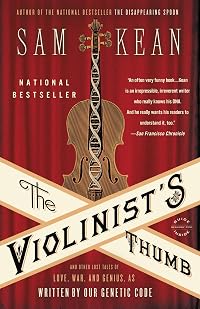
The Violinist's Thumb and Other Lost Tales of Love, War, and Genius, as Written by Our Genetic Code
by Sam Kean
On This Page
Description
"In The Disappearing Spoon, bestselling author Sam Kean unlocked the mysteries of the periodic table. In THE VIOLINIST'S THUMB, he explores the wonders of the magical building block of life: DNA. There are genes to explain crazy cat ladies, why other people have no fingerprints, and why some people survive nuclear bombs. Genes illuminate everything from JFK's bronze skin (it wasn't a tan) to Einstein's genius. They prove that Neanderthals and humans bred thousands of years more recently than show more any of us would feel comfortable thinking. They can even allow some people, because of the exceptional flexibility of their thumbs and fingers, to become truly singular violinists. Kean's vibrant storytelling once again makes science entertaining, explaining human history and whimsy while showing how DNA will influence our species' future"-- show lessTags
Recommendations







Member Recommendations
Member Reviews
Paraphrasing Tolstoy:
Perhaps all healthy bodies resemble each other, while each unhealthy body is unhealthy in its own way.
Another terrific collection of stories by Sam Kean about science and scientists, this one on genetics and DNA and inspired by his own genes -- haha! his parents, Gene and Jean.
It gives the fundamentals of DNA (its discovery, structure (including sequencing) and function) and touches on so many topics that have become known (or better understood) in the decades since my coursework -- of most interest to me are the incorporation of bacteria and viruses into our cells and DNA, and the environmental activation and suppression of genes that is the field of epigenetics. It’s awe-inspiring ... and as we look at lower show more animals and attribute so much of their behavior to instinct, I wonder how long until we’ll understand our own species enough to see how much of what we attribute to free will is actually biology?
As an aside, I liked this comparison of scientific fields:
A physicist stationed in Hiroshima might have pointed out that the gamma rays finished working over [the] DNA in a millionth of a billionth of a second. To a chemist, the most interesting part -- how the free radicals gnawed through DNA -- would have ceased after a millisecond. A cell biologist would have needed to wait maybe a few hours to study how cells patch up torn DNA. A doctor could have diagnosed radiation sickness [...] within a week. Geneticists needed the most patience. The genetic damage to the survivors didn’t surface for years, even decades. show less
Perhaps all healthy bodies resemble each other, while each unhealthy body is unhealthy in its own way.
Another terrific collection of stories by Sam Kean about science and scientists, this one on genetics and DNA and inspired by his own genes -- haha! his parents, Gene and Jean.
It gives the fundamentals of DNA (its discovery, structure (including sequencing) and function) and touches on so many topics that have become known (or better understood) in the decades since my coursework -- of most interest to me are the incorporation of bacteria and viruses into our cells and DNA, and the environmental activation and suppression of genes that is the field of epigenetics. It’s awe-inspiring ... and as we look at lower show more animals and attribute so much of their behavior to instinct, I wonder how long until we’ll understand our own species enough to see how much of what we attribute to free will is actually biology?
As an aside, I liked this comparison of scientific fields:
A physicist stationed in Hiroshima might have pointed out that the gamma rays finished working over [the] DNA in a millionth of a billionth of a second. To a chemist, the most interesting part -- how the free radicals gnawed through DNA -- would have ceased after a millisecond. A cell biologist would have needed to wait maybe a few hours to study how cells patch up torn DNA. A doctor could have diagnosed radiation sickness [...] within a week. Geneticists needed the most patience. The genetic damage to the survivors didn’t surface for years, even decades. show less
As usual, the actual contents of this Netgalley book came as a bit of a surprise – really? I requested a book about DNA? How unusual. And it is, very; I like a book which will feed me good solid science which has been cut into easily digested pieces rather than either handed to me whole or reduced to baby food, but I haven't read one in some time.
The fact that I was thinking of polar bear livers while typing that last sentence is an indication of how well this book has done its job.
Do I now understand all there is to know about DNA and genetics?
*
*
*
Oh, sorry. I was laughing too hard to type there for a minute. Because – No: I'm still an idiot in the world of science. I am now able to parrot the fact of, say, A-T and C-G pairings, show more and I have a tenuous grasp on what it means, but for me the general feeling is much like I remember from high school science, when I learned that color wasn't what I thought it was and that water is part of everything, even the most solid and desiccated of objects, on a cellular level. Information like that fights with my worldview. I understand the words on a theoretical level, like phasers and tribbles. It's the practical science that escapes me.
Which in no way is to detract from Mr. Kean's book. It's excellent. It's a joy. The fault, dear reader, lies not in my book but in myself, I'm sorry to say.
But I do know a whole heck of a lot more than I did when I started, and – more importantly – I understand a whole heck of a lot more than I did when I started. As for what I still don't understand … well, Mr. Kean did not leave me feeling like the idiot I am, despite the fact that he explained as clearly and simply – and, often, humorously – as any human being could. And every page was painted with the wonder Mr. Kean obviously still finds in science. If all teachers managed to demonstrate this sense of wonder into their lessons, the world would be a smarter place.
And in between and around the bits that refuse to compute, there was a tremendous amount of information I could happily wallow in. I had no idea of the gravity of the reasons behind keeping pregnant women away from kitty litter – and really, it is serious, don't go anywhere near it. It never occurred to me that there could be people who survived the bombings of Hiroshima and Nagasaki both, and no real concept of what that did to them. I never knew the quirky biographies of Darwin and Mendel, Thomas Hunt Morgan, Watson and Crick, or any of the other madmen that fills these pages. And of course the title condition, that which made Niccolò Paganini what he was, which allowed him speed and flexibility that led his listeners to believe he had traded in his soul for them – a beautiful piece of forensic diagnosis, and such fun to read. The humor never gets in the way of the learning, but – as with all the best teachers – facilitates it. It's wonderful.
Literally. show less
The fact that I was thinking of polar bear livers while typing that last sentence is an indication of how well this book has done its job.
Do I now understand all there is to know about DNA and genetics?
*
*
*
Oh, sorry. I was laughing too hard to type there for a minute. Because – No: I'm still an idiot in the world of science. I am now able to parrot the fact of, say, A-T and C-G pairings, show more and I have a tenuous grasp on what it means, but for me the general feeling is much like I remember from high school science, when I learned that color wasn't what I thought it was and that water is part of everything, even the most solid and desiccated of objects, on a cellular level. Information like that fights with my worldview. I understand the words on a theoretical level, like phasers and tribbles. It's the practical science that escapes me.
Which in no way is to detract from Mr. Kean's book. It's excellent. It's a joy. The fault, dear reader, lies not in my book but in myself, I'm sorry to say.
But I do know a whole heck of a lot more than I did when I started, and – more importantly – I understand a whole heck of a lot more than I did when I started. As for what I still don't understand … well, Mr. Kean did not leave me feeling like the idiot I am, despite the fact that he explained as clearly and simply – and, often, humorously – as any human being could. And every page was painted with the wonder Mr. Kean obviously still finds in science. If all teachers managed to demonstrate this sense of wonder into their lessons, the world would be a smarter place.
And in between and around the bits that refuse to compute, there was a tremendous amount of information I could happily wallow in. I had no idea of the gravity of the reasons behind keeping pregnant women away from kitty litter – and really, it is serious, don't go anywhere near it. It never occurred to me that there could be people who survived the bombings of Hiroshima and Nagasaki both, and no real concept of what that did to them. I never knew the quirky biographies of Darwin and Mendel, Thomas Hunt Morgan, Watson and Crick, or any of the other madmen that fills these pages. And of course the title condition, that which made Niccolò Paganini what he was, which allowed him speed and flexibility that led his listeners to believe he had traded in his soul for them – a beautiful piece of forensic diagnosis, and such fun to read. The humor never gets in the way of the learning, but – as with all the best teachers – facilitates it. It's wonderful.
Literally. show less
This was one of the most fascinating books I've read in a long time. Kean covers so much ground and does so in a way that is both respectful (there are some touchy subjects discussed) and engaging. I had so many good conversations with people based on things in this book that I learned or started to understand the connections of, and the references and reading suggestions has a wealth of future reading as well. The nerd in me also really relished needing to use two bookmarks to easily flip back and forth to the notes section :) Highly recommend!
Pretty much all of us know that DNA is what makes us, well, us. But few of us non-scientists really understand what that means. Through a bit of hard science, a little history, just a touch of humour, and some fascinating anecdotes, author San Kean sets out to rectify this in his marvelous book, The Violinist's Thumb.
Kean explains in simple and rather poetic terms, for example, the difference between DNA and genes. "DNA", he tells us, "is a thing - a chemical which sticks to your fingers" while genes are "like a story, with DNA as the language the story is written in". And DNA does much more than colour our eyes blue or our hair black. As Kean points out, if it weren't for DNA, we would lack the imagination to even wonder about these show more things never mind try to discover why they are what they are. DNA is really the story of us, the story of our place in the universe, and, if it seems a little sad to think we are really just the sum of our genetic makeup, there is a whole lot more to the story than just our biology. It is, in fact, our DNA which makes us not only human but humane.
In some wonderful anecdotes, Kean (whose own DNA has made him a born story teller) tells us about the unluckiest lucky man in the world, a Japanese man who survived the bombing of Hiroshima, only to head home to his family who lived in, you guessed it, Nagasaki. Yet, despite surviving two nuclear bombs, he went on to live a long and fruitful life. He also introduces us, thanks to DNA, to the mother of us all, the real Eve, who was a tiny woman who lived a hundred thousand years ago. And Kean also explains why, thanks to DNA, you should never eat the liver of a polar bear unless you are a seal.
The Violinist's Thumb has to be the most fun I have ever had reading a book about science. Oh, and in case you are wondering, the thumb in the title belonged to Paganini, an 18th century violinist so talented many thought he had sold his soul to the devil. Turns out it was something which seems on the surface, somewhat less poetic but certainly more surprising and decidedly human - Paganini's incredible skill was due not to Satan but to a genetic disorder which would eventually shorten his life but which allowed him to bend his fingers and thumbs in amazing ways. When Shakespeare said "our fortune lies not in our stars...but in ourselves", he was more right than he could have possibly imagined even given his wonderful DNA. show less
Kean explains in simple and rather poetic terms, for example, the difference between DNA and genes. "DNA", he tells us, "is a thing - a chemical which sticks to your fingers" while genes are "like a story, with DNA as the language the story is written in". And DNA does much more than colour our eyes blue or our hair black. As Kean points out, if it weren't for DNA, we would lack the imagination to even wonder about these show more things never mind try to discover why they are what they are. DNA is really the story of us, the story of our place in the universe, and, if it seems a little sad to think we are really just the sum of our genetic makeup, there is a whole lot more to the story than just our biology. It is, in fact, our DNA which makes us not only human but humane.
In some wonderful anecdotes, Kean (whose own DNA has made him a born story teller) tells us about the unluckiest lucky man in the world, a Japanese man who survived the bombing of Hiroshima, only to head home to his family who lived in, you guessed it, Nagasaki. Yet, despite surviving two nuclear bombs, he went on to live a long and fruitful life. He also introduces us, thanks to DNA, to the mother of us all, the real Eve, who was a tiny woman who lived a hundred thousand years ago. And Kean also explains why, thanks to DNA, you should never eat the liver of a polar bear unless you are a seal.
The Violinist's Thumb has to be the most fun I have ever had reading a book about science. Oh, and in case you are wondering, the thumb in the title belonged to Paganini, an 18th century violinist so talented many thought he had sold his soul to the devil. Turns out it was something which seems on the surface, somewhat less poetic but certainly more surprising and decidedly human - Paganini's incredible skill was due not to Satan but to a genetic disorder which would eventually shorten his life but which allowed him to bend his fingers and thumbs in amazing ways. When Shakespeare said "our fortune lies not in our stars...but in ourselves", he was more right than he could have possibly imagined even given his wonderful DNA. show less
A captivating, brainy read, The Violinist's Thumb is a science book for all biology lovers. The "lost tales of love, war, and genius" are completely fascinating, running the gamut from the biological explanation for cat hoarding to modern humans’ connection to Neanderthals. Author Sam Kean's personable style is a good fit for science writing, as he blends engaging, occasionally humorous, storytelling with scientific explanation. The biology discussion will stretch the brain a bit, and readers should know that Kean isn't a [a:Mary Roach|7956|Mary Roach|https://images.gr-assets.com/authors/1463591979p2/7956.jpg] clone, but The Violinist's Thumb is a far cry from a textbook. Readers with a strong grasp of biology will get the most out of show more the book, but those with only an average understanding won't ever find it boring or a waste of time. show less
You may recognize the author’s name because of his previous bestselling book about the periodic table, The Disappearing Spoon. In this book, he tackles genetics, doing a fine job in explaining a very complex subject bit by bit, with clever analogies and a good deal of humor.
There are loads of interesting tidbits:
Of all the survivors of the World War II atomic bombing of Hiroshima and Nagasaki, some 150 were caught near both cities on both days! (Talk about a run of bad luck!)
In the 1940’s and 1950’s, many female scientists were nuns, because, as Kean explains, "Women at the time usually had to relinquish their careers upon marrying, while unmarried women...provoked suspicion or derision and sometimes earned such low pay they show more couldn’t make ends meet.”
Humans share about 99% of our DNA with chimpanzees, making them our closest living relatives.
But male chimps have something humans don’t: little bumps called spines on their penises. According to Kean, “this loss decreases male sensation during sex and thereby prolongs copulation, which scientists suspect helps humans pair-bond and stay monogamous.”
Who knew?
Kean explains why Arctic explorers can risk death by eating the liver of polar bears, or why some people who have one cat start getting more cats. He also talks about the phenomenon of epigenetics: how genes can, in fact, be influenced by the environment, with the effects actually passed on to progeny, much as theorized by the discredited Jean-Baptiste Lamarck. He even explains how the beliefs of some religions couldn’t possibly be true: the genetic evidence tells a different story.
Evaluation: This book is full of fascinating anecdotes, as well as a lot of science, which you can actually just scan if you prefer, without it detracting from the general thrust of the book.
One big criticism: When I read a nonfiction book, I depend heavily on the index to help me refer back to ideas I just read 20 minutes ago but forgot already. The index in this book is extremely inadequate. Want to look up that bit about cats, for example? Well, you won’t find anything under “cat” or “feline”: unless you remember that the organism which is the culprit is called Toxoplasma gondii, you’re out of luck!
Otherwise, it was a very entertaining read; once again Kean has succeeded in making science fun, which is absolutely a good thing! show less
There are loads of interesting tidbits:
Of all the survivors of the World War II atomic bombing of Hiroshima and Nagasaki, some 150 were caught near both cities on both days! (Talk about a run of bad luck!)
In the 1940’s and 1950’s, many female scientists were nuns, because, as Kean explains, "Women at the time usually had to relinquish their careers upon marrying, while unmarried women...provoked suspicion or derision and sometimes earned such low pay they show more couldn’t make ends meet.”
Humans share about 99% of our DNA with chimpanzees, making them our closest living relatives.
But male chimps have something humans don’t: little bumps called spines on their penises. According to Kean, “this loss decreases male sensation during sex and thereby prolongs copulation, which scientists suspect helps humans pair-bond and stay monogamous.”
Who knew?
Kean explains why Arctic explorers can risk death by eating the liver of polar bears, or why some people who have one cat start getting more cats. He also talks about the phenomenon of epigenetics: how genes can, in fact, be influenced by the environment, with the effects actually passed on to progeny, much as theorized by the discredited Jean-Baptiste Lamarck. He even explains how the beliefs of some religions couldn’t possibly be true: the genetic evidence tells a different story.
Evaluation: This book is full of fascinating anecdotes, as well as a lot of science, which you can actually just scan if you prefer, without it detracting from the general thrust of the book.
One big criticism: When I read a nonfiction book, I depend heavily on the index to help me refer back to ideas I just read 20 minutes ago but forgot already. The index in this book is extremely inadequate. Want to look up that bit about cats, for example? Well, you won’t find anything under “cat” or “feline”: unless you remember that the organism which is the culprit is called Toxoplasma gondii, you’re out of luck!
Otherwise, it was a very entertaining read; once again Kean has succeeded in making science fun, which is absolutely a good thing! show less
I'm going to be honest and tell you the entire reason I picked up The Violinist's Thumb by Sam Kean is not because I'm interested in biology or DNA or anything to do with science really - it's because the name Paganini drew me in.
I've never been the type of girl to understand science. The closest I came was a low C in Biology 14 years ago when I attended the University of Wyoming. Ever since then I've operated under the assumption that magic sparkles course through my veins, that storks bring babies to deserving parents, and that my father gave me his caterpillar eyebrows as a way to torture me in my later years of life. Sound silly? Of course it does - that's because when I see science explained it looks as strange to me as reading a show more difficult piece of piano sheet music might to you (I say might here because I'm operating under the assumption that you don't play Rachmaninoff on a daily basis.)
In spite of all these misgivings, the name of Paganini, the famous violinists who - folk lore states - sold his soul to the devil for his ability to play drew me in to this book. Random fact: Franz Liszt (also rumored to be demonic in places) studied Paganini's skill on the violin and translated it to the piano. He also was the first to play music memorized on the stage for a concert. I blame him for my many breakdowns.
Anyway!
So Paganini was the bait, but what hooked me about this book was just how accessible the science was. Seriously, it blew me away. In between serious chunks of letters and strands and things I know nothing about were anecdotal stories and historic lessons about names and things I had never known about. It opened up a whole new world to me and in the process, I like to think, I learned a little something more then I expected to.
Fully enjoyable, well-researched and surprisingly fun - this book gave me really strange DNA dreams and made me feel a little bit like a smart person ... for a short while. show less
I've never been the type of girl to understand science. The closest I came was a low C in Biology 14 years ago when I attended the University of Wyoming. Ever since then I've operated under the assumption that magic sparkles course through my veins, that storks bring babies to deserving parents, and that my father gave me his caterpillar eyebrows as a way to torture me in my later years of life. Sound silly? Of course it does - that's because when I see science explained it looks as strange to me as reading a show more difficult piece of piano sheet music might to you (I say might here because I'm operating under the assumption that you don't play Rachmaninoff on a daily basis.)
In spite of all these misgivings, the name of Paganini, the famous violinists who - folk lore states - sold his soul to the devil for his ability to play drew me in to this book. Random fact: Franz Liszt (also rumored to be demonic in places) studied Paganini's skill on the violin and translated it to the piano. He also was the first to play music memorized on the stage for a concert. I blame him for my many breakdowns.
Anyway!
So Paganini was the bait, but what hooked me about this book was just how accessible the science was. Seriously, it blew me away. In between serious chunks of letters and strands and things I know nothing about were anecdotal stories and historic lessons about names and things I had never known about. It opened up a whole new world to me and in the process, I like to think, I learned a little something more then I expected to.
Fully enjoyable, well-researched and surprisingly fun - this book gave me really strange DNA dreams and made me feel a little bit like a smart person ... for a short while. show less
Members
- Recently Added By
Lists

Books Read in 2013
1,630 works; 51 members

KayStJ's to-read list
1,616 works; 11 members

The r/AskScience Reading List
159 works; 3 members
Author Information

29 Works 9,282 Members
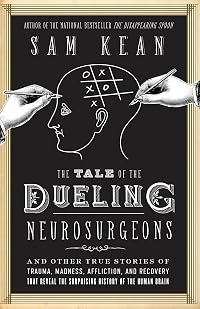
Sam Kean is the author of The Disappearing Spoon, The Violinist's Thumb, and The Tale of the Dueling Neurosurgeons: The History of the Human Brain as Revealed by True Stories of Trauma, Madness, and Recovery all of which were national bestsellers. The Disappearing Spoon was nominated by the Royal Society for one of the top science books of 2010, show more while The Violinist's Thumb was a finalist for PEN's literary science writing award. Kean's stories have appeared in The New York Times Magazine, Slate, Psychology Today, and The New Scientist, among other places, and his work has been featured on "Radiolab" and NPR's "All Things Considered," among other shows. (Bowker Author Biography) show less
Some Editions
Awards and Honors
Awards
Common Knowledge
- Canonical title
- The Violinist's Thumb: And Other Lost Tales of Love, War, and Genius, as Written by Our Genetic Code; The Violinist's Thumb and Other Lost Tales of Love, War, and Genius, as Written by Our Genetic Code
- Original title
- The Violinist's Thumb: And Other Lost Tales of Love, War, and Genius, as Written by Our Genetic Code
- Original publication date
- 2012-07-17
- First words
- This might as well come out up front, first paragraph.
- Last words
- (Click to show. Warning: May contain spoilers.)It's more that I'm glad I was here, am here, in the beginning.
- Blurbers
- Hoffert, Barbara
Classifications
Statistics
- Members
- 1,370
- Popularity
- 17,379
- Reviews
- 47
- Rating
- (3.95)
- Languages
- 7 — English, German, Italian, Polish, Portuguese, Spanish, Swedish
- Media
- Paper, Audiobook, Ebook
- ISBNs
- 23
- ASINs
- 11