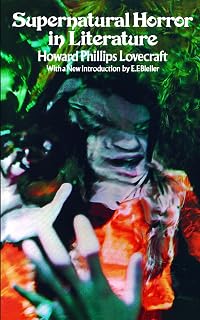
Supernatural Horror in Literature
by H. P. Lovecraft
On This Page
Description
Great modern American supernaturalist brilliantly surveys history of genre to 1930s, summarizing, evaluating scores of books, including works by Poe, Bierce, M.R. James, "Monk" Lewis, many others. Praised by critics as diverse as Edmund Wilson and Vincent Starrett. New introduction by E. F. Bleiler.Tags
Recommendations



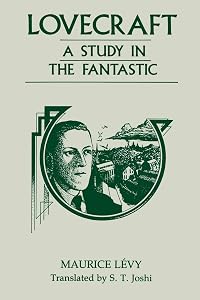
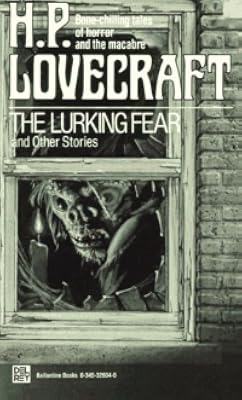
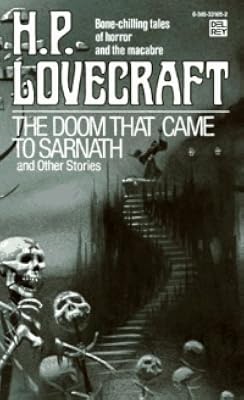

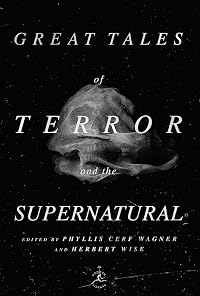













Member Recommendations
Member Reviews
I hate H.P. Lovecraft. I did even in high school when reading him was shorthand for a kind of literary anarchy, and before that I hated him in grade school when knowing who he was just made you a twisted freak. I could give you a dozen reasons why I’ve always hated Lovecraft, but suffice it to say that even the idea of reading one of his stories fills me with an unfathomable, timeless and formless dread. And I’m the only one I know who feels that way. (I’m also the only person I know who hated the movie Memento, and that’s with seven hours of getting to see Guy Pearce in his underpants. Of course, it wasn’t actually seven hours, it just felt that way.)
So today the copy of Supernatural Horror in Literature that I ordered on show more eBay comes in the mail. It cost a buck and the shipping was four bucks. Clue #1. It’s a Dover edition (love them) but the original intro by August Derleth has been replaced with one by E.F. Bleier—Clue #2— who uses the phrase “shockingly underrepresented in American libraries” when talking about LeFanu. Uh, no he’s not. He also laments Lovecraft's exile from the Literary Canon and makes him out to be a 'throw away' martyr. Bleier is a true believer and nothing will ever make me believe that Lovecraft was anything other than a cult of personality wiling away his time writing stories until acid could be invented. In fact, I wish Lovecraft would have lived to use acid, because I have a hunch that his vast and unsounded cosmic intelligence would have reached event horizon and imploded, and he’d have spent the rest of his days writing sensible and intelligible village cozies about landed gentry who hunt and an irascible vicar with a heart of gold.
I will never come in after a night with the boys and look for stuff to buy on eBay. Clue #3. And I’m not going to give the book more than the skimming it already got. It’s going into the donate pile tonight.
But that’s just my opinion. I’m right, but it is just my opinion. If you want a really creepy story about a formless dread, read The Haunting of Hill House. Or for real shivers from under appreciated authors, try David Martin. show less
So today the copy of Supernatural Horror in Literature that I ordered on show more eBay comes in the mail. It cost a buck and the shipping was four bucks. Clue #1. It’s a Dover edition (love them) but the original intro by August Derleth has been replaced with one by E.F. Bleier—Clue #2— who uses the phrase “shockingly underrepresented in American libraries” when talking about LeFanu. Uh, no he’s not. He also laments Lovecraft's exile from the Literary Canon and makes him out to be a 'throw away' martyr. Bleier is a true believer and nothing will ever make me believe that Lovecraft was anything other than a cult of personality wiling away his time writing stories until acid could be invented. In fact, I wish Lovecraft would have lived to use acid, because I have a hunch that his vast and unsounded cosmic intelligence would have reached event horizon and imploded, and he’d have spent the rest of his days writing sensible and intelligible village cozies about landed gentry who hunt and an irascible vicar with a heart of gold.
I will never come in after a night with the boys and look for stuff to buy on eBay. Clue #3. And I’m not going to give the book more than the skimming it already got. It’s going into the donate pile tonight.
But that’s just my opinion. I’m right, but it is just my opinion. If you want a really creepy story about a formless dread, read The Haunting of Hill House. Or for real shivers from under appreciated authors, try David Martin. show less
This is a very useful and informative survey of the supernatural element in literature and represents an important contribution to the study of genre writing, particularly fantasy, horror, and science fiction. No, no, no: this isn't just me ascribing to the so-called Lovecraftian "cult of personality." Don't roll your eyes in disdain! This survey is indeed genuine literary scholarship backed up by a lifetime of reading and verifiable expertise (Lovecraft wrote reams of this stuff in correspondences with lots and lots of folks!). But don't take my word for it. Take Edmund Wilson's! Yes, indeed, Edmund Wilson--the famous literary critic and author of the famous _Axel's Castle_--went so far as to say this was Lovecraft's greatest work. show more This compliment, of course, came at the end of a scathing and immature review of Lovecraft's fiction; nevertheless, I take Edmund Wilson's opinion on "literary scholarship" to be more trustworthy than his opinion on genre literature. What makes this book useful? Put simply: it substantially and succinctly surveys the treatment of the supernatural element in Western literature from Roman times to Lovecraft's contemporary moment. Although Lovecraft has some silly ideas about racial memory--for example, he gives a lot of stock to the ethnicity of writers and equates ethnicity to specific literary styles or psychological temperaments--his knowledge of the canonical literature is astounding. This is not to say he includes everything. He downplays Henry James _The Turn of the Screw_ and Sheridan LaFanu; nevertheless, if you find you have interest in the origins of horror fiction or supernatural fiction in general (read fantasy and science-fiction), this is a classic study that you absolutely need to know. show less
Although close to a century old, Lovecraft's review of weird fiction from its origins to the first quarter of the twentieth century still stands up to scrutiny today. Naturally a product of its time, it nevertheless has the virtue of being a study derived from practice of the art.
I can recommend the book as still a thorough grounding in the grand tradition of dark fantasy, the weird, supernatural horror and literary terror with mostly excellent judgement and acceptable restraint. Lovecraft avoids self-serving judgements and 'plays it straight' throughout.
I can recommend the book as still a thorough grounding in the grand tradition of dark fantasy, the weird, supernatural horror and literary terror with mostly excellent judgement and acceptable restraint. Lovecraft avoids self-serving judgements and 'plays it straight' throughout.
Having read all of Lovecraft's fiction, I thought this would be an interesting way to cap off his writing, with his essay on horror.
It starts out quite strong, giving a good overview of the origins of horror, and their impact. Unfortunately, once he devotes an entire section to Edgar Allan Poe, he starts to slide off the rails a bit, focusing more on various plot summaries (both of Poe and those who he highlights in the sections that follow) than he does on their impact on horror in general.
Still, for all that, it's a fascinating look into the mind that crafted a mythos that survives a century later and influences so many big names in the horror field.
It starts out quite strong, giving a good overview of the origins of horror, and their impact. Unfortunately, once he devotes an entire section to Edgar Allan Poe, he starts to slide off the rails a bit, focusing more on various plot summaries (both of Poe and those who he highlights in the sections that follow) than he does on their impact on horror in general.
Still, for all that, it's a fascinating look into the mind that crafted a mythos that survives a century later and influences so many big names in the horror field.
H. P. Lovecraft's 1927 treatise on weird fiction provides a solid historical overview of the genre, and along the way unearths a trove of works and authors for readers to explore. An invaluable book in one's library of supernatural literature.
If you're looking for an overview of the beginnings of the horror genre, this is a good place to look. Lovecraft originally published this long essay in the 1930s, and it still stands up as a strong overview up through that point. He didn't leave any definative authors or works unaddressed, and the book is sure to provide an ample extended reading list for anyone interested in the weird, the gothic, or horror. It's a quick read, and while there are no in depth discussions of any one work, the book provides a strong history of early horror and a worthwhile look at Poe. My reading list has grown quite a bit from a look into this book. If you're interested in what you're getting into, it's worth your time.
Rating: 4 of 5
Supernatural Horror in Literature proved a helpful resource, by one of the genre's masters, for fans of literary horror and dark fiction. I daresay there are enough references included in the pages of this essay to keep readers busy for a couple years at least. However, do not expect in-depth analysis of the works mentioned.
Now, the fun part begins ... reading the books Lovecraft suggested.
Supernatural Horror in Literature proved a helpful resource, by one of the genre's masters, for fans of literary horror and dark fiction. I daresay there are enough references included in the pages of this essay to keep readers busy for a couple years at least. However, do not expect in-depth analysis of the works mentioned.
Now, the fun part begins ... reading the books Lovecraft suggested.
Members
- Recently Added By
Lists

Weird and Weirder Fiction
270 works; 35 members

Blue Pyramid 1,276 Best Books of All Time
1,248 works; 32 members

Books With Our Favorite First Lines
168 works; 104 members
Talk Discussions
Past Discussions
THE DEEP ONES: "Supernatural Horror in Literature" by H.P. Lovecraft in The Weird Tradition (August 2015)
Author Information

1,940+ Works 74,180 Members
Howard Phillips Lovecraft, 1890 - 1937 H. P. Lovecraft was born on August 20, 1890 in Providence, Rhode Island. His mother was Sarah Susan Phillips Lovecraft and his father was Winfield Scott Lovecraft, a traveling salesman for Gorham & Co. Silversmtihs. Lovecraft was reciting poetry at the age of two and when he was three years old, his father show more suffered a mental breakdown and was admitted to Butler Hospital. He spent five years there before dying on July 19, 1898 of paresis, a form of neurosyphillis. During those five years, Lovecraft was told that his father was paralyzed and in a coma, which was not the case. His mother, two aunts and grandfather were now bringing up Lovecraft. He suffered from frequent illnesses as a boy, many of which were psychological. He began writing between the ages of six and seven and, at about the age of eight, he discovered science. He began to produce the hectographed journals, "The Scientific Gazette" (1899-1907) and "The Rhode Island Journal of Astronomy" (1903-07). His first appearance in print happened, in 1906, when he wrote a letter on an astronomical matter to The Providence Sunday Journal. A short time later, he began writing a monthly astronomy column for The Pawtuxet Valley Gleaner - a rural paper. He also wrote columns for The Providence Tribune (1906-08), The Providence Evening News (1914-18), The Asheville (N.C.) Gazette-News (1915). In 1904, his grandfather died and the family suffered severe financial difficulties, which forced him and his mother to move out of their Victorian home. Devastated by this, he apparently contemplated suicide. In 1908, before graduating from high school, he suffered a nervous breakdown. He didn't receive a diploma and failed to get into Brown University, both of which caused him great shame. Lovecraft was not heard from for five years, re-emerging because of a letter he wrote in protest to Fred Jackson's love story in The Argosy. His letter was published in 1913 and caused great controversy, which was noted by Edward F. Daas, President of the United Amateur Press Association (UAPA). Daas invited Lovecraft to join the UAPA, which he did in early 1914. He eventually became President and Official Editor of the UAPA and served briefly as President of the rival National Amateur Press Association (NAPA). He published thirteen issues of his own paper, The Conservative (1915-23) and contributed poetry and essays to other journals. He also wrote some fiction which titles include "The Beast in the Cave" (1905), "The Alchemist" (1908), "The Tomb" and "Dagon" (1917). In 1919, Lovecraft's mother was deteriorating, mentally and physically, and was admitted to Butler Hospital. On May 24, 1921, his mother died from a gall bladder operation. While attending an amateur journalism convention in Boston, Lovecraft met his future wife Sonia Haft Greene, a Russian Jew. They were married on March 3, 1924 and Lovecraft moved to her apartment in Brooklyn. Sonia had a shop on Fifth Avenue that went bankrupt. In 1925, Sonia went to Cleveland for a job and Lovecraft moved to a smaller apartment in the Red Hook district of Brooklyn. In 1926, he decided to move back to Providence. Lovecraft had his aunts bar his wife, Sonia, from going to Providence to start a business because he couldn't have the stigma of a tradeswoman wife. They were divorced in 1929. After his return to Providence, he wrote his greatest fiction, which included the titles "The Call of Cthulhu" (1926), "At the Mountains of Madness" (1931), and "The Shadow Out of Time" (1934-35). In 1932, his aunt, Mrs. Clark, died; and he moved in with his other aunt, Mrs. Gamwell, in 1933. Suffering from cancer of the intestine, Lovecraft was admitted to Jane Brown Memorial Hospital and on March 15, 1937 he died. (Bowker Author Biography) show less
Some Editions
Series
Belongs to Publisher Series
Work Relationships
Is contained in
Has as a reference guide/companion
Common Knowledge
- Canonical title*
- Supernatural Horror in Literature
- Original publication date
- 1927
- First words
- The oldest and strongest emotion of mankind is fear, and the oldest and strongest kind of fear is fear of the unknown.
- Last words
- (Click to show. Warning: May contain spoilers.)Radiant with beauty, the Cup of the Ptolemies was carven of onyx.
- Canonical DDC/MDS
- 813.52; 809.3872
- Canonical LCC
- PN3435
*Some information comes from Common Knowledge in other languages. Click "Edit" for more information.
Classifications
- Genres
- Literature Studies and Criticism, Nonfiction
- DDC/MDS
- 809.3872 — Literature & rhetoric Literature, rhetoric & criticism History, description, critical appraisal of more than two literatures Fiction Genre Fiction Mystery and Speculative Fiction Horror, Crime, Gothic
- LCC
- PN3435 — Language and Literature Literature (General) Literature (General) Prose. Prose fiction Special kinds of fiction. Fiction genres
- BISAC
Statistics
- Members
- 530
- Popularity
- 56,717
- Reviews
- 12
- Rating
- (3.78)
- Languages
- 9 — English, Finnish, French, German, Greek, Polish, Portuguese, Spanish, Swedish
- Media
- Paper, Ebook
- ISBNs
- 25
- UPCs
- 1
- ASINs
- 11