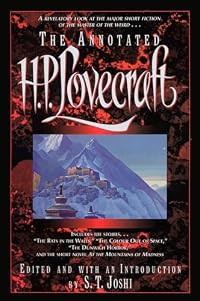
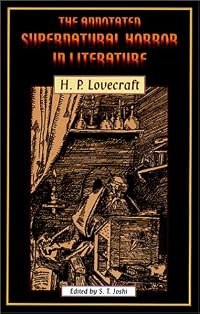
The Annotated H.P. Lovecraft
by H. P. Lovecraft
On This Page
Description
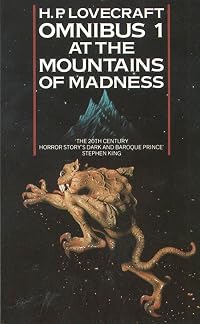
A revelatory look at the major short fiction of the master of the weird. Includes the stories: The rats in the walls ; The colour out of space ; The Dunwich horror ; and the short novel, At the mountains of madness.Tags
Recommendations












Member Reviews
A great sampling of four of Lovecraft's stories. This volume contains heavily annotated versions of "The Rats in the Walls," "The Colour out of Space," "The Dunwich Horror" and "At the Mountains of Madness."
This is my second time reading this and this time I read it without referring to the annotations. You really have to decide how you want to read this book before going in. The annotations are excellent and incredibly informative, but sometimes it feels there's as much annotation as there is actual text to the stories! This sounds like a knock but the annotations are worth having, just know what you're getting into going in: do you want a scholarly read or do want to soak in the eldritch ooze that is Lovecraft?
The three short stories show more are excellent and "At the Mountains of Madness" is a good story but felt a little long with a lot of scientific mumbo-jumbo that could (and probably should) have been trimmed. It's essential Lovecraft, but it really highlights why his shorter stories work best.
Overall a well researched and intriguing read. Highly recommended if you have anything beyond a casual interest in Lovecraft. show less
This is my second time reading this and this time I read it without referring to the annotations. You really have to decide how you want to read this book before going in. The annotations are excellent and incredibly informative, but sometimes it feels there's as much annotation as there is actual text to the stories! This sounds like a knock but the annotations are worth having, just know what you're getting into going in: do you want a scholarly read or do want to soak in the eldritch ooze that is Lovecraft?
The three short stories show more are excellent and "At the Mountains of Madness" is a good story but felt a little long with a lot of scientific mumbo-jumbo that could (and probably should) have been trimmed. It's essential Lovecraft, but it really highlights why his shorter stories work best.
Overall a well researched and intriguing read. Highly recommended if you have anything beyond a casual interest in Lovecraft. show less
WARNING - Footnotes are EVERYWHERE. They were seriously driving me nuts. There was a footnote for every person’s name and every place name and other random stuff too. Like we really need to know that this character’s name was possibly based off this old guy who Lovecraft may or may not have known of, but nothing can be proven about it. x_x Anyway, I read “The Rats in the Walls” and “The Dunwich Horror”. They were pretty good, kind of sci-fi/fantasy horror stuff, not too terribly scary, but not bad either. I didn’t read them while it was dark outside, so that might have helped. There’s lots of … undescribed horrors in these stories, which is a little disappointing, I could use a little bit more for my imagination to show more take over, but if you have a really good imagination, they may be more horrific to you. show less
Highly recommended for any fans of Lovecraft, even though there's a good chance that you may already have read (and own) the stories in the collection. The stories included are "The Rats in the Walls," "The Colour Out of Space," "The Dunwich Horror," and "At The Mountains of Madness." All four are footnoted, which provides some insight into Lovecraft's influence, his language, and the intertextuality of his stories. Also includes some excerpts from Lovecraft's letters regarding his theories on weird fiction, some quotes from authors influenced by Lovecraft, and a summary of Lovecraft and Lovecraftian movies circa mid-1990s.
I've had this book for a couple of years and I always go back to read a story I haven't gotten to yet. Some of my favorite Lovecraft tales are included -- The Rats In The Walls, The Dunwich Horror, and the Colour Out of Space.
A small collection containing a handful of Lovecraft's stories, heavily annotated. If you dislike Lovecraft, or if you find footnotes distracting, this will obviously not be the book for you. ;-) But those who enjoy Lovecraft or want to read a great deal about him and his works, or prefer annotated works in general, will probably like this book. It's an interesting and useful addition to the library of a Lovecraft fan.
The annotations made reading Lovecraft a bit easier.
Members
- Recently Added By
Lists

Evil Lurks Among Us
10 works; 1 member

Lucy's Long List
69 works; 1 member
Author Information

1,907+ Works 73,564 Members
Howard Phillips Lovecraft, 1890 - 1937 H. P. Lovecraft was born on August 20, 1890 in Providence, Rhode Island. His mother was Sarah Susan Phillips Lovecraft and his father was Winfield Scott Lovecraft, a traveling salesman for Gorham & Co. Silversmtihs. Lovecraft was reciting poetry at the age of two and when he was three years old, his father show more suffered a mental breakdown and was admitted to Butler Hospital. He spent five years there before dying on July 19, 1898 of paresis, a form of neurosyphillis. During those five years, Lovecraft was told that his father was paralyzed and in a coma, which was not the case. His mother, two aunts and grandfather were now bringing up Lovecraft. He suffered from frequent illnesses as a boy, many of which were psychological. He began writing between the ages of six and seven and, at about the age of eight, he discovered science. He began to produce the hectographed journals, "The Scientific Gazette" (1899-1907) and "The Rhode Island Journal of Astronomy" (1903-07). His first appearance in print happened, in 1906, when he wrote a letter on an astronomical matter to The Providence Sunday Journal. A short time later, he began writing a monthly astronomy column for The Pawtuxet Valley Gleaner - a rural paper. He also wrote columns for The Providence Tribune (1906-08), The Providence Evening News (1914-18), The Asheville (N.C.) Gazette-News (1915). In 1904, his grandfather died and the family suffered severe financial difficulties, which forced him and his mother to move out of their Victorian home. Devastated by this, he apparently contemplated suicide. In 1908, before graduating from high school, he suffered a nervous breakdown. He didn't receive a diploma and failed to get into Brown University, both of which caused him great shame. Lovecraft was not heard from for five years, re-emerging because of a letter he wrote in protest to Fred Jackson's love story in The Argosy. His letter was published in 1913 and caused great controversy, which was noted by Edward F. Daas, President of the United Amateur Press Association (UAPA). Daas invited Lovecraft to join the UAPA, which he did in early 1914. He eventually became President and Official Editor of the UAPA and served briefly as President of the rival National Amateur Press Association (NAPA). He published thirteen issues of his own paper, The Conservative (1915-23) and contributed poetry and essays to other journals. He also wrote some fiction which titles include "The Beast in the Cave" (1905), "The Alchemist" (1908), "The Tomb" and "Dagon" (1917). In 1919, Lovecraft's mother was deteriorating, mentally and physically, and was admitted to Butler Hospital. On May 24, 1921, his mother died from a gall bladder operation. While attending an amateur journalism convention in Boston, Lovecraft met his future wife Sonia Haft Greene, a Russian Jew. They were married on March 3, 1924 and Lovecraft moved to her apartment in Brooklyn. Sonia had a shop on Fifth Avenue that went bankrupt. In 1925, Sonia went to Cleveland for a job and Lovecraft moved to a smaller apartment in the Red Hook district of Brooklyn. In 1926, he decided to move back to Providence. Lovecraft had his aunts bar his wife, Sonia, from going to Providence to start a business because he couldn't have the stigma of a tradeswoman wife. They were divorced in 1929. After his return to Providence, he wrote his greatest fiction, which included the titles "The Call of Cthulhu" (1926), "At the Mountains of Madness" (1931), and "The Shadow Out of Time" (1934-35). In 1932, his aunt, Mrs. Clark, died; and he moved in with his other aunt, Mrs. Gamwell, in 1933. Suffering from cancer of the intestine, Lovecraft was admitted to Jane Brown Memorial Hospital and on March 15, 1937 he died. (Bowker Author Biography) show less
All Editions
Series
Belongs to Publisher Series
Work Relationships
Common Knowledge
- Canonical title
- The Annotated H.P. Lovecraft
- Original publication date
- 1997
- People/Characters
- William Dyer
- Important places
- Antarctica; Arkham, Massachusetts, USA (fictional); Dunwich, Massachusetts, USA (fictional); Massachusetts, USA; Miskatonic University, Arkham, Massachusetts, USA (fictional); Providence, Rhode Island, USA (show all 8); Rhode Island, USA; USA
- First words
- H.P. Lovecraft has now become the victim of his own posthumous celebrity.
- Last words
- (Click to show. Warning: May contain spoilers.)A serious adaptation of one of Lovecraft's great stories has yet to be attempted.
- Publisher's editor
- Leigh Grossman
Classifications
Statistics
- Members
- 551
- Popularity
- 53,542
- Reviews
- 7
- Rating
- (4.01)
- Languages
- English
- Media
- Paper
- ISBNs
- 4