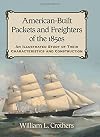
American-Built Packets and Freighters of the 1850s: An Illustrated Study of Their Characteristics and Construction
by William L. Crothers
On This Page
Description
"Up and down the Eastern seaboard during the 1850s, American shipyards constructed wooden merchant sailing vessels forming the backbone of the commercial shipping industry. This comprehensive volume appraises in minute detail the construction of these ships, outlining basic design criteria and enumerating and examining every plank and piece of timber involved in the process. More than 150 illustrations"--Provided by publisher.Tags
Recommendations














































Member Recommendations



Member Reviews
American-Built Packets and Freighters of the 1850s by William L. Crothers
I'm going to have to review this book without actually having read it; it's going to take me a very long time to read it through, and I need to get a review up on LibraryThing Early Reviewers now.
I've been looking for a book like this for decades. As the author says in the preface, "much has been written about the exploits and external appearance of these vessels, but little has been exposed concerning their interiors". Every time I've picked up a book on old sailing ships, hoping for some information on shipbuilding techniques, or even some idea of what their interior arrangements were like I've been disappointed. Book after book has focused on "exploits and show more external appearance". Finally it seems I've found the book I've been looking for.
This book is lavishly but simply illustrated, and it appears to be densely packed with fascinating details.
It appears that most of the information in the book comes from one source, the _Boston Daily Atlas_. If I have a quibble about the book, it's that it may rely too heavily on that single source of information. But that's got to be a pretty minor quibble.
Is it really possible that the author was 101 years old when this book was published? The verso of the title page says he was born in 1912. Sounds like this book was truly "the work of a lifetime."
As a final note: I love how the frontispiece and the final illustration (a bow view and a stern view of the same ship) serve as visual bookends for the content. show less
I'm going to have to review this book without actually having read it; it's going to take me a very long time to read it through, and I need to get a review up on LibraryThing Early Reviewers now.
I've been looking for a book like this for decades. As the author says in the preface, "much has been written about the exploits and external appearance of these vessels, but little has been exposed concerning their interiors". Every time I've picked up a book on old sailing ships, hoping for some information on shipbuilding techniques, or even some idea of what their interior arrangements were like I've been disappointed. Book after book has focused on "exploits and show more external appearance". Finally it seems I've found the book I've been looking for.
This book is lavishly but simply illustrated, and it appears to be densely packed with fascinating details.
It appears that most of the information in the book comes from one source, the _Boston Daily Atlas_. If I have a quibble about the book, it's that it may rely too heavily on that single source of information. But that's got to be a pretty minor quibble.
Is it really possible that the author was 101 years old when this book was published? The verso of the title page says he was born in 1912. Sounds like this book was truly "the work of a lifetime."
As a final note: I love how the frontispiece and the final illustration (a bow view and a stern view of the same ship) serve as visual bookends for the content. show less
 This review was written for LibraryThing Early Reviewers.
William L. Crothers' book "American-Built Packets and Freighters of the 1850s" is a niche publication of the first order. Yet it is an interesting - no, fascinating - book to read for several reasons, many of which carry appeal for a more general readership. Just to enumerate a few:
The line drawings that beautifully and clearly illustrate the entire book are almost artistic in their appeal. They are highly detailed, well labeled and worth careful examination and analysis.
A general history of shipbuilding is laid out in concise language in the brief introduction, but is then reinforced over and over again in the succeeding chapters as the historical background of specific innovations or developments incorporated into the packets and show more freighters of the 1850s are elucidated.
As with most specialty areas of endeavor, the reader is here introduced to a whole vocabulary of new words or reintroduced to commonplace words used in entirely different contexts. To study the glossary that is provided and to read the text with care is like learning a new language or having a new view world view based almost entirely on language opened up to the mind's eye.
And above all, the reader has to admire the mind of a person who could put such a concise, well organized, well explained and well written book together on a subject as esoteric as building packets and freighters in the 1850s! The charts and lists and explanations are a remarkable addition to the book in their own right, but the overall clarity of the presentation of such an intricate, complicated and arcane subject is worthy of praise.
Crothers' book is a pleasing and enjoyable acquisition for the library of one who has read the Hornblower series by C. S. Forester four or five times over the years, or who admires the seafaring writings of Alexander Kent, or who is enthralled by the golden age of sailing ships. Crothers' book helps better understand the sailing ship for what it was at the time - a technological marvel developed over centuries of experimentation and development as a basis for commerce, warfare and romance. show less
The line drawings that beautifully and clearly illustrate the entire book are almost artistic in their appeal. They are highly detailed, well labeled and worth careful examination and analysis.
A general history of shipbuilding is laid out in concise language in the brief introduction, but is then reinforced over and over again in the succeeding chapters as the historical background of specific innovations or developments incorporated into the packets and show more freighters of the 1850s are elucidated.
As with most specialty areas of endeavor, the reader is here introduced to a whole vocabulary of new words or reintroduced to commonplace words used in entirely different contexts. To study the glossary that is provided and to read the text with care is like learning a new language or having a new view world view based almost entirely on language opened up to the mind's eye.
And above all, the reader has to admire the mind of a person who could put such a concise, well organized, well explained and well written book together on a subject as esoteric as building packets and freighters in the 1850s! The charts and lists and explanations are a remarkable addition to the book in their own right, but the overall clarity of the presentation of such an intricate, complicated and arcane subject is worthy of praise.
Crothers' book is a pleasing and enjoyable acquisition for the library of one who has read the Hornblower series by C. S. Forester four or five times over the years, or who admires the seafaring writings of Alexander Kent, or who is enthralled by the golden age of sailing ships. Crothers' book helps better understand the sailing ship for what it was at the time - a technological marvel developed over centuries of experimentation and development as a basis for commerce, warfare and romance. show less
This review was written for LibraryThing Early Reviewers.Impressive scholarship and presentation: reading Crothers' Illustrated Study amounts to peeking in on a masters class on shipbuilding, not as student but auditor. In two hours' selected reading, a sense of what was overall possible can be had circa 1850 (Crothers positing it as the peak of wooden ships technology). See the Preface and Introduction, and Chapters 1 - 3 (hulls and general characteristics), 16 & 29 (masts), 30 (rigging), and a Conclusion. Later chapters are highly specific, offering a level of detail best read piecemeal, steadily building upon the initial foundation. Crothers acknowledges omitting any detailed discussion of sail-making, despite a detailed review and multiple schematics of the various rigging involved show more [354].
Given an interest in O'Brien's Aubrey-Maturin novels or the Age of Sail generally, Crothers offers rich background reading into the nature of wooden ships and those who worked them. The timeframe is post-Napoleanic, and Crothers addresses American commercial ships as opposed to the Royal Navy; nevertheless, he provides nuanced insight into design, building, and material of wooden ships, from a vantage effectively placing into wider context the technology available to Jack and his crews. Quite informative.
//
Commercial ships included schooners, packets, freighters. Packets could be line (regular schedule) or service (sailing when passenger list warranted), interior appointments maintained with comfort in mind. Freighters were primarily cargo, with corresponding interior (though some passenger accommodations included). Steerage was never comfortable, and often unlivable. See Crothers' separate book devoted to schooners (perhaps more directly relevant to naval ships); here are discussed only packets and freighters.
Hierarchy of rigging types, in principle independent of number of decks, with a key consideration the size of crew and skill necessary for more complex rigging. Considerations would be very different in a navy than a commercial fleet [351-54]:
● fore and aft schooner: coastal trade and small in tonnage; many variations, and as the name implies not square-rigged on any mast; a typical example steps two masts.
● topsail schooner: for coastal trade, two-masted with foremast square rigged (three yards), main mast fore-and-aft rigged
● brig: two square-rigged masts, usually no loftier than royals
● barkentine: three masts, foremast square rigged with main & mizzen fore-and-aft rigged.
● bark: three masts, two square-rigged with mizzen fore-and-aft rigged.
● ship (fully-rigged): three square-rigged masts with bowsprit; commercial vessels commonly sailed without royals (presumably the typical man-of-war included royals and even skysails).
Cross-referencing specific terms from the Index with the Glossary usually clears up any confusion (e.g. scantlings). In many cases, Crothers is good at concisely defining a term at first usage. show less
Given an interest in O'Brien's Aubrey-Maturin novels or the Age of Sail generally, Crothers offers rich background reading into the nature of wooden ships and those who worked them. The timeframe is post-Napoleanic, and Crothers addresses American commercial ships as opposed to the Royal Navy; nevertheless, he provides nuanced insight into design, building, and material of wooden ships, from a vantage effectively placing into wider context the technology available to Jack and his crews. Quite informative.
//
Commercial ships included schooners, packets, freighters. Packets could be line (regular schedule) or service (sailing when passenger list warranted), interior appointments maintained with comfort in mind. Freighters were primarily cargo, with corresponding interior (though some passenger accommodations included). Steerage was never comfortable, and often unlivable. See Crothers' separate book devoted to schooners (perhaps more directly relevant to naval ships); here are discussed only packets and freighters.
Hierarchy of rigging types, in principle independent of number of decks, with a key consideration the size of crew and skill necessary for more complex rigging. Considerations would be very different in a navy than a commercial fleet [351-54]:
● fore and aft schooner: coastal trade and small in tonnage; many variations, and as the name implies not square-rigged on any mast; a typical example steps two masts.
● topsail schooner: for coastal trade, two-masted with foremast square rigged (three yards), main mast fore-and-aft rigged
● brig: two square-rigged masts, usually no loftier than royals
● barkentine: three masts, foremast square rigged with main & mizzen fore-and-aft rigged.
● bark: three masts, two square-rigged with mizzen fore-and-aft rigged.
● ship (fully-rigged): three square-rigged masts with bowsprit; commercial vessels commonly sailed without royals (presumably the typical man-of-war included royals and even skysails).
Cross-referencing specific terms from the Index with the Glossary usually clears up any confusion (e.g. scantlings). In many cases, Crothers is good at concisely defining a term at first usage. show less
This review was written for LibraryThing Early Reviewers.This is an exhaustive reference work on the working sailing vessels of the mid-19th Century American merchant fleet. It features stunningly detailed illustrations, tables and narrative descriptions of the building materials and designs of the freighters and packets of the period. Specific chapters include those focused on hull design, construction techniques, interior fittings, hull ornamentation, rigging and masts.
This is not a book for the casual reader, but will be indispensable for those with a focus on the golden age of sail.
Truly an impressive labor of love.
This is not a book for the casual reader, but will be indispensable for those with a focus on the golden age of sail.
Truly an impressive labor of love.
This review was written for LibraryThing Early Reviewers.In this day and age of fiberglass and plastic hulls, aluminum masts along with mechanized halyards, sheets and other assorted modernities it is a pleasure to dip into the wood ship era. Now I have no brief against all the modern technology, after all I lived for years aboard one such and found the leisure time afforded me on long cruises by those helps to be delightful. But it is salutary to return to those times when everything was done by the skilled hands of craftsmen from the cutting down of carefully selected trees, the shaping and the fitting of the resultant cuts into a thing of tremendous beauty and power.
Packets and Freighters affords a detailed look into all this craftsmanship. So detailed that model ship builders of today show more should get a copy of this book for the plans and descriptions. They are comprehensive and detailed. Chapter one is “Preparation for Construction” and the following chapters detail specific areas of the ship’s construction ending with Chapter 30 “Rigging.” There are other chapters dealing with the names of the American packets, signaling and an excellent closing discussing the ships.
I believe the following quote from the book serves best to describe this excellent look at wooden ships: “...the building of ships, large and small, has been detailed from the initial concept, through laying of the keel, to the appropriate signal systems. The common thread was that all vessels, large or small, were built in the same fashion, requiring the same skills and varying only in magnitude.”
If you have an interest in wooden ships, whether it is because you have picked up a seafaring adventure novel , you are a deep water sailor, love building models of these ships or some combination thereof, get this book. show less
Packets and Freighters affords a detailed look into all this craftsmanship. So detailed that model ship builders of today show more should get a copy of this book for the plans and descriptions. They are comprehensive and detailed. Chapter one is “Preparation for Construction” and the following chapters detail specific areas of the ship’s construction ending with Chapter 30 “Rigging.” There are other chapters dealing with the names of the American packets, signaling and an excellent closing discussing the ships.
I believe the following quote from the book serves best to describe this excellent look at wooden ships: “...the building of ships, large and small, has been detailed from the initial concept, through laying of the keel, to the appropriate signal systems. The common thread was that all vessels, large or small, were built in the same fashion, requiring the same skills and varying only in magnitude.”
If you have an interest in wooden ships, whether it is because you have picked up a seafaring adventure novel , you are a deep water sailor, love building models of these ships or some combination thereof, get this book. show less
This review was written for LibraryThing Early Reviewers.I have two confessions to make. First, I didn't know what a packet was until I received this book. Turns out it designates a wooden ship intended for passengers as opposed to freight. Second confession, my interest in the age of sail stems solely from an interest in historical fiction centered around the early-to-mid 19th century.
I had no prior knowledge of ship architecture or construction methods, so this book was an entirely new world for me. And this book tosses the reader right into the deep end of the pool! Way more information than I ever even imagined existed pours out of every page. This is a true technical journal complete with dozens of beautifully rendered drawings and charts detailing the state of the art of 1850's ship show more construction. For the lay-person it's too much, too quickly.
I can say this. From now on, whenever a book I'm reading mentions a particular part of a sailing ship, I'll know where to go to find what they're talking about, complete with detailed drawings and a materials list in case I want to construct my own. show less
I had no prior knowledge of ship architecture or construction methods, so this book was an entirely new world for me. And this book tosses the reader right into the deep end of the pool! Way more information than I ever even imagined existed pours out of every page. This is a true technical journal complete with dozens of beautifully rendered drawings and charts detailing the state of the art of 1850's ship show more construction. For the lay-person it's too much, too quickly.
I can say this. From now on, whenever a book I'm reading mentions a particular part of a sailing ship, I'll know where to go to find what they're talking about, complete with detailed drawings and a materials list in case I want to construct my own. show less
This review was written for LibraryThing Early Reviewers.Fascinating as a reference book, thoroughly and exhaustively researched and documented. Not really something to read cover to cover.
This review was written for LibraryThing Early Reviewers.Members
- Recently Added By
Author Information
3 Works 59 Members
Common Knowledge
- Original publication date
- 2013
Classifications
- Genres
- Nonfiction, History, General Nonfiction
- DDC/MDS
- 623.822 — Applied Science & Technology Engineering Military Vehicles: Land, Air, & Sea Naval architecture; Shipbuilding History of Naval Architecture Sailing Vessels
- LCC
- VK23 .C76 — Naval Science Navigation. Merchant marine Navigation. Merchant marine History, conditions, etc.
- BISAC
Statistics
- Members
- 32
- Popularity
- 876,638
- Reviews
- 18
- Rating
- (4.80)
- Languages
- English
- Media
- Paper, Ebook
- ISBNs
- 2