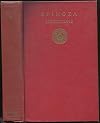
Spinoza Selections
by Baruch Spinoza  , John Wild (Editor)
On This Page
Tags
Recommendations



























Member Reviews
[“Instead of a Preface” to Of Human Bondage, New Edition (reset), Heinemann, 1934; reprinted in The Collected Edition, 1937:]
The first title I chose was Beauty from Ashes, a quotation from Isaiah, but this, I found, had been recently used and I had to look for another. It so happened that at that time I was reading Spinoza. When I came to the part of his great book that is called Of Human Bondage, it seemed to me that I could never find anything that so exactly suited me. I was told that it was a very forbidding title for a novel, but I insisted on my way. It was published in 1915.
[Of Human Bondage (1915), Chapter LIII:]
Sometimes great philosophers seemed to have nothing to say to him, but at others he recognised a mind with which show more he felt himself at home. He was like the explorer in Central Africa who comes suddenly upon wide uplands, with great trees in them and stretches of meadow, so that he might fancy himself in an English park. He delighted in the robust common sense of Thomas Hobbes; Spinoza filled him with awe, he had never before come in contact with a mind so noble, so unapproachable and austere; it reminded him of that statue by Rodin, L'Age d'Airain, which he passionately admired…
[The Summing Up (1938), Chapters LXIII, LXXIII & LXXIV:]
I look upon my first reading of Spinoza as one of the signal experiences of my life. It filled me with just that feeling of majesty and exulting power that one has at the sight of a great mountain range.
There is no explanation for evil. It must be looked upon as a necessary part of the order of the universe. To ignore it is childish; to bewail it senseless. Spinoza called pity womanish; the epithet has a harsh sound on the lips of that tender and austere spirit. I suppose he thought that it was but waste of emotion to feel strongly about what you could not alter.
Spinoza says that a free man thinks of nothing less than of death. It is unnecessary to dwell upon it, but it is foolish, as so many do, to shrink from all consideration of it. It is well to make up one's mind about it.
[A Writer’s Notebook (1949), “By way of postscript”, 1944:]
But there is one subject with which I can still occupy myself with my old excitement, and that is philosophy, not the philosophy that is disputatious and aridly technical – ‘Vain is the word of a philosopher which does not heal any suffering of man’ – but the philosophy that treats the problems that confront us all. Plato, Aristotle (who they say is dry, but in whom if you have a sense of humour you can find quite a lot to amuse you), Plotinus and Spinoza, with sundry moderns, among whom Bradley and Whitehead, never cease to entertain me and incite me to reflection. After all, they and the Greek tragedians deal with the only things that are important to man. They exalt and tranquillise. To read them is to sail with a gentle breeze in an inland sea studded with a thousand islands.
[Preface to The Partial View, Heinemann, 1954:]
Spinoza, that God intoxicated man, said that God has infinite attributes. Surely among them must be humour and common sense. If God exists and he concerns himself with the affairs of humanity, then surely he will take a lenient view, as lenient a view as a sensible man takes, of the weakness of human beings. show less
The first title I chose was Beauty from Ashes, a quotation from Isaiah, but this, I found, had been recently used and I had to look for another. It so happened that at that time I was reading Spinoza. When I came to the part of his great book that is called Of Human Bondage, it seemed to me that I could never find anything that so exactly suited me. I was told that it was a very forbidding title for a novel, but I insisted on my way. It was published in 1915.
[Of Human Bondage (1915), Chapter LIII:]
Sometimes great philosophers seemed to have nothing to say to him, but at others he recognised a mind with which show more he felt himself at home. He was like the explorer in Central Africa who comes suddenly upon wide uplands, with great trees in them and stretches of meadow, so that he might fancy himself in an English park. He delighted in the robust common sense of Thomas Hobbes; Spinoza filled him with awe, he had never before come in contact with a mind so noble, so unapproachable and austere; it reminded him of that statue by Rodin, L'Age d'Airain, which he passionately admired…
[The Summing Up (1938), Chapters LXIII, LXXIII & LXXIV:]
I look upon my first reading of Spinoza as one of the signal experiences of my life. It filled me with just that feeling of majesty and exulting power that one has at the sight of a great mountain range.
There is no explanation for evil. It must be looked upon as a necessary part of the order of the universe. To ignore it is childish; to bewail it senseless. Spinoza called pity womanish; the epithet has a harsh sound on the lips of that tender and austere spirit. I suppose he thought that it was but waste of emotion to feel strongly about what you could not alter.
Spinoza says that a free man thinks of nothing less than of death. It is unnecessary to dwell upon it, but it is foolish, as so many do, to shrink from all consideration of it. It is well to make up one's mind about it.
[A Writer’s Notebook (1949), “By way of postscript”, 1944:]
But there is one subject with which I can still occupy myself with my old excitement, and that is philosophy, not the philosophy that is disputatious and aridly technical – ‘Vain is the word of a philosopher which does not heal any suffering of man’ – but the philosophy that treats the problems that confront us all. Plato, Aristotle (who they say is dry, but in whom if you have a sense of humour you can find quite a lot to amuse you), Plotinus and Spinoza, with sundry moderns, among whom Bradley and Whitehead, never cease to entertain me and incite me to reflection. After all, they and the Greek tragedians deal with the only things that are important to man. They exalt and tranquillise. To read them is to sail with a gentle breeze in an inland sea studded with a thousand islands.
[Preface to The Partial View, Heinemann, 1954:]
Spinoza, that God intoxicated man, said that God has infinite attributes. Surely among them must be humour and common sense. If God exists and he concerns himself with the affairs of humanity, then surely he will take a lenient view, as lenient a view as a sensible man takes, of the weakness of human beings. show less
Ratings
Members
- Recently Added By
Lists

Trinity College Booklist (1951): Class Three, Philosophy and Religion
80 works; 3 members
Author Information

333+ Works 10,101 Members
Baruch Spinoza was born in Amsterdam, the son of Portuguese Jewish refugees who had fled from the persecution of the Spanish Inquisition. Although reared in the Jewish community, he rebelled against its religious views and practices, and in 1656 was formally excommunicated from the Portuguese-Spanish Synagogue of Amsterdam and was thus effectively show more cast out of the Jewish world. He joined a group of nonconfessional Christians (although he never became a Christian), the Collegiants, who professed no creeds or practices but shared a spiritual brotherhood. He was also apparently involved with the Quaker mission in Amsterdam. Spinoza eventually settled in The Hague, where he lived quietly, studying philosophy, science, and theology, discussing his ideas with a small circle of independent thinkers, and earning his living as a lens grinder. He corresponded with some of the leading philosophers and scientists of his time and was visited by Leibniz and many others. He is said to have refused offers to teach at Heidelberg or to be court philosopher for the Prince of Conde. During his lifetime he published only two works, The Principles of Descartes' Philosophy (1666) and the Theological Political Tractatus (1670). In the first his own theory began to emerge as the consistent consequence of that of Descartes (see also Vol. 5). In the second, he gave his reasons for rejecting the claims of religious knowledge and elaborated his theory of the independence of the state from all religious factions. After his death (probably caused by consumption resulting from glass dust), his major work, the Ethics, appeared in his Opera Posthuma, and presented the full metaphysical basis of his pantheistic view. Spinoza's influence on the Enlightenment, on the Romantic Age, and on modern secularism has been tremendous. (Bowker Author Biography) show less
Baruch Spinoza has a Legacy Library. Legacy libraries are the personal libraries of famous readers, entered by LibraryThing members from the Legacy Libraries group.
Series
Belongs to Publisher Series
Common Knowledge
- Original publication date
- 1930
- People/Characters
- Baruch Spinoza
- First words
- After experience has taught me that all the usual surroundings of social life are vain and futile; seeing that none of the objects of my fears contained in themselves anything either good or bad, except in so far as the mind ... (show all)is affected by them, I finally resolved to inquire whether there might be some real good having power to communicate itself, which would affect the mind singly, to the exclusion of all else; whether, in fact, there might be anything of which the discovery and attainment would enable me to enjoy continuous, supreme, and unending happiness.
Introduction -- Life -- It is perhaps impossible to understand any philosophy without a knowledge of the life and personality of which it is the expression. Of Spinozism this is especially the case, for, whether we view it fr... (show all)om the standpoint of the thought or that of the thinker of the thought, the two fuse into one organic and consistent whole. One of the most characteristic doctrines of the system is the identity of intellect and will, of thought and action.
[1st words of text witten by Spinoza] After experience has taught me that all the usual surroundings of social life are vain and futile; seeing that none of the objects of my fears contained in themselves anything either... (show all) good or bad, except in so far as the mind is affected by them, I finally resolved to inquire whether there might be some real good having power to communicate itself, which would affect the mind singly, to the exclusion of all else; whether, in fact, there might be anything of which the discovery and attainment would enable me to enjoy continuous, supreme, and unending happiness. - Last words
- (Click to show. Warning: May contain spoilers.)And so, farewell, most Noble Sir, and continue to love, etc., Your B. d. S.
(Click to show. Warning: May contain spoilers.)And so, farewell, most Noble Sir, and continue to love, etc.
Classifications
- Genres
- Philosophy, Nonfiction, General Nonfiction
- DDC/MDS
- 199.492 — Philosophy & psychology Modern western philosophy Philosophy in other geographic areas Europe Other European Countries Netherlands
- LCC
- B3958 .W5 — Philosophy, Psychology and Religion Philosophy (General) By period Modern By region or country
Statistics
- Members
- 118
- Popularity
- 276,691
- Reviews
- 1
- Rating
- (4.33)
- Languages
- English
- Media
- Paper
- ISBNs
- 3
- ASINs
- 9