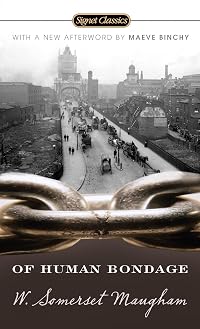
Of Human Bondage
by W. Somerset Maugham 
On This Page
Description
From a tormented orphan with a clubfoot, Philip Carey grows into an impressionable young man with a voracious appetite for adventure and knowledge. His cravings take him to Paris at age eighteen to try his hand at art, then back to London to study medicine. But even so, nothing can sate his nagging hunger for experience. Then he falls obsessively in love, embarking on a disastrous relationship that will change his life forever.Tags
Recommendations












Member Recommendations


Member Reviews
I've put off reading W. Somerset Maugham for a long time, for two rather idiosyncratic (and perhaps superficial) reasons. The first was my general unease around British 'society' novels, which appear deeply grounded in the mechanics of the class system (regardless of whether, on a case-by-case basis, this proves to be a fair suspicion or not). As a British working-class lad travelling through life on often unsteady socio-economic ground – "watch[ing] your life slide out of view," as Jarvis Cocker once put it – I'm instinctively opposed to the casual snobbery, petty conceit and idle condescension often present in upper-middle-class and aspirant middle-class novels in my country, whether written in 1815, 1915 or the present day (say show more hello, Sally Rooney). I'm not a class warrior; in fact, I often shy away from kitchen-sink material too. It's just not what I look for in my reading hobby. I look for either escapism or deep literary themes, and I don't find such things in repressed class-based stories. Such a characterisation would be unfair to pin on Maugham – whose book Of Human Bondage I promise I will soon begin to discuss – but the point I'm trying to make is that the titles which can be ring-fenced under this admittedly broad banner make me feel queasy, and I tend to avoid them entirely.
The second reason I had avoided Maugham was due to an arch put-down of the author by Christopher Hitchens, reproduced in Arguably, a collection of essays which was my first real exposure to Hitch. I'm aware that it is ridiculous to put too much stock in one man's opinion, particularly on something as subjective – or, more accurately, idiosyncratic – as literary taste, but Hitchens' writing was some of the first I read in my early twenties as I started to take my literary journey more seriously. That book, Arguably, prompted me to read Orwell, Nabokov, Hilary Mantel, the King James Bible and – for my which I am particularly grateful – the Flashman novels by George MacDonald Fraser. Suffice to say, I put great stock in Hitchens' opinions (and still do), and his dismissal of Maugham, however benign, was consequently hard to shift.
Now, having finally read Maugham's most well-known novel, Of Human Bondage, I have transferred my reticence onto this review. I review everything I read and prepare for what I will write, but I dread writing reviews when, even after finishing the book, I still don't know how I feel about it. Based on past experience, I know that I will usually figure something out as I write, but I also know this is usually hard work. But mostly, the sense of dread comes from this: I always find it hard to write a review which is one of admiration, but not love.
Certainly, it is much harder for me than it is for Maugham, who writes about love, admiration, infatuation – and plenty more besides – with a sometimes cringe-inducing alacrity. Of Human Bondage follows the life of Philip Carey (almost, but not entirely, an author avatar) from orphaned infanthood all the way to his early thirties, and casts an author's cool, appraising eye over family, youth, schooling, career, money, poverty, loves, infatuations, affairs, art, and everything else a young man is bruised by as he goes about establishing himself in the world. The reason Maugham chose Of Human Bondage as a title becomes clear: everything that goes into being human is bound within the pages of this book. It is not a novel you hold, but Philip himself.
This can become formidable to try to review. Maugham's book is rather quotable, but the following passage was one I was keen to note down as I was reading:
"… on the whole the impression was neither of tragedy nor of comedy. There was no describing it. It was manifold and various; there were tears and laughter, happiness and woe; it was tedious and interesting and indifferent; it was as you saw it: it was tumultuous and passionate; it was grave; it was sad and comic; it was trivial; it was simple and complex; joy was there and despair; the love of mothers for their children, and of men for women; lust trailed itself through the rooms with leaden feet, punishing the guilty and the innocent, helpless wives and wretched children; drink seized men and women and cost its inevitable price; death sighed in these rooms; and the beginning of life, filling some poor girl with terror and shame, was diagnosed there. There was neither good nor bad there. There were just facts. It was life." (pg. 462 – my emphasis)
In this passage, Maugham writes with more concision of the nature of his book than I could ever hope to do in this review. Consequently, I toss brevity to the side and say be damned to it, because it's worth taking the above passage as a prompt to further discussion. For one thing, take those words I emphasised – particularly the word 'diagnosed' – and the fact that the statement is a summary of Philip's time working in a hospital ward. Though Maugham's autobiographical element in Of Human Bondage is perhaps overstated (I was surprised how little his homosexuality influenced his writing here, even as a subtext), his medical background seems of great importance in his approach to the story. I have already said how this is not a novel you hold, but Philip himself, and certainly Maugham saw the experience as a purge. In his Foreword, Maugham writes of how he had been "obsessed by the teeming memories of my past life… they became such a burden to me, that I made up my mind there was only one way to be free of them and that was to write them all down on paper" (pg. 2). Maugham created a human body in words and then went about his diagnosis of its failings.
Another thing to mention is that the above lengthy passage from page 462 reminded me of Charles Dickens ("it was the best of times, it was the worst of times"). I was first reminded of Tolstoy in reading Of Human Bondage – the Russian count's War and Peace was a conscious attempt to incorporate "all of life" – but the comparison ultimately dissatisfied. Tolstoy was more literary; his book had a more regal air and was more explicitly concerned with themes – the lack of which perhaps explains why it still feels odd to approach Maugham's crowd-pleasing book with a literary appraisal. In contrast, the Dickens comparison sits well. Though there are differences between the two – Maugham has a surprising (and welcome) simplicity in his sentences, whereas Dickens was famously wordy – the two were, first and foremost, storytellers. Their strengths are in characterisation (all of Maugham's characters are excellently and compassionately drawn, even if they're only there for a single scene) and in pacing (absent any plot, Maugham's book is surprisingly engrossing for the entirety of its 700 pages). Their literary reputations developed through their success in storytelling rather than any conscious thematic questing.
There is a strange feeling which develops in a reader or reviewer when trying to assess a writer of this persuasion. In one respect, it is the lamentable (but entirely understandable) prejudice that if something is entertaining, it cannot be literary. This prejudice is wrongheaded, but difficult to surmount even for an honest admirer. And, as I wrote at the start of this review, admiration is harder for me to write about than love. I had a similar struggle with Larry McMurtry; I loved his book Lonesome Dove as entertainment, but I could also discern a literary merit. But, in contrast to more overtly literary novels, McMurtry's themes were a sort of all-pervading air, and rooted obscurely (but deeply) in his characters. I struggled to articulate it, and that was when I had love for the book; for Of Human Bondage, where there is only admiration, it is even harder.
Why admiration then, and not love? It's hard to say. In no small part, it must come down to personal preference. As I suggested at the start, I keep society novels rooted in class at arm's length and, perhaps, can never fully develop a love for one. But, moving beyond this, I also think it's in the nature of books of this type – the story- and character-driven literature of the likes of Dickens, Maugham and McMurtry – to defy literary review. Their strategy is to root their astute observations of life in their characters, rather than in structure or theme, which not only makes it damned hard to pull them out again for a review, but results in the story seeming misshapen – and lesser – when the pulling-apart is done. When I say books of this type defy review, it's not meant as an easy excuse, but rather a desire to avoid making them perishable. Putting a book whose strategy is in enjoyment and the magic of characters under a critical microscope is to subject them to something they were not designed for. It diminishes them, when surely the objective of a positive review is to commend.
Certainly, I found the most identifiable theme in Of Human Bondage – the Persian rug riddle – easy to understand and yet hard to align on a literary level. Within the story, it makes perfect sense, but it's something of a surprise to me now that I can write up my impressions of the story while scarcely mentioning it. I certainly don't feel obliged to make it the anchor of my review. In the broadest sense, it reflects within the story what I have tried to unpack in review. The book tries to establish a pattern – a narrative – among all the various things that can influence and bind a human life, and it is this which the Persian rug discussion in the book reflects.
A great virtue of this approach is that even aspects of the novel which appear to be flaws begin to be seen as advantages. When certain characters frustrate the reader – even Philip, the protagonist – this can be a sign of Maugham's effective characterisation. This is human life within the pages, and certainly there are frustrating characters in all our lives. Even with Mildred – the regular (and justified) target of a reader's hatred – you recognise that she is real. When she's there on the page, you don't feel like Maugham has let the story unravel with poor characterisation, as would be the case with a bad writer and a bad character. Rather, with her you feel you have to hold your tongue and endure, just as you do in real life whenever you see a friend, male or female, mooning over some classless slut or bluffing half-wit. Sometimes you hate Philip and sometimes you root for him. You are pulled every which way – and by following this in his narrative, Maugham shows you some of the powers and limiters which are in place over a human life.
This is not to say there aren't some drawbacks to the book. While some of Philip's earlier relationships are memorable (Miss Wilkinson, Miss Price), Maugham often had the advantage of me when he reintroduced or referred to characters I had not thought about for hundreds of pages. I would become muddled as to who the likes of Hayward or Clutton were, and thought perhaps there's a good reason Dickens chose monikers like Pumblechook and Magwitch over more non-descript names. I found Mildred's abrupt exit from the story dissatisfying, and while I enjoyed the happy ending more than others seem to have done, I was slightly perplexed by its ambiguity. I lacked the sense of momentousness that I usually feel when I finish a large literary tome.
I did, however, indeed see it as a happy ending. Philip, in being bound all his life by various forces and experiences, is now free. Having recognised he is free from obligation in the circumstances presented at the end, he chooses to be bound by them anyway. He wants human bondage, rather than romantic but uncertain wanderlust. In assessing the ending, we should recall something said much earlier by Cronshaw (who is also the one to present the Persian rug riddle):
"The illusion which man has that his will is free is so deeply rooted that I am ready to accept it. I act as though I were a free agent. But when an action is performed it is clear that all the forces of the universe from all eternity conspired to cause it, and nothing I could do could have prevented it." (pg. 238)
When it is delivered on page 238, this is merely an interesting philosophical discourse between Philip and Cronshaw. But by the end of the book, it has the weight of 700 pages behind it. Philip has lived thirty years of experience and decision, and has reached a point in the final pages where he feels free. And yet, it is clear to us that everything that has happened – all the forces of the universe, perhaps – has carried them there. Having grown in maturity, and overcome the terror of unemployment and poverty, he recognises the value of domestic security and contentment over restless dream-chasing and adventure. This is a bildungsroman, and Philip has now come of age.
Maugham, it seems, is often criticised for his lack of originality, and certainly, for most of the book the author appeared to be held back in this by the limitations of the bildungsroman format. After all, no young man, however lucid, has ever had a thought that had not already been thought by millions of young men before him. The book could appear, on the surface, to be a parlour game of characters – an almost superficial crowd-pleaser. But the way the story had been framed was key. Everything Philip has experienced in life influences his decision in the final pages. Just as that decision, added to the ranks of every previous decision, will influence the next one. A human life is an ongoing story. Here, the criticisms of Maugham's supposed lack of originality lose their thrust, because whilst from the outside a life can look just the same as any other life, when you are immersed in one – an individual life – you begin to see the small, accumulative things which direct it down one path or another. Every human life is original, if only by degrees.
Having overcome my reluctance to review Of Human Bondage, I now find myself in the contrary position of being reluctant to end the review. This is, by necessity, a very long novel and, to paraphrase Maugham, I am ashamed to make it longer by writing a review of it. But it is a book you can't be short about; to understand something with such scope you need to be immersed in it at length. "He did not know how wide a country, arid and precipitous, must be crossed before the traveller through life comes to an acceptance of reality" (pg. 135). Cronshaw tells us that the meaning of life is worthless unless you discover it yourself (pg. 237), and he expands on this with his Persian rug riddle. The preceding review is my attempt to discover it myself, using – as all literature should be used – the artist and his work as a lens.
Does it mean something that Mildred is the one to destroy Philip's Persian rug with a knife? Is it symbolic of her destructive relationship with Philip? I don't know; perhaps Maugham didn't even know. He only knew it made sense that she would – that it made sense for the characters to behave in this way within the context of their lives. That is the key to his success in Of Human Bondage. It is the strange effect of a literary writer seemingly unconcerned with literary affectation or convention, and yet being entirely conventional, accepting storytelling as the end in itself. After all, we use story to understand life. In a discussion on religion, one character argues the following:
"Perhaps religion is the best school of morality. It is like one of those drugs you gentlemen use in medicine which carries another in solution: it is of no efficacy in itself, but enables the other to be absorbed. You take your morality because it is combined with religion; you lost the religion and the morality stays behind. A man is more likely to be a good man if he has learned goodness through the love of God than through a perusal of Herbert Spencer." (pg. 497)
This is a statement as good as any on which to end this review. The statement comes from Athelny, not Philip, but we should remember the book is in large part directed by the influence various characters have on our protagonist. With its analogy, the statement recalls the medical diagnosis Maugham is making of his man. The author and protagonist share "the power of self-analysis", described as a "vice, as subtle as drug-taking" (pg. 273). And it is a vice at times; the book is often frustrating and sickening in the wretchedness of its characters. But the statement also hints at the entire purpose of the novel; in telling a story, the author teaches us something about life, and we are more likely to have a good read when the teachings are carried in the story. Of Human Bondage is a long book and difficult to appraise, but I can only conclude that Maugham got the dose right. show less
The second reason I had avoided Maugham was due to an arch put-down of the author by Christopher Hitchens, reproduced in Arguably, a collection of essays which was my first real exposure to Hitch. I'm aware that it is ridiculous to put too much stock in one man's opinion, particularly on something as subjective – or, more accurately, idiosyncratic – as literary taste, but Hitchens' writing was some of the first I read in my early twenties as I started to take my literary journey more seriously. That book, Arguably, prompted me to read Orwell, Nabokov, Hilary Mantel, the King James Bible and – for my which I am particularly grateful – the Flashman novels by George MacDonald Fraser. Suffice to say, I put great stock in Hitchens' opinions (and still do), and his dismissal of Maugham, however benign, was consequently hard to shift.
Now, having finally read Maugham's most well-known novel, Of Human Bondage, I have transferred my reticence onto this review. I review everything I read and prepare for what I will write, but I dread writing reviews when, even after finishing the book, I still don't know how I feel about it. Based on past experience, I know that I will usually figure something out as I write, but I also know this is usually hard work. But mostly, the sense of dread comes from this: I always find it hard to write a review which is one of admiration, but not love.
Certainly, it is much harder for me than it is for Maugham, who writes about love, admiration, infatuation – and plenty more besides – with a sometimes cringe-inducing alacrity. Of Human Bondage follows the life of Philip Carey (almost, but not entirely, an author avatar) from orphaned infanthood all the way to his early thirties, and casts an author's cool, appraising eye over family, youth, schooling, career, money, poverty, loves, infatuations, affairs, art, and everything else a young man is bruised by as he goes about establishing himself in the world. The reason Maugham chose Of Human Bondage as a title becomes clear: everything that goes into being human is bound within the pages of this book. It is not a novel you hold, but Philip himself.
This can become formidable to try to review. Maugham's book is rather quotable, but the following passage was one I was keen to note down as I was reading:
"… on the whole the impression was neither of tragedy nor of comedy. There was no describing it. It was manifold and various; there were tears and laughter, happiness and woe; it was tedious and interesting and indifferent; it was as you saw it: it was tumultuous and passionate; it was grave; it was sad and comic; it was trivial; it was simple and complex; joy was there and despair; the love of mothers for their children, and of men for women; lust trailed itself through the rooms with leaden feet, punishing the guilty and the innocent, helpless wives and wretched children; drink seized men and women and cost its inevitable price; death sighed in these rooms; and the beginning of life, filling some poor girl with terror and shame, was diagnosed there. There was neither good nor bad there. There were just facts. It was life." (pg. 462 – my emphasis)
In this passage, Maugham writes with more concision of the nature of his book than I could ever hope to do in this review. Consequently, I toss brevity to the side and say be damned to it, because it's worth taking the above passage as a prompt to further discussion. For one thing, take those words I emphasised – particularly the word 'diagnosed' – and the fact that the statement is a summary of Philip's time working in a hospital ward. Though Maugham's autobiographical element in Of Human Bondage is perhaps overstated (I was surprised how little his homosexuality influenced his writing here, even as a subtext), his medical background seems of great importance in his approach to the story. I have already said how this is not a novel you hold, but Philip himself, and certainly Maugham saw the experience as a purge. In his Foreword, Maugham writes of how he had been "obsessed by the teeming memories of my past life… they became such a burden to me, that I made up my mind there was only one way to be free of them and that was to write them all down on paper" (pg. 2). Maugham created a human body in words and then went about his diagnosis of its failings.
Another thing to mention is that the above lengthy passage from page 462 reminded me of Charles Dickens ("it was the best of times, it was the worst of times"). I was first reminded of Tolstoy in reading Of Human Bondage – the Russian count's War and Peace was a conscious attempt to incorporate "all of life" – but the comparison ultimately dissatisfied. Tolstoy was more literary; his book had a more regal air and was more explicitly concerned with themes – the lack of which perhaps explains why it still feels odd to approach Maugham's crowd-pleasing book with a literary appraisal. In contrast, the Dickens comparison sits well. Though there are differences between the two – Maugham has a surprising (and welcome) simplicity in his sentences, whereas Dickens was famously wordy – the two were, first and foremost, storytellers. Their strengths are in characterisation (all of Maugham's characters are excellently and compassionately drawn, even if they're only there for a single scene) and in pacing (absent any plot, Maugham's book is surprisingly engrossing for the entirety of its 700 pages). Their literary reputations developed through their success in storytelling rather than any conscious thematic questing.
There is a strange feeling which develops in a reader or reviewer when trying to assess a writer of this persuasion. In one respect, it is the lamentable (but entirely understandable) prejudice that if something is entertaining, it cannot be literary. This prejudice is wrongheaded, but difficult to surmount even for an honest admirer. And, as I wrote at the start of this review, admiration is harder for me to write about than love. I had a similar struggle with Larry McMurtry; I loved his book Lonesome Dove as entertainment, but I could also discern a literary merit. But, in contrast to more overtly literary novels, McMurtry's themes were a sort of all-pervading air, and rooted obscurely (but deeply) in his characters. I struggled to articulate it, and that was when I had love for the book; for Of Human Bondage, where there is only admiration, it is even harder.
Why admiration then, and not love? It's hard to say. In no small part, it must come down to personal preference. As I suggested at the start, I keep society novels rooted in class at arm's length and, perhaps, can never fully develop a love for one. But, moving beyond this, I also think it's in the nature of books of this type – the story- and character-driven literature of the likes of Dickens, Maugham and McMurtry – to defy literary review. Their strategy is to root their astute observations of life in their characters, rather than in structure or theme, which not only makes it damned hard to pull them out again for a review, but results in the story seeming misshapen – and lesser – when the pulling-apart is done. When I say books of this type defy review, it's not meant as an easy excuse, but rather a desire to avoid making them perishable. Putting a book whose strategy is in enjoyment and the magic of characters under a critical microscope is to subject them to something they were not designed for. It diminishes them, when surely the objective of a positive review is to commend.
Certainly, I found the most identifiable theme in Of Human Bondage – the Persian rug riddle – easy to understand and yet hard to align on a literary level. Within the story, it makes perfect sense, but it's something of a surprise to me now that I can write up my impressions of the story while scarcely mentioning it. I certainly don't feel obliged to make it the anchor of my review. In the broadest sense, it reflects within the story what I have tried to unpack in review. The book tries to establish a pattern – a narrative – among all the various things that can influence and bind a human life, and it is this which the Persian rug discussion in the book reflects.
A great virtue of this approach is that even aspects of the novel which appear to be flaws begin to be seen as advantages. When certain characters frustrate the reader – even Philip, the protagonist – this can be a sign of Maugham's effective characterisation. This is human life within the pages, and certainly there are frustrating characters in all our lives. Even with Mildred – the regular (and justified) target of a reader's hatred – you recognise that she is real. When she's there on the page, you don't feel like Maugham has let the story unravel with poor characterisation, as would be the case with a bad writer and a bad character. Rather, with her you feel you have to hold your tongue and endure, just as you do in real life whenever you see a friend, male or female, mooning over some classless slut or bluffing half-wit. Sometimes you hate Philip and sometimes you root for him. You are pulled every which way – and by following this in his narrative, Maugham shows you some of the powers and limiters which are in place over a human life.
This is not to say there aren't some drawbacks to the book. While some of Philip's earlier relationships are memorable (Miss Wilkinson, Miss Price), Maugham often had the advantage of me when he reintroduced or referred to characters I had not thought about for hundreds of pages. I would become muddled as to who the likes of Hayward or Clutton were, and thought perhaps there's a good reason Dickens chose monikers like Pumblechook and Magwitch over more non-descript names. I found Mildred's abrupt exit from the story dissatisfying, and while I enjoyed the happy ending more than others seem to have done, I was slightly perplexed by its ambiguity. I lacked the sense of momentousness that I usually feel when I finish a large literary tome.
I did, however, indeed see it as a happy ending. Philip, in being bound all his life by various forces and experiences, is now free. Having recognised he is free from obligation in the circumstances presented at the end, he chooses to be bound by them anyway. He wants human bondage, rather than romantic but uncertain wanderlust. In assessing the ending, we should recall something said much earlier by Cronshaw (who is also the one to present the Persian rug riddle):
"The illusion which man has that his will is free is so deeply rooted that I am ready to accept it. I act as though I were a free agent. But when an action is performed it is clear that all the forces of the universe from all eternity conspired to cause it, and nothing I could do could have prevented it." (pg. 238)
When it is delivered on page 238, this is merely an interesting philosophical discourse between Philip and Cronshaw. But by the end of the book, it has the weight of 700 pages behind it. Philip has lived thirty years of experience and decision, and has reached a point in the final pages where he feels free. And yet, it is clear to us that everything that has happened – all the forces of the universe, perhaps – has carried them there. Having grown in maturity, and overcome the terror of unemployment and poverty, he recognises the value of domestic security and contentment over restless dream-chasing and adventure. This is a bildungsroman, and Philip has now come of age.
Maugham, it seems, is often criticised for his lack of originality, and certainly, for most of the book the author appeared to be held back in this by the limitations of the bildungsroman format. After all, no young man, however lucid, has ever had a thought that had not already been thought by millions of young men before him. The book could appear, on the surface, to be a parlour game of characters – an almost superficial crowd-pleaser. But the way the story had been framed was key. Everything Philip has experienced in life influences his decision in the final pages. Just as that decision, added to the ranks of every previous decision, will influence the next one. A human life is an ongoing story. Here, the criticisms of Maugham's supposed lack of originality lose their thrust, because whilst from the outside a life can look just the same as any other life, when you are immersed in one – an individual life – you begin to see the small, accumulative things which direct it down one path or another. Every human life is original, if only by degrees.
Having overcome my reluctance to review Of Human Bondage, I now find myself in the contrary position of being reluctant to end the review. This is, by necessity, a very long novel and, to paraphrase Maugham, I am ashamed to make it longer by writing a review of it. But it is a book you can't be short about; to understand something with such scope you need to be immersed in it at length. "He did not know how wide a country, arid and precipitous, must be crossed before the traveller through life comes to an acceptance of reality" (pg. 135). Cronshaw tells us that the meaning of life is worthless unless you discover it yourself (pg. 237), and he expands on this with his Persian rug riddle. The preceding review is my attempt to discover it myself, using – as all literature should be used – the artist and his work as a lens.
Does it mean something that Mildred is the one to destroy Philip's Persian rug with a knife? Is it symbolic of her destructive relationship with Philip? I don't know; perhaps Maugham didn't even know. He only knew it made sense that she would – that it made sense for the characters to behave in this way within the context of their lives. That is the key to his success in Of Human Bondage. It is the strange effect of a literary writer seemingly unconcerned with literary affectation or convention, and yet being entirely conventional, accepting storytelling as the end in itself. After all, we use story to understand life. In a discussion on religion, one character argues the following:
"Perhaps religion is the best school of morality. It is like one of those drugs you gentlemen use in medicine which carries another in solution: it is of no efficacy in itself, but enables the other to be absorbed. You take your morality because it is combined with religion; you lost the religion and the morality stays behind. A man is more likely to be a good man if he has learned goodness through the love of God than through a perusal of Herbert Spencer." (pg. 497)
This is a statement as good as any on which to end this review. The statement comes from Athelny, not Philip, but we should remember the book is in large part directed by the influence various characters have on our protagonist. With its analogy, the statement recalls the medical diagnosis Maugham is making of his man. The author and protagonist share "the power of self-analysis", described as a "vice, as subtle as drug-taking" (pg. 273). And it is a vice at times; the book is often frustrating and sickening in the wretchedness of its characters. But the statement also hints at the entire purpose of the novel; in telling a story, the author teaches us something about life, and we are more likely to have a good read when the teachings are carried in the story. Of Human Bondage is a long book and difficult to appraise, but I can only conclude that Maugham got the dose right. show less
Follows the life of Philip Carey from the time of his mother's death when he was very young into his early 30s, which see him settling into life as a doctor. It's a journey through Philip's early life experiences and travels, and also through his intellectual and emotional coming-of-age. Normally I'm not excited by novels that spend too much time in a character's headspace, but I love Philip to bits and enjoyed spending time with his thoughts and feelings. He makes some downright stupid decisions here and there, but Maugham writes his story in such a way that I didn't get too irritated with those choices and instead rooted for Philip the whole way. The plot is engaging and interesting, and the forays into Deep Thoughts are spaced well show more enough throughout and very well written so that I didn't get restless with them. This is my first Maugham, but I doubt it will be my last. Very much worth the 600+ pages, this. show less
The title of W. Somerset Maugham’s novel has always seemed fraught to me. It seems even more so now. I wondered early on if it might be titillating but then I realized it was written at the end of the Victorian era, so little chance of that. It might have been an easier read if it was that kind of bondage. But there are many forms of bondage and this novel deals with the bondage of economics and gender and institutions in society. The novel portrays English society but women and poor in many parts of the world would probably see themselves in the story. With the destruction of the middle class in my country, it seems like 95% of us are sliding towards the type of life and bondage described by Maugham. But we’re not in a book, so show more maybe there is even less hope for a happy ending than the slim chance you would give for this book to end well.
Maybe this wasn’t a great choice for a pandemic read.
I disliked this novel often while I read it. By that I mean I was uncomfortable for a large percentage of my reading time. I was uncomfortable that so many people had to live with that kind uncertainty and scarcity of prospects and quiet desperation in their lives. While the protagonist Philip, whose life and prospects that the novel follows, made me uncomfortable and anxious for his individual future, the other characters, both major and minor, that were women, made me even more uncomfortable. It was like reading Dickens but without the ability to overlay the more comfortable and comic versions of Fagan that appear in the musicals and Disneyfied movies with the much darker character of the written Fagan. Or reading Les Misérables without being able ignore the social issues and turn it into a simple Broadway love story. It seemed so real. And that’s the mark of a great writer. I not only was a spectator uncomfortable with what was being described but it was visceral in the sense that I was feeling that what Philip was going through mimicked how I might feel in the same situations. I was uncomfortable because I see that uncertainty and scarcity in my world and society now in a way that could swallow up my kids or nephews and nieces. Or even me. And because I see that the uncertainty and scarcity is still worse for women than for men 100 years on from the novels setting.
Is it normal for a man reading a book written by a man about men in a men’s world to be most bothered by the fate of the women who are undeveloped, secondary characters? Maybe not. But my activism for women’s reproductive rights makes me sensitive, especially as there are several episodes in this book where a single woman’s inability to control her fertility dooms her while the man can just disappear. Or when it dooms a family that was already struggling to feed itself to potential disaster, as comes through in this passage:
"The people who dwelt here lived from hand to mouth. Babies were unwelcome, the man received them with surly anger, the mother with despair; it was one more mouth to feed, and there was little enough wherewith to fed those already there. Philip often discerned the wish that the child might be born dead or might die quickly."
The books resident philosopher, Cronshaw, hit on another resonance with today’s world when he says “My ancestors have lived in a civilised state so long that the fear of the police has eaten into my bones.”
The whole of what Philip is doing throughout the novel gets summed up philosophically at one point when he thinks:
"The thing then was to discover what one was and one’s system of philosophy would devise itself. It seemed to Philip that there were three things to find out: man’s relation to the world he lives in, man’s relation with the men among whom he lives, and finally man’s relation to himself."
Maybe the best thing about the novel is centering a protagonist with a disability, giving us a view into how it feels to live with disability on top of all the challenges that life and society throw our way. Philip’s clubfoot disability is mild compared to more debilitating and less treatable disabilities but probably more stigmatized than the stutter that Maugham himself experienced and used as a model for Philip’s disability.
Moving on to the experience of reading the novel in this particular fine press edition, I’ll start with maybe my favorite quote in the novel,
"I see you’re fond of books. You can always tell by the way people handle them."
I definitely resonated with Philip as a reader and lover of books. Early in the novel, as Maugham is developing his character, he writes:
"Insensibly he formed the most delightful habit in the world, the habit of reading: he did not know that thus he was providing himself with a refuge from all the distress of life; he did not know either that he was creating for himself an unreal world which would make the real world of every day a source of bitter disappointment."
One of the most delightful things about reading this Limited Editions Club edition was the cloth used for the binding. It is so soft and sensual to the touch that it was a delight to pick up and hold each time I read. That’s especially astonishing in that the book is 82-years old. I did notice that the spine did not have that same tactile feel, as it has been exposed most of those years (my copy does not have the glassine wrapper to protect it somewhat) and worn much smoother. So I suspect a combination of the slipcase doing its job and that the book has probably not been handled much or read before may be a prime factor in how amazing the book cloth feels. In his Monthly Letter dated February 1938, Number 105, Macy states that the cloth is an English Linen that was especially imported for the edition and that he had never seen before. He calls it coarse linen but that is not a word I would use to describe the way it feels.
The book was designed by Carl Rollins at The Printing-Office of the Yale University Press. I really liked the fact that the book was separated into two volumes to make it more comfortable to read and handle with the care of a book lover. Again in his letter, Macy states that the 6” x 9 1/8” size chosen for the book “always gives tactile pleasure when held in the hands.” The book is indeed easy and comfortable to read and the contact with that cover linen extraordinary.
I get the impression Macy didn’t love Bembo and thinks that Rollins chose it simply because Yale University Press was one of the few American presses to have it at the time. I found it very readable and an elegant companion to the delightful illuminated Old Caslon capitals at the beginning of each chapter. And even more elegant with the lined texture of the custom-made rag paper from Special Worthy Paper Company.
Given the length of this novel, I doubt we will ever see a better edition than the LEC. There are too few presses doing lengthy texts like this. You might want to search a copy out.
[Excursus on slip-cases] I’ve always been baffled by the negative view of slipcases held by many bookish folk. I even talked to a binder who viewed them as destructive due to the friction of inserting and removing the book, even in the correctly sized ones that they made (They recommended clamshell boxes, which I agree are better from the perspective they were coming from). I love them, especially if they are labeled so I can store my books spine inward to prevent fading. But the main reason I love them is illustrated here perfectly. The damage they absorb protects the book. My slipcase is in pieces after 82 years of doing its job. But the books are practically perfect except for some fading and loss of softness to the spine. Well done. I hope to learn to make slipcases, or have one made, so I can give the books another century of protection. Hopefully I’ll even be able to salvage the slipcase label…
AVAILABILITY: 1500 copies printed at the Yale University Press in 1938. As of this writing, I saw 28 copies on-line from about $600 to $100.
This review with photos of the book can be viewed at www.thewholebookexperience.com show less
Maybe this wasn’t a great choice for a pandemic read.
I disliked this novel often while I read it. By that I mean I was uncomfortable for a large percentage of my reading time. I was uncomfortable that so many people had to live with that kind uncertainty and scarcity of prospects and quiet desperation in their lives. While the protagonist Philip, whose life and prospects that the novel follows, made me uncomfortable and anxious for his individual future, the other characters, both major and minor, that were women, made me even more uncomfortable. It was like reading Dickens but without the ability to overlay the more comfortable and comic versions of Fagan that appear in the musicals and Disneyfied movies with the much darker character of the written Fagan. Or reading Les Misérables without being able ignore the social issues and turn it into a simple Broadway love story. It seemed so real. And that’s the mark of a great writer. I not only was a spectator uncomfortable with what was being described but it was visceral in the sense that I was feeling that what Philip was going through mimicked how I might feel in the same situations. I was uncomfortable because I see that uncertainty and scarcity in my world and society now in a way that could swallow up my kids or nephews and nieces. Or even me. And because I see that the uncertainty and scarcity is still worse for women than for men 100 years on from the novels setting.
Is it normal for a man reading a book written by a man about men in a men’s world to be most bothered by the fate of the women who are undeveloped, secondary characters? Maybe not. But my activism for women’s reproductive rights makes me sensitive, especially as there are several episodes in this book where a single woman’s inability to control her fertility dooms her while the man can just disappear. Or when it dooms a family that was already struggling to feed itself to potential disaster, as comes through in this passage:
"The people who dwelt here lived from hand to mouth. Babies were unwelcome, the man received them with surly anger, the mother with despair; it was one more mouth to feed, and there was little enough wherewith to fed those already there. Philip often discerned the wish that the child might be born dead or might die quickly."
The books resident philosopher, Cronshaw, hit on another resonance with today’s world when he says “My ancestors have lived in a civilised state so long that the fear of the police has eaten into my bones.”
The whole of what Philip is doing throughout the novel gets summed up philosophically at one point when he thinks:
"The thing then was to discover what one was and one’s system of philosophy would devise itself. It seemed to Philip that there were three things to find out: man’s relation to the world he lives in, man’s relation with the men among whom he lives, and finally man’s relation to himself."
Maybe the best thing about the novel is centering a protagonist with a disability, giving us a view into how it feels to live with disability on top of all the challenges that life and society throw our way. Philip’s clubfoot disability is mild compared to more debilitating and less treatable disabilities but probably more stigmatized than the stutter that Maugham himself experienced and used as a model for Philip’s disability.
Moving on to the experience of reading the novel in this particular fine press edition, I’ll start with maybe my favorite quote in the novel,
"I see you’re fond of books. You can always tell by the way people handle them."
I definitely resonated with Philip as a reader and lover of books. Early in the novel, as Maugham is developing his character, he writes:
"Insensibly he formed the most delightful habit in the world, the habit of reading: he did not know that thus he was providing himself with a refuge from all the distress of life; he did not know either that he was creating for himself an unreal world which would make the real world of every day a source of bitter disappointment."
One of the most delightful things about reading this Limited Editions Club edition was the cloth used for the binding. It is so soft and sensual to the touch that it was a delight to pick up and hold each time I read. That’s especially astonishing in that the book is 82-years old. I did notice that the spine did not have that same tactile feel, as it has been exposed most of those years (my copy does not have the glassine wrapper to protect it somewhat) and worn much smoother. So I suspect a combination of the slipcase doing its job and that the book has probably not been handled much or read before may be a prime factor in how amazing the book cloth feels. In his Monthly Letter dated February 1938, Number 105, Macy states that the cloth is an English Linen that was especially imported for the edition and that he had never seen before. He calls it coarse linen but that is not a word I would use to describe the way it feels.
The book was designed by Carl Rollins at The Printing-Office of the Yale University Press. I really liked the fact that the book was separated into two volumes to make it more comfortable to read and handle with the care of a book lover. Again in his letter, Macy states that the 6” x 9 1/8” size chosen for the book “always gives tactile pleasure when held in the hands.” The book is indeed easy and comfortable to read and the contact with that cover linen extraordinary.
I get the impression Macy didn’t love Bembo and thinks that Rollins chose it simply because Yale University Press was one of the few American presses to have it at the time. I found it very readable and an elegant companion to the delightful illuminated Old Caslon capitals at the beginning of each chapter. And even more elegant with the lined texture of the custom-made rag paper from Special Worthy Paper Company.
Given the length of this novel, I doubt we will ever see a better edition than the LEC. There are too few presses doing lengthy texts like this. You might want to search a copy out.
[Excursus on slip-cases] I’ve always been baffled by the negative view of slipcases held by many bookish folk. I even talked to a binder who viewed them as destructive due to the friction of inserting and removing the book, even in the correctly sized ones that they made (They recommended clamshell boxes, which I agree are better from the perspective they were coming from). I love them, especially if they are labeled so I can store my books spine inward to prevent fading. But the main reason I love them is illustrated here perfectly. The damage they absorb protects the book. My slipcase is in pieces after 82 years of doing its job. But the books are practically perfect except for some fading and loss of softness to the spine. Well done. I hope to learn to make slipcases, or have one made, so I can give the books another century of protection. Hopefully I’ll even be able to salvage the slipcase label…
AVAILABILITY: 1500 copies printed at the Yale University Press in 1938. As of this writing, I saw 28 copies on-line from about $600 to $100.
This review with photos of the book can be viewed at www.thewholebookexperience.com show less
“There will be time, there will be time
To prepare a face to meet the faces you meet;
There will be time to murder and create,
And time for all the works and days of hands
That lift and drop a question on your plate;
Time for you and time for me,
And time yet for a hundred indecisions,
And for a hundred visions and revisions,
Before the taking of a toast and tea.”
With apologies to any Eliot scholars, I’ve always read Prufrock as a caution against the inevitability of time and the absurdity its march leaves behind. Youth passes imperceptibly, exchanging the search for answers with routine and compromise. When you comprehend the passing, it is too late – in Eliot’s voice, the mermaids will no longer sing to you.
W. Somerset show more Maugham’s [Of Human Bondage] sets out a scope of inquiry no less than the meaning of life. How do you answer the single most important question in human existence? Philip Carey, born with a club foot and orphaned at the tender age of nine, begins his search living in his Uncle William’s vicarage. The rigidly pious atmosphere quickens ideas of a spiritual life for Philip, which he pursues more deeply at a religious-based boarding school. He begins to believe that he can escape his deformity and fulfill himself in a devout life of service. Philip’s belief is so earnest and innocent that he begins to pray for miraculous healing of his club foot, taking literally Jesus’ admonition to his disciples about faith in Matthew 17:20. When Philip’s prayers go unanswered, he turns his back on God.
Philip also abandons his Uncle’s hopes of an Oxford education and travels to Germany. There, in a pastoral setting, boarding in a home with several beautiful young ladies, thoughts of beauty and love begin to bloom in Phillip. He begins to think that life is meant to be spent in the pursuit of pleasure, in experiencing the world through the senses. Philip migrates to Paris, hoping to become an artist and to tap into that sensuality which will finally give meaning to his existence and give him a place in the world. But the endless avarice of his friends and colleagues ultimately leads Philip to see only vanity in the singular pursuit of pleasure and beauty. One friend in particular, Cronshaw, tells Philip that he will find the meaning of life in a Persian rug. When Philip asks him to explain, Cronshaw gives him a rug and tells him that it will only be clear if he can learn the meaning on his own.
Near destitute now, Philip returns to London and begins a search for some way to support himself. Studying to become a doctor, like his late father, Philip meets Mildred, a waitress in a tea shop. Philip falls in love with Mildred but she never shows any interest in him beyond his money and Philip eventually spends almost all of his money trying to win her love, hoping in her love to finally find fulfillment.
Homeless and destitute, Philip goes for help to the home of a former patient, Athelny, who had befriended him. Philip marvels at Athelny’s simple life, composed of little more than a deep love and care for his family and the pursuit of only their happiness. Philip remembers Cronshaw’s advice about the hidden meaning in the Persian rug and realizes the patterns in the rug mirror the patterns in a man’s life – that life has no meaning outside the patterns built from a man’s choices. Eventually, Philip falls in love with Athelny’s daughter and decides to marry her and start a life, calculating that “the simplest pattern, that in which a man was born, worked, married, had children, and died, was likewise the most perfect.”
The old boys of literature are daring – they are unafraid of facing the deep questions of human existence. And they take the exploration slowly, methodically. Modern literature rarely seems to take the same time and effort in asking and trying to answer such deep questions. Too much time is spent worrying about capturing the reader’s attention and then holding it hostage with finely tuned plots or exotic stories. But Maugham, and others like him, are more than just writers and storytellers. They are adventurers bound for uncharted waters, hoping to scratch out answers that perplex them and the readers for whom they write. Perhaps the reason so many of these classics still call to us is that their journey is so universal.
Do I agree completely with Maugham’s answer? No, but that’s not the point. The point is that he is able to explore the plight of human existence so thoroughly and offer an answer at all – that he is still able to entice the mermaids to sing to him, and that I can hear them still, too.
Bottom Line: Take the epic journey!
5 bones!!!!!
An early favorite for the year and new favorite for all time. show less
To prepare a face to meet the faces you meet;
There will be time to murder and create,
And time for all the works and days of hands
That lift and drop a question on your plate;
Time for you and time for me,
And time yet for a hundred indecisions,
And for a hundred visions and revisions,
Before the taking of a toast and tea.”
With apologies to any Eliot scholars, I’ve always read Prufrock as a caution against the inevitability of time and the absurdity its march leaves behind. Youth passes imperceptibly, exchanging the search for answers with routine and compromise. When you comprehend the passing, it is too late – in Eliot’s voice, the mermaids will no longer sing to you.
W. Somerset show more Maugham’s [Of Human Bondage] sets out a scope of inquiry no less than the meaning of life. How do you answer the single most important question in human existence? Philip Carey, born with a club foot and orphaned at the tender age of nine, begins his search living in his Uncle William’s vicarage. The rigidly pious atmosphere quickens ideas of a spiritual life for Philip, which he pursues more deeply at a religious-based boarding school. He begins to believe that he can escape his deformity and fulfill himself in a devout life of service. Philip’s belief is so earnest and innocent that he begins to pray for miraculous healing of his club foot, taking literally Jesus’ admonition to his disciples about faith in Matthew 17:20. When Philip’s prayers go unanswered, he turns his back on God.
Philip also abandons his Uncle’s hopes of an Oxford education and travels to Germany. There, in a pastoral setting, boarding in a home with several beautiful young ladies, thoughts of beauty and love begin to bloom in Phillip. He begins to think that life is meant to be spent in the pursuit of pleasure, in experiencing the world through the senses. Philip migrates to Paris, hoping to become an artist and to tap into that sensuality which will finally give meaning to his existence and give him a place in the world. But the endless avarice of his friends and colleagues ultimately leads Philip to see only vanity in the singular pursuit of pleasure and beauty. One friend in particular, Cronshaw, tells Philip that he will find the meaning of life in a Persian rug. When Philip asks him to explain, Cronshaw gives him a rug and tells him that it will only be clear if he can learn the meaning on his own.
Near destitute now, Philip returns to London and begins a search for some way to support himself. Studying to become a doctor, like his late father, Philip meets Mildred, a waitress in a tea shop. Philip falls in love with Mildred but she never shows any interest in him beyond his money and Philip eventually spends almost all of his money trying to win her love, hoping in her love to finally find fulfillment.
Homeless and destitute, Philip goes for help to the home of a former patient, Athelny, who had befriended him. Philip marvels at Athelny’s simple life, composed of little more than a deep love and care for his family and the pursuit of only their happiness. Philip remembers Cronshaw’s advice about the hidden meaning in the Persian rug and realizes the patterns in the rug mirror the patterns in a man’s life – that life has no meaning outside the patterns built from a man’s choices. Eventually, Philip falls in love with Athelny’s daughter and decides to marry her and start a life, calculating that “the simplest pattern, that in which a man was born, worked, married, had children, and died, was likewise the most perfect.”
The old boys of literature are daring – they are unafraid of facing the deep questions of human existence. And they take the exploration slowly, methodically. Modern literature rarely seems to take the same time and effort in asking and trying to answer such deep questions. Too much time is spent worrying about capturing the reader’s attention and then holding it hostage with finely tuned plots or exotic stories. But Maugham, and others like him, are more than just writers and storytellers. They are adventurers bound for uncharted waters, hoping to scratch out answers that perplex them and the readers for whom they write. Perhaps the reason so many of these classics still call to us is that their journey is so universal.
Do I agree completely with Maugham’s answer? No, but that’s not the point. The point is that he is able to explore the plight of human existence so thoroughly and offer an answer at all – that he is still able to entice the mermaids to sing to him, and that I can hear them still, too.
Bottom Line: Take the epic journey!
5 bones!!!!!
An early favorite for the year and new favorite for all time. show less
Could this book have been a little bit shorter and been just as effective? At 684 pages, of course. Yet I am so glad I stayed with it.
I nearly did otherwise. Midway, it felt like nothing more than the story of a young man making one bad decision after another. And it was definitely that! Then came the philosophy.
"He could not be positive that reason was much help in the conduct of life. It seemed to him that life lived itself."
"He did not act with a part of himself but altogether. The power that possessed him seemed to have nothing to do with reason: all that reason did was to point out the methods of obtaining what his whole soul was striving for."
Philip Carey is orphaned young and lives a hard life. The story does not take some of show more the obvious turns that you think it might. Philip makes a brief stab at being a chartered accountant; tries to be an artist in Paris; then finds his groove as a medical student before falling into penury. He learns much along the way, finally (at page 590) finding a sense of meaning in the meaninglessness of life. "As the weaver elaborated his pattern for no end but the pleasure of his aesthetic sense, so might a man live his life, or if one was forced to believe that this actions were outside his choosing, so might a man look at his life, that it made a pattern." It's really a beautiful couple of pages that follow. show less
I nearly did otherwise. Midway, it felt like nothing more than the story of a young man making one bad decision after another. And it was definitely that! Then came the philosophy.
"He could not be positive that reason was much help in the conduct of life. It seemed to him that life lived itself."
"He did not act with a part of himself but altogether. The power that possessed him seemed to have nothing to do with reason: all that reason did was to point out the methods of obtaining what his whole soul was striving for."
Philip Carey is orphaned young and lives a hard life. The story does not take some of show more the obvious turns that you think it might. Philip makes a brief stab at being a chartered accountant; tries to be an artist in Paris; then finds his groove as a medical student before falling into penury. He learns much along the way, finally (at page 590) finding a sense of meaning in the meaninglessness of life. "As the weaver elaborated his pattern for no end but the pleasure of his aesthetic sense, so might a man live his life, or if one was forced to believe that this actions were outside his choosing, so might a man look at his life, that it made a pattern." It's really a beautiful couple of pages that follow. show less
An orphaned boy goes through the trials of early life and into manhood at the turn of the 20th century in middle class England. A report from another time that reflects our own with its economic and societal pressures. There was also a glimpse of an earlier time (mid 19th century) that was still in view in 1900.
SM's characters were sympathetic and his philosophical insights into their lives, and ours, were thought provoking. How a novel with such little action and suspense could be so readable is a credit to SM. His sense of place, especially in Kent, touched upon an earlier England that was agrarian and livable. Carey's obsession with Mildred throughout his life made me want to punch the guy in the nose. His brush with poverty and his show more dealings with the lower classes gave a peak at other aspects of British life during the Empire's heyday. And the ending with Phillip's internal musings almost pushed this to a 5.
Will be reading more SM. show less
SM's characters were sympathetic and his philosophical insights into their lives, and ours, were thought provoking. How a novel with such little action and suspense could be so readable is a credit to SM. His sense of place, especially in Kent, touched upon an earlier England that was agrarian and livable. Carey's obsession with Mildred throughout his life made me want to punch the guy in the nose. His brush with poverty and his show more dealings with the lower classes gave a peak at other aspects of British life during the Empire's heyday. And the ending with Phillip's internal musings almost pushed this to a 5.
Will be reading more SM. show less
The Short of It:
Happiness is an elusive thing.
The Rest of It:
If you’ve been following along then you know that I chose Of Human Bondage for an October read-along. It’s a book that has long been on my radar but it never seemed like the right time to read it. While I was in the hospital after brain surgery, I began to think about all the books that I haven’t gotten to, so once I was well enough, I promised myself to get to it. Boy, am I glad I did.
Philip is orphaned at a fairly young age. He is sent to live with his Uncle and Aunt, the Uncle is a Vicar so religion plays a huge role in the first half of the book. There, for only a short while really, he comes off as difficult and can be mean-spirited to his Aunt who truly seems to show more only want the best for him. So off Philip goes to a prep school.
There, he meets an interesting cast of characters, both classmates and professors but he is relentlessly bullied for the club foot he was born with. Not able to play sports, not able to wear regular shoes, as soon as anyone becomes cross with him the insults fly out of their mouths, always targeting his foot. This often leaves Philip isolated and alone.
The book chronicles Philip’s poor choices. He has many grand ideas but they often come to him on a whim and are poorly executed. Money, poverty really becomes a struggle as does his desire to be important and to be happy but what does that even mean?
Philip wants to go into religion, then business, then art and the bits of him in Paris are quite good. He does all of this to avoid the inevitable, him going to med school, like his father did. Surprisingly, he ends up seeing value in medicine and perhaps learns a thing or two while pursuing that.
The story sounds rather basic but it’s made much more complicated by certain characters. Mildred for one. She is a horrible, shrew of a person and Philip’s obsession. No matter what she does, and she does plenty, he cannot for the life of him figure out a way to live without her.
She is a villain if there ever was one. In the first movie version of this book she was played by Bette Davis. Accurate casting if I do say so.
Mildred from Of Human Bondage
The book feels very “Dickensian” and Philip reminded me a lot of Holden from Catcher in the Rye. As long as this book is, nearly 700 pages, I never once felt it a chore to read. I enjoyed picking it up. I had to know how Philip ended up. Did he ever obtain that elusive happiness? Read it and find out! It will be on my faves list at the end of the year. I usually don’t place classics on that list but I did enjoy it quite a bit. Such a character study.
For more reviews, visit my blog: Book Chatter. show less
Happiness is an elusive thing.
The Rest of It:
If you’ve been following along then you know that I chose Of Human Bondage for an October read-along. It’s a book that has long been on my radar but it never seemed like the right time to read it. While I was in the hospital after brain surgery, I began to think about all the books that I haven’t gotten to, so once I was well enough, I promised myself to get to it. Boy, am I glad I did.
Philip is orphaned at a fairly young age. He is sent to live with his Uncle and Aunt, the Uncle is a Vicar so religion plays a huge role in the first half of the book. There, for only a short while really, he comes off as difficult and can be mean-spirited to his Aunt who truly seems to show more only want the best for him. So off Philip goes to a prep school.
There, he meets an interesting cast of characters, both classmates and professors but he is relentlessly bullied for the club foot he was born with. Not able to play sports, not able to wear regular shoes, as soon as anyone becomes cross with him the insults fly out of their mouths, always targeting his foot. This often leaves Philip isolated and alone.
The book chronicles Philip’s poor choices. He has many grand ideas but they often come to him on a whim and are poorly executed. Money, poverty really becomes a struggle as does his desire to be important and to be happy but what does that even mean?
Philip wants to go into religion, then business, then art and the bits of him in Paris are quite good. He does all of this to avoid the inevitable, him going to med school, like his father did. Surprisingly, he ends up seeing value in medicine and perhaps learns a thing or two while pursuing that.
The story sounds rather basic but it’s made much more complicated by certain characters. Mildred for one. She is a horrible, shrew of a person and Philip’s obsession. No matter what she does, and she does plenty, he cannot for the life of him figure out a way to live without her.
She is a villain if there ever was one. In the first movie version of this book she was played by Bette Davis. Accurate casting if I do say so.
Mildred from Of Human Bondage
The book feels very “Dickensian” and Philip reminded me a lot of Holden from Catcher in the Rye. As long as this book is, nearly 700 pages, I never once felt it a chore to read. I enjoyed picking it up. I had to know how Philip ended up. Did he ever obtain that elusive happiness? Read it and find out! It will be on my faves list at the end of the year. I usually don’t place classics on that list but I did enjoy it quite a bit. Such a character study.
For more reviews, visit my blog: Book Chatter. show less
Members
- Recently Added By
Lists

1001 Books You Must Read Before You Die
1,448 works; 1,136 members

The Guardian's 1000 Novels Everyone Must Read
1,005 works; 551 members

Recommend the 20 best books you've read in the last five years
2,168 works; 607 members
20th Century Literature
1,161 works; 55 members

Favorite Coming of Age Novels.
164 works; 51 members

Favorite Long Books
330 works; 42 members

1910s
90 works; 16 members

100 books to read in a lifetime
102 works; 37 members

Best Books Set in London
157 works; 42 members

Canon de la narrativa universal del siglo XX
254 works; 6 members

Books That Made Me Cry
199 works; 104 members

Love and Marriage
93 works; 10 members
Best 20th Century Books as of 1924
100 works; 6 members

Twentieth Century Greatest Hits
27 works; 11 members
Folio Society
831 works; 53 members

Fictional Characters With Disabilities
43 works; 9 members

Top Five Books of 2014
1,064 works; 398 members

Troublesome bodies
110 works; 7 members

Best books read in 2011
200 works; 51 members

The Guardian's 100 Best Novels Written in English
105 works; 13 members

Modernism
140 works; 9 members

1,001 BYMRBYD Concensus
723 works; 27 members
Top Five Books of 2016
795 works; 229 members

A Novel Cure
742 works; 23 members

First published in 1915
87 works; 11 members

1964 College Preparatory Reading List
202 works; 8 members

Authors from England
147 works; 4 members

Mensa for Kids Excellence in Reading Award Program (Grades 9-12)
116 works; 3 members

Lamont's Hundred Best Novels (1947)
100 works; 4 members

End of Your Life Book Club
134 works; 4 members
Mensa for Kids Excellence in Reading Award Program (Grades 9-12)
116 works; 5 members

SomethingAwful TBB BOTM
66 works; 2 members
The Modern Library's 100 Best Novels: The Board's List
85 works; 6 members

The Novels of W. Somerset Maugham
22 works; 2 members
United Kingdom
82 works; 5 members
Best Books of the 20th Century
193 works; 5 members
Trinity College Booklist (1951): Class Ten, English Literature
358 works; 5 members

For Further Reading: A List of 160 Novels from 15 Literatures
160 works; 4 members
Canon de la narrativa universal del s. XX (cicutadry)
499 works; 3 members
Modern Library's 100 Best Novels
100 works; 2 members
.
396 works; 1 member

.
194 works; 2 members
The Complete Rory Gilmore Reading List
506 works; 5 members

DigitalDreamDoor top 300
300 works; 4 members

Books Read in 2025
4,128 works; 98 members

Just Kids by Patti Smith
43 works; 1 member

art
3 works; 1 member
Recommended Reading : 600 Classics Reviewed, Editors of Salem Press, 2015
634 works; 6 members

autobiographies, biographies & memoirs
56 works; 1 member

Alphabetical Books
211 works; 3 members

Great Films Based on Books
319 works; 140 members

Books With the Most Memorable Titles
478 works; 158 members
Novels/Poems/Short Stories/Anything Storytelling Related
112 works; 2 members

Tagged Doctors
15 works; 5 members

a picture or a thousand words
39 works; 5 members

Unread books
1,063 works; 87 members
Talk Discussions
Past Discussions
Of Human Bondage in Someone explain it to me... (July 2014)
Author Information

708+ Works 46,742 Members
Writer William Somerset Maugham was born in Paris on January 25, 1874. He attended St. Thomas's Medical School in London. A prolific writer, Maugham produced novels, short stories, plays, and an autobiographical novel, "Of Human Bondage." Although he remains popular for his novels and short stories, when he was alive his plays, now dated, were show more also popular, and in 1908 four of his plays ran simultaneously. Maugham died in Nice, France, on December 16, 1965. (Bowker Author Biography) show less
W. Somerset Maugham has a Legacy Library. Legacy libraries are the personal libraries of famous readers, entered by LibraryThing members from the Legacy Libraries group.
Some Editions
Awards and Honors
Distinctions
Notable Lists
Series
Belongs to Publisher Series
I libri del pavone [Mondadori] (367-368)
Zephyr Books (21, 22)
I Garzanti (538)
Oscar Narrativa (697)
Colecção Mil Folhas (70)
Biblioteca Adelphi (509)
detebe (20298)
Modern Library (176)
A tot vent (256)
Gli Oscar [Mondadori] (1771)
Work Relationships
Is contained in
Contains
Has the adaptation
Is abridged in
Has as a study
Has as a student's study guide
Common Knowledge
- Canonical title
- Of Human Bondage
- Original title
- Of human bondage
- Original publication date
- 1915-08-12
- People/Characters
- Philip Carey; Sally Athelny; Dr. South; Helen Carey; Henrietta Watkin; William Carey (character) (show all 121); Louisa Carey; Mr. Carey; Emma; Mary Ann; Henry Carey; Mr Elis; Miss Brooks; Josiah Graves; Miss Graves; Mrs. Wilson; Mr. Wilson; Mrs. Wigram; Dr. Wigram; Mr. Cox; Miss Philips; Mr. Watson; Helen Watson; Mr. Kenning; Mr. Ducroz; G. Etheridge Hayward; Mr. Weeks; Mr. Sung; Heinrich; Emil; Miss Förster; Kuno Fischer; Mrs. Foyot; Albert Nixon; Herbert Carter; Miss O'Connor; Mr. Macdougal; Mr. Goodworthy; Mr. Thompson; Lucy Otter; Fanny Price; Mr. Rice; Mr. Singer; Mr. Mason; Mr. Luard; Dr. Fleming; Tom Perkins; Mr. Turner; Mr. Elridge; B. B. Gordon; Mr. Walters; Mr. Rose; Mr. Hunter; Mr. Sharpe; Mr. Norton; Emiliy Wilkinson; Helene Erlin; Thekla Erlin; Anna Erlin; Hedwig; Cäcilie; Mr. Wharton; Adolf Erlin; Mr. Clutton; Mr. Flanagan; Mrs. Flanagan; Frederick Lawson; J. Cronshaw; Michel Rollin; Ruth Chalice; Mildred Rogers; Mr. Potter; Miguel Ajuria; Mrs. Rawlingson; Mr. Newson; Mr. Dunsford; Harry Griffith; Emil Miller; Norah Nesbit; Leonard Upjohn; Mr. Macalister; Dr. Deacon; Mrs. Owen; Mrs. Harding; Mr. Kingsford; Mr. Ramsden; Dr. Tyrell; Thorpe Athelny; Mrs. Hodgeson; Jane Athelny; Thorpe Athelny jr.; Athelstan Athelny; Harold Athelny; Edward Athelny; Molly Athelny; Connie Athelny; Rosie Athelny; Mr. Gibbons; Mr. Sampson; Mr. Harris; Mr. Prior; Mr. Bell; Mrs. Hodges; Miss Jewell; Miss Bennet; Mrs. Fletcher; Victoria Virgo; Alice Antonia; Peter Gann; Mrs. Heath; Mrs. Jones; Mrs. Forster; Mr. Simmond; Polly; Herb; Jim; Mr. Chandler; Harry; Mr. Donaldson; Robert Kemp; Mrs. Kemp
- Important places
- Blackstable, England, UK; Baden-Württemberg, Germany; Brighton, East Sussex, England, UK; East Sussex, England, UK; Farnley, West Yorkshire, England, UK; Heidelberg, Baden-Württemberg, Germany (show all 10); London, England, UK; Paris, France; Tercanbury, England, UK; West Yorkshire, England, UK
- Related movies
- Of Human Bondage (1934 | IMDb); Of Human Bondage (1946 | IMDb); Of Human Bondage (1964 | IMDb)
- First words
- The day broke grey and dull.
- Quotations
- Insensibly he formed the most delightful habit in the world, the habit of reading: he did not know that thus he was providing himself with a refuge from all the distress of life; he did not know either that he was creating fo... (show all)r himself an unreal world which would make the real world of every day a source of bitter disappointment.
... he was beginning to realize that he was the creature of a God who appreciated the discomfort of his worshippers.
He satisfied his conscience by the more comfortable method of expressing his repentance only to the Almighty.
Of course schools are made for the average. The holes are all round, and whatever shape the pegs are they must wedge in somehow. One hasn't time to bother anything but the average.
In schools the rather stupid boys who work always do better than the clever boy who's idle.
You know, there are two good things in life, the freedom of thought and the freedom of action. In France you get freedom of action: you can do what you like and nobody bothers, but you must think as anybody else. In Germany you must do what everybody does, but you may think as choose. They're both very good things. I personally prefer the freedom of thought. But in England you get neither: you're ground down by convention. You can't think as you like and you can't act as you like. That's because it's a democratic country. I expect America's worse.
But one mark of a writer's greatness is that different minds can find in him different opinions.
Perhaps his taciturnity hid a contempt for the human race which has abandoned the great dreams of his youth and now wallowed in sluggish ease; or perhaps these thirty years of revolution had thought him that men are unfit for liberty, and he thought that he had spent his life in the pursuit of that which was not worth the finding. Or maybe he was tired out and waited only with indifference for the release of death.
He was so young, he did not realize how much less is the sense of obligation in those who receive favours that in those who grant them.
... when feeling is the gauge you can snap your your fingers at logic, and when your logic is weak that is very agreeable.
... he felt that in putting into plain words what the other had expressed in paraphrase, he had been guilty of vulgarity.
'St. Augustin believed that the earth was flat and that the sun turned around it.'
'I don't know what that proves.'
'Why, it proves that you believe with your generation. Your saints lived in an age of faith, when it was practically impossible to disbelieve what to us is positively incredible.'
'Then how d'you know that we have the truth now?'
'I don't.'
[...]
'I don't see why the things we believe absolutely now shouldn't be just as wrong as what they believed in the past.'
'Neither do I.'
'Then how can you believe in anything at all.'
'I don't know.'
[...]
'Men have always formed gods in their own image.'
[...]
'I don't see why one should believe in God at all.'
Faith had been forced upon him from the outside. It was a matter of environment and example. A new environment and a new example gave him the opportunity to find himself. [...] The religious exercises which for so many years had been upon him were part and parcel of religion to him.
[...]
Suddenly he realized that he had lost also that burden of responsibility which made every action of his life a matter of urgent consequence. He could breath more freely in a lighter air. He was responsible only to himself for the things he did. Freedom! He was his own master at last. From old habit, unconsciously he thanked God that he no longer believed in him.
It is an illusion that youth is happy, an illusion of those who have lost it; but the young know they are wretched, for they are full of the truthless ideals which have been instilled into them and each time they come in contact with the real they are bruised and wounded.
He was a man who saw nothing for himself but only through a literary atmosphere, and he was dangerous because he had deceived himself into sincerity. He honestly mistook his sensuality for romantic emotion, his vacillation for the artistic temperament, and his idleness for philosophic calm. His mind, vulgar at its effort at refinement, saw everything a little larger than life size, with the outlines blurred, in a golden mist of sentimentality. He lied and never knew that he lied, and when it was pointed out to him said that lies are beautiful. He was an idealist.
Like all week men he laid an exaggerated stress on not changing one's opinion.
But art is a luxury. Men attach importance only to self-preservation and the propagation of their species. It is only when these instincts are satisfied that they consent to occupy themselves with the entertainment which is provided for them by writers, painters, and poets.
He had pondered for twenty years the problem whether he loved liquor because it made him talk or whether he loved conversation because it made him thirsty.
'By George, I believe I've got genius.'
He was in fact very drunk, but as he had not taken more than one glass of beer, it could have been due only to a more dangerous intoxicant than alcohol.
Art [...] is merely the refuge which the ingenious have invented, when they were supplied with food and women, to escape the tediousness of life.
The Almighty can hardly be such a fool as the churches make out. If you keep His laws I don't think He can care a packet of pins whether you believe in Him or not.
The illusion which man has that his will is free is so deeply rooted that
I am ready to accept it.
I refuse to make a hierarchy of human actions and ascribe worthiness to some and ill-repute to others. The terms vice and virtue have no signification for me. I do not confer praise or blame: I accept. I am the measure of all things. I am the centre of the world.
But are you under the impression that men ever do anything except for selfish reasons?
You will find as you grow older that the first thing needful to make the world a tolerable place to live in is to recognize the inevitable selfishness of humanity. You demand unselfishness from others, which is a preposterous claim that they should sacrifice their desires to yours. Why should they? When you are reconciled to the fact that each is for himself in the world you will ask less from your fellows. They will not disappoint you, and you will look upon them more charitably. Men seek but one thing in life - their pleasure.
You rear like a frightened colt, because I use a word to which your Christianity ascribes a deprecatory meaning. You have a hierarchy of values; pleasure is at the bottom of the ladder, and you speak with a little thrill of self-satisfaction, of duty, charity, and truthfulness. [...] It is pleasure that lurks in the practice of every one of your virtues. Man performs actions because they are good for him, and when they are good for other people as well they are thought virtuous: if he finds pleasure in giving alms he is charitable; if he finds pleasure in helping others he is benevolent; if he finds pleasure in working for society he is public-spirited; but it is for your private pleasure that you give twopence to a beggar as much as it is for my private pleasure that I drink another whiskey and soda. I, less of a humbug than you, neither applaud myself for my pleasure nor demand your admiration.
People ask you for criticism, but they only want praise.
Criticism has nothing to do with the artist. It judges objectively, but the objective doesn't concern the artist.
We paint from within outwards - if we force our vision on the world it calls us great painters; if we don't it ignores us; but we are the same. We don't attach any meaning to greatness or to smallness. What happens to our work afterwards is unimportant; we have got all we could out of it while we were doing it.
Oh, my dear fellow, if you want to be a gentleman you must give up being an artist. They've got nothing to do with one another. You hear of men painting pot-boilers to keep an aged mother - well, it shows they're excellent sons, but it's no excuse for bad work. They're only tradesmen. An artist would let his mother go to the workhouse.
There is nothing so degrading as the constant anxiety about one's means of livelihood. I have nothing but contempt for the people who despise money. They are hypocrites or fools. Money is like a sixth sense without which you cannot make a complete use of the other five. Without an adequate income half the possibilities of life are shut off. The only thing to be careful about is that you do not pay more than a shilling for the shilling you earn. You will hear people say that poverty is the best spur to the artist. They have never felt the iron of it in their flesh. They do not know how mean it makes you. It exposes you to endless humiliation, it cuts your wings, it eats into your soul like a cancer. It is not wealth one asks for, but just enough to preserve one's dignity, to work unhampered, to be generous, frank, and independent. I pity with all my heart the artist, whether he writes or paints, who is entirely dependent for subsistence upon his art.
I see no talent in anything you have shown me. I see industry and intelligence. You will never be anything but mediocre.
It is cruel to discover one's mediocrity only when it is too late.
I daresay one profits more by the mistakes one makes off one's own bat than by doing the right thing on somebody's else advice.
Follow your inclinations with due regard to the policeman round the corner.
He found that it was easy to make a heroic gesture, but hard to abide by its results.
But age is a matter of knowledge rather than of years;
I shouldn't mind marrying, but I don't want to marry if I'm going to be no better off than what I am now. I don't see the use of it.
You know, I don't believe in churches and parsons and all that [...] but I believe in God, and I don't believe He minds much about what you do as long as you keep your end up and help a lame dog over a stile when you can. And I think people on the whole are very nice, and I'm sorry for those who aren't.
Life wouldn't be worth living if I worried over the future as well as the present. When things are at their worst I find something always happens.
...he did not think he had been more selfish than anyone else...
It's the simplest thing in the world to have an affair with a woman [...] but it's a devil of a nuisance to get out of it.
There is nothing so terrible as the pursuit of art by those who have no talent.
There's always one who loves and one who lets himself be loved.
One's always rather apt to exaggerate the passion one's inspired other people with.
"Oh, it's always the same," she sighed, "if you want men to behave well to you, you must be beastly to them; if you treat them decently they make you suffer for it."
It's not very pleasant being in love.
It doesn't matter what a man does if he's ready to take the consequences.
He had heard people speak contemptuously of money: he wondered if they had ever tried to do without it. He knew that the lack made a man petty, mean, grasping; it distorted his character and caused him to view the world from a vulgar angle; when you had to consider every penny, money became of grotesque importance: you needed a competency to rate it at its proper value.
"Thing I've always noticed, people don't commit suicide for love, as you'd expect, that's just a fancy of novelists; they commit suicide because they haven't got any money. I wonder why that is."
"I suppose money's more important than love," suggested Philip. - Last words
- (Click to show. Warning: May contain spoilers.)Cabs and omnibuses hurried to and fro, and crowds passed, hastening in every direction, and the sun was shining.
- Blurbers
- Dreiser, Theodore
- Original language
- English
Classifications
Statistics
- Members
- 9,423
- Popularity
- 1,116
- Reviews
- 166
- Rating
- (4.06)
- Languages
- 21 — Catalan, Chinese, Dutch, English, Estonian, Finnish, French, German, Hungarian, Italian, Lithuanian, Norwegian (Bokmål), Polish, Romanian, Russian, Slovak, Slovenian, Spanish, Swedish, Turkish, Portuguese (Portugal)
- Media
- Paper, Audiobook, Ebook
- ISBNs
- 241
- UPCs
- 2
- ASINs
- 213