On This Page
Description
David Feintuch's acclaimed Seafort Saga begins as Nicholas Seafort sets off on an interstellar naval adventure he will never forget. In the year 2194, seventeen-year-old Nicholas Seafort is assigned to the Hibernia as a lowly midshipman. Destination: the thriving colony of Hope Nation. But when a rescue attempt goes devastatingly wrong, Seafort is thrust into a leadership role he never anticipated. The other officers resent him, but Seafort must handle more dangerous problems, from a show more corrupted navigation computer to a deadly epidemic. Even Hope Nation has a nasty surprise in store. Seafort might be the crew's only This page-turning science fiction in the vein of Robert Heinlein and Orson Scott Card - with a dash of Horatio Hornblower - marks the captivating debut adventure in Feintuch's hugely popular Seafort Saga. show lessTags
Recommendations


















Member Reviews
Brilliant - absolutely brilliant.
When I first read Midshipman's Hope it was nearly 30 years ago, and I was about the age of the the Ship's boy Ricky Fuentes - the Middies were are a few years older than I, and the main character was an unimaginably elderly 17 year old going on 18! Now in middle-age my life perspective is very different - but how has it affected my view of the book?
If anything, I like it more now than I did when I first read it all those years ago. Nicholas Seafort is thrust into command, responsibility, and manhood before he was ready - yet it's not a tale of a swashbuckling hero - it's introspective, he makes mistakes, he has regrets, the weight of decisions bear heavily upon him. It's a brutally honest portrayal, and show more the novel is all the better for it.
The world building is also top-notch - a believable dystopia, and one which seems almost prescient in some ways considering the direction of the world today.
tl;dr
19th century British Navy - in Space! show less
When I first read Midshipman's Hope it was nearly 30 years ago, and I was about the age of the the Ship's boy Ricky Fuentes - the Middies were are a few years older than I, and the main character was an unimaginably elderly 17 year old going on 18! Now in middle-age my life perspective is very different - but how has it affected my view of the book?
If anything, I like it more now than I did when I first read it all those years ago. Nicholas Seafort is thrust into command, responsibility, and manhood before he was ready - yet it's not a tale of a swashbuckling hero - it's introspective, he makes mistakes, he has regrets, the weight of decisions bear heavily upon him. It's a brutally honest portrayal, and show more the novel is all the better for it.
The world building is also top-notch - a believable dystopia, and one which seems almost prescient in some ways considering the direction of the world today.
tl;dr
19th century British Navy - in Space! show less
In Midshipman's Hope, David Feintuch gives us Hornblower in Space straight without a chaser. Published a year or two after David Weber’s first Honor Harrington novel, Feinttuch is not as interested in space battles as he is in the angst of leadership. When a chain of disasters kills the senior officers of the UNS Hibernia on its way to an airless mining colony, 17-year-old Midshipman Nicholas Seafort finds himself in command. He buys into the top-down leadership model fostered by the Navy, but he worries that his crew and passengers will not take him seriously in his new role. He blames himself for everything that goes wrong on the voyage and gives himself no credit for his growth as a commander. He suffers from an almost pathological show more self-hatred. The naval tradition comes directly from its 18th-century progenitor, complete with severe hazing of young midshipmen and the death penalty for rebellious crew. Feintuch never adequately explains why a starship needs a large, uneducated crew fit only for swabbing the decks. 3.5. show less
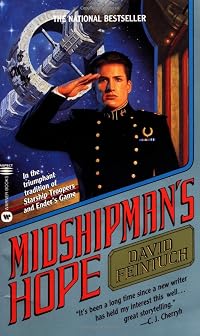
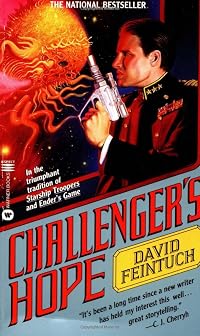
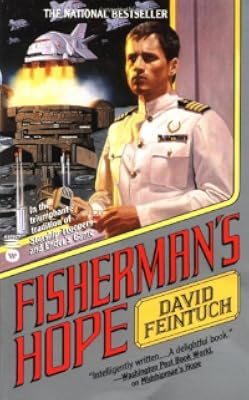
The cover blurb says this book is
In the triumphant tradition of Starship Troopers and Ender's Game
I disagree. Midshipman's Hope is nothing like either of those books, other than being military science fiction. What Midshipman's Hope is really like is Mr. Midshipman Hornblower or Master and Commander. Each of these works is about the Napoleonic British navy, and tell the tale of a young lad who grows to the fullness of command through daring and luck.
Feintuch's favorite period is apparently the Victorian, however. Whereas the Napoleonic navy offered plentiful opportunities for glory and treasure, the Victorians bestrode the world like a colossus, and consequently their navy had glorious traditions, but little to do other than swab the show more deck one more time. Enter Nicholas Seafort, first middy of the Hibernia. Space travel manages to be even slower than sail, with voyages of up to 18 months between worlds. This provides ample time to polish the bulkheads and study regulations.
The United Nations world government is a firm ally of the Yahwehist Reunification Church, a rather toothless low church version of the Church of England. While blasphemy is officially a capital offense, it is rarely invoked. In fact, the Reunion Church is broadly tolerant, not only of other sects, but also of every sexual vice and hedonistic practice imaginable, with the exception of carelessly procreating and smoking tobacco. Is is refreshing to see a reminder in fiction that theocratic societies aren't uniformly grim and repressive, but in fact can run the gamut from laxity to strictness.
The central psychological drama comes from Seafort's own rather Puritan upbringing. He is grim, loyal to a fault, and incapable of breaking an oath. This makes him simultaneously fascinating, and a bit depressing. Through a series of misadventures, Nick finds himself in command of the Hibernia, and he manages to do more right than wrong as Captain. But he cannot forgive himself for his failures, or sometimes even for his successes. Nick has no greater critic than himself, and in space, you have far too much time inside your own head.
There are not quite as many books in this series as either Hornblower or the Aubrey-Maturin collections, but 7 books should be enough to keep most people occupied for a while, if you can stand Nick Seafort. show less
In the triumphant tradition of Starship Troopers and Ender's Game
I disagree. Midshipman's Hope is nothing like either of those books, other than being military science fiction. What Midshipman's Hope is really like is Mr. Midshipman Hornblower or Master and Commander. Each of these works is about the Napoleonic British navy, and tell the tale of a young lad who grows to the fullness of command through daring and luck.
Feintuch's favorite period is apparently the Victorian, however. Whereas the Napoleonic navy offered plentiful opportunities for glory and treasure, the Victorians bestrode the world like a colossus, and consequently their navy had glorious traditions, but little to do other than swab the show more deck one more time. Enter Nicholas Seafort, first middy of the Hibernia. Space travel manages to be even slower than sail, with voyages of up to 18 months between worlds. This provides ample time to polish the bulkheads and study regulations.
The United Nations world government is a firm ally of the Yahwehist Reunification Church, a rather toothless low church version of the Church of England. While blasphemy is officially a capital offense, it is rarely invoked. In fact, the Reunion Church is broadly tolerant, not only of other sects, but also of every sexual vice and hedonistic practice imaginable, with the exception of carelessly procreating and smoking tobacco. Is is refreshing to see a reminder in fiction that theocratic societies aren't uniformly grim and repressive, but in fact can run the gamut from laxity to strictness.
The central psychological drama comes from Seafort's own rather Puritan upbringing. He is grim, loyal to a fault, and incapable of breaking an oath. This makes him simultaneously fascinating, and a bit depressing. Through a series of misadventures, Nick finds himself in command of the Hibernia, and he manages to do more right than wrong as Captain. But he cannot forgive himself for his failures, or sometimes even for his successes. Nick has no greater critic than himself, and in space, you have far too much time inside your own head.
There are not quite as many books in this series as either Hornblower or the Aubrey-Maturin collections, but 7 books should be enough to keep most people occupied for a while, if you can stand Nick Seafort. show less
Midshipman's Hope was named an ALA Notable book for Young Adults. I haven't been a "young" anything in a few years, but I must have an immature mind because I just finished a rereading and enjoyed it as much as I did the first time. This is a space opera adventure with no pretenses of being much more than prime entertainment.
The year is 2194. After worldwide communication has led to a breakdown of national order and a war has been fought, the United Nations is firmly in control of Earth, hand-in-hand with the Reunification Church. Interstellar travel is possible on ship-generated N waves, but a journey to the colonial planet Hope Nation takes 17 months one way. Because most people choose not to be educated, the rankings in the UN Navy show more come from the urban wastelands and discipline must be swift and harsh. Starships operate like the 19th century British navy.
Into this mix comes Nicholas Ewing Seafort, midshipman on his first interstellar flight, and senior middy in charge of the wardroom (to the chagrin of the older, more competent former senior, Vax Holser). About halfway through the trip out, a couple of tragedies leave Seafort as ranking officer, and therefore, ship's captain. Nick, the product of a cold, demanding father, is determined to be captain by the book. My only quibble is that Nick can't get outside his perfectionist self-flagellation, and the reader is subjected to his internal monologues fairly relentlessly. The science is a rather haphazard mix of 20th century and 22nd, but the adventure is the point and the adventure will keep the average adolescent and me flipping pages. show less
The year is 2194. After worldwide communication has led to a breakdown of national order and a war has been fought, the United Nations is firmly in control of Earth, hand-in-hand with the Reunification Church. Interstellar travel is possible on ship-generated N waves, but a journey to the colonial planet Hope Nation takes 17 months one way. Because most people choose not to be educated, the rankings in the UN Navy show more come from the urban wastelands and discipline must be swift and harsh. Starships operate like the 19th century British navy.
Into this mix comes Nicholas Ewing Seafort, midshipman on his first interstellar flight, and senior middy in charge of the wardroom (to the chagrin of the older, more competent former senior, Vax Holser). About halfway through the trip out, a couple of tragedies leave Seafort as ranking officer, and therefore, ship's captain. Nick, the product of a cold, demanding father, is determined to be captain by the book. My only quibble is that Nick can't get outside his perfectionist self-flagellation, and the reader is subjected to his internal monologues fairly relentlessly. The science is a rather haphazard mix of 20th century and 22nd, but the adventure is the point and the adventure will keep the average adolescent and me flipping pages. show less
Stars burn hot and silent in the deepest gulf. It is their nature, and they do it with constant and unflinching duty. Of such stuff is Nicholas Seafort.While marred by a few awkward plot complications and some general stiffness, "Midshipman's Hope" is a fast-paced, enjoyable read. Our protagonist gets few breaks as threats, both internal and external, mount with increasing complexity. This is both a coming-of-age story and an exploration of the core of leadership.
The first time I picked this up I was just a young teenager who loved Science Fiction, but I didn't have the stomach for the story at the time. I was used to Hardy Boys and Star Trek novels. Books that had very straight forward morality and 90 percent of the time ended exactly how I knew they would. This book threw me for a loop.
But, when I went back and started it again, a few years later, I found that it is an engaging story that never shies away from an uncomfortable topic, from cancer (albeit cancer in the future) to unfaithfulness, to the fun stuff (mechanical/science fiction geeky fun and explosions at inopportune times).
But, when I went back and started it again, a few years later, I found that it is an engaging story that never shies away from an uncomfortable topic, from cancer (albeit cancer in the future) to unfaithfulness, to the fun stuff (mechanical/science fiction geeky fun and explosions at inopportune times).
Midshipman's Hope is one of my favorite sci fi books. I've read it over and over. Nicholas Seafort is a futuristic young Horatio Hornblower, a midshipman who finds himself the ship's only hope on a voyage that goes from bad to worse, in a galaxy that's about to be turned upside down as humanity finds we're not alone... Heaven help that midshipman or the colonist will never reach Hope Nation.
Members
- Recently Added By
Lists

Favorite Series
238 works; 94 members

What Makes This Book So Great
102 works; 16 members

Comfort Reads
221 works; 41 members

Best Military Science Fiction
57 works; 26 members

Best Science Fiction Novels
816 works; 430 members
Author Information

15 Works 4,763 Members
Some Editions
Awards and Honors
Awards
Distinctions
Series

Work Relationships
Common Knowledge
- Canonical title
- Midshipman's Hope
- Original title
- Midshipman's Hope
- Original publication date
- 1994-11
- People/Characters
- Nicholas Seafort; Vax Holser; Alexi Tamarov; Sandy Wilsky; Lieutenant Harv Malstrom; Chief McAndrews (show all 9); Derek Carr; Amanda Frowell; the Treadwells
- Important places
- UNS Hibernia; Hope Nation; Miningcamp; Detour Station
- Epigraph
- Being the first voyage of Nicholas Seafort, U.N.N.S., in the year of our Lord 2194
- Dedication
- To Ragtime Rick of Toledo, and Ardath Mayhar, who made it possible, and to Jettie, who makes it worthwhile.
- First words
- "Stand to!" I roared, but I was too late; even as Alexi and Sandy snapped to attention, Hibernia's two senior lieutenants strolled around the corridor bend.
- Last words
- (Click to show. Warning: May contain spoilers.)I was going home. To Amanda. To my crew. To my ship.
- Blurbers
- Cherryh, C.J. ; Drake, David ; Gerrold, David ; Stirling, S. M. ; Moran, Daniel Keys ; Allen, Roger MacBride
Classifications
Statistics
- Members
- 951
- Popularity
- 28,048
- Reviews
- 16
- Rating
- (3.68)
- Languages
- Czech, English, German
- Media
- Paper, Audiobook, Ebook
- ISBNs
- 12
- ASINs
- 5