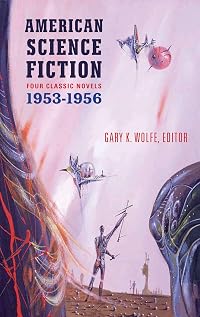
American Science Fiction: Four Classic Novels 1953–56
by Gary K. Wolfe (Editor)
On This Page
Description
Following its acclaimed three-volume edition of the novels of science fiction master Philip K. Dick, The Library of America now presents a two-volume anthology of nine groundbreaking works from the golden age of the modern science fiction novel, works by turns satiric, adventurous, incisive, and hauntingly lyrical. Long unnoticed or dismissed by the literary establishment, these visionary "outsider" novels grappled in fresh ways with a world in rapid transformation and have gradually been show more recognized as American classics that opened new imaginative territory in American writing.This first volume contains: Frederik Pohl & C. M. Kornbluth / "The Space Merchants"Theodore Sturgeon / "More Than Human"Leigh Brackett / "The Long Tomorrow"Richard Matheson / "The Shrinking Man" show lessTags
Recommendations



Member Reviews
Frederik Pohl and C. M. Kornbluth, The Space Merchants (1952)
This is a novel that has long stuck in my head because Isaac Asimov briefly mentions it in his introduction to More Soviet Science Fiction under its alternate title of "Gravy Planet," which is, to be honest, a bit of a daft title, but certainly an evocative one. It is not about a planet of literal gravy, alas. It's also not about merchants flying through space, which is what I had imagined before reading it; it's about the people trying to sell the public on going to space, the people merchanting space.
Asimov cites it as an example of what he calls the "Stage Three-C" anti-utopian science fiction story: "It deals with a dreadfully overpopulated world in which advertising show more techniques have been made the only acceptable guide to human behavior. Its gambits are: 'If the population explosion goes on—' and 'If the theory that anything that is good for business is morally correct goes on—'" The former gambit has dated itself a bit, but the latter has held up, and if anything probably seems even more likely than it did back in 1952. Senators literally represent corporate interests, no form of advertising or corporate skulduggery is illegal—except where corporations infringe on each other, they can do whatever they like to people. The main character is an advertising executive put in charge of selling Venus to the American people, who suddenly finds himself on the outs when he had been on the top.
The actual story is what it is; I don't think it's terrible or anything, but it's not why you're reading the book. It's one of those sf books you read for the world. Pohl and Kornbluth have that 1950s sf obsession with advertising-as-science, which also appears in Alfred Bester's The Demolished Man (1952), Mark Clifton and Frank Riley's They'd Rather Be Right (1954), and Philip K. Dick's Ubik (1969), this belief that with the right combination of triggers, anyone can be sold anything. The advertising satire is one of the best parts of the book; the book definitely performs a Stage Three-C gambit with the ubiquity of advertising, and it's hard to imagine that Dick hadn't read The Space Merchants. The leap that Pohl and Kornbluth don't quite make (but are so close on) is that, as John Berger would highlight in Ways of Seeing (1972), advertising doesn't just sell you a product, it sells you the entire idea that the way to improve your life is through the purchase of product. What the novel does delve into, though, is how there's an invisible class divide when it comes to marketing—well, invisible to those on the top, anyway. Some people aren't even worth selling to!
It's a quick read and a fun one; Pohl and Kornbluth have an easy style and the protagonist has a strong narrative voice. This would be fun to teach in a class on early science fiction, or one in a class on advertising in sf.
Theodore Sturgeon, More Than Human (1953)
While three of the books in this volume's companion, Five Classic Novels, 1956-1958, were Hugo winners, none of the books published here were, mostly because they come at the very beginning of the process. Though the first Hugos were given out in 1953, the second set was in 1955; the 1954 Worldcon didn't do any—and this is the year that More Than Human would have been eligible. The book was a finalist for the 1954 Retro Hugo (awarded in 2004), which was intended to fill that gap, though it lost to Ray Bradbury's Fahrenheit 451. And fair's fair, that book is a juggernaut. Even a very good book probably didn't stand a chance against it.
More Than Human is an expansion of Theodore Sturgeon's novella "Baby Is Three" (1952); the novella makes up the middle section of the novel, to which is added a first part, showing where all the main characters came from, and a third, showing where they all ended up. I had a vague inkling that I had read "Baby Is Three" though I remembered nothing about it, and when I finished More Than Human, I went and looked up "Baby Is Three" on ISFDB, which tells me I must have read it in The Science Fiction Hall of Fame, Volume Two A... which I remember as being my least favorite of the four SFWA "Hall of Fame" volumes that I have read! Sturgeon is someone I haven't read much by; as a Star Trek fan, I primarily know of him as one of the legit sf writers who was courted by Roddenberry and ended up contributing to the show; he wrote "Amok Time" and "Shore Leave," two of the second season's most significant episodes. (Trivia fans will note there is a character here named "Barrows," as well as in Sturgeon's "Shore Leave.")
Alas, the novel didn't do much for me. All science fiction is of course very much of its time, but there's a particular kind of science fiction that I feel like was popular in the middle of the twentieth century whose appeal has not really persisted, the story of (to steal a term from DC's "Captain Comet" comics) the "evolutionary throw-forward," the next phase in human evolution born ahead of time. Usually this entails precocious intelligence and psi powers. A lot of mid-century sf writers seem fascinated by this figure—but unfortunately I do not find it fascinating, and I rarely get anything out of such stories...* even if they are well told from a writing standpoint, which I must admit More Than Human was.
Sturgeon is a strong writer, with an above-average sense of voice and place for a 1950s sf author, and there were lots of little moments of characterization that shone strongly. Unfortunately, the actual story was one that largely failed to engage me. It's one of those cases where I can recognize the craft, but fundamentally the story is just doing something I don't care about.
Leigh Brackett, The Long Tomorrow (1955) / Richard Matheson, The Shrinking Man (1956)
The former was, as far as I know, my first experience of the work of Leigh Brackett, a pioneering author of her era; The Long Tomorrow was a finalist for the 1965 Hugo Award for Best Novel, but lost out to Heinlein's Double Star (1956). I've read a few pieces by Matheson, including his 1975 novel Somewhere in Time.
What strikes me reading and writing them up together is that they are both concerned with what it means to be a man. The Long Tomorrow is a bildungsroman set in a postapocalyptic United States. It's not a novel of nuclear fallout or anything; what the novel focuses on is the fact that the U.S. government banned the establishment of communities of a certain size. No more cities, no more large buildings. This slows down technological redevelopment and prevents the creation of large targets for enemy nations. The main character is a boy, later young man, from an Amish-adjacent community in rural Ohio, who struggles as he runs up against the stipulations of his family and his village. Eventually, he goes on the run, traveling to a city on the Ohio River and then further west, in search of a mythical place where people can build cities and develop advanced technology once more.
The big conflict of the novel, though, is internal. How do you decide what values to adhere to, and what ones to ignore? Especially when these values seem to boil down to a form of fanaticism? But... what is there to replace them with other than a different form of fanaticism? I am a sucker for a good bildungsroman, and this is an excellent one, my favorite of the four novels collected in this volume. Lots of acutely observed, painful human psychology wedded to strong worldbuilding and atmospheric prose. I do really like Double Star, but if this had won the Hugo, I would have been quite pleased too.
But if The Long Tomorrow is a bildungsroman, the novel of the making of a man, then The Shrinking Man is the opposite—the novel of the unmaking of a man. I had thought going in from the cheesy title of the film based on the book (The Incredible Shrinking Man, which admittedly I have not seen) that this would be a cheesy story... but actually the title is very clever. Yes, the novel is about a shrinking man, but more specifically, it is about a shrinking man. As the protagonist shrinks, he loses his sense of masculinity and thus his sense of self, he diminishes in terms of being able to think of himself as a person who can do the kind of things men are supposed to be able to do: to provide for women and to desire and be desired by women, to exert physical authority over others. I can't say I loved this novel—Matheson takes you through his diminishment in a very methodical way that sometimes becomes plodding—but it was considerably more interesting than I expected it to be, and it paired nicely with The Long Tomorrow.
As a man can be built up by figuring out what he values, so too can he be torn down by having what he values taken away. Both of these novels showcase the ability of science fiction to defamiliarize the familiar, to get the reader to reconsider how their world operates by presenting a different one.
* One exception: I do remember really liking Wilmar Shiras's "In Hiding" (1948), which is collected in The Science Fiction Hall of Fame, Volume Two B. Maybe that's because, if I recall correctly, its precocious superchild was a Boy Scout! show less
This is a novel that has long stuck in my head because Isaac Asimov briefly mentions it in his introduction to More Soviet Science Fiction under its alternate title of "Gravy Planet," which is, to be honest, a bit of a daft title, but certainly an evocative one. It is not about a planet of literal gravy, alas. It's also not about merchants flying through space, which is what I had imagined before reading it; it's about the people trying to sell the public on going to space, the people merchanting space.
Asimov cites it as an example of what he calls the "Stage Three-C" anti-utopian science fiction story: "It deals with a dreadfully overpopulated world in which advertising show more techniques have been made the only acceptable guide to human behavior. Its gambits are: 'If the population explosion goes on—' and 'If the theory that anything that is good for business is morally correct goes on—'" The former gambit has dated itself a bit, but the latter has held up, and if anything probably seems even more likely than it did back in 1952. Senators literally represent corporate interests, no form of advertising or corporate skulduggery is illegal—except where corporations infringe on each other, they can do whatever they like to people. The main character is an advertising executive put in charge of selling Venus to the American people, who suddenly finds himself on the outs when he had been on the top.
The actual story is what it is; I don't think it's terrible or anything, but it's not why you're reading the book. It's one of those sf books you read for the world. Pohl and Kornbluth have that 1950s sf obsession with advertising-as-science, which also appears in Alfred Bester's The Demolished Man (1952), Mark Clifton and Frank Riley's They'd Rather Be Right (1954), and Philip K. Dick's Ubik (1969), this belief that with the right combination of triggers, anyone can be sold anything. The advertising satire is one of the best parts of the book; the book definitely performs a Stage Three-C gambit with the ubiquity of advertising, and it's hard to imagine that Dick hadn't read The Space Merchants. The leap that Pohl and Kornbluth don't quite make (but are so close on) is that, as John Berger would highlight in Ways of Seeing (1972), advertising doesn't just sell you a product, it sells you the entire idea that the way to improve your life is through the purchase of product. What the novel does delve into, though, is how there's an invisible class divide when it comes to marketing—well, invisible to those on the top, anyway. Some people aren't even worth selling to!
It's a quick read and a fun one; Pohl and Kornbluth have an easy style and the protagonist has a strong narrative voice. This would be fun to teach in a class on early science fiction, or one in a class on advertising in sf.
Theodore Sturgeon, More Than Human (1953)
While three of the books in this volume's companion, Five Classic Novels, 1956-1958, were Hugo winners, none of the books published here were, mostly because they come at the very beginning of the process. Though the first Hugos were given out in 1953, the second set was in 1955; the 1954 Worldcon didn't do any—and this is the year that More Than Human would have been eligible. The book was a finalist for the 1954 Retro Hugo (awarded in 2004), which was intended to fill that gap, though it lost to Ray Bradbury's Fahrenheit 451. And fair's fair, that book is a juggernaut. Even a very good book probably didn't stand a chance against it.
More Than Human is an expansion of Theodore Sturgeon's novella "Baby Is Three" (1952); the novella makes up the middle section of the novel, to which is added a first part, showing where all the main characters came from, and a third, showing where they all ended up. I had a vague inkling that I had read "Baby Is Three" though I remembered nothing about it, and when I finished More Than Human, I went and looked up "Baby Is Three" on ISFDB, which tells me I must have read it in The Science Fiction Hall of Fame, Volume Two A... which I remember as being my least favorite of the four SFWA "Hall of Fame" volumes that I have read! Sturgeon is someone I haven't read much by; as a Star Trek fan, I primarily know of him as one of the legit sf writers who was courted by Roddenberry and ended up contributing to the show; he wrote "Amok Time" and "Shore Leave," two of the second season's most significant episodes. (Trivia fans will note there is a character here named "Barrows," as well as in Sturgeon's "Shore Leave.")
Alas, the novel didn't do much for me. All science fiction is of course very much of its time, but there's a particular kind of science fiction that I feel like was popular in the middle of the twentieth century whose appeal has not really persisted, the story of (to steal a term from DC's "Captain Comet" comics) the "evolutionary throw-forward," the next phase in human evolution born ahead of time. Usually this entails precocious intelligence and psi powers. A lot of mid-century sf writers seem fascinated by this figure—but unfortunately I do not find it fascinating, and I rarely get anything out of such stories...* even if they are well told from a writing standpoint, which I must admit More Than Human was.
Sturgeon is a strong writer, with an above-average sense of voice and place for a 1950s sf author, and there were lots of little moments of characterization that shone strongly. Unfortunately, the actual story was one that largely failed to engage me. It's one of those cases where I can recognize the craft, but fundamentally the story is just doing something I don't care about.
Leigh Brackett, The Long Tomorrow (1955) / Richard Matheson, The Shrinking Man (1956)
The former was, as far as I know, my first experience of the work of Leigh Brackett, a pioneering author of her era; The Long Tomorrow was a finalist for the 1965 Hugo Award for Best Novel, but lost out to Heinlein's Double Star (1956). I've read a few pieces by Matheson, including his 1975 novel Somewhere in Time.
What strikes me reading and writing them up together is that they are both concerned with what it means to be a man. The Long Tomorrow is a bildungsroman set in a postapocalyptic United States. It's not a novel of nuclear fallout or anything; what the novel focuses on is the fact that the U.S. government banned the establishment of communities of a certain size. No more cities, no more large buildings. This slows down technological redevelopment and prevents the creation of large targets for enemy nations. The main character is a boy, later young man, from an Amish-adjacent community in rural Ohio, who struggles as he runs up against the stipulations of his family and his village. Eventually, he goes on the run, traveling to a city on the Ohio River and then further west, in search of a mythical place where people can build cities and develop advanced technology once more.
The big conflict of the novel, though, is internal. How do you decide what values to adhere to, and what ones to ignore? Especially when these values seem to boil down to a form of fanaticism? But... what is there to replace them with other than a different form of fanaticism? I am a sucker for a good bildungsroman, and this is an excellent one, my favorite of the four novels collected in this volume. Lots of acutely observed, painful human psychology wedded to strong worldbuilding and atmospheric prose. I do really like Double Star, but if this had won the Hugo, I would have been quite pleased too.
But if The Long Tomorrow is a bildungsroman, the novel of the making of a man, then The Shrinking Man is the opposite—the novel of the unmaking of a man. I had thought going in from the cheesy title of the film based on the book (The Incredible Shrinking Man, which admittedly I have not seen) that this would be a cheesy story... but actually the title is very clever. Yes, the novel is about a shrinking man, but more specifically, it is about a shrinking man. As the protagonist shrinks, he loses his sense of masculinity and thus his sense of self, he diminishes in terms of being able to think of himself as a person who can do the kind of things men are supposed to be able to do: to provide for women and to desire and be desired by women, to exert physical authority over others. I can't say I loved this novel—Matheson takes you through his diminishment in a very methodical way that sometimes becomes plodding—but it was considerably more interesting than I expected it to be, and it paired nicely with The Long Tomorrow.
As a man can be built up by figuring out what he values, so too can he be torn down by having what he values taken away. Both of these novels showcase the ability of science fiction to defamiliarize the familiar, to get the reader to reconsider how their world operates by presenting a different one.
* One exception: I do remember really liking Wilmar Shiras's "In Hiding" (1948), which is collected in The Science Fiction Hall of Fame, Volume Two B. Maybe that's because, if I recall correctly, its precocious superchild was a Boy Scout! show less
The Space Merchants by Frederik Pohl & C.M. Kornbluth
So many aspects of this book felt like such familiar tropes that I was constantly wondering if this was the book that spawned them all, or if it was borrowing as well from what had already been established in the genre.
At times the book is pretty stiff, but really, it takes unrestrained capitalism and a rigid class system to an extreme end and offers up a pretty disturbing dystopia. But then often undermines itself as a commentary with a protagonist who for most of the book doesn't really believe the critique (and in the end, may only be pretending to get the girl), and by implying this is still a meritocracy by how easily and quickly he gains mobility and reputation after being flung show more to the bottom of the ladder, based on his education and ability to write.
Also a bit disjointed (but with two authors and multiple editors, it's easy to see why). But there are memorable scenes and interesting concepts. Overall I enjoyed it quite a lot.
More than Human by Theodore Sturgeon
This was my least favorite book of the four. At times startlingly original, wickedly funny, or deeply touching, there were long stretches in between where I felt alienated from all of the characters, confused about what was going on, or totally bored. Each of the characters has special abilities, and though they develop strong bonds with each other, they struggle to find a morality that fits being in a world where none are their equals. For much of the book, this results in no discernible morality at all, which was off-putting. Though I was relieved that the ending attempted to rescue the book from being some Randian fantasy.
The Long Tomorrow by Leigh Brackett
In a post-apocalyptic world, who would survive? In Brackett's book, it's the Amish and Mennonites who are least bothered by the sudden absence of a power grid, amongst all the other amenities provided by industrialization, and so it is no surprise that the narrative of the Destruction becomes that God passed judgement against our wicked, lay ways, and both technologies and cities (any settlement over a certain size), are not just forbidden, but outlawed.
But what technologies would be left behind, possibly preserved in secret enclaves? And what becomes of the basic human inclination to learn and to discover, when being interested in such secrets can provoke a lynching? And even if you intellectually reject the prejudices of your childhood, might some be programmed too deep to be conquered?
Very interesting. And I'm not just saying that because it's the only novel in the collection written by a woman.
The Shrinking Man y Richard Matheson
Sometimes familiar, often bitter, generally an adept metaphor for male anxiety in an impersonal, often uncaring world, it is the story of a man who shrinks one-seventh of an inch a day. Progressively alienated from a world not designed for him, unable to take even himself seriously as a man, it seems sure to be a long slide to a desperate end. Yet the ending is shockingly hopeful! I probably never would have read this book had it not been included here, and I'm glad that I did. show less
So many aspects of this book felt like such familiar tropes that I was constantly wondering if this was the book that spawned them all, or if it was borrowing as well from what had already been established in the genre.
At times the book is pretty stiff, but really, it takes unrestrained capitalism and a rigid class system to an extreme end and offers up a pretty disturbing dystopia. But then often undermines itself as a commentary with a protagonist who for most of the book doesn't really believe the critique (and in the end, may only be pretending to get the girl), and by implying this is still a meritocracy by how easily and quickly he gains mobility and reputation after being flung show more to the bottom of the ladder, based on his education and ability to write.
Also a bit disjointed (but with two authors and multiple editors, it's easy to see why). But there are memorable scenes and interesting concepts. Overall I enjoyed it quite a lot.
More than Human by Theodore Sturgeon
This was my least favorite book of the four. At times startlingly original, wickedly funny, or deeply touching, there were long stretches in between where I felt alienated from all of the characters, confused about what was going on, or totally bored. Each of the characters has special abilities, and though they develop strong bonds with each other, they struggle to find a morality that fits being in a world where none are their equals. For much of the book, this results in no discernible morality at all, which was off-putting. Though I was relieved that the ending attempted to rescue the book from being some Randian fantasy.
The Long Tomorrow by Leigh Brackett
In a post-apocalyptic world, who would survive? In Brackett's book, it's the Amish and Mennonites who are least bothered by the sudden absence of a power grid, amongst all the other amenities provided by industrialization, and so it is no surprise that the narrative of the Destruction becomes that God passed judgement against our wicked, lay ways, and both technologies and cities (any settlement over a certain size), are not just forbidden, but outlawed.
But what technologies would be left behind, possibly preserved in secret enclaves? And what becomes of the basic human inclination to learn and to discover, when being interested in such secrets can provoke a lynching? And even if you intellectually reject the prejudices of your childhood, might some be programmed too deep to be conquered?
Very interesting. And I'm not just saying that because it's the only novel in the collection written by a woman.
The Shrinking Man y Richard Matheson
Sometimes familiar, often bitter, generally an adept metaphor for male anxiety in an impersonal, often uncaring world, it is the story of a man who shrinks one-seventh of an inch a day. Progressively alienated from a world not designed for him, unable to take even himself seriously as a man, it seems sure to be a long slide to a desperate end. Yet the ending is shockingly hopeful! I probably never would have read this book had it not been included here, and I'm glad that I did. show less
I found this collection outstanding. Not perfect, mind you, but quite wonderful. And it counts as 4 books in my bookreading count. (my count, my rules ;)
Favorite book would be The Shrinking Man (better than the movie, which is one of my favorites). Favorite writing would be Sturgeon's in More Than Human. I hadn't read any of his works before this. Which is also true about Frederick Pohl and Leigh Brackett. Really enjoyed their stories, too.
If you want to read some classic sf, that's not all rocket parts and physics and dry as dust, give this collection a spin.
Favorite book would be The Shrinking Man (better than the movie, which is one of my favorites). Favorite writing would be Sturgeon's in More Than Human. I hadn't read any of his works before this. Which is also true about Frederick Pohl and Leigh Brackett. Really enjoyed their stories, too.
If you want to read some classic sf, that's not all rocket parts and physics and dry as dust, give this collection a spin.
The Space Merchants
Welcome to the future. Everybody has been turned into happy consumers by sophisticated advertising techniques that have a touch of Huxley's Brave New World.
Earth is about to begin the exploration of Venus and Mitchell Courtenay has been selected to run the Venus project by Fowler Schocken the head of the biggest ad agency in the world Schocken Associates.
But Mitchell Courtenay gets hit on the head and wakes up William George Groby. Groby has a five year contract to work skimming algae in Costa Rica. He has gone from the top of the heap to the bottom and this book is the fascinating story of how he climbs back to the top and then changes the rules. Along the way he is introduced to a side of the world he didn't know show more existed. He is shown how advertising and big industry are destroying the world by inches while it keeps everybody happy.
He meets B.J. Taunton another big advertising head who stays drunk all the time and murders people to get ahead.
The book showed an interesting glimpse of a possible future while telling a fast paced story that was very entertaining. I give it a rarely awarded five stars. show less
Welcome to the future. Everybody has been turned into happy consumers by sophisticated advertising techniques that have a touch of Huxley's Brave New World.
Earth is about to begin the exploration of Venus and Mitchell Courtenay has been selected to run the Venus project by Fowler Schocken the head of the biggest ad agency in the world Schocken Associates.
But Mitchell Courtenay gets hit on the head and wakes up William George Groby. Groby has a five year contract to work skimming algae in Costa Rica. He has gone from the top of the heap to the bottom and this book is the fascinating story of how he climbs back to the top and then changes the rules. Along the way he is introduced to a side of the world he didn't know show more existed. He is shown how advertising and big industry are destroying the world by inches while it keeps everybody happy.
He meets B.J. Taunton another big advertising head who stays drunk all the time and murders people to get ahead.
The book showed an interesting glimpse of a possible future while telling a fast paced story that was very entertaining. I give it a rarely awarded five stars. show less
Ratings
Members
- Recently Added By
Author Information

All Editions
Series
Belongs to Publisher Series
Library of America (227)
Work Relationships
Common Knowledge
- Canonical title
- American Science Fiction: Four Classic Novels 1953–56
- Alternate titles
- American Science Fiction: Four Classic Novels 1953-56 (LOA #227) (LOA #227)
- Original publication date
- 2012-09
- First words
- As I dressed that morning I ran over in my mind the long list of statistics, evasions, and exaggerations that they would expect in my report.
- Last words
- (Click to show. Warning: May contain spoilers.)Scott Carey ran into his new world, searching.
Classifications
- Genres
- Fiction and Literature, Science Fiction
- DDC/MDS
- 813.0876208 — Literature & rhetoric American literature in English American fiction in English By type Genre fiction Adventure fiction Speculative fiction Science fiction Collections and anthologies Anthologies
- LCC
- PS648 .S3 .A5154 — Language and Literature American literature American literature Collections of American literature Prose (General)
- BISAC
Statistics
- Members
- 224
- Popularity
- 145,953
- Reviews
- 4
- Rating
- (4.31)
- Languages
- English
- Media
- Paper
- ISBNs
- 1
- ASINs
- 1