
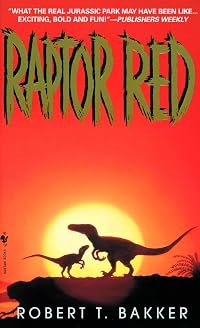
Raptor Red
by Robert T. Bakker
On This Page
Description
A stunning debut in the blockbuster tradition of Jurassic Park -- enhanced with dramatic sound effects. A pair of fierce but beautiful eyes look out from the undergrowth of conifers. The eyes follow every movement in the great herd of plant-eating dinosaurs that mills around the open meadows, moving back and forth with the rapid scanning of a hunter who is thinking about everything she sees. She is an intelligent time -- 120 million years ago. The place -- the plains of prehistoric Utah. The show more eyes belong to one of the most unforgettable heroines you will ever meet. Her name -- Raptor Red. Raptor Red is a female raptor dinosaur, struggling to survive on her own after losing her mate. Painting a rich and colorful picture of a lush prehistoric world, leading paleontologist Robert T. Bakker tells the story from within Raptor Red's extraordinary mind, dramatizing his groundbreaking theories in an exciting, one-of-a-kind tale. With keen insight and stunning authenticity, he tracks the raptor on her yearlong odyssey of survival as she braves a devastating storm, migrates toward the ocean to escape powerful predators, and heads north in a desperate attempt to escape the threat of deadly acrocanthosaurs, all while carrying out her natural duty to search for a new mate.From its tragic opening to its thrilling climax on a snowy mountaintop, Raptor Red is a unique and utterly compelling look at a year in the life of a dinosaur -- a revolutionary work of fiction. show lessTags
Recommendations






























Member Recommendations
Member Reviews
When I grabbed this off the swap shelf at Tesco I wasn't expecting more than a fun little read to tide me over. I was not expecting to be thoroughly drawn into Red's world and to be so invested in these dinosaurs. I guess once a dinosaur kid, always a dinosaur kid. Kind of 'Land Before Time' but for adults.
With Raptor Red, Robert Bakker gives us a glimpse at a long distant past through the eyes of a creature unlike any other. We follow Raptor Red, a young female utahraptor who has just lost her mate. Desperate for company, and the possibility of a new mate, Raptor Red searches for others of her kind. In a stroke of rapturine luck, she stumbles upon her sister, who has also lost a mate. Red’s sister has three chicks she is raising alone, so Red joins her to help care for them. The next year will find the raptor family, along with other raptor packs, moving farther and farther west, escaping from encroachment by acrocanthosaurs.
A potential mate joins the small group, but he's eventually driven off by Red’s sister, who doesn't approve show more of a foreign male near her chicks. He's too much of a danger. Even though it's Red and not her sister that he's interested in, there's still the possibility that he could turn on the chicks because they aren't his. The loss of two pack members make finding a partner priority for Red. They need hunting help. Year's end finds the pack increased significantly, with lifemate pairs, and new chicks. They've entered a land where, for now, there is an abundance of food.
Told entirely from the view of these sentient yet vastly different beings, Raptor Red breathes life and vibrancy into dusty bones of the ancient past. Much, by necessity, is speculation. There's plenty of evidence to suggest that raptors could have, and likely would have, behaved in such ways. These were the beasties that our birds eventually descended from, after all. There's a reason why they share the same appellation as our modern birds of prey.
Occasionally, the author delved into the minds of other species. I enjoyed seeing the thought processes of these other beasts, such as astrodon, and gastonia, a brontosaurid, and ankylosaurid respectively. Oh, and the Trinity turtle! It was cute to see how the curious raptors interacted with the environment. Red investigates the turtle, turning the closed shell into a toy before finally leaving the placid, patient creature to her business. She and her family play with a small troop of troodon in the snow. Other critters were quite smart in their own way, too. The big, white-winged pterosaur that worked with the raptors, like wolves and ravens, scouting potential prey and leading the pack to it. This is the perfect read for anyone interested in dinosaurs, or who enjoys animal-centric stories.
***This book was purchased for my own pleasure, with no expectation of a review. show less
A potential mate joins the small group, but he's eventually driven off by Red’s sister, who doesn't approve show more of a foreign male near her chicks. He's too much of a danger. Even though it's Red and not her sister that he's interested in, there's still the possibility that he could turn on the chicks because they aren't his. The loss of two pack members make finding a partner priority for Red. They need hunting help. Year's end finds the pack increased significantly, with lifemate pairs, and new chicks. They've entered a land where, for now, there is an abundance of food.
Told entirely from the view of these sentient yet vastly different beings, Raptor Red breathes life and vibrancy into dusty bones of the ancient past. Much, by necessity, is speculation. There's plenty of evidence to suggest that raptors could have, and likely would have, behaved in such ways. These were the beasties that our birds eventually descended from, after all. There's a reason why they share the same appellation as our modern birds of prey.
Occasionally, the author delved into the minds of other species. I enjoyed seeing the thought processes of these other beasts, such as astrodon, and gastonia, a brontosaurid, and ankylosaurid respectively. Oh, and the Trinity turtle! It was cute to see how the curious raptors interacted with the environment. Red investigates the turtle, turning the closed shell into a toy before finally leaving the placid, patient creature to her business. She and her family play with a small troop of troodon in the snow. Other critters were quite smart in their own way, too. The big, white-winged pterosaur that worked with the raptors, like wolves and ravens, scouting potential prey and leading the pack to it. This is the perfect read for anyone interested in dinosaurs, or who enjoys animal-centric stories.
***This book was purchased for my own pleasure, with no expectation of a review. show less
"The time is a hundred and twenty million years ago. On the flat, featureless floodplains that were central Utah, an evolutionary event is about to occur that will shock the ecological community of dinosaurs. This event is the arrival of a new superpredator."
- Raptor Red by Robert T. Bakker
Robert T. Bakker's Raptor Red is the story of the giant Utahraptor, as told through the eyes and experiences of a young female living in the Early Cretaceous period. Pieced together from the fossil remains of Utahraptor and from other clues found in the surrounding sediments, Raptor Red gives the reader a glimpse into evolutionary forces that were changing the natural world during the Early Cretaceous period. During this time, the invisible hand of show more natural selection was creating not only our own human relatives, but also the earliest beginnings of other animals and plants that enjoy supremacy in today's world. Bakker reminds us that Utahraptor's story is part of our story - hers was a "beautifully alert and sentient species", and her story is nothing short of astonishing.
I was never a "dinosaur girl" growing up - that distinction belonged to my little sister. I can remember her having lots of books and toy dinosaurs laying around when we were children. I always thought of dinosaurs as a "boy thing", so I was just not interested. As I grew up and went to college, I became interested in evolutionary biology and biological anthropology, etc., and I now proudly proclaim to the world that I am very much a "dinosaur girl", and hope to read many more books on the subject! But I digress...
Back to the book. The heroine in this novel is almost identical to the Velociraptor made famous by the blockbuster movie "Jurassic Park" about a year after the discovery of her fossil remains. This new species in the fossil record - christened Utahraptor - is Raptor Red, our heroine. She is an intelligent killer, a fast-moving, 500-pound beast with razor-sharp claws and feet.
Bakker relates Raptor Red's story beautifully, with more character development than you will find in many novels about people. From the first pages of her story, you find yourself identifying with Raptor Red, holding your breath when she stalks her prey and when she is in danger, aching for her loss, sighing as she rejoins her sister's pod, and celebrating when she finds a new mate.
When an author attempts to evoke the life experiences of an animal from the animal's point of view, it can sometimes fall flat if the research concerning the subject is not credible. This is not the case in Raptor Red. It is clear from the beginning, that Bakker knows his subject. The action is fast-paced and incredible, while the science behind the story remains authentic and well-researched.
Raptor Red is a highly entertaining novel, full of scientific explanation that is subtly weaved into the story. Utahraptor was an intelligent, cunning, and efficient superpredator with an amazingly complex society. I thoroughly enjoyed reading about Raptor Red's intelligence, ingenuity, and inquisitiveness as she explored her world. The unique blend of action and information in Robert T. Bakker's Raptor Red makes for a compelling read for anyone interested in dinosaurs or other animals. show less
- Raptor Red by Robert T. Bakker
Robert T. Bakker's Raptor Red is the story of the giant Utahraptor, as told through the eyes and experiences of a young female living in the Early Cretaceous period. Pieced together from the fossil remains of Utahraptor and from other clues found in the surrounding sediments, Raptor Red gives the reader a glimpse into evolutionary forces that were changing the natural world during the Early Cretaceous period. During this time, the invisible hand of show more natural selection was creating not only our own human relatives, but also the earliest beginnings of other animals and plants that enjoy supremacy in today's world. Bakker reminds us that Utahraptor's story is part of our story - hers was a "beautifully alert and sentient species", and her story is nothing short of astonishing.
I was never a "dinosaur girl" growing up - that distinction belonged to my little sister. I can remember her having lots of books and toy dinosaurs laying around when we were children. I always thought of dinosaurs as a "boy thing", so I was just not interested. As I grew up and went to college, I became interested in evolutionary biology and biological anthropology, etc., and I now proudly proclaim to the world that I am very much a "dinosaur girl", and hope to read many more books on the subject! But I digress...
Back to the book. The heroine in this novel is almost identical to the Velociraptor made famous by the blockbuster movie "Jurassic Park" about a year after the discovery of her fossil remains. This new species in the fossil record - christened Utahraptor - is Raptor Red, our heroine. She is an intelligent killer, a fast-moving, 500-pound beast with razor-sharp claws and feet.
Bakker relates Raptor Red's story beautifully, with more character development than you will find in many novels about people. From the first pages of her story, you find yourself identifying with Raptor Red, holding your breath when she stalks her prey and when she is in danger, aching for her loss, sighing as she rejoins her sister's pod, and celebrating when she finds a new mate.
When an author attempts to evoke the life experiences of an animal from the animal's point of view, it can sometimes fall flat if the research concerning the subject is not credible. This is not the case in Raptor Red. It is clear from the beginning, that Bakker knows his subject. The action is fast-paced and incredible, while the science behind the story remains authentic and well-researched.
Raptor Red is a highly entertaining novel, full of scientific explanation that is subtly weaved into the story. Utahraptor was an intelligent, cunning, and efficient superpredator with an amazingly complex society. I thoroughly enjoyed reading about Raptor Red's intelligence, ingenuity, and inquisitiveness as she explored her world. The unique blend of action and information in Robert T. Bakker's Raptor Red makes for a compelling read for anyone interested in dinosaurs or other animals. show less
While this is a romanticized portrait of "Raptor Red" and her family and mates, it nonetheless accomplishes everything that a solid, great novel should. I was astounded with the depth and accuracy that you are able to experience the novel with once you give some credence and credibility (as well as creative license) to the author. This is really a fine book and one that should be remembered.
4.5 stars- VERY well done.
4.5 stars- VERY well done.
What an entertaining book! Famous paleontologist Robert Bakker has written a biography of one particular dinosaur who lived 120 million years ago in what is now Utah. Appropriately, she is known as a Utah Raptor and is named Raptor Red. It is the story of her life as pieced together through her fossil record and paleontological research.
I am 71 years old. When I was a child and first learned about dinosaurs, they were presented as giant, cold blooded lizard related animals. So, too, was Robert Bakker. However, Dr. Bakker now convincingly argues just the opposite. He believes that they were warm blooded, mobile, intelligent, social animals. Raptor Red reflects this proposition.
Some of the professional criticism this book received when show more first published was that it was not well written (I disagree) and that he mixed up some of the fauna and animal life into the time frame. I'm okay with this because Dr. Bakker never intended this book to be a professional journal, but rather an entertaining novel in which he could present his theories about dinosaurs and their behavior, as well as teach a bit about evolution itself to the general, non scientific public. In this attempt he does an excellent job.
Written from the point of view of an outside observer, this unusual story is highly entertaining for those of us who have always had a soft spot for dinosaurs. By the way, Utah Raptor is the dinosaur featured in Jurassic Park that is not T-Rex. Coincidently, the movie (and those raptors) were being made at the same time as the first fossils were being discovered of Utah Raptor, justifying the larger size of the raptors in the movie. Velociraptors were much smaller. Calvin would definitely own this book! show less
I am 71 years old. When I was a child and first learned about dinosaurs, they were presented as giant, cold blooded lizard related animals. So, too, was Robert Bakker. However, Dr. Bakker now convincingly argues just the opposite. He believes that they were warm blooded, mobile, intelligent, social animals. Raptor Red reflects this proposition.
Some of the professional criticism this book received when show more first published was that it was not well written (I disagree) and that he mixed up some of the fauna and animal life into the time frame. I'm okay with this because Dr. Bakker never intended this book to be a professional journal, but rather an entertaining novel in which he could present his theories about dinosaurs and their behavior, as well as teach a bit about evolution itself to the general, non scientific public. In this attempt he does an excellent job.
Written from the point of view of an outside observer, this unusual story is highly entertaining for those of us who have always had a soft spot for dinosaurs. By the way, Utah Raptor is the dinosaur featured in Jurassic Park that is not T-Rex. Coincidently, the movie (and those raptors) were being made at the same time as the first fossils were being discovered of Utah Raptor, justifying the larger size of the raptors in the movie. Velociraptors were much smaller. Calvin would definitely own this book! show less
Every once in a while you're lucky enough to find a book that seems like it was written just for you. This is one of those books for myself. Set in the early cretacous the story follows a female Utahraptor in her battles to survive. It does its best to put you in the mindset of a dinosaur and tells of a remarkable journey. It was also just plain relaxing to read.
A few events in the book are based on fossil evidence such as a flood. The rest is sciences best guess on what life for the species would have meant. Written in 96. I'm sure if it was written 10 years later Raptor Red would have been feathered. The author is most famous for his proposal that dinosaurs were not cold blooded reptiles but had similar physiology to birds (which is show more widely accepted now) so the author goes into detail about their ability to stay warm, he even described counter-current heat exchange briefly which is commonplace in birds. I'm sure he's now focused on other research but I think it'd be fantastic if it could be revised routinely to include new discoveries in relation to the Utahraptor or the other species described in the book.
How wonderful to dedicate your life to research and then be able to share a story based on it. show less
A few events in the book are based on fossil evidence such as a flood. The rest is sciences best guess on what life for the species would have meant. Written in 96. I'm sure if it was written 10 years later Raptor Red would have been feathered. The author is most famous for his proposal that dinosaurs were not cold blooded reptiles but had similar physiology to birds (which is show more widely accepted now) so the author goes into detail about their ability to stay warm, he even described counter-current heat exchange briefly which is commonplace in birds. I'm sure he's now focused on other research but I think it'd be fantastic if it could be revised routinely to include new discoveries in relation to the Utahraptor or the other species described in the book.
How wonderful to dedicate your life to research and then be able to share a story based on it. show less
I saw this book mentioned somewhere recently and it piqued my interest. Paleontologist Robert Bakker was noted in the 80's for his revolutionary theories on dinosaurs popularized in his non-fiction book The Dinosaur Heresies. He wrote a few children's books and one fiction novel for older (adult) readers and this is it. It is certainly something different. It is a story of one year in the life of a female Utahraptor; he names her "Raptor Red". This book essentially brings Bakker's theories to life.
Bakker includes a preface and epilogue to supplement his story. I'll quote Bakker from his introductory pages to the novel to best explain:
"We can learn from Utahraptor's story. Hers was a beautifully alert and sentient species. By looking show more through her eyes we can see the evolutionary forces that were changing the natural world during the Early Cretaceous. Our own human ancestors were being created by the invisible hand of natural selection, as were the beginnings of the other animals and plants that enjoy supremacy in today's world. Utahraptor's story is part of our story.
The story begins with an invasion, an ambush, and a death.
----------
The time is a hundred and twenty million years ago. On the flat, featureless floodplains that were central Utah, an evolutionary event is about to occur that will shock the ecological community of dinosaurs. The event is the arrival of a new superpredator."
Although intrigued, I wasn't excited about this book like I might have been if I was 10 or 11 years old. I did enjoy it but I felt like I was watching a documentary reenactment of some sort much of the time. I could even hear Rex Allen inside my head doing the narration. It kept my interest throughout and I did learn some things. I think a novel like this would be most enjoyed by middle school students. Throughout the novel I felt I was being taught to, but I give it credit for teaching in a way that mostly avoided dry details. Towards the latter part of the book the didactic tone lessens considerably and the story picked up and I liked it more and more. I can also understand a bit better the fun that being a dinosaur fossil hunter could bring.
This novel falls into the lower end of what I consider a good read. show less
Bakker includes a preface and epilogue to supplement his story. I'll quote Bakker from his introductory pages to the novel to best explain:
"We can learn from Utahraptor's story. Hers was a beautifully alert and sentient species. By looking show more through her eyes we can see the evolutionary forces that were changing the natural world during the Early Cretaceous. Our own human ancestors were being created by the invisible hand of natural selection, as were the beginnings of the other animals and plants that enjoy supremacy in today's world. Utahraptor's story is part of our story.
The story begins with an invasion, an ambush, and a death.
----------
The time is a hundred and twenty million years ago. On the flat, featureless floodplains that were central Utah, an evolutionary event is about to occur that will shock the ecological community of dinosaurs. The event is the arrival of a new superpredator."
Although intrigued, I wasn't excited about this book like I might have been if I was 10 or 11 years old. I did enjoy it but I felt like I was watching a documentary reenactment of some sort much of the time. I could even hear Rex Allen inside my head doing the narration. It kept my interest throughout and I did learn some things. I think a novel like this would be most enjoyed by middle school students. Throughout the novel I felt I was being taught to, but I give it credit for teaching in a way that mostly avoided dry details. Towards the latter part of the book the didactic tone lessens considerably and the story picked up and I liked it more and more. I can also understand a bit better the fun that being a dinosaur fossil hunter could bring.
This novel falls into the lower end of what I consider a good read. show less
Members
- Recently Added By
Lists

Best Prehistoric Novels
64 works; 10 members

Geology - Fiction
13 works; 2 members

Our Favorite Comfort Reads
334 works; 200 members

Books We Couldn't Put Down
443 works; 197 members
Books We Want To Read Again For The First Time
384 works; 160 members

The Five Books That Represent Us
390 works; 147 members
Author Information

20+ Works 2,297 Members
Some Editions
Awards and Honors
Notable Lists
Common Knowledge
- Canonical title
- Raptor Red
- Original publication date
- 1995
- First words
- "Call her Utahraptor."
A pair of fierce but beautiful eyes look out from the dull green undergrowth of conifers and ferns that bound the edges of mud flats and riverbeds. - Last words
- (Click to show. Warning: May contain spoilers.)A significant minority—twenty percent or so--will say they like Utahraptor best.
(Click to show. Warning: May contain spoilers.)When I imagine Raptor Red, she is looking at me with eyes like those.
Classifications
- Genres
- Fiction and Literature, General Fiction, Science Fiction, Historical Fiction
- DDC/MDS
- 813.54 — Literature & rhetoric American literature in English American fiction in English 1900-1999 1945-1999
- LCC
- PS3552 .A43814 .R3 — Language and Literature American literature American literature Individual authors 1961-
- BISAC
Statistics
- Members
- 1,043
- Popularity
- 24,655
- Reviews
- 23
- Rating
- (3.91)
- Languages
- 6 — English, French, German, Italian, Norwegian (Bokmål), Portuguese
- Media
- Paper, Audiobook, Ebook
- ISBNs
- 20
- ASINs
- 8