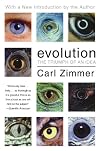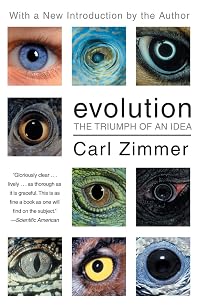
Evolution: The Triumph of an Idea
by Carl Zimmer 
On This Page
Description
This remarkable book presents a rich and up–to–date view of evolution that explores the far–reaching implications of Darwin's theory and emphasizes the power, significance, and relevance of evolution to our lives today. After all, we ourselves are the product of evolution, and we can tackle many of our gravest challenges –– from lethal resurgence of antiobiotic–resistant diseases to the wave of extinctions that looms before us –– with a sound understanding of the science.Tags
Recommendations



















Member Reviews
Drawing upon the Beagle's journey, Carl Zimmer leads us through time and space to tell us how evolution through natural selection came to impose itself in the scientific realm.
In this superb book, easy to read yet abounding in details, very well documented, biology waltzes with suitors as diverse as palaeontology to geology and prehistory, showing that evolution is more than a explanation for the diversity of life on Earth: its understanding is crucial to our survival, from medicine to environmental issues. Facts are dancing before our wondering eyes, displaying how deep, brilliant, but also dangerous Darwin's idea was.
Indeed, Carl Zimmer deals not only with social Darwinism, but, also, with the existence or not of God in a last chapter show more where, sparing deism, he nevertheless dismisses both creationism and so-called 'intelligent design'.
A golden mine of information! show less
In this superb book, easy to read yet abounding in details, very well documented, biology waltzes with suitors as diverse as palaeontology to geology and prehistory, showing that evolution is more than a explanation for the diversity of life on Earth: its understanding is crucial to our survival, from medicine to environmental issues. Facts are dancing before our wondering eyes, displaying how deep, brilliant, but also dangerous Darwin's idea was.
Indeed, Carl Zimmer deals not only with social Darwinism, but, also, with the existence or not of God in a last chapter show more where, sparing deism, he nevertheless dismisses both creationism and so-called 'intelligent design'.
A golden mine of information! show less
Science writing, and especially history of science writing, always has two opposite goals. On the one hand, one wants to show how brilliant and far reaching the described work is, wrapping the story into a neat narrative and disarming the opponents of the described ideas and theories. On the other hand, one wants to portray the research process as honestly as possible, and there are always diversions, bumps in the road, lengthy periods of verification, dissent among scientists and the public at large, personalities of key players. Balancing between these two poles is what makes great science writing, and Zimmer does an admirable job. This book is sort of a catch-all story of evolution, from Darwin's biography to current scientific show more research in diverse fields (virology and human health, ecology, genetics) to the debate about what should be taught in American public schools.
Gould's introduction is a little odd, since the book is mostly history and his topic is decidedly philosophical (the nature of scientific knowledge). Zimmer does get into a little bit of philosophy at the end, but that's clearly not his strength. The best parts of the book are the insights into Darwin's life and the lives of the people who are still testing the hypotheses spawned from the theory of natural selection. There are some very personal details (the color of Anne Darwin's vomit) and some very good quotations from researchers that perfectly encapsulate the fascination with the subject, the large body of observation and the hesitation to speculate before more evidence is gathered that seems to be widespread among people knee-deep in a research project ("One possible scenario is that pathogens wipe out entire gardens. Then the ants are forced to go to neighboring ants and steal a replacement, or temporarily join with them in one happy community. But occasionally we also see them invade a neighboring nest and wipe out the ants and take over their gardens." p. 206). show less
Gould's introduction is a little odd, since the book is mostly history and his topic is decidedly philosophical (the nature of scientific knowledge). Zimmer does get into a little bit of philosophy at the end, but that's clearly not his strength. The best parts of the book are the insights into Darwin's life and the lives of the people who are still testing the hypotheses spawned from the theory of natural selection. There are some very personal details (the color of Anne Darwin's vomit) and some very good quotations from researchers that perfectly encapsulate the fascination with the subject, the large body of observation and the hesitation to speculate before more evidence is gathered that seems to be widespread among people knee-deep in a research project ("One possible scenario is that pathogens wipe out entire gardens. Then the ants are forced to go to neighboring ants and steal a replacement, or temporarily join with them in one happy community. But occasionally we also see them invade a neighboring nest and wipe out the ants and take over their gardens." p. 206). show less
An interesting exploration of the evolutionary worldview, as it was understood in 2002. It spoils itself by wasting a chapter attacking Creationism and ID.
-My second read of this (first was in 2007... yes, 14 years ago)
Zimmer presents an extremely concise, understandable approach to the subjects he covers in his journalism. The present volume is a prime example.
From the plain language, to the examples to which all can understand, "Evolution: The Triumph of an Idea" is as an engaging of a text as any I've read.
Zimmer presents an extremely concise, understandable approach to the subjects he covers in his journalism. The present volume is a prime example.
From the plain language, to the examples to which all can understand, "Evolution: The Triumph of an Idea" is as an engaging of a text as any I've read.
A great introduction to the topic and covers a lot of ground, from Darwin’s life aboard the Beagle to host-bacteria arms races (stop having antibiotics, people!) to man-caused mass extinctions to whales with legs to the invention of language.
If you’re thinking of buying the book, be aware that the 2006 paperback edition does not come with those lavish illustrations the Amazon reviews mention. It’s still worth it, but I can only imagine how much better the original -and sold out- 2001 edition is, since this is a subject that really benefits from images.
If you’re thinking of buying the book, be aware that the 2006 paperback edition does not come with those lavish illustrations the Amazon reviews mention. It’s still worth it, but I can only imagine how much better the original -and sold out- 2001 edition is, since this is a subject that really benefits from images.
This is an excellent introduction or review of the theory basics. This covers sufficient detail to supply a solid foundation of evidence of change in species without being boring.
Only towards the ends does Mr Zimmer seem to begin to present ideas with some bias. I did not read the 'Natural History of Rape" by Thornhill & Palmer but I did read the original paper on the scorpion fly rape behavior. This paper was given very short shrift by Zimmer despite being good research and well written. Since the paper was not listed in his bibliography I assume he didn't even read it. The scathing review he quotes points to a small portion of the book using a small data sample that may have been of marginal applicability but I remember reading show more statistic papers with very large data samples relating human behavior and rape victim ages so I know there is far more work being done that is relevant but not mentioned in Mr Zimmer's critique. This type of work by evolutionary biologists is slapped down by Zimmer as being based on minute samples and because their "samples usually a few dozen American undergraduates- mostly white, mostly affluent, - can hardly be expected to represent the universal human condition." This statement is implying this was all that was being done but I have read papers with a far broader data base so I know this isn't true.
Zimmer is being very loaded in his method of presenting the work he is ctirisizing. So while I may not be utterly familiar with all the work this type of obvious bias makes me hesitate to take other items as being fairly presented. This is me nit picking on one segment of a book I enjoyed but it bothered me. show less
Only towards the ends does Mr Zimmer seem to begin to present ideas with some bias. I did not read the 'Natural History of Rape" by Thornhill & Palmer but I did read the original paper on the scorpion fly rape behavior. This paper was given very short shrift by Zimmer despite being good research and well written. Since the paper was not listed in his bibliography I assume he didn't even read it. The scathing review he quotes points to a small portion of the book using a small data sample that may have been of marginal applicability but I remember reading show more statistic papers with very large data samples relating human behavior and rape victim ages so I know there is far more work being done that is relevant but not mentioned in Mr Zimmer's critique. This type of work by evolutionary biologists is slapped down by Zimmer as being based on minute samples and because their "samples usually a few dozen American undergraduates- mostly white, mostly affluent, - can hardly be expected to represent the universal human condition." This statement is implying this was all that was being done but I have read papers with a far broader data base so I know this isn't true.
Zimmer is being very loaded in his method of presenting the work he is ctirisizing. So while I may not be utterly familiar with all the work this type of obvious bias makes me hesitate to take other items as being fairly presented. This is me nit picking on one segment of a book I enjoyed but it bothered me. show less
Probably the best summary of evolution out there. Very good read. Zimmer is a great writer.
Members
- Recently Added By
Author Information

118+ Works 6,153 Members
Carl Zimmer is a columnist for the New York Times. His most recent books are Life's Edge and She Has Her Mother's Laugh, the latter named the best science book of 2018 by the Guardian. He is professor adjunct of bio-physics and biochemistry and a lecturer in English at Yale University.
Carl Zimmer is a LibraryThing Author, an author who lists their personal library on LibraryThing.
Some Editions
Awards and Honors
Distinctions
Common Knowledge
- Original publication date
- 2001
- Dedication
- To Grace
- First words
- In late October 1831 a 90-foot coaster named HMS Beagle lay docked at Plymouth, England.
- Last words
- (Click to show. Warning: May contain spoilers.)He began the exploration of this remarkable world, and he left us to walk deeper into it, without him.
- Publisher's editor
- Winston, Gail
- Blurbers
- Johanson, Donald C.; Bodanis, David; Jones, Steve; Ridley, Matt; Henig, Robin Marantz
Classifications
Statistics
- Members
- 880
- Popularity
- 30,926
- Reviews
- 12
- Rating
- (4.12)
- Languages
- Dutch, English, French, Portuguese (Portugal)
- Media
- Paper, Audiobook, Ebook
- ISBNs
- 13
- ASINs
- 4