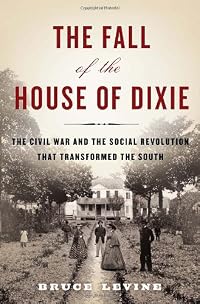
The Fall of the House of Dixie: The Civil War and the Social Revolution That Transformed the South
by Bruce Levine
On This Page
Description
In this major new history of the Civil War, Bruce Levine tells the riveting story of how that conflict upended the economic, political, and social life of the old South, utterly destroying the Confederacy and the society it represented and defended.Tags
Recommendations























Member Reviews
Great history books weave the writings of the past into a narrative to help the reader understand and feel the events, emotions and motivations of those times. Bruce Levine has written a great history book!
The haunting parallels of his quotes and citations to today's events are shivering. Citizen's United and Dred Scot? The speech given by Rand Paul days ago at CPAC about men resisting invasion of their rights to their "property" and the words of the slave masters are hair raisingly similar. The moves to Gerrymander Congressional districts and restrict voting rights, the dogma of the Tea Party and right wing Republicans, the rationalization that poverty is only because people will not work hard enough or refuse to work hard enough are show more all eerily reminiscent of the Civil War era rhetoric about slavery and rights of the wealthy and powerful. Even the trickle down economic theories we hear on Fox News and the "job creator" nonsense are all old ideas used by those who use to own people, controlling them with "stripes" (lashing with rough leather whips). The vilification of Lincoln is often only a few words different than those used now for President Obama.
The slave masters controlled the majority of Southerners by ignorance, rhetoric and pleas for their unique "Christian" doctrine. When one looks at the makeup of the current majority of the US House of Representatives it is too weird to be coincidence. There are numerous quotes from slave masters which document their designs to stay in power and preserve a form of slavery through laws to control former slaves economically.
Oh my, what we will do to each other for money and power over our fellow citizens on our short time on this rock. Will we ever take a lesson from history to move forward? I thank Providence for historians like Mr. Levine. show less
The haunting parallels of his quotes and citations to today's events are shivering. Citizen's United and Dred Scot? The speech given by Rand Paul days ago at CPAC about men resisting invasion of their rights to their "property" and the words of the slave masters are hair raisingly similar. The moves to Gerrymander Congressional districts and restrict voting rights, the dogma of the Tea Party and right wing Republicans, the rationalization that poverty is only because people will not work hard enough or refuse to work hard enough are show more all eerily reminiscent of the Civil War era rhetoric about slavery and rights of the wealthy and powerful. Even the trickle down economic theories we hear on Fox News and the "job creator" nonsense are all old ideas used by those who use to own people, controlling them with "stripes" (lashing with rough leather whips). The vilification of Lincoln is often only a few words different than those used now for President Obama.
The slave masters controlled the majority of Southerners by ignorance, rhetoric and pleas for their unique "Christian" doctrine. When one looks at the makeup of the current majority of the US House of Representatives it is too weird to be coincidence. There are numerous quotes from slave masters which document their designs to stay in power and preserve a form of slavery through laws to control former slaves economically.
Oh my, what we will do to each other for money and power over our fellow citizens on our short time on this rock. Will we ever take a lesson from history to move forward? I thank Providence for historians like Mr. Levine. show less
A much different perspective on the Civil War, focusing on slavery and Southern Whites' relationship to it. Levine makes clear, as do some other recent books, that slavery was the reason for the civil war and that the post-war Southern revisionist view of the war as a fight for states rights was nonsense. As this narrative shows, however, Southern planters (the largest slaveholders) certainly did employ states' rights as a reason not to heed the Confederate Government's calls to provide slaves to help the army, build fortifications, and in the last resort, become soldiers. In each case, the large planters reacted with fury about an over-reaching government taking their personal property! The author shows that the breakdown of the slave show more system within the South as invading Northern armies caused slaveholders to flee, losing most of their slaves in the process, was a major factor in the hard fought and overlong Union path to victory. Levine also shows how an overly forgiving North handed their lands back to the large slaveholders or to Northern entrepreneurs who hired ex-slave labor at rock bottom prices and began the exploitation that lasted, in its worse form, for perhaps a hundred years.
If you are worn out on the Civil War and Civil War books, you should still pick up this one and have your eyes opened a bit. show less
If you are worn out on the Civil War and Civil War books, you should still pick up this one and have your eyes opened a bit. show less
Really enjoyable read about how Southern culture and social structures affected the Civil War. Lots of anecdotes mixed in with the statistics to keep things interesting!
5115. The Fall of the House of Dixie The Civil War and the Social Revolution That Transformed the South, by Bruce Levine (read 27 Jan 2014) I have read a lot on the Civil War but do not consider myself a Civil War buff. I do not think it was really necessary to read this book, but it struck me as probably an interesting book to read, and I was not wrong. It tells the story of the war from the standpoint of its effect on slavery. It shows conclusively what I have long known--the cause of the war was the desire to maintain slavery in the South. There can be no doubt of that. As usual, it was satisfying to read of the last days of the war, and that those who sought to maintain slavery had to face the truth in regard to the evil thereof and show more that it would be abolished despite the fact they thought such abolishment would be bad for them. It is true that in the years after the war the losers managed, after a time, to throttle the blacks of the South, but though it took a hundred years even that effort was eventually overcome. The book is carefully researched and fully footnoted, with an excellent bibliography. show less
This might be my fault for not reading the jacket, but I was expecting to get more social history of the South with a good deal of discussion on Reconstruction. Instead, this book gives a bird's-eye view of the Civil War with a focus on slavery and African American issues. There are a lot of books that cover the war in a far superior way.
Although the book provided a lot of information gleaned from the writings of individuals during the Civil War, the book just seemed like it took forever to get through - I read a lot of non-fiction, especially books dealing with war time, but this one I seemed to struggle with. Also, although after going back and looking at the jacket and some online information, I was surprised to see this book covered only the Civil War period in the south and did not cover any changes in the south much beyond the end of the war. I guess I was expecting, based on the subtitle of "the Social Revolution That Transformed the South" that there would be more coverage of the true social revolution in the south that has taken place in the 150 years since the show more end of the war - but that time period was not covered. Not a criticism of the book as I should have looked at the description ahead of time.... show less
Wonderful addition to the study of the social history of the Civil War.
Members
- Recently Added By
Published Reviews
ThingScore 88
A sensitive, informed rendering of the wrenching reformation of the South.
added by Richardrobert
In a deep, rich, and complex analysis of the period surrounding and including the American Civil War, University of Illinois historian Levine (Confederate Emancipation) compares the South to the House of Usher in Poe’s famous story: the prosperous and powerful South looked invincible, but it had a flaw that made its collapse slow but inevitable.
added by Richardrobert
Author Information

11+ Works 1,037 Members
Bruce Levine is J. G. Randall Professor of History at the University of Illinois at Urbana-Champaign
Common Knowledge
- Original publication date
- 2013-01-08
- Important places
- Southern States, USA; Confederate States of America
- Important events
- American Civil War
- Dedication
- to Ruth Hoffman
- First words
- Decades after the Civil War ended, Katherine Stone recalled the "gay, busy life" she led at Brokenburn, her family's 1,200-acre plantation in prewar Louisiana.
In the middle of the nineteenth century, southern writers and politicians boasted often -- and with considerable justification -- that their states were the richest, most socially stable, and most politically powerful in the ... (show all)United States as a whole (Introduction)
The House of Dixie was an imposing thing indeed. (Chapter One) - Last words
- (Click to show. Warning: May contain spoilers.)"We should rejoice that there was normal life and health enough in us to stand in our appointed place, and do this great service for mankind."
- Publisher's editor
- Bartlet, Tim; Schwoeri, Lindsey
- Blurbers
- Coates, Ta-Nehisi; Gallagher, Gary W.; Blight, David W.; McPherson, James M.; Varon, Elizabeth R.; Rediker, Marcus (show all 7); Oakes, James
Classifications
Statistics
- Members
- 484
- Popularity
- 62,103
- Reviews
- 7
- Rating
- (4.04)
- Languages
- English, Italian
- Media
- Paper, Audiobook, Ebook
- ISBNs
- 8
- ASINs
- 3