On This Page
Description
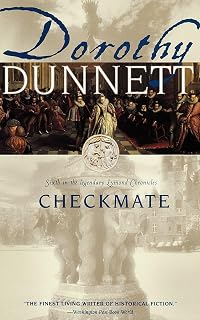
For the first time Dunnett's Lymond Chronicles are available in the United States in quality paperback editions.Sixth in the legendary Lymond Chronicles, Checkmate takes place in 1557, where Francis Crawford of Lymond is once again in France, leading an army against England. But even as the Scots adventurer succeeds brilliantly on the battlefield, his haunted past becomes a subject of intense interest to forces on both sides.
From the Trade Paperback edition.
.
Tags
Recommendations




Member Reviews
I’m done. Oh. A confession: I was reading the book slower than I could have. Yes, life happened. But I was also scared shitless of the ending, whatever is was going to be – because I know Dunnett by now, and because I didn’t want the series to end.
First, let me tell you about Dunnett character arcs. The characters climb, overcome, develop in amazing ways. Once they have climbed to a top of some kind, the author puts up a foot and kicks them from behind. You watch the flight down, gloriously rendered. Sometimes, unexpectedly, there is someone there to catch them. Sometimes there isn’t.
In this book Dunnett takes every cliche of a historical romance novel, dresses it up beautifully, then throws it in the reader’s face, laughing show more maniacally. It wasn’t at all what I expected, not after the emotional complexity of a very different kind in the previous books. This is what Dunnett is about, I suppose: subverting every expectation and breaking your heart in the process.
The above doesn’t mean that this novel is not complex – the intrigues, the court shenanigans, the adventures, the military campaigns are all great. And so is when the characters are being their own worst enemies. Yes, I am looking at you, Lymond, I have my shovel and I will not hesitate to use it.
Dunnett is so good at creating a rich tapestry. It is wonderful when viewed from a distance. And when you look closer, you find scenes and chapters that are pure genius. I loved: the assassins in the fog in Lyon; Lymond playing an apple-seller; the Antique Triumph staged for the heroes of Calais by the City Fathers of Paris – what a delicious disaster.
Lymond coming to terms with… everything is an interesting, emotional, and very bumpy journey. I have to say that his family’s closets must be very crowded. All those skeletons! Hear them snap their jaws at each other. Snappity-snap.
With Philippa, I’ve come a long way: from screaming “Philippa the brat!” at the book to “Go, Philippa, you’re awesome!” She is awesome in this book too – but a lot less so after dissolving into a love-sick sacrifice. I have a bone to pick with Dunnett for reducing her to trauma and a single emotion. Well, there is always this:
“Your self-esteem has had a lifetime of steady attention,” said Philippa abstractedly.
“You haven’t enough artillery, have you?”
“Against you or the Germans?” said Lymond.
“My dear man,” Philippa said. “It seems to me that you have no spirit left but the spirit of resentment.”
The melodrama, did I mention the melodrama? It’s intense. My dramameter broke. (Do I send the bill to the Dorothy Dunnett Society?) Dunnet’s writing makes it work. Amazingly, she also makes the soap opera events and reveals of the last chapters work. Satisfying, I tell you.
A few more favourite quotes, and I am almost done, without having said half of the things I want to say:
“You cannot love any one person adequately until you have made friends with the rest of the human race also. Adult love demands qualities which cannot be learned living in a vacuum of resentment.”
“If one believes in God, but has learned not to pray, one offers only, in silence, one’s apologies, and then asks the spirit to do what it can.”
“More than your death I fear mine; because you would be left here to mourn for me. More than your love I want peace for you; so better your need of me died, then it should become unendurable.”
And now I want to go back to the beginning and reread the whole thing!
This series is a milestone in my reading life :) show less
First, let me tell you about Dunnett character arcs. The characters climb, overcome, develop in amazing ways. Once they have climbed to a top of some kind, the author puts up a foot and kicks them from behind. You watch the flight down, gloriously rendered. Sometimes, unexpectedly, there is someone there to catch them. Sometimes there isn’t.
In this book Dunnett takes every cliche of a historical romance novel, dresses it up beautifully, then throws it in the reader’s face, laughing show more maniacally. It wasn’t at all what I expected, not after the emotional complexity of a very different kind in the previous books. This is what Dunnett is about, I suppose: subverting every expectation and breaking your heart in the process.
The above doesn’t mean that this novel is not complex – the intrigues, the court shenanigans, the adventures, the military campaigns are all great. And so is when the characters are being their own worst enemies. Yes, I am looking at you, Lymond, I have my shovel and I will not hesitate to use it.
Dunnett is so good at creating a rich tapestry. It is wonderful when viewed from a distance. And when you look closer, you find scenes and chapters that are pure genius. I loved: the assassins in the fog in Lyon; Lymond playing an apple-seller; the Antique Triumph staged for the heroes of Calais by the City Fathers of Paris – what a delicious disaster.
Lymond coming to terms with… everything is an interesting, emotional, and very bumpy journey. I have to say that his family’s closets must be very crowded. All those skeletons! Hear them snap their jaws at each other. Snappity-snap.
With Philippa, I’ve come a long way: from screaming “Philippa the brat!” at the book to “Go, Philippa, you’re awesome!” She is awesome in this book too – but a lot less so after dissolving into a love-sick sacrifice. I have a bone to pick with Dunnett for reducing her to trauma and a single emotion. Well, there is always this:
“Your self-esteem has had a lifetime of steady attention,” said Philippa abstractedly.
“You haven’t enough artillery, have you?”
“Against you or the Germans?” said Lymond.
“My dear man,” Philippa said. “It seems to me that you have no spirit left but the spirit of resentment.”
The melodrama, did I mention the melodrama? It’s intense. My dramameter broke. (Do I send the bill to the Dorothy Dunnett Society?) Dunnet’s writing makes it work. Amazingly, she also makes the soap opera events and reveals of the last chapters work. Satisfying, I tell you.
A few more favourite quotes, and I am almost done, without having said half of the things I want to say:
“You cannot love any one person adequately until you have made friends with the rest of the human race also. Adult love demands qualities which cannot be learned living in a vacuum of resentment.”
“If one believes in God, but has learned not to pray, one offers only, in silence, one’s apologies, and then asks the spirit to do what it can.”
“More than your death I fear mine; because you would be left here to mourn for me. More than your love I want peace for you; so better your need of me died, then it should become unendurable.”
And now I want to go back to the beginning and reread the whole thing!
This series is a milestone in my reading life :) show less
I absolutely dragged out the finishing of this to a ridiculous degree, to the extent that as the story moved into its final stages and the suffering of its main characters reached an unbearable pitch I began to feel guilty for protracting their agonies. I did not want to leave the world of Dorothy Dunnett, a world which as far as I'm concerned encompasses King Hereafter, Niccolo and Lymond in one massive epic generational saga. In the latter case, a characters who is introduced to us as a rogue and a bit of a prick, frankly, albeit by the end of the book proven to have been forced into the role, is stripped bare of all defences and shown to be barely hanging on by a thread thanks to a lot of things that are no fault of his own. show more Checkmate has everything - torrid romance, intrigue, action, self-sacrifice, humour, war, high pagentry, low villainy, emotions repressed so damned hard they are literally killing their repressers, and lots of French poetry. I sigh, I swoon, I'll come back soon. show less
If Lymond serves the King of France for a year in his wars, his marriage will be annulled.
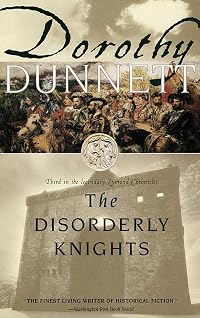
I don’t like absolutely every detail in Checkmate nor do I think it’s the most impressive of the series -- Maybe that honour goes to The Disorderly Knights? -- but, oh! how I loved it! It was so satisfying to get progress on -- and then, resolution to -- longstanding problems and mysteries. In particular, to get more answers regarding what is going on in Lymond’s head and his heart -- these books have mostly allows its protagonist to keep his distance and his secrets, and more often referred to him as “Lymond” than by his given- or family-name. But here there are conversations like the one in which Lymond says:
“[...] You asked me a show more question, and I think we have come to the place where I must answer it. For one thing, you are being hurt. And for another… as you see… I seem to be losing the knack of concealing things from you.’”
Which brings me to what I loved the most -- how this book tackles a growing romantic relationship between two intelligent people who challenge and respect and and complement and care about each other, even when they have understandable reasons for keeping their distance. And by “keeping their distance”, I mean planning to annul their marriage of convenience. Two people who have the potential to build an equal partnership.
This the longest audiobook I’ve ever listened to, at 29 hours. I love David Monteath’s narration but at some point during the final section, I switched to the ebook because I was so desperate to find out what happened.
There are a few points where I was like “DOROTHY HOW DARE YOU” -- although one event turned out to be not as terrible as it first appeared, and for another, I appreciated how sensitively Dunnett (and the characters involved) handled the aftermath of trauma, so these moments didn’t outweigh everything else I loved.
“It’s my turn to beg your pardon. I only wanted to assure you that I have nothing to tender but friendship. But if you want it, there is a great deal of that, going cheaply.”
He slowed, with the intention perhaps of confronting her. But on second thoughts he said only, “Then the cost should not be beyond me. The pledge, without Latreia or Douleia, is simple friendship?” He had begun once again to walk briskly.
Rousing herself: “The pledge,” said Philippa, tartly, “is friendship. Simplicity is not, you will agree, one of your prominent attributes.” show less
I don’t like absolutely every detail in Checkmate nor do I think it’s the most impressive of the series -- Maybe that honour goes to The Disorderly Knights? -- but, oh! how I loved it! It was so satisfying to get progress on -- and then, resolution to -- longstanding problems and mysteries. In particular, to get more answers regarding what is going on in Lymond’s head and his heart -- these books have mostly allows its protagonist to keep his distance and his secrets, and more often referred to him as “Lymond” than by his given- or family-name. But here there are conversations like the one in which Lymond says:
“[...] You asked me a show more question, and I think we have come to the place where I must answer it. For one thing, you are being hurt. And for another… as you see… I seem to be losing the knack of concealing things from you.’”
Which brings me to what I loved the most -- how this book tackles a growing romantic relationship between two intelligent people who challenge and respect and and complement and care about each other, even when they have understandable reasons for keeping their distance. And by “keeping their distance”, I mean planning to annul their marriage of convenience. Two people who have the potential to build an equal partnership.
This the longest audiobook I’ve ever listened to, at 29 hours. I love David Monteath’s narration but at some point during the final section, I switched to the ebook because I was so desperate to find out what happened.
There are a few points where I was like “DOROTHY HOW DARE YOU” -- although one event turned out to be not as terrible as it first appeared, and for another, I appreciated how sensitively Dunnett (and the characters involved) handled the aftermath of trauma, so these moments didn’t outweigh everything else I loved.
“It’s my turn to beg your pardon. I only wanted to assure you that I have nothing to tender but friendship. But if you want it, there is a great deal of that, going cheaply.”
He slowed, with the intention perhaps of confronting her. But on second thoughts he said only, “Then the cost should not be beyond me. The pledge, without Latreia or Douleia, is simple friendship?” He had begun once again to walk briskly.
Rousing herself: “The pledge,” said Philippa, tartly, “is friendship. Simplicity is not, you will agree, one of your prominent attributes.” show less
Allow me to rhapsodize for a brief moment:
The Lymond Chronicles is, as a whole, a monumental ode to the romantic hero. A grand achievement in storytelling. An unforgettable romp through the 16th Century. And Checkmate itself is absolutely a worthy conclusion, elevated by all the blood, sweat, and tears (from reader and characters alike) that precede it.
There's really very little I can add to all the wonderful reviews out there. So, I'll just add a small appreciation that's been lingering since I turned the final page: the idea of sacrifice, self or otherwise, is ever-present in the series. It takes on many forms and it's always difficult. But during the final moments, this line appears:
"And if we hold firm, the men who peopled our earth show more need not be ashamed, when the reckoning comes, to say, we worked with all we had been given; and for one another."
And I can't think when last I read something so beautiful, given both the personal and the political context in which it is delivered. show less
The Lymond Chronicles is, as a whole, a monumental ode to the romantic hero. A grand achievement in storytelling. An unforgettable romp through the 16th Century. And Checkmate itself is absolutely a worthy conclusion, elevated by all the blood, sweat, and tears (from reader and characters alike) that precede it.
There's really very little I can add to all the wonderful reviews out there. So, I'll just add a small appreciation that's been lingering since I turned the final page: the idea of sacrifice, self or otherwise, is ever-present in the series. It takes on many forms and it's always difficult. But during the final moments, this line appears:
"And if we hold firm, the men who peopled our earth show more need not be ashamed, when the reckoning comes, to say, we worked with all we had been given; and for one another."
And I can't think when last I read something so beautiful, given both the personal and the political context in which it is delivered. show less
I liked this conclusion to the Lymond Chronicles, which is filled with plenty of adventure and plot twists. I especially liked how the relationship between Francis and Philippa evolved throughout the book. I enjoyed seeing literary cameos of some of my favorite historical figures - Mary Queen of Scots, Elizabeth Tudor, Mary Tudor, Margaret Douglass, Mary of Guise, etc. Overall, this book and the entire series made for good reading and I appreciated the author's deep research into this fascinating era.
Early in this book, Lymond is cornered in the streets of Lyon by various people intent on murdering him. With his companion Philippa Somerville he embarks on a high-speed chase through the streets and over the rooftops, involving extreme physical danger, courage, agility and a healthy measure of quick-witted verbal assaults on his attackers.
It's a throwback to a similar episode in "Queens' Play", but it's also a fair metaphor for the whole Lymond series. As a reader, I spent much of my time feeling rather like Philippa - pitchforked into situations of which I had no experience; forced to keep up by finding a mental toughness and agility I didn't know I possessed.
This is the epitome of great historical fiction. Dunnett doesn't stop to show more explain anything; she makes few concessions to a modern readership's sensibilities; but she invites us into the sparkling, complex, contradictory world of the mid-sixteenth century, and shows us exactly what made that world tick. And in the process, she shows us a lot about what we too are capable of achieving.
I tend to read this book when I need to walk taller, when I need to achieve the impossible. show less
It's a throwback to a similar episode in "Queens' Play", but it's also a fair metaphor for the whole Lymond series. As a reader, I spent much of my time feeling rather like Philippa - pitchforked into situations of which I had no experience; forced to keep up by finding a mental toughness and agility I didn't know I possessed.
This is the epitome of great historical fiction. Dunnett doesn't stop to show more explain anything; she makes few concessions to a modern readership's sensibilities; but she invites us into the sparkling, complex, contradictory world of the mid-sixteenth century, and shows us exactly what made that world tick. And in the process, she shows us a lot about what we too are capable of achieving.
I tend to read this book when I need to walk taller, when I need to achieve the impossible. show less
I have waited until I finished this magnificent series to review it, all I can say is- I wish there were more writers like Lady Dunnett. From the first meeting with the brilliant, and sardonic Francis Crawford of Lymond to the unexpected end of an epic journey filled with intrigue and as many murders as broken hearts, I for one was completely ensnared. The writing is deep and for many I imagine rather difficult to follow, it is clear that the authoress really knew what she was writing about. She manages to weave in unexpected twists with them seeming overdone and portrays the torment in Lymond's soul without making him whiny and unbearable. The romance is there but these books are not about a nobleman's string of conquests, it's about a show more veritable Lucifer who can't stop people from loving him. From his own family and a young protege, to a doomed archer and the mistress of a powerful noble, a knight who has lost his faith, or the young daughter of one of his best friends, Lymond tries to protect everyone dear to him in the machinations of half a dozen courts and nearly succeeds. It is the best historical fiction series I have ever read and I salute Lady Dunnett for her skill, wit, and knowledge. This is a true epic. show less
Members
- Recently Added By
Lists

One Book, Many Authors
441 works; 40 members

Books We Want To Read Again For The First Time
384 works; 160 members
Author Information

35+ Works 18,093 Members
Dorothy Dunnett was born on August 25, 1923 in Dunfermline, Fife, Scotland. She attended Gillespie's High School for Girls. After graduation she attended Edinburgh College of Art, and transferred, upon her marriage, to Glasgow School of Art. From 1940-1955, she worked for the Civil Service as a press officer. Her first novel, The Game of Kings, show more was published in the United States in 1961 and in the United Kingdom the year after. During her lifetime, she wrote over 20 books including King Hereafter, the six-part Lymond Chronicles, and the eight-part House of Niccolo series. She was also a professional portrait painter and exhibited at the Royal Scottish Academy. In 1992 she was awarded the Office of the British Empire for services to literature. She died from cancer on November 9, 2001 at the age of 78. (Bowker Author Biography) show less
Some Editions
Series

Work Relationships
Is contained in
Has as a reference guide/companion
Common Knowledge
- Canonical title
- Checkmate
- Original publication date
- 1975
- People/Characters
- Francis Crawford of Lymond and Sevigny; Catherine de Medici; Philippa Somerville; Richard Crawford, Baron Culter; Sybilla Crawford, Dowager Baroness Culter
- Important places
- Lyon, Rhône, Auvergne-Rhône-Alpes, France; Paris, Île-de-France, France
- First words
- What the celebration at the castle had been, Austin Grey never discovered.
- Last words
- (Click to show. Warning: May contain spoilers.)'We have reached the open sea, with some charts; and the firmament.'
Classifications
Statistics
- Members
- 1,204
- Popularity
- 20,697
- Reviews
- 22
- Rating
- (4.62)
- Languages
- English, Italian
- Media
- Paper, Audiobook, Ebook
- ISBNs
- 27
- ASINs
- 14