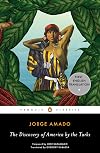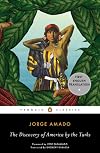
The Discovery of America by the Turks
by Jorge Amado
On This Page
Description
Two Arab immigrants' "Turks" as Brazilians call them, arrive in the rough Brazilian frontier on the same ship in 1903, hoping to find a future. They rub shoulders with gunslingers and plantation owners, and also tangle with merchants, one of whom is desperate to marry off his impossible daughter. Thus ensues a farcical drama that produces, in a humorous twist, the unlikeliest of suitors in this whimsical Brazilian take on The Taming of the Shrew.Tags
Recommendations



























Member Reviews
A late novella, written as a tie-in with the celebrations for the 500th anniversary of Columbus's discovery of China Hispaniola. Amado reasons that if Columbus could be said to have "discovered America", the same thing could just as well be said of two Ottoman opportunists who happened to arrive in Bahia on the same immigrant ship in 1903. Raduan becomes a professional poker-player, Jamil a shopkeeper, and there's a comic plot of Raduan trying to marry Jamil off to Adma, fearsome daughter of Ibrahim, proprietor of the Bon Marché drapery.
Amado uses a deceptively simple kind of Arabian Nights narrative style to tell the story, but it's all heavily loaded with irony. If it's a rehash of The taming of the shrew then it's one in which the show more men are shown to be just as shallow and selfish as the women. Ibrahim's chief motivation for marrying off his daughter is to obtain the freedom to go fishing in the mornings again: he apparently sees nothing odd about canvassing a possible suitor for her hand during a party at the local brothel. Amado's narrator seems to be on the side of the men in the battle, but it's not at all clear that the reader is expected to agree with that. show less
Amado uses a deceptively simple kind of Arabian Nights narrative style to tell the story, but it's all heavily loaded with irony. If it's a rehash of The taming of the shrew then it's one in which the show more men are shown to be just as shallow and selfish as the women. Ibrahim's chief motivation for marrying off his daughter is to obtain the freedom to go fishing in the mornings again: he apparently sees nothing odd about canvassing a possible suitor for her hand during a party at the local brothel. Amado's narrator seems to be on the side of the men in the battle, but it's not at all clear that the reader is expected to agree with that. show less
As the 500th anniversary of Columbus's "discovery" of America approached, an Italian public relations firm commissioned Amado, along with a Spanish author (Fuentes) and a US author (Mailer), to write novellas related to the "discovery," but the plan fell apart. Nevertheless, Amado wrote this novella, and a delightful sex farce it is.
The "Turks" are not Turks, but a Lebanese and a Syrian coming to the Bahia region of Brazil in the early 19th century. They are traveling on passports from the Ottoman Empire; hence these Arabs are called Turks. Readers of Showdown will find a certain similarity between one of the characters in that novel, a similarity that Amado acknowledges in his preface. Basically, there is an Arab running a store in a show more town in the cacao region of Bahia, or rather his wife runs it. When she dies, everything goes downhill, with his daughters and sons-in-law running the store into the ground. But he has a eldest daughter, age 30, ugly and with a bad temperament. If he can find a responsible man who could run the store and who will marry that daughter, he will make him a partner. A store owner in a place in the countryside is a good prospect, but he dilly dallies, assessing how to make a go of it, store-wise and daughter-wise. In the meantime, a local waiter, who has also been approached with the prospect mulls it over too. There is much sexual innuendo -- and action -- in this novella, which I read in one sitting. show less
The "Turks" are not Turks, but a Lebanese and a Syrian coming to the Bahia region of Brazil in the early 19th century. They are traveling on passports from the Ottoman Empire; hence these Arabs are called Turks. Readers of Showdown will find a certain similarity between one of the characters in that novel, a similarity that Amado acknowledges in his preface. Basically, there is an Arab running a store in a show more town in the cacao region of Bahia, or rather his wife runs it. When she dies, everything goes downhill, with his daughters and sons-in-law running the store into the ground. But he has a eldest daughter, age 30, ugly and with a bad temperament. If he can find a responsible man who could run the store and who will marry that daughter, he will make him a partner. A store owner in a place in the countryside is a good prospect, but he dilly dallies, assessing how to make a go of it, store-wise and daughter-wise. In the meantime, a local waiter, who has also been approached with the prospect mulls it over too. There is much sexual innuendo -- and action -- in this novella, which I read in one sitting. show less
There are funny bits, but essentially it all boils down to the ol' patriarchal "what she really needs is..."
Bonita historia, por más que sea una de las cosas más misóginas que he leido en mi vida. De algún modo el autor logra que resulte más divertido que molesto. Quizá tiene que ver el haber leido antes 'Gabriela, clavo y canela', que deja claro que solo está recogiendo el sentimiento de la época que describe y no expresando el propio.
Feb 14, 2007Spanish
Escrita en 1991, a raíz de una iniciativa relacionada con el V Centenario del descubrimiento de América, Jorge Amado (1912-2001) da rienda suelta en esta novela a su inagotable capacidad de fabulación, a su irreverente sentido del humor y a su desinhibida vitalidad. Procedentes del entonces aún existente imperio otomano, los "turcos" de Amado son dos inmigrantes árabes (el sirio Jamil Bichara y el libanés Raduan Murad), arribados a Brasil en el mismo barco, como tantos y tantos otros inmigrantes a principios del siglo XX. Sus peripecias tras instalarse en el sur de Bahía, «el Eldorado del cacao», son el eje en torno al cual se hila esta entretenida obra que satisface el placer de la lectura y deja al lector una sonrisa en los show more labios.
Escrita en 1991, a raíz de una iniciativa relacionada con el V Centenario del descubrimiento de América, Jorge Amado (1912-2001) da rienda suelta en esta novela a su inagotable capacidad de fabulación, a su irreverente sentido del humor y a su desinhibida vitalidad. Procedentes del entonces aún existente imperio otomano, los "turcos" de Amado son dos inmigrantes árabes (el sirio Jamil Bichara y el libanés Raduan Murad), arribados a Brasil en el mismo barco, como tantos y tantos otros inmigrantes a principios del siglo XX. Sus peripecias tras instalarse en el sur de Bahía, «el Eldorado del cacao», son el eje en torno al cual se hila esta entretenida obra que satisface el placer de la lectura y deja al lector una sonrisa en los labios. show less
Escrita en 1991, a raíz de una iniciativa relacionada con el V Centenario del descubrimiento de América, Jorge Amado (1912-2001) da rienda suelta en esta novela a su inagotable capacidad de fabulación, a su irreverente sentido del humor y a su desinhibida vitalidad. Procedentes del entonces aún existente imperio otomano, los "turcos" de Amado son dos inmigrantes árabes (el sirio Jamil Bichara y el libanés Raduan Murad), arribados a Brasil en el mismo barco, como tantos y tantos otros inmigrantes a principios del siglo XX. Sus peripecias tras instalarse en el sur de Bahía, «el Eldorado del cacao», son el eje en torno al cual se hila esta entretenida obra que satisface el placer de la lectura y deja al lector una sonrisa en los labios. show less
Jan 24, 2023Spanish
Jorge Amado ; ilustrações e arte grafica de Pedro Costa
Apr 30, 2025Portuguese (Portugal)
Ratings
Members
- Recently Added By
Author Information

154+ Works 10,846 Members
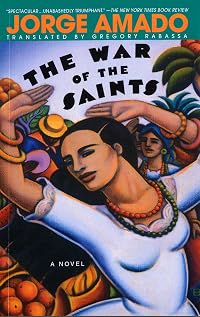
Jorge Amado, August 10, 1912 - August 6, 2001 Elected to the Brazilian Academy of Letters, Jorge Amado possesses a talent for storytelling as well as a deep concern for social and economic justice. He was born in Bahia, Brazil, in 1912. Some critics claim that his early works suffer from his politics. Others commonly express reservations show more concerning Amado's sentimentality and erotico-mythic stereotyping. In the works represented in English translation, his literary merits prevail. The Violent Land (1942) chronicles the development of Brazilian territory and struggles for its resources, memorializing the deeds of those who built the country. Gabriela, Clove and Cinnamon (1958), which achieved critical and popular success in both Brazil and the United States, tells a sensual love story of a Syrian bar owner and his beautiful cook. Home Is the Sailor (1962) introduces Captain Vasco Moscoso de Aragao, a comic figure in the tradition of Don Quixote. In Dona Flor and Her Two Husbands (1966), Amado introduced the folk culture of shamans and Yorube gods. The protagonists of Shepherds of the Night (1964) are Bahia's poor. (Bowker Author Biography) Jorge Amado has been called the greatest twentieth-century Brazilian novelist. He was born in 1912 in Ilheus, in the northeastern-most state of Bahai. This area serves as the backdrop for most of Amado's work, which reflects a deep appreciation of the Brazilian essence. Amado's works have made him a national figure in Brazil. Amado's early novels were shaped by a belief in Marxism, and relate the sufferings of humble fishermen and cocoa plantation workers. By the 1950s, he had turned his attention to the plight of middle-class Bahains. This more jovial approach brought him worldwide acclaim, and his keen comic sense and appreciation of the common man have drawn comparisons to the novels of Charles Dickens. Music, cuisine, and passion figure prominently in Amado's literary output. Amado's works have been translated from Portuguese into more than forty languages, have sold over fifty million copies worldwide, and have been reworked for film, television, and stage. His portraits of commanding female characters, including Gabriela from Gabriela, Clove and Cinnamon, and Dona Flor from Dona Flor and Her Two Husbands, have been adapted to the screen, and actress Sonia Braga earned her initial success in these roles. Other titles include The Sand Captains; Memory of a Child; The War of the Saints; and Home Is the Sailor. (Bowker Author Biography) show less
Some Editions
Awards and Honors
Awards
Series
Belongs to Publisher Series
Work Relationships
Common Knowledge
- Canonical title
- The Discovery of America by the Turks
- Original title
- A Descoberta da América pelos Turcos
- Original publication date
- 1994
- People/Characters*
- Adma Jafet; Adib Barud; Jamil Bichara; Raduan Murad
- Related movies*
- Port of Miracles (2001 | IMDb)
- Publisher's editor*
- Editora Record
- Original language
- Portuguese
*Some information comes from Common Knowledge in other languages. Click "Edit" for more information.
Classifications
- Genres
- Fiction and Literature, General Fiction
- DDC/MDS
- 869.3 — Literature & rhetoric Spanish Literature Literatures of Portuguese and Galician languages Portuguese fiction
- LCC
- PQ9697 .A647 .D47 — Language and Literature French, Italian, Spanish and Portuguese literatures Portuguese literature Provincial, local, colonial, etc. Brazil
- BISAC
Statistics
- Members
- 176
- Popularity
- 186,421
- Reviews
- 6
- Rating
- (3.20)
- Languages
- 6 — English, French, Italian, Korean, Portuguese (Brazil), Spanish
- Media
- Paper, Ebook
- ISBNs
- 21
- ASINs
- 3