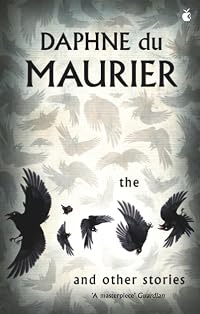
The Birds and Other Stories
by Daphne Du Maurier
On This Page
Description
A classic of alienation and horror, The Birds was immortalised by Hitchcock in his celebrated film. The five other chilling stories in this collection echo a sense of dislocation and mock man's dominance over the natural world. The mountain paradise of 'Monte Verità' promises immortality, but at a terrible price; a neglected wife haunts her husband in the form of an apple tree; a professional photographer steps out from behind the camera and into his subject's life; a date with a cinema show more usherette leads to a walk in the cemetery; and a jealous father finds a remedy when three's a crowd . . . show lessTags
Recommendations




















Member Recommendations


Member Reviews
Overall, this is an excellent set of short stories. Monte Verita was my least favorite, and I spent a lot of time rolling my eyes while reading it. The others are exceptional.
The Birds — Avians take-over-the-world book is better than the movie. There's a very real sense of doom that isn't present in the movie version. Give it a go.
Monte Verita — Tedious mountain climbing with naked California-esque woo-woo at the top. Unbearably idiotic characters. (I hate mountain climbing and despise woo, so this is not a good one for me.)
The Apple Tree — His wife is an apple tree, and he is rude and insufferable. A good portrayal of delusional paranoia.
The Little Photographer — Bored narcissist thinks that she is clever, but proves she is show more very dumb indeed. A straightforward tale for today.
Kiss Me Again, Stranger — Daphne du Maurier is way, way ahead of her time. Clever girl in more ways than one.
The Old Man — An adroit tale of murder in which the last paragraph changes everything. show less
The Birds — Avians take-over-the-world book is better than the movie. There's a very real sense of doom that isn't present in the movie version. Give it a go.
Monte Verita — Tedious mountain climbing with naked California-esque woo-woo at the top. Unbearably idiotic characters. (I hate mountain climbing and despise woo, so this is not a good one for me.)
The Apple Tree — His wife is an apple tree, and he is rude and insufferable. A good portrayal of delusional paranoia.
The Little Photographer — Bored narcissist thinks that she is clever, but proves she is show more very dumb indeed. A straightforward tale for today.
Kiss Me Again, Stranger — Daphne du Maurier is way, way ahead of her time. Clever girl in more ways than one.
The Old Man — An adroit tale of murder in which the last paragraph changes everything. show less
There are six stories in 'The Birds and other stories', the first five of which I liked:
- The Birds: a piece of speculative fiction about how humans react to a sudden and deadly change in their environment
- Monte Verità: a story about the pursuit of a life beyond the ordinary
- The Apple Tree: an unusual ghost story
- The Little Photographer: a story of indolent self-indulgence leading to violence and grief.
- Kiss Me Again, Stranger: an encounter with a stranger that changes the life of an otherwise ordinary man
I found each of the fiche stories to be deeply engaging. They're original, character-driven, vivid, surprisingly modern and quite different from one another. I strongly recommend them.
I've reviewed each of the first five stories show more below. The final story, The Old Man didn't work for me so I haven't reviewed it.
Forget the Hitchcock movie, We're not in California in the 1960s. We're in coastal Cornwall shortly after the war. There's no Tippi Hedren character delivering lovebirds. There's just an observant, self-reliant farmworker, living in an isolated cottage on a peninsula, trying to ensure that his family survive an inexplicable and lethal change in the world.
The original story is forty pages of slowly intensifying threat as what starts out as a shocking aberration, a nighttime incursion into the children's bedroom by apparently desperate small birds, lashing out in terror and confusion, but becomes something more sinister, more deadly and much harder to take in - all the different species of birds working together in an organised way to attack humanity.
'The Birds' is threaded through with threat, made larger by vivid violence and the struggle to accept the inexplicable but undeniable.
The thing that I liked most about the story was the skilful way in which, in a very few pages. Du Maurier turns a 'No, that's not possible' incredible idea into a grim, deadly, hope extinguishing reality. This is largely done by counterpointing the bizarre idea of an organised mass attack on humanity by all the birds working together with the observations and reactions of a very down to earth, uncharismatic farm worker who demonstrates the mental flexibility to accept and adapt to the reality of the threat and the focus and courage to do what can be done to ensure that his family survives. He is a man who understands terror and helplessness and who has no expectation of 'the authorities' doing anything to help him. He lived through the bombing of Plymouth and knows what it is to shelter in fear from an attack by a force you can't defeat or deflect but only endure.
If 'The Birds' has a message, it's that the world is not safe, new threats can emerge at any time and that survival depends on staying vigilant, adapting quickly and spending your energy on doing what you can to protect yourself and your family without waiting for outside help. That's an interesting insight into the mentality of post-war England.
I was fascinated by the contrast between style and content in this story. In tone, it reads like an adventure that might have been written at the end of the nineteenth century or the beginning of the twentieth century - think H Rider Haggard's 'She' or Edgar Rice Burrough's 'Tarzan'; yet the structure is much more modern than that - the narrative starts at the end of the story, sharing an outcome that we lack the context to understand, and then turning back in time to calibrate the loss that the start of the story describes.
The main characters are Englishmen, born to privilege at the start of the twentieth century, one a landowner with a country seat and one an international businessman. Mountain climbing is their shared passion, although one approaches the mountain with caution buttressed by careful planning while the other constantly falls under the spell of the mountains which call to him to climb to higher and more remote places. Their lives change when one of them meets and marries Anna, an extraordinary woman that they both fall in love with and who, eventually disappears into a strange, isolated community at the top of Monte Verità, the mountain of truth.
With its whispers of magic and immortality, the story seems to echo Haggard's 'She' with Anna as a mystical twist on she-who-must-be obeyed; but, when the secret of the sect is finally revealed, the thinking behind it is not something any nineteenth-century mind would have come up with, it is too stripped of romance and too challenging of the values of our day-to-day lives.
The two disruptive ideas behind this story, the ones that mark it as the product of a mid-twentieth century generation that has lived through two world wars that have reshaped the world, are that: serenity is found only by those who hunger for and are prepared to accept the unvarnished truth and that the world hates truth-based serenity and reacts to is with violence, not just because it is beyond their reach but because the existence of such serenity undermines the value of their day-to-day lives, challenges the dream that they choose to live in and calls away their best and brightest.
I found this to be a particularly disturbing ghost story, not because the ghost was so terrifying but because the portrait of the man, haunted by the spirit of the man, haunted by the spirit of his recently deceased wife, is so vivid and so damning.
I had thought that the most challenging thing about this story might be making the idea that a man might be haunted by an old apple tree that has long stood outside his house but which now reminds him, by its abject posture and barrens, of his dead wife. Daphne du Maurier pulled that off easily. The haunting is suggested rather than explicit. No one but the haunted man see anything wrong with the tree or its fruit but he can tolerate neither. Even the way in which the tree brought harm to the man need not be attributed to anything supernatural but the man himself sees nothing but malice in what befalls him.
The most challenging part of the story turned out to be the way in which Daphne du Maurier slowly brought me not only to have no sympathy for the haunted man but rather to despise him. We meet him three months after his wife's death when he notices the apple tree for the first time. We follow his actions as he adjusts to life as a widower and reflects on how it differs from his married life. There is no overt condemnation in the authorial voice. It remains a dispassionate narrator of events and the man's interior reflections and memories. Yet, with each thing I learned about the man, the more real he became to me and the less I liked him.
He is a naturally solitary, mildly hedonistic man who wants nothing of life except to be left alone to enjoy it. He has no need to connect with the people around him. He prefers to swim among them anonymously, while he takes his pleasure. He is the kind of man who does not seem to be temperamentally suited for married life. This, I could have understood and forgiven. Yet he did marry and he had reached the point where he saw his wife as the bane of his existence. The first examples he gives of she brings misery to his life seem convincing enough but bit by bit it becomes clear that he has, for many years, withheld himself from his wife, rejecting and belittling her and making her unhappy.
The details of who this man is and how he thinks and behaves build slowly, like wind-driven leaves piling up in a corner, until my distaste for him was palpable. He was not a monster. Sadly, he is the kind of man it is not at all hard to imagine existing in their thousands. He would see himself as a perfectly reasonable man, burdened with an unsuitable wife, who, now that she's dead, is finally free to live as he pleases.
Which brings me to the haunting.
It's tempting to attribute to this unlikeable man a lack of self-knowledge. I found myself thinking of a question asked in 'All's Well That Ends Well'
"Is it possible he should know what he is, and be that he is?”
It's plausible that he's the kind of man who is so easily comfortable with himself because he never truly sees himself.
But...
Do apple trees really haunt people? Do dead wives, who suffered years of emotional neglect, come back and haunt their husbands?
Or...
Does a man who has been suppressing what he knows about himself find his subconscious eating away at him, tainting the lie that his life has become, forcing him to face the truth and change or hold on to the lie and take the consequences?
What I like most about this story is that Daphne du Maurier leaves me to pose the question and to from my own answer to it.
'The Little Photographer' is a character-driven story structured around a crime and its consequences but the power of the piece comes not from the crime but from the portrait of the woman who commits it.
Daphne du Maurier shows us the world as seen by Madame la Marquise as she sojourns at a luxury hotel somewhere on the French Riviera in the company of her two little girls and their English nanny. Her husband has chosen to pay attention to his business affairs rather than join her. She is bored, not just with her life at the hotel but with the monotony of the life that she has married into, surrounded by old things and old people, locked into routines that never vary. The only solace the Marquise finds in her boredom is her own beauty and the admiration that it generates whenever she appears in public.
The story is told at a pace that fits the indolence and ennui of the Marquise as she seeks stimulation and admiration wherever she can find it. Her narcissism dominates her life. She is obsessed with herself to the point where she is incapable of seeing the people around her as real. They exist for her only to the extent that they satisfy or frustrate her desires.
What I liked most about the story was the way, caught up in the dream of her own image, the Marquise falls into an affair with a local photographer with no more agency than if she were sleepwalking. The man has talent but he is poor and has a clubfoot that limits his mobility. The Marquis is interested in him primarily because she sees him as having been instantly enslaved by her beauty. She thinks only of herself. She seeks only to bathe in the admiration of a man besotted by her. She has no awareness of either risks or consequences.
The crime follows when she is violently woken from her dream and made to see the sordid mess she has created and the threat it poses to her privileged life. Her reaction is exactly what I would expect from someone so self-obsessed.
I wondered if Daphne du Maurier was going to let this privileged woman escape the consequences of her crime. I should have realised by now that her answer would be more ambiguous than that. The range of consequences that Marquise will face is only hinted at by the end of the story, with freedom still being a possibility, albeit at a price.
I had wondered why Daphne du Maurier decided that the photographer should have a clubfoot. I couldn't see why that particular disadvantage was necessary. It was the Marquis, who arrived to pick up his wife at the end of the story, who gave me the answer. He explained to his wife that a friend of his had had a clubfoot but that it hadn't hindered him from marrying a beautiful, healthy woman. Yet, when their son was born, he too had a clubfoot. The taint in the blood could not be bred out.
Nothing is made of this remark. The Marquise doesn't seem to register its implications. Her mind is occupied with more pressing matters. I was left wondering whether this signified that there would be at least one consequence from which the Marquise could not escape.
'Kiss Me Again, Stranger' is another character piece but this time the character is a nice but ordinary man who has a close encounter with a beautiful but strange cinema usherette that, through the filters of his innate decency, he fails fully to understand until it is over.
Told as a first-person account of a man looking back on a defining moment of his life, the power of the story comes from the tension between the incidental details that reveal the narrator to be a good man or modest means and ambitions to whom something extraordinary has happened and the growing sense of threat that the reader feels like a too-fast pulse beneath the fingers but which the narrator is completely blind to.
It's a simple story, skilfully told. It delivers a quiet sense of dread while drawing a vivid picture of a quietly contented man who, after being de-mobbed from the Army, has built a new life for himself as a mechanic, only to have the limits and omissions of that life revealed when he meets someone who wakes in him a hunger for something more. show less
This is my first Du Maurier, and I'm glad I started here. Even if its just because The Birds has been a favorite Hitchcock since I was a child. Not that the story bears much resemblance to the movie, which isn't surprising given that Hitchcock is well known for not caring to make a movie that closely resembles the source material but rather to just taking 'inspiration' from it.
The titular Birds definitely has some War of the Worlds in its ancestry, and just as clearly seems like it was drawn upon for Matheson's I Am Legend. As for the rest of the stories, there isn't a dud among them. Though I think the only other potentially 'weird' story is Monte Verita. Even there, I think there's a reading that doesn't involve anything beyond show more mundane drives, desires, and happenings. Which I think is great...while there are readings of it and The Apple Tree that involve the supernatural, they can be read as being the result of nothing more than the mundane horrors of what people due to one another. Given the rest of the stories, I'm inclined to lean into the mundane readings, which make them no less effective. The dysfunctional relationships or individuals, reliable and unreliable narrators, give a fantastic tension and close to home horror. show less
The titular Birds definitely has some War of the Worlds in its ancestry, and just as clearly seems like it was drawn upon for Matheson's I Am Legend. As for the rest of the stories, there isn't a dud among them. Though I think the only other potentially 'weird' story is Monte Verita. Even there, I think there's a reading that doesn't involve anything beyond show more mundane drives, desires, and happenings. Which I think is great...while there are readings of it and The Apple Tree that involve the supernatural, they can be read as being the result of nothing more than the mundane horrors of what people due to one another. Given the rest of the stories, I'm inclined to lean into the mundane readings, which make them no less effective. The dysfunctional relationships or individuals, reliable and unreliable narrators, give a fantastic tension and close to home horror. show less
Some of these stories, especially "The Birds" and "The Apple Tree," I really liked. The others I just liked, without the adverb. "The Old Man" made me smile. I enjoyed the atmosphere of "Kiss Me Again, Stranger" but was kind of disappointed in the ending (although I'm SO glad she wasn't a vampire) . "The Little Photographer" left me feeling squirmy; I couldn't decide what I wanted to happen to the main character. "Monte Verita" was almost awesome, but the turn it took at the end seemed weird to me.
Overall, I really like the structure of du Maurier's stories. They circle back in a satisfying way, and often they're peopled with characters who either become overly emotional about smallish things or accept with a pragmatic shrug of the show more shoulders things that seem to warrant a bigger reaction. show less
Overall, I really like the structure of du Maurier's stories. They circle back in a satisfying way, and often they're peopled with characters who either become overly emotional about smallish things or accept with a pragmatic shrug of the show more shoulders things that seem to warrant a bigger reaction. show less
A collection of short stories from Daphne Du Maurier. The first, The Birds, inspired the famous Hitchcock film of the same name; I say inspired, because apart from a seaside setting and the birds themselves, there is little similarity between du Maurier's original work and Hitchcock's interpretation. Du Maurier's tale explores the increasing realisation of a family as they become more isolated and observe, and begin to understand, the intentions of the gathering birds.
Most of the stories in the book are taut, well-written tales; my only disappointment was the predictability of The Apple Tree. My personal favourite was The Old Man, a short, sharp story that keeps its secret to the very end.
Most of the stories in the book are taut, well-written tales; my only disappointment was the predictability of The Apple Tree. My personal favourite was The Old Man, a short, sharp story that keeps its secret to the very end.
1) I like short stories to interweave with a common thread/theme a-la Le Fanu. This book does not do that, so I struggled a little.
2) Some of the stories are great, or have great sections (The Birds is chilling, Monte Verida has some wonderful descriptions of the joy of climbing a mountain) but most are pockmarked with poor sections.
So in summary: A flawed book this definitely is, but an enjoyable read nonetheless.
2) Some of the stories are great, or have great sections (The Birds is chilling, Monte Verida has some wonderful descriptions of the joy of climbing a mountain) but most are pockmarked with poor sections.
So in summary: A flawed book this definitely is, but an enjoyable read nonetheless.
Di 6 racconti, solo uno l’ho trovato dimenticabile, per fortuna l’ultimo. Gli altri? Tra lo splendido e l’ok.
Du Maurier riesce a cogliere l’essenza dei personaggi in maniera spettacolare, tenendo il lettore attaccato alla pagina e con il desiderio di entrare nella storia successiva: per quanto strana e perturbante.
Gli uccelli è il più famoso dei sei, ma non il migliore: per chi prendesse in mano questa raccolta, il meglio ha da venire!
Du Maurier riesce a cogliere l’essenza dei personaggi in maniera spettacolare, tenendo il lettore attaccato alla pagina e con il desiderio di entrare nella storia successiva: per quanto strana e perturbante.
Gli uccelli è il più famoso dei sei, ma non il migliore: per chi prendesse in mano questa raccolta, il meglio ha da venire!
Members
- Recently Added By
Lists

Read the book and saw the movie
1,170 works; 195 members

Best Horror Books
281 works; 85 members

Favourite Virago Modern Classics
183 works; 38 members

Pleasant Surprises: Books That Exceeded Our Expectations
418 works; 142 members

Favorite Short Fiction
228 works; 99 members

Books Set in Small Towns and Villages
278 works; 16 members

le donne raccontano
116 works; 1 member
Put a Bird On It
75 works; 12 members

Nightmares Not Included
175 works; 3 members

Books Read in 2025
4,091 works; 97 members

BlackDog's Complete Paperbacks From Hell List
639 works; 3 members
Author Information

204+ Works 57,483 Members
Daphne Du Maurier was born in London on May 13, 1907 and educated in Paris. In 1932, she married Lieutenant-General Sir Frederick Browning. She began writing short stories of mystery and suspense for magazines in 1928, a collection of which appeared as The Apple Tree in 1952. Her first novel, The Loving Spirit, was published in 1931. Her tightly show more woven, highly suspenseful plots and her strong characters make her stories perfect for adaptation to film or television. Among her many novels that were made into successful films are Jamaica Inn (1936), Rebecca (1938), Frenchman's Creek (1941), Hungry Hill (1943), My Cousin Rachel (1952), and The Scapegoat (1957). Her short story, The Birds (1953), was brought to the screen by director Alfred Hitchcock in a treatment that has become a classic horror-suspense film. She died on April 19, 1989 at the age of 81. (Bowker Author Biography) show less
Some Editions
Awards and Honors
Distinctions
Series
Belongs to Publisher Series
Work Relationships
Is contained in
Contains
Common Knowledge
- Canonical title
- The Birds and Other Stories
- Original title
- The Apple Tree: A Short Novel and Several Long Stories
- Original publication date
- 1952
- Related movies
- The Birds (1963 | IMDb)
- First words*
- Die Vögel: Am dritten Dezember schlug der Wind über Nacht um, und es wurde Winter.
Der kleine Fotograf: Die Marquise ruhte in ihrem Liegestuhl auf dem Balkon des Hotels.
Zum Tode erwacht: Eines Morgens gegen elf Uhr dreissig begab sich Mary Farren in den Waffenraum, nahm das Gewehr ihres Mannes, lud es und erschoss sich.
Die blauen Gläser: Es war der Tag, da die Verbände abgenommen und die blauen Gläser eingesetzt wurden. - Last words*
- (Click to show. Warning: May contain spoilers.)Die Vögel: Dann warf er die leere Hülle ins Feuer und sah zu, wie sie verbrannte.
(Click to show. Warning: May contain spoilers.)Der kleine Fotograf: Vor ihr lag der lange, gerade Weg nach Hause, in die Sicherheit. Sicherheit?
(Click to show. Warning: May contain spoilers.)Zum Tode erwacht: Black hatte sich bisher niemals für sentimental oder gefühlsduselig gehalten; von nun an war er davon nicht mehr so fest überzeugt.
(Click to show. Warning: May contain spoilers.)Die blauen Gläser: Die Augen, die ihren Blick erwiderten, waren Rehaugen, von Angst vor der Opferung erfüllt, und schon senkte sich der Kopf des scheuen Tiers demütig und in das Schicksal ergeben. - Original language*
- Englisch
- Canonical DDC/MDS
- 823.912
- Canonical LCC
- PR6007.U47
- Disambiguation notice
- Publishing history - 1952, UK, Gollancz "The Apple Tree and Other Stories"; 1963, UK, Pan "The Birds and Other Stories". This last title is the one that has continued to be used ever since. (As far as i can tell);
St... (show all)ories include:
"The Birds",
"Monte Verità",
"The Apple Tree",
"The Little Photographer",
"Kiss Me Again, Stranger", and
"The Old Man"
In 1953 in the US, Doubleday published the stories included in "The Apple Tree..." along with two additional stories ("The Split Second" and "No Motive") as the collection "Kiss Me Again, Stranger"
*Some information comes from Common Knowledge in other languages. Click "Edit" for more information.
Classifications
Statistics
- Members
- 1,174
- Popularity
- 21,325
- Reviews
- 44
- Rating
- (3.86)
- Languages
- 13 — Catalan, Czech, Dutch, English, Estonian, Finnish, French, German, Italian, Polish, Russian, Spanish, Swedish
- Media
- Paper, Audiobook, Ebook
- ISBNs
- 33
- ASINs
- 15