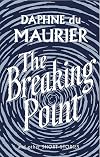
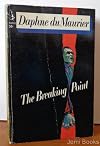
The Breaking Point: Short Stories
by Daphne Du Maurier
On This Page
Description
In this collection of suspenseful tales in which fantasies, murderous dreams and half-forgotten worlds are exposed, Daphne du Maurier explores the boundaries of reality and imagination. Her characters are caught at those moments when the delicate link between reason and emotion has been stretched to the breaking point. Often chilling, sometimes poignant, these stories display the full range of Daphne du Maurier's considerable talent.Tags
Recommendations




















Member Recommendations
Member Reviews
Another excellent collection of short stories by Daphne du Maurier. Every story demonstrates an excellent understanding of what makes people tick, and most of the stories have some element of the strange or surreal. My particular favourites were “The Blue Lenses” and “The Menace”. “The Blue Lenses” creeped me out the most, because it was about eye surgery and I’m squeamish about eye things to begin with. “The Menace” was actually a sweet story, in a way, with only a touch of the strange (the “feelies” being a new development in motion pictures that smacked of Brave New World).
I also liked “Ganymede”, the story set in Venice; du Maurier and Patricia Highsmith do an excellent job of bringing Venice to life show more whenever they set stories there. And “The Alibi” set the tone at the beginning of the collection, with a man planning to defeat suburban boredom by randomly choosing a house whose occupants he will murder.
“The Pool” made me think of Narnia for some reason, and as an older sister myself I appreciated the interactions between the girl and her younger brother. This one made me nostalgic for summers we spent with our own grandparents (although I never discovered a secret world). “The Archduchess” was well constructed and I thought very on point with some of its observations, particularly of how depressingly easy it could be for people to sow the seeds of anarchy in a normally peace-loving society. In today’s era of spreading misinformation online, Ronda would have succumbed to revolution that much sooner.
The last two stories in the collection, “The Chamois” and “The Lordly Ones”, I didn’t get as much out of, possibly because I was trying to read this one to a deadline. Of the two, “The Chamois” had stronger characterization for me (the husband was a total jerk). “The Lordly Ones” was one I’d have to think about some more, although I don’t doubt that it achieved the effect it was after.
If you haven’t read any of du Maurier’s short stories, do yourself a favour and pick up one of her collections. show less
I also liked “Ganymede”, the story set in Venice; du Maurier and Patricia Highsmith do an excellent job of bringing Venice to life show more whenever they set stories there. And “The Alibi” set the tone at the beginning of the collection, with a man planning to defeat suburban boredom by randomly choosing a house whose occupants he will murder.
“The Pool” made me think of Narnia for some reason, and as an older sister myself I appreciated the interactions between the girl and her younger brother. This one made me nostalgic for summers we spent with our own grandparents (although I never discovered a secret world). “The Archduchess” was well constructed and I thought very on point with some of its observations, particularly of how depressingly easy it could be for people to sow the seeds of anarchy in a normally peace-loving society. In today’s era of spreading misinformation online, Ronda would have succumbed to revolution that much sooner.
The last two stories in the collection, “The Chamois” and “The Lordly Ones”, I didn’t get as much out of, possibly because I was trying to read this one to a deadline. Of the two, “The Chamois” had stronger characterization for me (the husband was a total jerk). “The Lordly Ones” was one I’d have to think about some more, although I don’t doubt that it achieved the effect it was after.
If you haven’t read any of du Maurier’s short stories, do yourself a favour and pick up one of her collections. show less
“The Breaking Point” is a collection of nine short stories published in 1959; the short preface notes that there “comes a moment in the life of every individual when reality must be faced. When this happens, it is as though a link between emotion and reason is stretched to the limit of endurance, and sometimes snaps.” This point is reached in each of these stories, by individuals and, in one tale, by an entire country. Obviously different readers will have different responses to these well-crafted, atmospheric stories; my favourite was “The Blue Lenses,” in which eye surgery to replace faulty lenses has unusual results - I don’t want to say more, except that it’s quite brilliant. I also loved “The Archduchess,” in show more which a fictional European country has a revolution that changes its leadership from 700 years of autocratic rule by one family to a delicious system called “Popular Front Ltd.,” a combination of big business and communism - I had never thought of Du Maurier as being politically engaged or as writing satire, but this is a terrific example of both! All of the stories are compelling, however, and showcase the author’s remarkable talent as a writer; there’s a reason she’s still read some 60 years (in the case of this book) later. Highly recommended! show less
Quite an uneven collection of stories. The very best are those that concern children and their development, notably The pool, in which the ''other world'' shuts its gates forever, due to the first menstruation of the protagonist girl. And also The lordly ones, where a mute boy escapes from his cruel parents by joining a flock of roaming animals (or whatever they are, faeries?) on the moors, the lordly ones, only to be abandoned by them shortly after. These two stories border on the edge of what today is called ''fantasy'', but are written in a sober style to great effect. Of the stories about grown-ups The alibi stands out, even though the idea of a perfectly normal citizen freaking out in secret while no one notices is not very show more original. The execution of this particular story is excellent. On the minus side, there is Ganymede', completely filled with commonplace and The menace, whose protagonist is an unlikely caricature without the writer knowing so. All in all, certainly worthwhile for the 3-4 excellent stories this contains. show less
This collection of short stories is at times bizarre, and at times fascinating. The opening story is about James Fenton who on a Sunday walk with his family suddenly decides he must change his life. The solution he chooses is to murder someone.
The second story concerns the consequences when a young woman has an eye operation and suffers post op illusions. The story "Ganymede" describes the consequences when a man on holidays in Venice shows too much interest in a young boy and the boy's family make him pay for his indescretion.
Another story covered how citizens can be turned into a mob when manipulated by people and other citizens who know better do not risk their lives to stop the mob. "The Limpet" concerns a woman who destroys the show more lives around her by her indescretions and manipulation yet seems to be clueless about why those people try to avoid her or if they cannot, wither away. show less
The second story concerns the consequences when a young woman has an eye operation and suffers post op illusions. The story "Ganymede" describes the consequences when a man on holidays in Venice shows too much interest in a young boy and the boy's family make him pay for his indescretion.
Another story covered how citizens can be turned into a mob when manipulated by people and other citizens who know better do not risk their lives to stop the mob. "The Limpet" concerns a woman who destroys the show more lives around her by her indescretions and manipulation yet seems to be clueless about why those people try to avoid her or if they cannot, wither away. show less
This collection of short stories is riveting. Clearly in the author's haunting style. The characters are all wonderful.
In Ganymede, A tourist is transfixed by a fifteen-year-old boy who is small for his age. He befriends the boy, daydreams of whisking him back to London from Venice, but the boy dies an untimely death in a boating acident. Also publ. in The Blue Lenses and Other Stories.
Una scrittrice la Du Maurier con una spiccata predilezione per le tinte fosche. I suoi personaggi vivono costantemente in bilico tra ragione e spietatezza, talvolta sono travolti in modo inesorabile da onde emotive e violente o da forme di follia visionaria.
Jan 18, 2017Italian
Members
- Recently Added By
Lists

Favourite Virago Modern Classics
183 works; 38 members

Backlisted
109 works; 9 members
Author Information

204+ Works 57,490 Members
Daphne Du Maurier was born in London on May 13, 1907 and educated in Paris. In 1932, she married Lieutenant-General Sir Frederick Browning. She began writing short stories of mystery and suspense for magazines in 1928, a collection of which appeared as The Apple Tree in 1952. Her first novel, The Loving Spirit, was published in 1931. Her tightly show more woven, highly suspenseful plots and her strong characters make her stories perfect for adaptation to film or television. Among her many novels that were made into successful films are Jamaica Inn (1936), Rebecca (1938), Frenchman's Creek (1941), Hungry Hill (1943), My Cousin Rachel (1952), and The Scapegoat (1957). Her short story, The Birds (1953), was brought to the screen by director Alfred Hitchcock in a treatment that has become a classic horror-suspense film. She died on April 19, 1989 at the age of 81. (Bowker Author Biography) show less
Some Editions
Awards and Honors
Distinctions
Series
Belongs to Publisher Series
Virago Modern Classics (540)
Work Relationships
Is contained in
Common Knowledge
- Canonical title
- The Breaking Point and Other Stories; The Breaking Point: Short Stories
- Alternate titles
- The Blue Lenses and Other Stories
- Original publication date
- 1959
- Epigraph*
- There comes a moment in the life of every individual when reality must be faced. When this happens, it is as though a link between emotion and reason is stretched to the limit of endurance, and sometimes snaps. In this collec... (show all)tion of stories, men, women, children and a nation are brought to the breaking-point. Whether the link survives or snaps, the reader must judge for himself.
- First words
- The eight short stories here were first published in 1959. They were written immediately after one of Daphne du Maurier's finest novels, The Scapegoat, and immediately before The Infernal World of Branwell Bronte,... (show all)i> her biography of the most tormented of the Bronte siblings. The Scapegoat concerns itself with the question of doubles or Doppelganger, with the extremes for good and evil we all contain within ourselves; The Infernal World is a study a greatly gifted, fabulous boy, fatally ill equipped to deal with the real world, and ultimately broken by it.
The stories here reflect the concerns of those adjacent books: they are dark, difficult, perturbing - and sometimes shocking. - Foreword, Sally Beauman, London, October 2008
The Fentons were taking their usual Sunday walk along the Embankment. They had come to Albert Bridge, and paused, as they always did, before deciding whether to cross it to the gardens, or continue along past the houseboats; ... (show all)and Fenton's wife, following some process of thought unknown to him, said, "Remind me to telephone the Alhusons when we get home to ask them for drinks. It's their turn to come to us." -1, The Alibi - Last words*
- (Click to show. Warning: May contain spoilers.)He heard the cry tear his chest, and he shouted, 'No ... no ... no ...' for the first and the last time, and he fell face downwards in the snow.
- Canonical DDC/MDS
- 823.912
- Canonical LCC
- PZ3.D8916 PR6007 .U47
- Disambiguation notice
- The Breaking Point is a collection of eight short stories by Daphne du Maurier first published in 1959 by Victor Gollancz in the UK and Doubleday in the US. It has also been published under the title The Blue Lenses and Other... (show all) Stories.
Includes:- The Alibi
- The Blue Lenses
- Ganymede
- The Pool
- The Archduchess
- The Menace
- The Chamois
- The Lordly Ones
*Some information comes from Common Knowledge in other languages. Click "Edit" for more information.
Classifications
Statistics
- Members
- 420
- Popularity
- 73,653
- Reviews
- 8
- Rating
- (3.67)
- Languages
- English, Italian, Spanish
- Media
- Paper, Ebook
- ISBNs
- 13
- ASINs
- 23