On This Page
Description
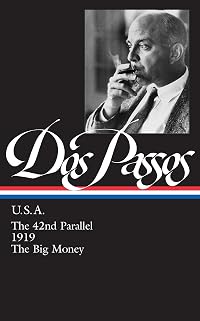
Unique among American novels for its epic scope and panoramic social sweep, John Dos Passos' U.S.A. has long been acknowledged as a monument of modern fiction. In the novels that make up the trilogy -- The 42nd Parallel (1930), 1919 (1932), and The Big Money (1936) -- Dos Passos creates a collective portrait of America in the first three decades of the 20th century, shot through with sardonic comedy and social observation. He interweaves the careers of his characters and the events of their show more time with a narrative verve and technical skill that make U.S.A. among the most compulsively readable of modern classics. In his prologue, Dos Passos writes: "U.S.A. is the slice of a continent. U.S.A. is a group of holding companies, some aggregations of trade unions, a set of laws bound in calf, a radio network, a chain of moving picture theatres, a column of stock quotations rubbed out and written in by a Western Union boy on a blackboard, a public library full of old newspapers and dogeared history books with protests scrawled on the margins in pencil ... But mostly U.S.A. is the speech of the people." The trilogy is filled with American speech: labor radicals and advertising executives, sailors and stenographers, interior decorators and movie stars. This edition also contains newly researched chronologies of Dos Passos' life and of world events cited in U.S.A., notes, and an essay on textual selection. show lessTags
Recommendations





Member Recommendations
by chrisharpe
Member Reviews
My what a splendid book this is. Vast in its scope and magnanimous in its treatment of the varied strata that made up a nation coming to terms with the 20th century. I defy you to enjoy this, despite it being well over 1,000 pages long, a trilogy that follows 12 characters some related and others not. Not only is it written in a style that is incredibly accessible for such a long novel, it’s written in four styles that are incredibly accessible. Even the stream of consciousness episodes are so well crafted and (ahem) so short, that they fly by.
While I enjoyed the characters and what they got up to, what I most enjoyed was how I saw the nation of the US through their eyes and experiences. It was a promising time for the US and various show more ideals are put to the test including the spectral opposites of capitalism and socialism. Neither of them come off well, but I kind of felt, a bit like in Sinclair’s masterpiece The Jungle, that it was the ones who espoused a more societal basis for life that were painted with more touches of heroism. Certainly, you sympathised a lot more with those who fell victims to mass industry and the drive to industrialise at the sake of the common man.
Certainly Dos Passos here composed a classic but not just for his storytelling skills. It’s a nation analysed and put to the test of history. Interestingly, it shows how weak the ideals are, ideals that, even today are either praised or vilified in equal measure depending on which facet of US citizenry you talk to. I’m not sure that the US has really grown much more mature in its pursuit of an identity than it is portrayed in this novel. I wonder what the USAnians among you would respond to that.
For outsiders who want to know more of why the US is as it is, this is a good novel to reflect on. There’s such a vast amount here to consider there’s no way to do it justice. Even just one of the 12 character threads would provide book clubs with hours of discussion. For those of you on the inside, I think this is a good one to have under your belt to say you know where US literature is coming from and to provide food for thought as you continue to build on what those 12 characters built before you. show less
While I enjoyed the characters and what they got up to, what I most enjoyed was how I saw the nation of the US through their eyes and experiences. It was a promising time for the US and various show more ideals are put to the test including the spectral opposites of capitalism and socialism. Neither of them come off well, but I kind of felt, a bit like in Sinclair’s masterpiece The Jungle, that it was the ones who espoused a more societal basis for life that were painted with more touches of heroism. Certainly, you sympathised a lot more with those who fell victims to mass industry and the drive to industrialise at the sake of the common man.
Certainly Dos Passos here composed a classic but not just for his storytelling skills. It’s a nation analysed and put to the test of history. Interestingly, it shows how weak the ideals are, ideals that, even today are either praised or vilified in equal measure depending on which facet of US citizenry you talk to. I’m not sure that the US has really grown much more mature in its pursuit of an identity than it is portrayed in this novel. I wonder what the USAnians among you would respond to that.
For outsiders who want to know more of why the US is as it is, this is a good novel to reflect on. There’s such a vast amount here to consider there’s no way to do it justice. Even just one of the 12 character threads would provide book clubs with hours of discussion. For those of you on the inside, I think this is a good one to have under your belt to say you know where US literature is coming from and to provide food for thought as you continue to build on what those 12 characters built before you. show less
The theme of "U.S.A." was Dos Passos’ topic of choice- social injustice. Book 1, "The 42nd Parallel" - takes place between 1900 and 1914. Book 2, "1919" - covers World War I, and book 3, titled "Big Money" - ends in the 1930’s. Each of the three volumes can be read individually, but none are of significant importance on their own. The complete set however, makes an epic masterpiece that is rated number 23 on Modern Library’s 100 greatest novels. Leaning strongly towards socialism at the onset of writing "U.S.A"., Dos Passos writes about labor organizers, socialist rebels, union strikes and working conditions that are a stark reminder of why labor unions were invented in the first place.
"The 42nd Parallel" is the story of seven show more primary characters including several very modern progressive-thinking women. It is difficult to determine through most of this volume exactly where Dos Passos is going with his story because, although some of the characters are acquainted with each other, there is no clear connection between them. In addition, Dos Passos has the habit of starting a narrative about a particular character, filling the reader in on their history, family and background, describing their intimate feelings and motivation, taking the character to a point in time... then abruptly dropping them and moving on to the next character from a totally different background. In some instances he never returns to that character... leaving them hanging in unexplained limbo.
Told from a position of an unemotional and purely objective outsider, the lack of feeling often carries over to the reader. Inevitably, just as you become interested in a character, poof... they disappear and the story changes direction. Not to mislead you, some of the characters do coincidentally meet up later in the 2nd and 3rd books of the trilogy, but with a total count of 1240 pages, by the time the character resurfaces, it is like running into an old acquaintance you barely remember and are not sure you ever really knew at all.
One thing all the characters seemed to have in common was being raised in families that faced a daily struggle. Surrounded by poverty, they all have a strong will to succeed in a society that demands hard labor just to survive... a society having no sympathy for slackers. It was not uncommon for children in their early teens to drop out of school and leave home in search of a job with one change of clothes in a sack and no idea where they would eventually end up.
Dos Passos’ unique writing style is mesmerizing: simple, down-to-earth, to the point, using local dialects, down-home jargon, street slang, and old fashioned sayings like, “that’s swell” and “I lied like a fish” (page 419). Dos Passos has the habit of running words together like: cigarsmoky, shinydark, greenslimy, stillwarm, returnedhero, eveningclothes, and afterthetheater. Descriptions titillate the senses and are for any aspiring writer to envy: nuns were “dripping in black”. “a small grayhaired pigeonbreasted woman” (page 133). “a stout redfaced man who smoked many cigars and cleared his throat a great deal and had a very oldtimey Southern Godblessmysoul way of talking” (page 137).
One of the most memorable scenes of "The 42nd Parallel" is descriptions of how the general public reacted when the announcement came that the United States had entered World War I. The overwhelming enthusiasm was cause for celebration like the 4th of July and New Years Eve all rolled into one. War is nothing to glorify, but the overwhelming sense of patriotism was beautiful.
"1919" carries the reader through the turbulent years of World War I. Following the lives of four characters introduced in "The 42nd Parallel" and two additional principal characters, Dos Passos passionately paints a picture of an era of industrial expansion and the creation of wealth for the fortunate few... with back-breaking labor and sacrifice for the masses. An atmosphere of despondency saturates the pages... prostitutes, promiscuity, shot-gun-weddings, social diseases, striking workers, and Marxist revolutionaries spouting communist doctrine.
World War I is in full bloom but there are no scenes of combat. Instead, we view a high school dropout taking a job for less than minimum wage as a Merchant Marine and the story of his struggle to survive a lonely dismal life at sea, two girlfriends who share an apartment and interior decorating business in New York City, a professional Marxist striker who travels the country in support of union employees, and a well-to-do spoiled “wanna-be socialist” young woman who is prejudiced, bigoted, and too prissy to get her hands dirty. The closest we get to the war is through an American volunteer serving as an ambulance driver in France and Italy prior to the United States entrance in the war.
Since Dos Passos did volunteer for an ambulance crew during those years and in those exact countries (along with is friend Ernest Hemingway), there is apparent authenticity in the telling... and it’s not a pretty picture. Always assuming the American volunteer ambulance drivers were conscientious heroic people, it was shocking to learn that in this case, it was quite the opposite - a cowardly pacifist looking for a good adventurous party and a way to avoid the American draft. This is where the prostitutes and whores come in.
Dos Passos can tell a dynamic story. He’s an excellent communicator writing in fast paced, startlingly crisp, short staccato sentences... volleying the conversation back and forth effortlessly. Dos Passos’ historic eye-witness illuminating account of what life was like during the World War I years definitely qualifies the book as an American literary classic. Unfortunately, most of the characters were not very likable people; petty, small-minded, superficial, self-centered, and looking for instant gratification. Didn’t Dos Passos know any nice people? Or perhaps, the nice people just didn’t make for entertaining reading.
The third and final book of the "U.S.A." Trilogy is by far the best of the set. By this time in the collective story, World War I is over, and Dos Passos’ is clearly becoming disillusioned with the socialist doctrine... leaning more towards free market enterprise. This is clearly reflected in his writing.
Returning to the story with some of the characters from the first book, "The 42nd Parallel", Dos Passos takes us through the 1920’s and into the 1930’s. The war is over and it’s time to get serious about making money. Notice the book is called "Big Money" and not "Easy Money". Regardless of if-and-how any of the characters become wealthy, it doesn’t come easy and there is a heavy price to pay.
Dos Passos’ characters include a returning soldier who expects to ride the wave of his heroic war reputation, an aspiring actress with big blue eyes and a heart of gold but no talent, a collection of independent self-supporting women who thought they had everything going for them but find they are now “old maids”, and socialist revolutionaries who realize they are nothing more than aging rabble-rousers fighting for a lost cause.
As the story unfolds it is like watching a train wreck in the making. It is so obvious what is coming... the one way trip down the path to personal destruction. Yet you are mesmerized - you can’t turn your back. And as it happens - just like you knew it would, you realize that it could not end in any other way. But oh, why? Just why?
This is the beauty of Dos Passos’ writing. He was a realist. He may have had dreams of the ideal society, but as time passed he came to realize that there is good and bad, strength and weakness, in every human. Even the die-hard socialists who claimed to be working for the good of mankind could be coldhearted, cruel, selfish, ego maniacs. And human nature often dictates that people live through decisions of the heart- not by logical evaluation of their options. And when things go bad, everyone around them is nodding and saying, “What were they thinking?” show less
"The 42nd Parallel" is the story of seven show more primary characters including several very modern progressive-thinking women. It is difficult to determine through most of this volume exactly where Dos Passos is going with his story because, although some of the characters are acquainted with each other, there is no clear connection between them. In addition, Dos Passos has the habit of starting a narrative about a particular character, filling the reader in on their history, family and background, describing their intimate feelings and motivation, taking the character to a point in time... then abruptly dropping them and moving on to the next character from a totally different background. In some instances he never returns to that character... leaving them hanging in unexplained limbo.
Told from a position of an unemotional and purely objective outsider, the lack of feeling often carries over to the reader. Inevitably, just as you become interested in a character, poof... they disappear and the story changes direction. Not to mislead you, some of the characters do coincidentally meet up later in the 2nd and 3rd books of the trilogy, but with a total count of 1240 pages, by the time the character resurfaces, it is like running into an old acquaintance you barely remember and are not sure you ever really knew at all.
One thing all the characters seemed to have in common was being raised in families that faced a daily struggle. Surrounded by poverty, they all have a strong will to succeed in a society that demands hard labor just to survive... a society having no sympathy for slackers. It was not uncommon for children in their early teens to drop out of school and leave home in search of a job with one change of clothes in a sack and no idea where they would eventually end up.
Dos Passos’ unique writing style is mesmerizing: simple, down-to-earth, to the point, using local dialects, down-home jargon, street slang, and old fashioned sayings like, “that’s swell” and “I lied like a fish” (page 419). Dos Passos has the habit of running words together like: cigarsmoky, shinydark, greenslimy, stillwarm, returnedhero, eveningclothes, and afterthetheater. Descriptions titillate the senses and are for any aspiring writer to envy: nuns were “dripping in black”. “a small grayhaired pigeonbreasted woman” (page 133). “a stout redfaced man who smoked many cigars and cleared his throat a great deal and had a very oldtimey Southern Godblessmysoul way of talking” (page 137).
One of the most memorable scenes of "The 42nd Parallel" is descriptions of how the general public reacted when the announcement came that the United States had entered World War I. The overwhelming enthusiasm was cause for celebration like the 4th of July and New Years Eve all rolled into one. War is nothing to glorify, but the overwhelming sense of patriotism was beautiful.
"1919" carries the reader through the turbulent years of World War I. Following the lives of four characters introduced in "The 42nd Parallel" and two additional principal characters, Dos Passos passionately paints a picture of an era of industrial expansion and the creation of wealth for the fortunate few... with back-breaking labor and sacrifice for the masses. An atmosphere of despondency saturates the pages... prostitutes, promiscuity, shot-gun-weddings, social diseases, striking workers, and Marxist revolutionaries spouting communist doctrine.
World War I is in full bloom but there are no scenes of combat. Instead, we view a high school dropout taking a job for less than minimum wage as a Merchant Marine and the story of his struggle to survive a lonely dismal life at sea, two girlfriends who share an apartment and interior decorating business in New York City, a professional Marxist striker who travels the country in support of union employees, and a well-to-do spoiled “wanna-be socialist” young woman who is prejudiced, bigoted, and too prissy to get her hands dirty. The closest we get to the war is through an American volunteer serving as an ambulance driver in France and Italy prior to the United States entrance in the war.
Since Dos Passos did volunteer for an ambulance crew during those years and in those exact countries (along with is friend Ernest Hemingway), there is apparent authenticity in the telling... and it’s not a pretty picture. Always assuming the American volunteer ambulance drivers were conscientious heroic people, it was shocking to learn that in this case, it was quite the opposite - a cowardly pacifist looking for a good adventurous party and a way to avoid the American draft. This is where the prostitutes and whores come in.
Dos Passos can tell a dynamic story. He’s an excellent communicator writing in fast paced, startlingly crisp, short staccato sentences... volleying the conversation back and forth effortlessly. Dos Passos’ historic eye-witness illuminating account of what life was like during the World War I years definitely qualifies the book as an American literary classic. Unfortunately, most of the characters were not very likable people; petty, small-minded, superficial, self-centered, and looking for instant gratification. Didn’t Dos Passos know any nice people? Or perhaps, the nice people just didn’t make for entertaining reading.
The third and final book of the "U.S.A." Trilogy is by far the best of the set. By this time in the collective story, World War I is over, and Dos Passos’ is clearly becoming disillusioned with the socialist doctrine... leaning more towards free market enterprise. This is clearly reflected in his writing.
Returning to the story with some of the characters from the first book, "The 42nd Parallel", Dos Passos takes us through the 1920’s and into the 1930’s. The war is over and it’s time to get serious about making money. Notice the book is called "Big Money" and not "Easy Money". Regardless of if-and-how any of the characters become wealthy, it doesn’t come easy and there is a heavy price to pay.
Dos Passos’ characters include a returning soldier who expects to ride the wave of his heroic war reputation, an aspiring actress with big blue eyes and a heart of gold but no talent, a collection of independent self-supporting women who thought they had everything going for them but find they are now “old maids”, and socialist revolutionaries who realize they are nothing more than aging rabble-rousers fighting for a lost cause.
As the story unfolds it is like watching a train wreck in the making. It is so obvious what is coming... the one way trip down the path to personal destruction. Yet you are mesmerized - you can’t turn your back. And as it happens - just like you knew it would, you realize that it could not end in any other way. But oh, why? Just why?
This is the beauty of Dos Passos’ writing. He was a realist. He may have had dreams of the ideal society, but as time passed he came to realize that there is good and bad, strength and weakness, in every human. Even the die-hard socialists who claimed to be working for the good of mankind could be coldhearted, cruel, selfish, ego maniacs. And human nature often dictates that people live through decisions of the heart- not by logical evaluation of their options. And when things go bad, everyone around them is nodding and saying, “What were they thinking?” show less
Having only just finished 'The 42nd parallel' I'll comment on '1919' and 'The Big Money' when and as I get to them as I expect to move into the next as I really liked the first book of this trilogy a lot. 'The 42nd parallel would probably rate as a 4 to 4 and a half. There's a kind of looseness in Dos Passos's prose but he finds ways of tying things in to each other. The book covers a space in time in American life roughly from the beginning of the 20th century until American entry into World War 1. He develops several characters from various social strata and moves them around upwards and downwards through the fabric of society. We see them in small towns, in rural settings and large cities--their varying ambitions and the kinds of show more friendships they make and cast off. The social biases--the struggle of the laboring classes--the beginnings of new marketing and advertising ideas--their cynicism and sometimes relative innocence. Anyway Dos Passos's writing tends towards fluidity sometimes almost stream of consciousness. I found it engaging and liked how he separated his main chapters with newspaper clippings often in a cut and paste style--which I'm sure was most unusual for 1930 when the 42nd parallel was first published. I liked the short biographies as well of famous american public figures of those times. In a sense he is going after something much bigger than a novel--is almost trying to create a picture (or a consciousness) of those times in the minds of his readers.
6-30-2008--To go on--having finished the whole trilogy now--I find Dos Passos' trilogy a remarkable work--both in an artistic sense and on the whole as a work of deep social commitment. It's amazing to me how the Nobel committee could bypass creations of this kind and give their prize to another american writer such as Hemingway who was clearly not in the same league in terms of depth, skill or creative ability but that is a gripe heard often enough and practically every year when a new laureate is named. Dos Passos had remarkable range crossing over social barriers dffortlessly with a level of insight far beyond the works of any of his peers and with great creative elan reminiscent at times of James Joyce. Of his American peers in his time only Faulkner compares well in terms of creativity. Anyway this massive trilogy of works gets a 5 from me. show less
6-30-2008--To go on--having finished the whole trilogy now--I find Dos Passos' trilogy a remarkable work--both in an artistic sense and on the whole as a work of deep social commitment. It's amazing to me how the Nobel committee could bypass creations of this kind and give their prize to another american writer such as Hemingway who was clearly not in the same league in terms of depth, skill or creative ability but that is a gripe heard often enough and practically every year when a new laureate is named. Dos Passos had remarkable range crossing over social barriers dffortlessly with a level of insight far beyond the works of any of his peers and with great creative elan reminiscent at times of James Joyce. Of his American peers in his time only Faulkner compares well in terms of creativity. Anyway this massive trilogy of works gets a 5 from me. show less
My reaction to reading the trilogy in 1997. Spoilers may follow.
I read this trilogy to get some appreciation of the style so successfully used by science fiction writers John Brunner and Joe Haldeman, and I found that style interesting. I liked the Camera Eye sections – impressionistic vignettes sometimes told from the point of view of some of the characters and sometimes they seem to feature viewpoint characters never seen elsewhere in the trilogy. The Newsreel sections were compelling, and the very best thing about the trilogy is a series of biographies of historical personages. Told in a variety of styles, a variety of tones, they sometimes approach prose-poems and are always interesting and very revealing in the large and small show more details of the people’s lives (cultural, political, scientific, and business figures).
These techniques, together with straight fictional prose, create, as they do in sf novels, a definite sense of place and time – here America in the first approximately 25 years of the 20th Century. Unfortunately, while this book evokes a time and place, it doesn’t work as drama. Many of the characters blurred together in my mind. All were on the make – at least in The Big Money. Unplanned pregnancies play a major part in the plot (as they probably did in the real lives of people during the time of this trilogy since artificial contraception was often illegal) and, for that reason, I probably confused the female characters more often than the male, but all the characters suffered from lack of memorable distinctions.
However, I’m glad I read this book to examine Dos Passos’ wonderful, groundbreaking, influential style and the history I learned. show less
I read this trilogy to get some appreciation of the style so successfully used by science fiction writers John Brunner and Joe Haldeman, and I found that style interesting. I liked the Camera Eye sections – impressionistic vignettes sometimes told from the point of view of some of the characters and sometimes they seem to feature viewpoint characters never seen elsewhere in the trilogy. The Newsreel sections were compelling, and the very best thing about the trilogy is a series of biographies of historical personages. Told in a variety of styles, a variety of tones, they sometimes approach prose-poems and are always interesting and very revealing in the large and small show more details of the people’s lives (cultural, political, scientific, and business figures).
These techniques, together with straight fictional prose, create, as they do in sf novels, a definite sense of place and time – here America in the first approximately 25 years of the 20th Century. Unfortunately, while this book evokes a time and place, it doesn’t work as drama. Many of the characters blurred together in my mind. All were on the make – at least in The Big Money. Unplanned pregnancies play a major part in the plot (as they probably did in the real lives of people during the time of this trilogy since artificial contraception was often illegal) and, for that reason, I probably confused the female characters more often than the male, but all the characters suffered from lack of memorable distinctions.
However, I’m glad I read this book to examine Dos Passos’ wonderful, groundbreaking, influential style and the history I learned. show less
James T. Farrell, with [Studs Lonigan], and Sherwood Anderson, with [Winesburg, Ohio], executed this story better than does Dos Passos. The material follows a group of Americans in the early 20th century, discussing economics, race, politics, and social movements of the time. Farrell made the journey so much more compelling by unifying the narritive behind a central character. Anderson took the same approach as Dos Passos, following several characters and stories which loosely touched each other. But Anderson's work was a more cohesive and singular narrative.
Reading the first two pages of the first in the triology, The 42nd Parrallel, I was very hopeful about the book. Those pages represented a sort of a poetic prolouge to the book, show more describing the various pieces and parts of the USA. Sadly, the remainder of hte book did not live up to that expectation for me. The characters are introduced one at a time and followed through some portion of their lives, with little regard to the timing of when one character's life crosses another. The story is interrupted frequently with Dos Passos' regurgitation of historical reference material, written in sentence fragments and merged together in a confusing and frustrating heap. The pace of the Dos Passos' writing is also a little unusual, with an almost military or automoton stacatto, goosestepping along, spewing the details of a character's life as though speed talking without any emotional connection.
To be fair, I only lasted through about 60 pages of the second in the trilogy before deciding not to force myself through the remainder. I am sure this set appeals to some but I didn't enjoy it at all. It gets 2 1/2 bones; 2 because it is not poorly written just written in a way that doesn't appeal to me; another 1/2 bone for the first two pages, writing which I would like to have seen more of. show less
Reading the first two pages of the first in the triology, The 42nd Parrallel, I was very hopeful about the book. Those pages represented a sort of a poetic prolouge to the book, show more describing the various pieces and parts of the USA. Sadly, the remainder of hte book did not live up to that expectation for me. The characters are introduced one at a time and followed through some portion of their lives, with little regard to the timing of when one character's life crosses another. The story is interrupted frequently with Dos Passos' regurgitation of historical reference material, written in sentence fragments and merged together in a confusing and frustrating heap. The pace of the Dos Passos' writing is also a little unusual, with an almost military or automoton stacatto, goosestepping along, spewing the details of a character's life as though speed talking without any emotional connection.
To be fair, I only lasted through about 60 pages of the second in the trilogy before deciding not to force myself through the remainder. I am sure this set appeals to some but I didn't enjoy it at all. It gets 2 1/2 bones; 2 because it is not poorly written just written in a way that doesn't appeal to me; another 1/2 bone for the first two pages, writing which I would like to have seen more of. show less
364. U. S. A. 1. The 42nd Parallel 2. Nineteen Nineteen 3. The Big Money, by John Dos Passos (read 17 Aug 1949) (Book of the Year) I read this book in the summer of 1949 and occasionally commented on my reading: On July 3 I said I found the book reekingly exposing of the dreadful mediocrity seemingly so intimate a concomitant of America in this century. On Aug 6 I said I found the style of the book a queer one and that I've never seen the like. His camera eyes are more or less unintelligible to me. Story is panoramic and rambling but I enjoy it, though a person forgets it as it is so jumbledly. On Aug 7 I said I was finding the book eminently readable. On Aug 10 I said I love the style of the book since it is so matter-of-fact and show more thinking-seeming. Story, however, is lacking. On August 14 I said the book is just too long, and without any intensive plot it almost gets boring at times and the camera eye is still just words to me; and new characters keep coming in. I finished reading it on Aug 17 and said it took over two weeks to read, but of course it had 1447 pages. I don't know, the book was too disjointed to be read in snatches as I read it. I doubt I got all out of it that I should have. But it did rouse in me old fires of radicalism and led me to say I am a firm advocate of native, virile radicalism. The style of the book kept it from being overwhelming. The book reeks with the exposing of all the rottenness and contempt-inspiring conventions of capitalist America. The book had a real dry bite to it.
Some years later when I was picking the best book read in 1949 I chose it as such. I don't think I re-read my diary entries about the book when I made that selection. Looking at the books I read that year, I think now The Grapes of Wrath was a more memorable book..Is that cause I've seen the movie? show less
Some years later when I was picking the best book read in 1949 I chose it as such. I don't think I re-read my diary entries about the book when I made that selection. Looking at the books I read that year, I think now The Grapes of Wrath was a more memorable book..Is that cause I've seen the movie? show less
I have only dipped into it. The bits I've read are vividly written but depressing realistic fiction interwoven with quotations from contemporary news.
Members
- Recently Added By
Lists

The Guardian's 1000 Novels Everyone Must Read
1,005 works; 547 members

New York Public Library's Books of the Century
120 works; 20 members

The Top Ten: Writers Pick Their Favorite Books
240 works; 31 members
20th Century Literature
1,161 works; 54 members
Novels from The Guardian's Great American Novelist Tournament
148 works; 24 members
Larry McCaffery's 20th Century Greatest Hits: 100 English-Language Books
103 works; 12 members

The Guardian's 100 greatest novels of all time
100 works; 16 members

Stream of Consciousness
87 works; 8 members

In or About the 1930s
198 works; 27 members

New York Public Library's Books of the Century - All
170 works; 14 members
The American Experience
173 works; 18 members

LibraryThingers' 1001 Books You Must Read Before You Die
442 works; 30 members

The Guardian's 100 Best Novels Written in English
105 works; 13 members

The Greatest Books
99 works; 5 members

Experimental Literature
141 works; 18 members

Modernism
140 works; 8 members

Excessive, Maximalist, Encyclopedic
10 works; 1 member
The Modern Library's 100 Best Novels: The Board's List
85 works; 6 members

1930s
262 works; 5 members
My list of 100 books to read next
100 works; 4 members
American Lit for Eng 11 Research Project
368 works; 6 members
Best of American Literature
146 works; 9 members

DigitalDreamDoor top 300
300 works; 4 members

My Mad Men Reading List
47 works; 1 member
.
396 works; 1 member
American prose, fiction
1 work; 1 member
Modern Library's 100 Best Novels
100 works; 2 members

Trinity College Booklist (1951): Class Ten, English Literature
358 works; 5 members

The Atlantic's The Great American Novel
136 works; 12 members

Mustich's 1000 Books to Read Before You Die: A Life Changing List
1,001 works; 19 members

My TBR
371 works; 3 members
Harold Bloom - The Western Canon: D. The Chaotic Age
833 works; 24 members

Read
293 works; 4 members

Income Inequality
20 works; 4 members

Books Read in Library
21 works; 1 member

Personal 2026 reads
29 works; 1 member
Author Information

116+ Works 11,642 Members
John Dos Passos, 1896 - 1970 John Passos was born January 14,1896 to John Randolph Dos Passos and Lucy Addison Sprigg Madison. He attended Harvard University from 1912-1916. He was in the ambulance service units in France and Italy and in 1918, enlisted in the U.S. Army Medical Corps. From 1926-29, he directed New Playwrights' Theatre in New York show more City. In 1929, Passos married Katharine Smith and in 1947, they were in an automobile accident that killed his wife and left him blind in one eye. He married Elizabeth Holdridge in 1949 and a year later, Lucy Hamlin Dos Passos was born. Passos' many novels include "One Man's Initiation" (1917), "Three Soldiers" (1921), which has met with wide acclaim, "Streets of Night" (1923), "Facing the Chair" (1927), which defends the immigrants Sacco and Vanzetti, "Orient Express" (1927), "The Ground We Stand On" (1949), and "Prospects of a Golden Age" (1959). He received the Gold Medal for fiction from the National Institute of Arts and Letters in 1957, the Feltrinelli Prize for Fiction in 1967 and was elected to the American Academy of Arts and Letters in 1947. On September 28, 1970, Passos died of heart failure in Baltimore, Maryland. (Bowker Author Biography) show less
Some Editions
Awards and Honors
Notable Lists
The Great American Novels (1937)
Daniel S. Burt's Novel 100 (068 – 68)
Series

Belongs to Publisher Series
Work Relationships
Contains
Has the adaptation
Has as a student's study guide
Common Knowledge
- Canonical title
- U.S.A.
- Original title
- The 42nd Parallel; 1919; The Big Money
- Original publication date
- 1938
- Important places
- USA
- Original language
- English
- Disambiguation notice
- This work is titled U.S.A. by the publisher (Library of America) and contains "The 42nd Parallel", "1919", and "The Big Money". Each of these titles also appear as separate works by the author, John Dos Passos, which should N... (show all)OT be combined with this omnibus entry.
Classifications
Statistics
- Members
- 1,711
- Popularity
- 12,953
- Reviews
- 14
- Rating
- (3.99)
- Languages
- 6 — English, French, German, Greek, Hungarian, Italian
- Media
- Paper, Ebook
- ISBNs
- 18
- ASINs
- 57