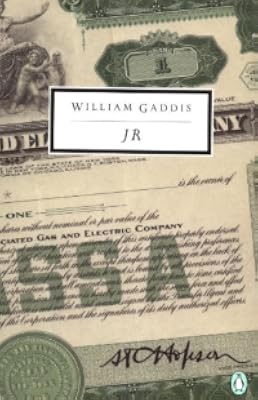
J R
by William Gaddis 
On This Page
Description
A National Book Award-winning satire about the unchecked power of American capitalism, written more than three decades before the 2008 financial crisis. At the center of J R is J R Vansant, a very average sixth grader from Long Island with torn sneakers, a runny nose, and a juvenile fascination with junk-mail get-rich-quick offers. Responding to one, he sees a small return; soon, he is a running a massive Ponzi scheme out of a phone booth in the school hallway. Everyone from the school staff show more to the municipal government to the squabbling heirs of a player-piano company to the titans of Wall Street and the politicians in Washington will be caught up in endlessly ballooning bubble of the J R Company. First published in 1975, J R is an appallingly funny and all-too-prophetic depiction of America's romance with finance. It is also a book about suburban development and urban decay, divorce proceedings and disputed wills, the crumbling facade of Western civilization and the impossible demands of love and art, with characters ranging from the earnest young composer Edward Bast, to the berserk publicist Davidoff. Told almost entirely through dialogue, William Gaddis's novel is both a literary tour de force and an unsurpassed reckoning with the way we live now. show lessTags
Recommendations





Member Recommendations
Member Reviews
If you thought David Foster Wallace wrote obscenely long convoluted sentences, try reading this two pound behemoth that has not one (not one I tell you!) chapter break in its entirety. It's like reading The Neverending Paragraph. If that sounds daunting enough, factor in that the narrative is ninety per cent dialogue, only the dialogue doesn't increase reading speed because it's dialogue that Gaddis has purposely not clearly delineated who's speaking what to whom ninety-nine per cent of the time (sound confusing, try reading it) for one must deduce who's speaking without any he said/she saids to help you sort it all out, similar to the unspecified-as-to-who's-speaking-dialogue featured in "A Clean, Well Lighted Place," only J R, mind show more you, is not a ten page short story by Hemingway, but a 752 page menacing gargoyle of a novel comprising vast Himalayan-like exchanges of dialogue and it takes at times the concentration or meditation of a Tibetan monk to decipher what it all means, let alone figuring out who's speaking. It's scary to face, yes, and it's hard keeping track of who said what to who what where when why and how, true, and it mocks the comprehension of one accustomed to instant gratification in light easy reading, but other than that, it's a real breeze. A nice cool refreshing breeze after running a marathon.
And since it's about money and capitalism gone so wild and satirically haywire that even a precocious elementary school kid working a payphone at recess as if he were a bookie, or working a payphone out on a school field trip to the local stock exchange can become a zillionaire practically overnight on stocks and bonds, it's quite topical to boot given the present state of our abysmal and, some might argue, broken economy run into the ground by children dressed up all nice and spiffy as if they were genuine businessmen and women not certainly seeking to go Ponzi on an all too gullible American public willing to buy anything. It's funny too, and not quite as depressing as our abysmal and, some might argue, broken economy run into the ground by children dressed up all nice and spiffy as if they were genuine businessmen and women not certainly seeking to go Ponzi on an all too gullible American public willing to buy anything. So stop overlooking William Gaddis and I'll stop being redundant, wordy, and pontificating, too. Just put down the Pynchon for a sec and give this neglected great master postmodernist whom Pynchon actually looked up to once upon a time in his young'n days before "V" had been conceived -- and the 1976 National Book Award Winner for crying out loud -- the larger audience he finally deserves. show less
And since it's about money and capitalism gone so wild and satirically haywire that even a precocious elementary school kid working a payphone at recess as if he were a bookie, or working a payphone out on a school field trip to the local stock exchange can become a zillionaire practically overnight on stocks and bonds, it's quite topical to boot given the present state of our abysmal and, some might argue, broken economy run into the ground by children dressed up all nice and spiffy as if they were genuine businessmen and women not certainly seeking to go Ponzi on an all too gullible American public willing to buy anything. It's funny too, and not quite as depressing as our abysmal and, some might argue, broken economy run into the ground by children dressed up all nice and spiffy as if they were genuine businessmen and women not certainly seeking to go Ponzi on an all too gullible American public willing to buy anything. So stop overlooking William Gaddis and I'll stop being redundant, wordy, and pontificating, too. Just put down the Pynchon for a sec and give this neglected great master postmodernist whom Pynchon actually looked up to once upon a time in his young'n days before "V" had been conceived -- and the 1976 National Book Award Winner for crying out loud -- the larger audience he finally deserves. show less
J R Vansant is, quite likely, the most improbable corporate titan ever portrayed in literature. An 11-year old sixth-grader at a progressively dysfunctional school on Long Island, J R parlays a field trip to a Wall Street brokerage firm organized by one of his teachers into the creation of a massive business empire—the J R Family of Companies—using a lot of borrowed assets, creative side deals, and considerable chutzpah. And the lad does this while operating completely behind the scenes, using Edward Bast, a struggling music composer who works part-time as a music instructor, as an unwitting figurehead spokesman for the firm while he himself conducts business from the school’s pay phone and a run-down Manhattan apartment! Indeed, show more he becomes the very embodiment of the American Dream, or at least what that dream had become 200 years after the founding of the country.
It is hard to know where to even start to analyze this remarkable novel, which won the National Book Award and cemented William Gaddis’ reputation as one of the most innovative and important literary voices during the second half of the 20th century. Certainly, it is a fierce satire of many things, most notably the ethically stilted Wall Street culture and the capitalist system it represents. However, the book also skewers the follies of a modern educational system that all too often confuses its true purpose, as well as the way in which art (i.e., music, literature, painting) gets corrupted when it becomes enmeshed with commerce. Beyond that, Gaddis’ writing is frequently very funny and the plotting is quite impressive given the multitude of characters, scenes, obscure references, and story lines that are crammed into the tale.
That said, it must also be noted that J R is a very challenging book to read. By now, the author’s all-dialogue writing style has been well documented and, in fact, it does take a lot of getting used to before the reader can find the proper rhythm. Also, the lack of chapters, section breaks, or even manageable paragraphs made it difficult to even keep track of what was happening in the story at times. (I found myself referring to an excellent on-line synopsis that outlined the chronology in the novel and explained a lot of the references.) Of course, the confusion that these literary devices generated appears to have been purposeful; like Thomas Pynchon, Gaddis was intrigued by the concept of entropy and creating an intentionally “noisy” atmosphere throughout the novel (e.g., hidden radios blaring, half-heard conversations, continuously running water) underscored the main theme of a free market economic system that has run amok.
I really enjoyed the several weeks it took me to consume this sprawling, ambitious novel. Despite the myriad obstacles he puts in the way, Gaddis was a brilliant writer with quite a bit to contribute to our understanding of modern conditions, both economic and personal. I have seen J R described in number of ways, from being a masterpiece to a “smoke screen for an author who has nothing interesting, wise, or entertaining to say” (apparently, Jonathan Franzen was not a fan!). I would have to say that the former depiction seems about right to me. show less
It is hard to know where to even start to analyze this remarkable novel, which won the National Book Award and cemented William Gaddis’ reputation as one of the most innovative and important literary voices during the second half of the 20th century. Certainly, it is a fierce satire of many things, most notably the ethically stilted Wall Street culture and the capitalist system it represents. However, the book also skewers the follies of a modern educational system that all too often confuses its true purpose, as well as the way in which art (i.e., music, literature, painting) gets corrupted when it becomes enmeshed with commerce. Beyond that, Gaddis’ writing is frequently very funny and the plotting is quite impressive given the multitude of characters, scenes, obscure references, and story lines that are crammed into the tale.
That said, it must also be noted that J R is a very challenging book to read. By now, the author’s all-dialogue writing style has been well documented and, in fact, it does take a lot of getting used to before the reader can find the proper rhythm. Also, the lack of chapters, section breaks, or even manageable paragraphs made it difficult to even keep track of what was happening in the story at times. (I found myself referring to an excellent on-line synopsis that outlined the chronology in the novel and explained a lot of the references.) Of course, the confusion that these literary devices generated appears to have been purposeful; like Thomas Pynchon, Gaddis was intrigued by the concept of entropy and creating an intentionally “noisy” atmosphere throughout the novel (e.g., hidden radios blaring, half-heard conversations, continuously running water) underscored the main theme of a free market economic system that has run amok.
I really enjoyed the several weeks it took me to consume this sprawling, ambitious novel. Despite the myriad obstacles he puts in the way, Gaddis was a brilliant writer with quite a bit to contribute to our understanding of modern conditions, both economic and personal. I have seen J R described in number of ways, from being a masterpiece to a “smoke screen for an author who has nothing interesting, wise, or entertaining to say” (apparently, Jonathan Franzen was not a fan!). I would have to say that the former depiction seems about right to me. show less
4.5 / 5
Wow. I won't be able to write everything here right now. This book is such a monumental achievement. I can't imagine what it took to write it, and I can't pretend to understand all of it. Everyone is so connected through back channels or invisible ties...it's hard to make sense of it all. Despite it being entirely in dialogue (well almost), and despite the book feeling at first as though it may not be able to create a fully formed 3D whole person, the book ends up brimming and overflowing with complex characters searching for meaning and purpose or else for money and success and all being stymied by each other (often unknowingly) or by the very system they are working in / creating.
Franzen was wrong about this novel. I don't know show more what is wrong with him if he can't take the fucking time to read it.
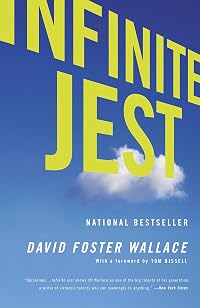
This book reminded me a lot of Infinite Jest. I think it is an order of magnitude better. I don't know why IJ gets more attention than JR. If you liked the former, you will absolutely love the latter.
Amy, JR, Gibbs, Rhoda, Bast, Duncan... oh lord these were great characters. The novel fucking explodes with connections and chaos and heartbreak in the last 100 or so pages.
Wow...simply wow. I must read the rest of Gaddis' work. show less
Wow. I won't be able to write everything here right now. This book is such a monumental achievement. I can't imagine what it took to write it, and I can't pretend to understand all of it. Everyone is so connected through back channels or invisible ties...it's hard to make sense of it all. Despite it being entirely in dialogue (well almost), and despite the book feeling at first as though it may not be able to create a fully formed 3D whole person, the book ends up brimming and overflowing with complex characters searching for meaning and purpose or else for money and success and all being stymied by each other (often unknowingly) or by the very system they are working in / creating.
Franzen was wrong about this novel. I don't know show more what is wrong with him if he can't take the fucking time to read it.
This book reminded me a lot of Infinite Jest. I think it is an order of magnitude better. I don't know why IJ gets more attention than JR. If you liked the former, you will absolutely love the latter.
Amy, JR, Gibbs, Rhoda, Bast, Duncan... oh lord these were great characters. The novel fucking explodes with connections and chaos and heartbreak in the last 100 or so pages.
Wow...simply wow. I must read the rest of Gaddis' work. show less
Genre and literary fiction are different. After reading JR, Cloud Atlas, Zazen, and a few other books this year, I think I'm finally starting to learn a bit more about those differences. Consider (and I promise to bring this discussion back to JR, bear with me):
The Wizard of Oz. It’s about a girl trapped in another world, and the enemies and friends she makes while trying to get home. Every sentence forwards that story. The book could not be any shorter and still tell that story. The book has a beginning, middle and end.
Anathem. It’s about a kid who grows up in a mathematical monastery, but his life is upended when aliens visit his world. Every chapter of the book is focused on telling that story. The author engages in some show more interesting asides about mathematics and philosophy; these add interest to the story without advancing the plot much. The story has a beginning, a middle, and (somewhat surprisingly for a Stephenson novel) an end.
Infinite Jest. It’s about what happens to a tennis student whose father created the most dangerous video in history, and the recovering drug addict destined to help him find it. MOST of the book is focused on telling that story, but not all of it. It has a beginning and a middle, but no end. The story’s left dangling at the end of the book, although you can piece together bits of the end of the story if you read closely.
J R. It’s about an 11-year-old boy who is a financial genius and secretly creates a multinational corporation from a public school pay phone. But not really; the author has other goals besides telling that story. MOST of the book is not related to that story line at all. The book really only has a middle; there’s no beginning or end in the conventional sense. The story is simply a clothes hanger for the author to display the larger fish he has to fry … stylistic experimentation and a singularly grim treatise on the relation of art and work in late capitalism.
Finnegan's Wake. I'm not even going to get into it, partly because I haven't finished it (who has?) and partly because if you know anything about that book, you already know the facts about it that are relevant to this discussion. It's the epitome of the "difficult literary book."
This short summary partly describes the spectrum between pure genre fiction and literary fiction. I seem to be happiest somewhere in the middle; I found Oz and JR both somewhat trying, while Anathem and Infinite Jest were top-notch. As writers abandon story, they start to experiment with other aspects of text. I'm sure that can be compelling in the right hands -- Joyce and Gaddis simply don't hold much attraction for me. I've had an opportunity, with the #OccupyGaddis group, to read this book more deeply than I'm used to. That experience, more than the book itself, was unique, compelling, and enjoyable.
I think 400 pages of the middle of this book lift right out, leaving a much better book. I also think Gaddis would be horrified at the very idea, and probably considered those 400 pages the soul of the book. And who the hell am I to take an ax to a National Book Award winner? My likes and dislikes are not necessarily relevant to a true literary analysis, although neither are they immaterial. I find it hard to look past them, however, which is probably why pomo texts were part of what turned me away from a literature degree.
In that middle 400 pages, drunken Gibbs’ ranting and Whitebeck’s insipid stammering are hackneyed, tin-eared, and ultimately poisonous to reader communication. Gibbs’ dialogue, in particular, resembles the very worst sections of Stephen King’s prose, with endlessly repeated phraselet motifs that don’t get any deeper or more meaningful when they’re repeated 37 times. After 10 pages of Whitebeck, there's not a reader alive who wouldn't get the point that bureaucrats and bankers don't listen to anyone but themselves. But you don't get 10 pages, you get 150.
Having said all that: J R certainly does have a unique effect on the reader, and as you round the final curve, somewhere around Rhoda's soliloquy to Gibbs in the squalid 96th St. apartment, that effect begins to shift from annoyance to a quiet frisson. You begin to think back over the book and realize the amazing things Gaddis has achieved ... that he's written a novel entirely without any hint of internal experience; that he's painted perhaps the most damning and accurate portrait of work and finance in America between Sinclair Lewis and Douglas Coupland; and that between the lines of J R, he has described life in the 1970s in a way that I, as a child of that decade, found compelling and darkly nostalgic.
I'm conflicted about J R, and about this review. I hope the above sums up my different thoughts, but if not, here's a one sentence summary: Here's a good book that I'd not read again. show less
The Wizard of Oz. It’s about a girl trapped in another world, and the enemies and friends she makes while trying to get home. Every sentence forwards that story. The book could not be any shorter and still tell that story. The book has a beginning, middle and end.
Anathem. It’s about a kid who grows up in a mathematical monastery, but his life is upended when aliens visit his world. Every chapter of the book is focused on telling that story. The author engages in some show more interesting asides about mathematics and philosophy; these add interest to the story without advancing the plot much. The story has a beginning, a middle, and (somewhat surprisingly for a Stephenson novel) an end.
Infinite Jest. It’s about what happens to a tennis student whose father created the most dangerous video in history, and the recovering drug addict destined to help him find it. MOST of the book is focused on telling that story, but not all of it. It has a beginning and a middle, but no end. The story’s left dangling at the end of the book, although you can piece together bits of the end of the story if you read closely.
J R. It’s about an 11-year-old boy who is a financial genius and secretly creates a multinational corporation from a public school pay phone. But not really; the author has other goals besides telling that story. MOST of the book is not related to that story line at all. The book really only has a middle; there’s no beginning or end in the conventional sense. The story is simply a clothes hanger for the author to display the larger fish he has to fry … stylistic experimentation and a singularly grim treatise on the relation of art and work in late capitalism.
Finnegan's Wake. I'm not even going to get into it, partly because I haven't finished it (who has?) and partly because if you know anything about that book, you already know the facts about it that are relevant to this discussion. It's the epitome of the "difficult literary book."
This short summary partly describes the spectrum between pure genre fiction and literary fiction. I seem to be happiest somewhere in the middle; I found Oz and JR both somewhat trying, while Anathem and Infinite Jest were top-notch. As writers abandon story, they start to experiment with other aspects of text. I'm sure that can be compelling in the right hands -- Joyce and Gaddis simply don't hold much attraction for me. I've had an opportunity, with the #OccupyGaddis group, to read this book more deeply than I'm used to. That experience, more than the book itself, was unique, compelling, and enjoyable.
I think 400 pages of the middle of this book lift right out, leaving a much better book. I also think Gaddis would be horrified at the very idea, and probably considered those 400 pages the soul of the book. And who the hell am I to take an ax to a National Book Award winner? My likes and dislikes are not necessarily relevant to a true literary analysis, although neither are they immaterial. I find it hard to look past them, however, which is probably why pomo texts were part of what turned me away from a literature degree.
In that middle 400 pages, drunken Gibbs’ ranting and Whitebeck’s insipid stammering are hackneyed, tin-eared, and ultimately poisonous to reader communication. Gibbs’ dialogue, in particular, resembles the very worst sections of Stephen King’s prose, with endlessly repeated phraselet motifs that don’t get any deeper or more meaningful when they’re repeated 37 times. After 10 pages of Whitebeck, there's not a reader alive who wouldn't get the point that bureaucrats and bankers don't listen to anyone but themselves. But you don't get 10 pages, you get 150.
Having said all that: J R certainly does have a unique effect on the reader, and as you round the final curve, somewhere around Rhoda's soliloquy to Gibbs in the squalid 96th St. apartment, that effect begins to shift from annoyance to a quiet frisson. You begin to think back over the book and realize the amazing things Gaddis has achieved ... that he's written a novel entirely without any hint of internal experience; that he's painted perhaps the most damning and accurate portrait of work and finance in America between Sinclair Lewis and Douglas Coupland; and that between the lines of J R, he has described life in the 1970s in a way that I, as a child of that decade, found compelling and darkly nostalgic.
I'm conflicted about J R, and about this review. I hope the above sums up my different thoughts, but if not, here's a one sentence summary: Here's a good book that I'd not read again. show less
This 700 page novel by William Gaddis (1922-1998) is a splendid work of literature. And in case you’re wondering about the title, JR is the name of one of the main characters, a grungy 12-year old boy who happens to be a financial genius working his money-magic from a public telephone booth in a hallway at his school. An alternate meaning of the two huge letters on the book’s cover could be ‘Jabbering Ruck’, since the novel is mostly dialogue and, make no mistake, every single person – down-on-their-luck men, flower-loving women, corporate business-types, school administrators, ticket takers, school kids, old ladies – do not possess the patience or capacity to hear one another out. Nearly every sentence in the entire novel show more is cut off before the sentence is completed. And, equally telling about American culture, everybody stops talking mid-sentence to answer the phone. Interruption as a mode of communication.
There is a quote cited in the middle of the novel: ‘That a work of art has a beginning, middle and end, life is all middle.’ Curiously, from the very first page to the last page, I had the distinct feeling I was in the middle of Gaddis’s novel, and for good reason: there are no chapter breaks nor scene demarcations, the dialogue has no character attributions, that is, there are no he said, she said, Tom said, Amy said. Dialogue and descriptions, action and interruptions, connections and misconnection, intimacies and alienation are part of one unending literary gush – novel reading as three weeks of ultimate extreme rafting down white water rapids. Do they pass out awards for finishing JR? They should.
And, man o’ man, what a novel: grand in scope, sweeping social commentary, satire, dark humor (yes, be prepared to laugh-out-loud a few times on every page) as Gaddis writes about multiple aspects of the American dream and American nightmare and everything in between – business, commerce, education,, government, sex, love, marriage, divorce, vision, literature, art, music, to name just a dozen – and with some of the most memorable characters you will ever encounter. However, I can see where Jonathan Franzen and other literary types judge JR a difficult book. But, from my own experience, once you follow Gaddis’s pace and rhythm, the language is quite engaging and not at all overwhelming. Here is a snatch of dialogue where an old aunt explains some family history to a visiting lawyer:
“Well, Father was just sixteen years old. As I say, Ira Cobb owned him some money. It was for work that Father had done, probably repairing some farm machinery. Father was always good with his hands. And then this problem came up over money, instead of paying Father Ira gave him an old violin and he took it down to the barn to try to learn to play it. Well his father heard it and went right down, and broke the violin over Father’s head. We were a Quaker family, after all, where you just didn’t do things that didn’t pay.”
How about that for insight into the culture? A young boy wants to play violin instead of fixing farm machinery or dealing in money. Well, whack! . . . take that kid. Get back to work so you can hand me some money! Bulls-eye, Mr. Gaddis. And heaven help those adults who don't grow out of wanting to play music or paint pictures or write books. Darn. . . why don't they really grow up and get a real job and do something useful so they can make some serious money?
One of my favorite characters is Whiteback, the school principal, who speaks pure Buffoon-ese. My guess is Gaddiss had great fun including Whiteback. I love the fact Whiteback displays his Horatio Alger award and 56 honorary degrees on his wall. 56! Here is Whiteback meeting with Dan, one of the school testers, and a Major Hyde, a corporate-military type pushing his company’s agenda on the school. At one point in the conversation, Whiteback pontificates on the justification of monies being given his school for standardized testing:
“Right, Dan, the norm in each case supporting or we might say being supported, substantiated that is to say, by an overall norm, so that in other words in terms of the testing the norm comes out as the norm, or we have no norm to test against, right? So that presented in these terms the equipment can be shown to justify itself in budgetary terms that is to say, would you agree, Major?
--- I’ll say one thing Dan, if you can present it at the budget meeting the way Whiteback’s just presented it here no one will dare to argue with you . . . “
What a scream. No joke, no one will argue. How do you argue with blustering sophistic double-speak?! Language as an administrate cover-up. Ironically, JR was published during the Watergate era.
In one scene we have Jack Gibbs making his entrance into a ramshackle, crumbling apartment, bottle in hand, to join his buddy. Through Gibbs's rant, Gaddis gives us the myth of the American writer/artist – the surly, gruff, liquor-fueled, poetic, perceptive outsider shooting holes through all the hypocrisy, shallowness, stupidity, self-righteousness and insensitivity of modern American life. It is as if the spirits of Henry Miller, Jackson Pollock, Charles Bukowski and other American tough-guy writers and artists loom over Gibb’s shoulder; matter of fact, one could take the words of Gibb’s rant and easily transpose them into a number of Bukowski-style poems. My sense is Gaddis also sees these looming spirits and knows the downside of the myth. What real freedom is there when one is tied to the scotch bottle and crusty, hard-boiled cynicism? But, then again, perhaps Gaddis detects some keen wisdom in a crusty cynicism, after all, his novel depicts how modern American cultural fuels one-dimensionality and a constriction of choice, where people are forced to live in a world constantly bombarded by noise, tawdriness, commercialism, land destruction, cesspools and intrusive gadgets.
JR is a challenging book, but a book well worth the effort. And, even if they don’t give you an award for finishing, at least you can tell your friends you made it to the end. show less
This 700 page novel by William Gaddis (1922-1998) is a splendid work of literature. And in case you’re wondering about the title, JR is the name of one of the main characters, a grungy 12-year old boy who happens to be a financial genius working his money-magic from a public telephone booth in a hallway at his school. An alternate meaning of the two huge letters on the book’s cover could be ‘Jabbering Ruck’, since the novel is mostly dialogue and, make no mistake, every single person – down-on-their-luck men, flower-loving women, corporate business-types, school administrators, ticket takers, school kids, old ladies – do not possess the patience or capacity to hear one another out. Nearly every sentence in the entire novel show more is cut off before the sentence is completed. And, equally telling about American culture, everybody stops talking mid-sentence to answer the phone. Interruption as a mode of communication.
There is a quote cited in the middle of the novel: ‘That a work of art has a beginning, middle and end, life is all middle.’ Curiously, from the very first page to the last page, I had the distinct feeling I was in the middle of Gaddis’s novel, and for good reason: there are no chapter breaks nor scene demarcations, the dialogue has no character attributions, that is, there are no he said, she said, Tom said, Amy said. Dialogue and descriptions, action and interruptions, connections and misconnection, intimacies and alienation are part of one unending literary gush – novel reading as three weeks of ultimate extreme rafting down white water rapids. Do they pass out awards for finishing JR? They should.
And, man o’ man, what a novel: grand in scope, sweeping social commentary, satire, dark humor (yes, be prepared to laugh-out-loud a few times on every page) as Gaddis writes about multiple aspects of the American dream and American nightmare and everything in between – business, commerce, education,, government, sex, love, marriage, divorce, vision, literature, art, music, to name just a dozen – and with some of the most memorable characters you will ever encounter. However, I can see where Jonathan Franzen and other literary types judge JR a difficult book. But, from my own experience, once you follow Gaddis’s pace and rhythm, the language is quite engaging and not at all overwhelming. Here is a snatch of dialogue where an old aunt explains some family history to a visiting lawyer:
“Well, Father was just sixteen years old. As I say, Ira Cobb owned him some money. It was for work that Father had done, probably repairing some farm machinery. Father was always good with his hands. And then this problem came up over money, instead of paying Father Ira gave him an old violin and he took it down to the barn to try to learn to play it. Well his father heard it and went right down, and broke the violin over Father’s head. We were a Quaker family, after all, where you just didn’t do things that didn’t pay.”
How about that for insight into the culture? A young boy wants to play violin instead of fixing farm machinery or dealing in money. Well, whack! . . . take that kid. Get back to work so you can hand me some money! Bulls-eye, Mr. Gaddis. And heaven help those adults who don't grow out of wanting to play music or paint pictures or write books. Darn. . . why don't they really grow up and get a real job and do something useful so they can make some serious money?
One of my favorite characters is Whiteback, the school principal, who speaks pure Buffoon-ese. My guess is Gaddiss had great fun including Whiteback. I love the fact Whiteback displays his Horatio Alger award and 56 honorary degrees on his wall. 56! Here is Whiteback meeting with Dan, one of the school testers, and a Major Hyde, a corporate-military type pushing his company’s agenda on the school. At one point in the conversation, Whiteback pontificates on the justification of monies being given his school for standardized testing:
“Right, Dan, the norm in each case supporting or we might say being supported, substantiated that is to say, by an overall norm, so that in other words in terms of the testing the norm comes out as the norm, or we have no norm to test against, right? So that presented in these terms the equipment can be shown to justify itself in budgetary terms that is to say, would you agree, Major?
--- I’ll say one think Dan, if you can present it at the budget meeting the way Whiteback’s just presented it here no one will dare to argue with you . . . “
What a scream. No joke, no one will argue. How do you argue with blustering sophistic double-speak?! Language as an administrate cover-up. Ironically, JR was published during the Watergate era.
In one scene we have Jack Gibbs making his entrance into a ramshackle, crumbling apartment, bottle in hand, to join his buddy. Through Gibbs's rant, Gaddis gives us the myth of the American writer/artist – the surly, gruff, liquor-fueled, poetic, perceptive outsider shooting holes through all the hypocrisy, shallowness, stupidity, self-righteousness and insensitivity of modern American life. It is as if the spirits of Henry Miller, Jackson Pollock, Charles Bukowski and other American tough-guy writers and artists loom over Gibb’s shoulder; matter of fact, one could take the words of Gibb’s rant and easily transpose them into a number of Bukowski-style poems. My sense is Gaddis also sees these looming spirits and knows the downside of the myth. What real freedom is there when one is tied to the scotch bottle and crusty, hard-boiled cynicism? But, then again, perhaps Gaddis detects some keen wisdom in a crusty cynicism, after all, his novel depicts how modern American cultural fuels one-dimensionality and a constriction of choice, where people are forced to live in a world constantly bombarded by noise, tawdriness, commercialism, land destruction, cesspools and intrusive gadgets.
JR is a challenging book, but a book well worth the effort. And, even if they don’t give you an award for finishing, at least you can tell your friends you made it to the end. show less
As others have noted, this really bogs down in the middle. Gaddis' method of satire depends upon relentless repetition of his main motifs; does he think we don't get it? or does he think more is more? Anyway, I don't think we would have missed about 200 pages, since no story line would have suffered.
There are five somewhat interconnected story lines, and each is told in unattributed dialogue. That isn't as difficult as it would seem, since it's usually clear who is speaking. The difficulty comes in the frustrating manner in which everyone speaks, which seems like everyone has an extreme ADD going on, so sentences are never concluded, either because the speaker jumps to something else, or more likely, someone else interrupts them. show more Perhaps most irritating are the one-sided phone conversations; we hear only one of the talkers and have to fill in the other's speech via the context.
I found JR the most irritating of all, the eponymous child "investor", who isn't the financial genius that some reviewers would have you think. Rather, he has read about how to leverage every single deal, taking advantage of financial instruments he does not understand and which will eventually lead him (and others) into serious legal (and physical) jeopardy. A lot of this absurdity is only possible because of Bast, a composer who must be a complete idiot to let himself be the willing dupe in JR's harebrained schemes.
And that's what I find confusing here. I would have thought that the artists here (writers mostly) would be portrayed more sympathetically, to offset the greed of the capitalists on display. Instead, they come off as being selfish in self-destructive ways, not particularly talented, and doing nothing to correct the squalor of their abodes (or is that supposed to be the source of a lot of laughs?). They do provide Gaddis the opportunity to provide some pretty obscure references to various works of poetry and other literature -- take that, James Joyce! I think the problem is that Gaddis was an amateur at humor and thought that being exhaustive equaled brilliance. The essential points could have been made in a book easily half this length. I'm probably being generous with the fourth star, but at least he had some prescience regarding how out of control the greedheads of capitalism could be. And we still suffer from that without anyone being particularly upset. At least not enough to do something substantive about it. show less
There are five somewhat interconnected story lines, and each is told in unattributed dialogue. That isn't as difficult as it would seem, since it's usually clear who is speaking. The difficulty comes in the frustrating manner in which everyone speaks, which seems like everyone has an extreme ADD going on, so sentences are never concluded, either because the speaker jumps to something else, or more likely, someone else interrupts them. show more Perhaps most irritating are the one-sided phone conversations; we hear only one of the talkers and have to fill in the other's speech via the context.
I found JR the most irritating of all, the eponymous child "investor", who isn't the financial genius that some reviewers would have you think. Rather, he has read about how to leverage every single deal, taking advantage of financial instruments he does not understand and which will eventually lead him (and others) into serious legal (and physical) jeopardy. A lot of this absurdity is only possible because of Bast, a composer who must be a complete idiot to let himself be the willing dupe in JR's harebrained schemes.
And that's what I find confusing here. I would have thought that the artists here (writers mostly) would be portrayed more sympathetically, to offset the greed of the capitalists on display. Instead, they come off as being selfish in self-destructive ways, not particularly talented, and doing nothing to correct the squalor of their abodes (or is that supposed to be the source of a lot of laughs?). They do provide Gaddis the opportunity to provide some pretty obscure references to various works of poetry and other literature -- take that, James Joyce! I think the problem is that Gaddis was an amateur at humor and thought that being exhaustive equaled brilliance. The essential points could have been made in a book easily half this length. I'm probably being generous with the fourth star, but at least he had some prescience regarding how out of control the greedheads of capitalism could be. And we still suffer from that without anyone being particularly upset. At least not enough to do something substantive about it. show less
Members
- Recently Added By
Published Reviews
ThingScore 100
J R is the perfect novel for our new recession-driven world.
added by Shortride
Lists

Great American Novels
158 works; 40 members

Novels from The Guardian's Great American Novelist Tournament
148 works; 24 members
Larry McCaffery's 20th Century Greatest Hits: 100 English-Language Books
103 works; 12 members

Favorite Long Books
330 works; 41 members

The Top Ten: Writers Pick Their Favorite Books
240 works; 31 members

Favourite Books
1,819 works; 316 members

50 Tough Books for Extreme Readers
71 works; 40 members

1970s
657 works; 23 members

Experimental Literature
141 works; 18 members

Most difficult novels
68 works; 27 members
Best of American Literature
146 works; 9 members

Best First Lines
133 works; 8 members

hopes
34 works; 1 member

Amanda's Guaranteed Books
110 works; 5 members

Existentialism
90 works; 11 members
Franklit
95 works; 1 member

Swinging Seventies
255 works; 18 members

Books
85 works; 1 member

National Book Award - Fiction
78 works; 10 members

National Book Award winners
65 works; 11 members

Novels without quotation marks
25 works; 1 member
Author Information

9+ Works 7,350 Members
William Gaddis was born on December 29, 1922, in Manhattan, New York City. He was an American novelist. In Recognition of William Gaddis (1984) is a collection of essays supporting the view that Gaddis is the Herman Melville of the twentieth century. The comparison may prove justified, not only because of artistic similarities, but also because show more both writers suffered from years of neglect before achieving fame. Gaddis' novel The Recognitions (1955) baffled and angered most of its initial reviewers, but it has slowly, steadily attracted a growing number of appreciative readers willing to work through its more than 900 demanding pages. Its length and encyclopedic complexity caused some critics mistakenly to hail it as the American Ulysses, but Gaddis disclaimed much knowledge of James Joyce. It was named one of TIME magazine's 100 best novels from 1923 to 2005. As if to make amends for the neglect of The Recognitions, most reviewers greeted Gaddis' second novel, JR (1975), with respectful attention. Although not a popular success, it won the National Book Award. Gaddis won a second National Book Award in 1994 for his book, A Frolic of His Own. Gaddis died at home in East Hampton, New York, of prostate cancer on December 16, 1998. show less
William Gaddis has a Legacy Library. Legacy libraries are the personal libraries of famous readers, entered by LibraryThing members from the Legacy Libraries group.
Some Editions
Awards and Honors
Awards
Series
Belongs to Publisher Series
Common Knowledge
- Canonical title
- J R
- Original publication date
- 1975
- Dedication
- For Matthew
Once more onto the breach, dear friend, once more - First words
- ... A magnificent example of rant. A perfect example really. The Recognitions, his first novel, was seven years in construction. J R, his second, took more than twice that long. In each case, the invalid miracul... (show all)ously arose and, with commanding vigor, transformed and transforming, entered the realm of great literature. -Introduction, Joy Williams
-Money...? in a voice that rustled.
-Paper, yes.
-And we'd never seen it. Paper money.
-It looked so strange the first time we saw it. Lifeless.
-You couldn't believe it was worth a thing.
-Not after Father jin... (show all)gling his change.
-Those were silver dollars.
-And silver halves, yes and quarters, Julia. The ones from his pupils. I can hear him now... - Canonical DDC/MDS
- 813.54
- Canonical LCC
- PS3557.A28 J2
Classifications
Statistics
- Members
- 1,611
- Popularity
- 14,040
- Reviews
- 20
- Rating
- (4.14)
- Languages
- 5 — English, French, German, Italian, Spanish
- Media
- Paper, Audiobook, Ebook
- ISBNs
- 22
- ASINs
- 11