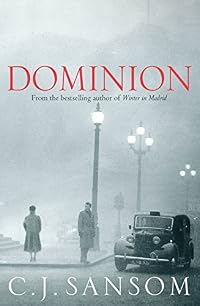
Dominion
by C. J. Sansom
On This Page
Description
C.J. SANSOM REWRITES HISTORY IN A THRILLING NOVEL THAT DARES TO IMAGINE BRITAIN UNDER THE THUMB OF NAZI GERMANY. 1952. Twelve years have passed since Churchill lost to the appeasers and Britain surrendered to Nazi Germany. The global economy strains against the weight of the long German war against Russia still raging in the east. The British people find themselves under increasingly authoritarian rule--the press, radio, and television tightly controlled, the British Jews facing ever greater show more constraints. But Churchill's Resistance soldiers on. As defiance grows, whispers circulate of a secret that could forever alter the balance of the global struggle. The keeper of that secret? Scientist Frank Muncaster, who languishes in a Birmingham mental hospital. Civil Servant David Fitzgerald, a spy for the Resistance and University friend of Frank's, is given the mission to rescue Frank and get him out of the country. Hard on his heels is Gestapo agent Gunther Hoth, a brilliant, implacable hunter of men, who soon has Frank and David's innocent wife, Sarah, directly in his sights. C.J. Sansom's literary thriller Winter in Madrid earned Sansom comparisons to Graham Greene, Sebastian Faulks, and Ernest Hemingway. Now, in his first alternative history epic, Sansom doesn't just recreate the past--he reinvents it. In a spellbinding tale of suspense, oppression and poignant love, DOMINION dares to explore how, in moments of crisis, history can turn on the decisions of a few brave men and women--the secrets they choose to keep and the bonds they share. show lessTags
Recommendations















Member Recommendations

Member Reviews
I'm not sure if early 2017 is the best or worst time to read a work of counter-factual historical fiction like this: set in a 1950s England where the forces of appeasement won out, Winston Churchill is the fugitive head of the British Resistance, and an ageing Hitler is about to celebrate two decades in power.
Overall, this is a bit of a mixed bag. Sansom does a good job of sketching out a grey and gloomy London, suffocating under a coal-fuelled smog and fascism in equal measure; what atmosphere his pen can't supply, the reader's imagination can easily substitute in nowadays. What does the destruction of civilisation and democracy need but spineless self-interest and ignorance and apathy?
However, Dominion's characterisation is thin, show more the tension never quite ratchets up as much as the reader might want thanks to a weak central plot McGuffin and a failure to fillet out flabby back stories, and Sansom's insistence on the dangers of particularly Scottish nationalism is a bit ironic in light of the Brexit referendum (you were looking at the wrong side of the border for evidence of the really toxic stuff, buddy). Still, this is a step above the usual airport thriller, and provides an added dose of moral discomfort for the reader for good measure. If the worst happened, what kind of coward would you be? show less
Overall, this is a bit of a mixed bag. Sansom does a good job of sketching out a grey and gloomy London, suffocating under a coal-fuelled smog and fascism in equal measure; what atmosphere his pen can't supply, the reader's imagination can easily substitute in nowadays. What does the destruction of civilisation and democracy need but spineless self-interest and ignorance and apathy?
However, Dominion's characterisation is thin, show more the tension never quite ratchets up as much as the reader might want thanks to a weak central plot McGuffin and a failure to fillet out flabby back stories, and Sansom's insistence on the dangers of particularly Scottish nationalism is a bit ironic in light of the Brexit referendum (you were looking at the wrong side of the border for evidence of the really toxic stuff, buddy). Still, this is a step above the usual airport thriller, and provides an added dose of moral discomfort for the reader for good measure. If the worst happened, what kind of coward would you be? show less
Wow. What a terrific book! Today's political environment nationally and worldwide makes this book more challenging but also more valuable. It's definitely not escapist reading. The first half of the book is a slow build, developing the world and the characters, and then the plot speeds up a lot in the second half. The slower pacing in the first half is good, though, because the world itself and the characters are interesting and because it's so effective at establishing the stakes for when the action speeds up later. I'm impressed by how the differing political sides, even the ones the author clearly disagrees with, are treated with nuance and understanding of what drives people. Even the antagonist is realistically human, even if he's show more awful. It's a pleasure and sadly difficult to find a book with clear moral vision but nuanced portrayals of all important characters. show less
It is 1952 and twelve years since Prime Minister Lord Halifax surrendered to the German army after the British Norway offensive failed. David Fitzgerald is a senior civil servant in the Dominions Office, secretly working for the Resistance and supplying them with secret material. Frank Muncaster is a university friend of David’s with a brother in America working on top-secret weapons research. Uninhibited by drink, Frank’s brother boasts to him about his work, prompting Frank to lose control, resulting in the brother falling through the window and breaking his arm, and Frank to rave about the end of the world while smashing up his flat. David is ordered by the Resistance to reacquaint himself with Frank, who has been sectioned and show more is now confined to a mental hospital, and give them an assessment of his mental state. Unbeknownst to them, the Germans have also got wind of the situation and sent one of their best Gestapo officers to England to track down Frank and find out what he knows. Now it is a race against time for David and his Resistance friends to get Frank out of the country before the Germans find and extract the secret from him.
This is a spy thriller of the highest order set in an alternate Britain, following the individual narrative threads of David, his wife Sarah, Frank and Gunther, the German. Sansom masterly increases the tension by setting the individual timelines slightly out of sync, thereby letting the reader move backwards and then forwards in time and allowing them to anticipate a moment when the individual strands inevitably converge. As ever, he is a master in conveying the atmosphere of a place, in this case 1950s Britain ruled by an authoritarian regime with close links to Nazi Germany. It is brimful with authentic cultural references of the period and manages to impart a sense of fear and suspicion, yet also the cold, dampness and smog-covered streets of a London autumn. It is heartbreaking and harrowing in places, making for uncomfortable reading at times as it questions the reader’s own beliefs. Despite its setting in 1952, Sansom shows us that he’s an immensely talented writer by making some of the themes covered in the novel as topical and relevant as ever: newspaper magnates dabbling in politics and influencing government policy, nationalism and fascism, the importance of standing up for one’s beliefs and not looking away when atrocities are committed on citizens by those in power. He describes how fascism can arise in any country when the circumstances are right, and in the novel (as in reality) Britain, France and Slovakia quickly followed in Germany’s footsteps in producing their own versions of it, yet he is also at pains to point out that, despite the fascists’ brash arguments, a lot of them are simply motivated by greed and self-preservation. With fifteen pages of historical notes, this feels like an intensely personal and political book, with Sansom almost going so far as to call on his readership to fight the rise of nationalism wherever it is encountered. It is a thought-provoking and important work and deserves all the critical acclaim that has been heaped on it so far. show less
This is a spy thriller of the highest order set in an alternate Britain, following the individual narrative threads of David, his wife Sarah, Frank and Gunther, the German. Sansom masterly increases the tension by setting the individual timelines slightly out of sync, thereby letting the reader move backwards and then forwards in time and allowing them to anticipate a moment when the individual strands inevitably converge. As ever, he is a master in conveying the atmosphere of a place, in this case 1950s Britain ruled by an authoritarian regime with close links to Nazi Germany. It is brimful with authentic cultural references of the period and manages to impart a sense of fear and suspicion, yet also the cold, dampness and smog-covered streets of a London autumn. It is heartbreaking and harrowing in places, making for uncomfortable reading at times as it questions the reader’s own beliefs. Despite its setting in 1952, Sansom shows us that he’s an immensely talented writer by making some of the themes covered in the novel as topical and relevant as ever: newspaper magnates dabbling in politics and influencing government policy, nationalism and fascism, the importance of standing up for one’s beliefs and not looking away when atrocities are committed on citizens by those in power. He describes how fascism can arise in any country when the circumstances are right, and in the novel (as in reality) Britain, France and Slovakia quickly followed in Germany’s footsteps in producing their own versions of it, yet he is also at pains to point out that, despite the fascists’ brash arguments, a lot of them are simply motivated by greed and self-preservation. With fifteen pages of historical notes, this feels like an intensely personal and political book, with Sansom almost going so far as to call on his readership to fight the rise of nationalism wherever it is encountered. It is a thought-provoking and important work and deserves all the critical acclaim that has been heaped on it so far. show less
I was recommended the novels of C.J. Sansom by someone I sat next to at a recent wedding. I don’t remember their name but do recall the subject of their PhD, which probably says a lot about my social skills. Anyway, when a history PhD tells me that [b:A Place of Greater Safety|101921|A Place of Greater Safety|Hilary Mantel|https://images.gr-assets.com/books/1363435037s/101921.jpg|1168385] is one of their favourite books, I obviously ask them for historical fiction recommendations. I’m glad I did, because ‘Dominion’ was an excellent read. Upon reaching the end, I also realised it was very timely, as the author includes an opinion piece criticising the current nationalistic turn in European politics generally, and the Scottish show more independence campaign in particular. Writing in 2012, he is scathing about the SNP and their opportunistic politics. I’m not sure to what extent I agree with him on that particular issue, but certainly the broad nationalistic trend (tending to neo-fascism in Greece and elsewhere) is deeply disquieting.
That final extended author’s note, more of an essay, demonstrates that Sansom has carefully thought out and meticulously researched his counterfactual history. In the alternate universe of ‘Dominion’, Churchill did not take over from Chamberlain as Prime Minister in 1940, instead it was Lord Halifax. Halifax subsequently sued for peace after the fall of France to the Nazis. The novel then picks up in 1952, building a grimly fascinating UK in which fascism has gradually crept in and the Nazis occupy the Isle of Wight. In Germany Hitler is dying and a power struggle beckons, whilst war on the Eastern Front continues endlessly with massive losses to both sides. I did wonder a bit about the Asian situation, although unrest in India was often referred to. The world-building of alternate Europe is absolutely magnificent and definitely better than any other alternate Second World War novel I’ve read before. (I think those that I’ve read before have all been American, [b:The Man in the High Castle|216363|The Man in the High Castle|Philip K. Dick|https://images.gr-assets.com/books/1448756803s/216363.jpg|2398287] for example, and provided a less detailed vision.)
Although the counterfactual itself is undoubtedly the best thing about the book, I also found the plot very involving. The sense of individual characters being pawns in larger political machinations was well portrayed and tension was kept up over quite a long narrative. The characters themselves were sympathetic enough, although they sometimes descended into cliché. I was disappointed that all the main female characters carried a torch for David the lead male and that their character development seemed to be disproportionately about him. Frank was quite effectively painted as a tragic figure, however his story was so unremittingly dismal as to sometimes seem excessive. Now and again giving the point of view to a Nazi named Gunther provided interesting contrast and heightened the tension. Nonetheless, I’d say that the plot and world-building far outshone the characters. I loved the use of 1952’s Great Fog as a plot device, as well as references to the fates of such diverse figures as Ghandi, Vera Brittain, and Vidkun Quisling.
I hesitated between giving this book four or five stars. On balance I think five are merited, given the fantastic setting and excellent plotting. For once I will forgive the short-changing of female characters; they did at least get to be brave, adventurous, and to have their own point of view at times. The resolution at the end was satisfactory and well-judged too. Tiptoeing around spoilers, I don’t like when thrillers end with the simplistic message that everything has changed for the better thanks to the doings of these few characters (often This One Guy). The world is much more complex than that, which I think the narrative of ‘Dominion’ always remembers. It’s a thoughtful, deeply interesting read if you have any yen for the history of the Second World War, and a solid spy thriller on top of that. show less
That final extended author’s note, more of an essay, demonstrates that Sansom has carefully thought out and meticulously researched his counterfactual history. In the alternate universe of ‘Dominion’, Churchill did not take over from Chamberlain as Prime Minister in 1940, instead it was Lord Halifax. Halifax subsequently sued for peace after the fall of France to the Nazis. The novel then picks up in 1952, building a grimly fascinating UK in which fascism has gradually crept in and the Nazis occupy the Isle of Wight. In Germany Hitler is dying and a power struggle beckons, whilst war on the Eastern Front continues endlessly with massive losses to both sides. I did wonder a bit about the Asian situation, although unrest in India was often referred to. The world-building of alternate Europe is absolutely magnificent and definitely better than any other alternate Second World War novel I’ve read before. (I think those that I’ve read before have all been American, [b:The Man in the High Castle|216363|The Man in the High Castle|Philip K. Dick|https://images.gr-assets.com/books/1448756803s/216363.jpg|2398287] for example, and provided a less detailed vision.)
Although the counterfactual itself is undoubtedly the best thing about the book, I also found the plot very involving. The sense of individual characters being pawns in larger political machinations was well portrayed and tension was kept up over quite a long narrative. The characters themselves were sympathetic enough, although they sometimes descended into cliché. I was disappointed that all the main female characters carried a torch for David the lead male and that their character development seemed to be disproportionately about him. Frank was quite effectively painted as a tragic figure, however his story was so unremittingly dismal as to sometimes seem excessive. Now and again giving the point of view to a Nazi named Gunther provided interesting contrast and heightened the tension. Nonetheless, I’d say that the plot and world-building far outshone the characters. I loved the use of 1952’s Great Fog as a plot device, as well as references to the fates of such diverse figures as Ghandi, Vera Brittain, and Vidkun Quisling.
I hesitated between giving this book four or five stars. On balance I think five are merited, given the fantastic setting and excellent plotting. For once I will forgive the short-changing of female characters; they did at least get to be brave, adventurous, and to have their own point of view at times. The resolution at the end was satisfactory and well-judged too. Tiptoeing around spoilers, I don’t like when thrillers end with the simplistic message that everything has changed for the better thanks to the doings of these few characters (often This One Guy). The world is much more complex than that, which I think the narrative of ‘Dominion’ always remembers. It’s a thoughtful, deeply interesting read if you have any yen for the history of the Second World War, and a solid spy thriller on top of that. show less
A closer call than we like to think
Dominion by C. J. Sansom (Mulholland Books, $9.99).
It’s not the newest premise on the alternate-history block, but C.J. Sansom uses it as an opportunity to explore British national character and turn Winston Churchill into a rebel leader.
In Dominion, it’s 1952, and following a Lloyd George-engineered truce to end the war much ealier than in our timeline, the British are reduced to a client-state of the Third Reich.
This isn’t a far-fetched possibility; serious students of history know that Britain was in much worse shape than publicly acknowledged prior to U.S. entry into the war, and without FDR’s assistance, might even have lost.
In this case, Sansom gives us a policeman hero: David show more Fitzgerald, who harbors a pretty big secret in a racially-segregated nation. He’s a half-Jew. And the Nazis are about to introduce their “Final Solution” to England.
First, it’s an astounding piece of world-building. But it’s also a fascinating look at how ordinary people respond to fascism, with those who prefer distinct lines of authority and hierarchy generally having much less trouble adapting than we might hope.
Fitzgerald gets involved in gathering intelligence for Churchill’s resistance movement (they graffiti “V” around London, among other, more important activities), which makes this novel technically a thriller. But at heart, it’s a painful and honest examination of just how well we—or someone like us—might stand up to a dictatorship.
We can only hope we’d do as well as Fitzgerald. In his world, people like E. M. Forster and W. H. Auden, who dared to speak out, simply disappeared.
Reviewed on Lit/Rant: www.litrant.tumblr.com show less
Dominion by C. J. Sansom (Mulholland Books, $9.99).
It’s not the newest premise on the alternate-history block, but C.J. Sansom uses it as an opportunity to explore British national character and turn Winston Churchill into a rebel leader.
In Dominion, it’s 1952, and following a Lloyd George-engineered truce to end the war much ealier than in our timeline, the British are reduced to a client-state of the Third Reich.
This isn’t a far-fetched possibility; serious students of history know that Britain was in much worse shape than publicly acknowledged prior to U.S. entry into the war, and without FDR’s assistance, might even have lost.
In this case, Sansom gives us a policeman hero: David show more Fitzgerald, who harbors a pretty big secret in a racially-segregated nation. He’s a half-Jew. And the Nazis are about to introduce their “Final Solution” to England.
First, it’s an astounding piece of world-building. But it’s also a fascinating look at how ordinary people respond to fascism, with those who prefer distinct lines of authority and hierarchy generally having much less trouble adapting than we might hope.
Fitzgerald gets involved in gathering intelligence for Churchill’s resistance movement (they graffiti “V” around London, among other, more important activities), which makes this novel technically a thriller. But at heart, it’s a painful and honest examination of just how well we—or someone like us—might stand up to a dictatorship.
We can only hope we’d do as well as Fitzgerald. In his world, people like E. M. Forster and W. H. Auden, who dared to speak out, simply disappeared.
Reviewed on Lit/Rant: www.litrant.tumblr.com show less
Here's the scenario, the Germans won the war, England is occupied, Churchill is in hiding, the Nazis have complete control and the British Fascists hold key positions. The British population has by and large accepted it and keep their heads down.
There is a resistance movement but it is scattered and capable of not a lot more than isolated raids. England is same old drab, dirty, boring, underwhelming, place it has always been except the Brits now have something to moan about except they are too shit scared to do so.
Now, imagine that an 8 part television drama was made in the early 1980s but was set in the 1950's, if you can grasp that then you'll love this book.
The story is good, atmospheric, gripping, and very well told. It's almost show more 600 pages long so there's plenty to get your teeth into but there isn't a cast of thousands to confuse you and a very short timeline so none of that intergenerational stuff and everyone is called Geoff, or Steve, or Robert, or David. There are no unpronounceable names, just weak tea and stale biscuits mainly.
Don't get me wrong it took me three lockdown days to plough through it. I loved every minute of it and no recipes.
Being an unreconstructed Brit I thought the description of how things panned out under the Germans was surprisingly well thought out, the Jews were allowed to stay, a kind of democracy was in place but everything was controlled by the Germans. The various politicians were named and they were the pro-fascist bunch from that era, except here, all their wildest dreams did come true.
England still had bobbies and postmen and milkmen and firemen just like before. The country was broke, everything was drab and that which wasn't was expensive. How it would read to a non-English audience I'm not sure, but then again I have read dystopian novels set in the US and that did not cause problems, sure, I missed some of the references but not enough to spoil it.
In essence it is a thriller and a bloody good one too. If you are interested in this era and alternative histories then you will be at home here. show less
There is a resistance movement but it is scattered and capable of not a lot more than isolated raids. England is same old drab, dirty, boring, underwhelming, place it has always been except the Brits now have something to moan about except they are too shit scared to do so.
Now, imagine that an 8 part television drama was made in the early 1980s but was set in the 1950's, if you can grasp that then you'll love this book.
The story is good, atmospheric, gripping, and very well told. It's almost show more 600 pages long so there's plenty to get your teeth into but there isn't a cast of thousands to confuse you and a very short timeline so none of that intergenerational stuff and everyone is called Geoff, or Steve, or Robert, or David. There are no unpronounceable names, just weak tea and stale biscuits mainly.
Don't get me wrong it took me three lockdown days to plough through it. I loved every minute of it and no recipes.
Being an unreconstructed Brit I thought the description of how things panned out under the Germans was surprisingly well thought out, the Jews were allowed to stay, a kind of democracy was in place but everything was controlled by the Germans. The various politicians were named and they were the pro-fascist bunch from that era, except here, all their wildest dreams did come true.
England still had bobbies and postmen and milkmen and firemen just like before. The country was broke, everything was drab and that which wasn't was expensive. How it would read to a non-English audience I'm not sure, but then again I have read dystopian novels set in the US and that did not cause problems, sure, I missed some of the references but not enough to spoil it.
In essence it is a thriller and a bloody good one too. If you are interested in this era and alternative histories then you will be at home here. show less
Alternate histories attract us because they show what might have been, paths we could perhaps easily have taken. Dpminion is a powerful historical thriller. At first it appears to show what would have happened if the appeasers in British politics had won out against Hitler's Nazis and never declared war. It shows a 1950's austerity Britain firmly under the political domination of the Nazis. The story concerns the resistance movement smuggling a scientist out of the country to prevent his knowledge falling into Nazi hands. Dig deeper though, and it becomes clear this is a novel showing the destructive force of nationalism and the way it drives people to despise the other - Jews, blacks, Americans - and ultimately to despise their closest show more friends and family and ultimately themselves.
This is a sombre story, sombrely told, using the historic London smogs as a metaphor for the propagandist ways that governments and authorities can use hatred of others to keep a population starved of knowledge, of being able to see the whole picture and to make judgements of their own. show less
This is a sombre story, sombrely told, using the historic London smogs as a metaphor for the propagandist ways that governments and authorities can use hatred of others to keep a population starved of knowledge, of being able to see the whole picture and to make judgements of their own. show less
Members
- Recently Added By
Published Reviews
ThingScore 100
But, as in all the best war-related alternative fiction, the finger of suspicion also jabs uncomfortably at the reader. Sansom directly confronts the frequent, smug view in the UK that nazism and the Jewish Holocaust were inherently German perversions. The English, in this version, often prove just as susceptible to strong but psychotic leadership and the prospect of racist genocide. The song show more from Cabaret that poses the question "What Would You Do?" might be the theme tune to a tremendous novel that shakes historical preconceptions while also sending shivers down the spine. show less
added by souloftherose
Sansom has woven a thriller with the tale of a man's growth into moral courage, but he has done it with the compassion and richness that many literary writers should emulate. Every detail of this nightmare Britain rings true, from the way that morris dancing is televised as a cultural expression of nationalism to the absence of the name "Lyons" in Corner Houses. Cowardice and collaboration are show more everywhere. show less
added by passion4reading
Lists

Top Five Books of 2013
1,564 works; 716 members

Best Alternate History
111 works; 60 members

Unread books
1,063 works; 87 members

Best Books Set in London
157 works; 40 members

Books Set in Great Britain
191 works; 13 members

Books about World War II
241 works; 22 members

Alternate Englands
34 works; 7 members

Books Read in 2015
3,298 works; 126 members

BingoDOG 2015 Challenge
49 works; 3 members

Speculative Fiction to Read
706 works; 32 members

SFFCat 2015
35 works; 1 member

IMPAC Dublin Literary Award 2014 longlist
150 works; 3 members

Global Reads: Books Set in Western Europe
186 works; 10 members

Kirkus Reviews Best Fiction of 2014
100 works; 7 members

Books Read in 2019
4,052 works; 110 members

Wishlist
99 works; 1 member
Author Information

Some Editions
Awards and Honors
Awards
Distinctions
Notable Lists
Common Knowledge
- Canonical title*
- Skygge over London
- Original title
- Dominion
- Original publication date
- 2012
- People/Characters
- Winston Churchill; Neville Chamberlain; David Fitzgerald; Sarah Fitzgerald; Natalia; Frank Muncaster (show all 23); Ben Hall; Geoff Drax; Gunther Hoth; William Syme; Sir Harold Jackson; Standartenfuhrer Gessler; Edgar Muncaster; Carol Bennett; Adolf Hitler; Irene; Archie Hubbold; Max Aitken, Lord Beaverbrook; Oswald Mosley; Bert Sperrin; Lord Halifax; Dilys; Mr. Dabb
- Important places
- England, UK; London, England, UK; Germany; Birmingham, England, UK; Scotland, UK; Sussex, England, UK
- Important events
- Great Smog of '52 (1952-12-05)
- Epigraph
- The whole fury and might of the enemy must very soon be turned on us. Hitler knows that he will have to break us in this island or lose the war. If we can stand up to him all Europe may be free, and the life of the world ... (show all)will move forward into broad, sunlit uplands; but if we fail, then the whole world, including the United States, and all that we have known and cared for, will sink into the abyss of a new dark age made more sinister,and perhaps more prolonged, by the lights of a perverted science. -- Winston Churchill, 18 June 1940.
- Dedication
- To the memory of my parents, TREVOR SANSOM (1921-2000) and ANN SANSOM (1924-1990) who in 1939-45 endured the hardships and did their bit to defeat the Nazis. And of ROSALITA, R.I.P. 19.2.2012
- First words
- Churchill was last to arrive.
- Quotations
- Whenever a party tells you national identity matters more than anything else in politics, that nationalism can sort out all the other problems, then watch out, because you're on a road that can end with fascism. Even if it do... (show all)esn't, the idea that nationality's some sort of magic that can make other problems disappear, it's like believin' in fairies. And of course nationalists always have to have an enemy, the English or the French or the Jews, there always has tae be some other bugger that's caused all the problems.
There's a physicist in America who thinks the world we live in is only one of millions of parallel worlds, existing alongside each other, each different in tiny little ways. Maybe worlds where everyone is happy.
People dividing each other up according to nationality and religion, it's the worst thing, it causes nothing but misery and bloodshed.
Frank hated drink, it loosened people's inhibitions and inhibitions were the only things that kept them from savagery.
Didn't Gandhi say peaceful protest only works if those you're protesting against are capable of being shamed?
David remembered something Sarah had said once, that the Great War had made mass slaughter ordinary, that was why Stalin and Hitler could commit murder on a scale inconceivable before 1914. It was why these old men could talk... (show all) like Soviet Commissars or SS men.
Gunther thought, he's got courage, the limited courage of the stupid.
...given the right circumstances fascism can infest any country, feeding off the hatreds and nationalisms that already exist. Nobody is safe.
We spend all our lives walking on the thinnest of thin ice, it can break at any moment and then we fall through. - Last words
- (Click to show. Warning: May contain spoilers.)'Yes. The exiles will be returning soon. To help us rebuild. Rebuild! We need them all now.'
- Blurbers
- Atkinson, Kate; James, P.D.; Cumming, Charles; King, Stephen
- Original language
- English UK
*Some information comes from Common Knowledge in other languages. Click "Edit" for more information.
Classifications
Statistics
- Members
- 1,209
- Popularity
- 20,428
- Reviews
- 65
- Rating
- (3.65)
- Languages
- 10 — Czech, Dutch, English, French, German, Italian, Norwegian (Bokmål), Norwegian, Russian, Spanish
- Media
- Paper, Audiobook, Ebook
- ISBNs
- 36
- ASINs
- 14