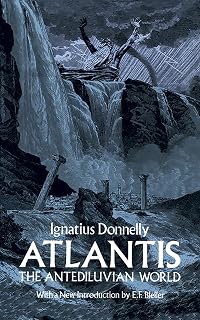
Atlantis: The Antediluvian World
by Ignatius Donnelly
On This Page
Description
Neither an occult book nor a work of fantasy, this 1882 classic offers an erudite blend of evidence from geologic, oceanographic, and anthropologic studies and remains a captivating work of enthusiasm and imaginative thought. 128 illustrations. Introduction by E. F. Bleiler.Tags
Recommendations






























Member Reviews
It's more convincing than I expected. The author's work was first published in 1882. He presents geological, cross-cultural, historical, linguistic, and biographical evidence. Primary points include: geological evidence of major land mass in the Atlantic Ocean which sank before our modern history due to volcanic eruption and underwater turbulence (tops of the Azores are a remnant); land mass includes extentions toward Africa and South American and a point of island near Ireland; plethora examples exist of similarities between American and European history (direction of origin; flood legend; 12 (or 10) tribes/families legends; stories of gods; architecture (pyramids, mounds, arches, etc.); language (Atlantis, Atlazl, Adhem, Adam; Baal, show more Bel, Baalz, god names, and common terms); last section ties specific details to Atlantean legends from Mississippi Valley, Ohio valley, Mexico, Peru, Chile, Ireland, Iberian Peninsula, Egypt, Greece, Italy, et al. The beginning section quotes Plato's entire discourse on Atlantis, which scholars have debated as being either a moral example or an actual recounting of what other scholars told him. Atlantean society had 12 organized families/tribes; black, white, and red races; well-described laws (with legacies in Egypt, American, Judaism, Islam, etc); scientific discovery (gunpowder, major grains, compass, et al). The founders of Atlantis became "gods" in descendant cultures. show less
A rightly justified classic. All Atlantis books are a footnote to Donnelly's study.
A book I read many years ago when researching Atlantis - the myths, the legends and the theories. This is an important book to read, now save on my 'to read' pile again.
The book to read on Atlantis
EUROPEAN LITERATURE ON ATLANTIS SINCE 1914, REVIEWED. By EGERTON SYKES.
Subsequent articles will deal with the Latin American comIjlex
and thie English Speaking World, respectively.
In Europe. The revival of interest in matters Atlantean,
after the dull and uninteresting first years of this Century,
may be said to date from the end of World War I, when Germany
was undergoing the agonies of defeat and France those
of victory, and the minds of many writers turned to the study
of that portion of our cultural past where finality had seemingly
been reached.
In Prance, although not the first in order of date, Pierre
Benoit really set the ball rolling with his Atlantide (1919), a
work of fiction which not only turned attention to the past,
but also show more satisfied France’s colonial aspirations by placing the
Lost Continent in French North Africa. This work, the only
one on Atlantis to have been filmed, has been the subject of
three inferior productions in Europe and the U.S.A.
Meanwhile, a timid beginning had already been made by
Paul Gatfarel, whose Atlantide, published in 1913, was followed
in 1914 by a series of papers presented over the next ten years
to the Paris Academy of Sciences by Emile Belot, who had
been working on a lunar theory similar to that of Hoerbiger.
Louis Germain had also presented a paper to the Academy in
1911, but did not amplify his conclusions until his Atlantide
appeared in 1924.
R. M. Gattefosse with Adam L’Homme
Tertiare (1919), La Verite Sur L’Atlantide (1923), Les Portes
de Bronze (1941) and Les Sages Ecritures (1945), and his
brother, Jean Gattefosse with L’Hypothese de la Derive des
Continents (1925) and L’Hyperboree et les Migrations
Neolithiques (1940) were two of the three producers of the
Bibliographie de L’Atlantide in 1926, the third being C. Roux,
also the author of much Atlantean material.
In 1925, Paul Le Cour was appointed Secretary General
of the newly-formed French Atlantis Society, which shortly
afterwards split into two groups, the break-away being headed
by R. Devigne, himself the author of Atlantide (1923). The
journal of the Society Atlantis of which Paul Le Cour is editor,
is still in existence, although in the interim it has tiirned somewhat
towards Celtic Mysticism. He has written numerous
books and articles of which perhaps the most important is
A La Recherche D’Un Monde Perdu (1926).
In 1928, P'aul Coussin launched a bitter attack on the
Atlantis hypothesis in his book L’Atlantide de Platon, but, as
has so frequently happened, his evidence is more in favour
than against. Shortly before that, the French translation of
Bessmertny from the German had been completed by A. Gidon,
who had also published Les Submersions Atlantiques in 1914,
and was later to translate Imbelloni from the Spanish. In
1924 the Abbe Moreux published a popular ... show less
Subsequent articles will deal with the Latin American comIjlex
and thie English Speaking World, respectively.
In Europe. The revival of interest in matters Atlantean,
after the dull and uninteresting first years of this Century,
may be said to date from the end of World War I, when Germany
was undergoing the agonies of defeat and France those
of victory, and the minds of many writers turned to the study
of that portion of our cultural past where finality had seemingly
been reached.
In Prance, although not the first in order of date, Pierre
Benoit really set the ball rolling with his Atlantide (1919), a
work of fiction which not only turned attention to the past,
but also show more satisfied France’s colonial aspirations by placing the
Lost Continent in French North Africa. This work, the only
one on Atlantis to have been filmed, has been the subject of
three inferior productions in Europe and the U.S.A.
Meanwhile, a timid beginning had already been made by
Paul Gatfarel, whose Atlantide, published in 1913, was followed
in 1914 by a series of papers presented over the next ten years
to the Paris Academy of Sciences by Emile Belot, who had
been working on a lunar theory similar to that of Hoerbiger.
Louis Germain had also presented a paper to the Academy in
1911, but did not amplify his conclusions until his Atlantide
appeared in 1924.
R. M. Gattefosse with Adam L’Homme
Tertiare (1919), La Verite Sur L’Atlantide (1923), Les Portes
de Bronze (1941) and Les Sages Ecritures (1945), and his
brother, Jean Gattefosse with L’Hypothese de la Derive des
Continents (1925) and L’Hyperboree et les Migrations
Neolithiques (1940) were two of the three producers of the
Bibliographie de L’Atlantide in 1926, the third being C. Roux,
also the author of much Atlantean material.
In 1925, Paul Le Cour was appointed Secretary General
of the newly-formed French Atlantis Society, which shortly
afterwards split into two groups, the break-away being headed
by R. Devigne, himself the author of Atlantide (1923). The
journal of the Society Atlantis of which Paul Le Cour is editor,
is still in existence, although in the interim it has tiirned somewhat
towards Celtic Mysticism. He has written numerous
books and articles of which perhaps the most important is
A La Recherche D’Un Monde Perdu (1926).
In 1928, P'aul Coussin launched a bitter attack on the
Atlantis hypothesis in his book L’Atlantide de Platon, but, as
has so frequently happened, his evidence is more in favour
than against. Shortly before that, the French translation of
Bessmertny from the German had been completed by A. Gidon,
who had also published Les Submersions Atlantiques in 1914,
and was later to translate Imbelloni from the Spanish. In
1924 the Abbe Moreux published a popular ... show less
May 30, 2018Spanish
Ratings
Members
- Recently Added By
Author Information

22+ Works 846 Members
Ignatius Donnelly (1831-1901) was the author of Atlantis (1882), Dr. Huguet (1891), and The Great Cryptogram (1888), which attempts to prove that Francis Bacon wrote Shakespeare's plays Nicholas Ruddick is Professor of English at the University of Regina
Some Editions
Series
Belongs to Publisher Series
Common Knowledge
- Original title
- Atlantis
- Alternate titles*
- The Antediluvian World
- Original publication date
- 1882
- Important places
- Atlantis
- Epigraph
- The world has made such comet-like advance. Lately on science, we may almost hope, Before we die of Sheer decay, to learn. Something about our infancy; when lived. That great, original, broad-eyed, sunken race. Whose knowledg... (show all)e, like the sea-sustaining rocks.
Hath formed the base of this world's fluctuous lore.--FESTUS - Original language
- English
*Some information comes from Common Knowledge in other languages. Click "Edit" for more information.
Classifications
- Genres
- General Nonfiction, Nonfiction, History, Religion & Spirituality
- DDC/MDS
- 398.42 — Society, government, & culture Customs, etiquette & folklore Folklore & Folktales Paranatural and legendary phenomena as subjects of folklore Legendary places
- LCC
- GN751 .D68 — Geography, Anthropology and Recreation Anthropology Anthropology Prehistoric archaeology
- BISAC
Statistics
- Members
- 541
- Popularity
- 55,145
- Reviews
- 5
- Rating
- (3.43)
- Languages
- Czech, English, French, German
- Media
- Paper, Audiobook, Ebook
- ISBNs
- 41
- UPCs
- 1
- ASINs
- 24