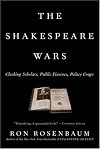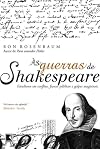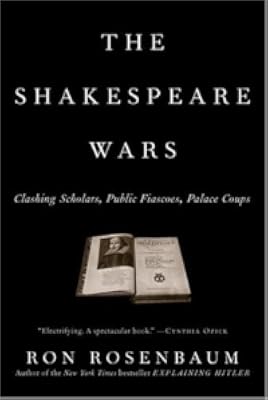
The Shakespeare Wars: Clashing Scholars, Public Fiascoes, Palace Coups
by Ron Rosenbaum
On This Page
Description
Cultural historian Rosenbaum gives readers a way of rethinking the greatest works of the human imagination, as he shakes up much that we thought we understood about a vital subject and renews our sense of excitement and urgency. Rather than raking over worn-out fragments of biography, Rosenbaum focuses on cutting-edge controversies about the true source of Shakespeare's enchantment and illumination--the astonishing language itself. He takes readers into the midst of fierce battles among the show more most brilliant Shakespearean scholars and directors over just how to delve deeper into the mind of Shakespeare. He makes ostensibly arcane textual scholarship seductive, and he shows us great directors as Shakespearean scholars in their own right. This book offers a thrilling opportunity to engage with Shakespeare's work at its deepest levels.--From publisher description. show lessTags
Recommendations




Member Recommendations

souci To the interpretation of Shakespeare as a writer, and his methods
Member Reviews
I loved this book. Is it repetitive at times? Yes. Does Rosenbaum have an annoying habit of using fragmented sentences? Yes. But look past these quirks, and you'll find a fascinating collection of the most interesting scholarly debates about Shakespeare's works. This is not a book about who Shakespeare was – Rosenbaum has little good to say about attempts at biography. This is a book about what Shakespeare wrote, and what scholars argue about when the argue about Shakespeare. The author wants you to see these debates from the inside, to feel the weight of the conflicts and attempts to resolve them. And that, for a guy like me, is what really makes this book worthwhile. For someone who prefers the "Shakespeare In Love" approach to the show more Bard, perhaps not so much. It can all seem a little pointless if you have no natural inclination toward exegesis. Personally, I found the question of the multiple Hamlet texts enlightening, as well as the debate over proper verse speaking (how important is a pause?) and spelling (does modernizing impoverish readings?).
The issues here circle a single, important question: "What does it mean to be 'Shakespearean'?" Can we articulate what makes Shakespeare special; or as one of Rosenbaum's idols Stephen Booth put it, "What's all the fuss about?" On this topic, I think Rosenbaum grows to an important point, which is that Shakespeare's writing is "bottomless." That is to say, the more closely you read the plays and sonnets, the more you find: more metaphors, more puns, more polysemy, more meaning, seemingly without end. "Shakespearean," then, is a supreme level of wordplay, married with a sense of human character and dilemma (dilemmas of love, of revenge, of forgiveness, of the self), that, when studied, appears limitless.
And yet, as dryly academic as this might sound, what drives Rosenbaum is a life-changing experience seeing Peter Brook's infamous staging of A Midsummer Night's Dream. And that, I think, is one of my most important takeaways from The Shakespeare Wars, one to which I can fully relate. It's worth your time to analyze the texts, but these are plays meant to be seen and performed. Invariably, the spark of a lifelong love of Shakespeare really begins not on the page, but on the stage.
As such, one who is already in love will find more to appreciate here than the merely infatuated. But writing quirks aside, there is much to value, and I count The Shakespeare Wars among those books that helped me to finally understand the fuss. show less
The issues here circle a single, important question: "What does it mean to be 'Shakespearean'?" Can we articulate what makes Shakespeare special; or as one of Rosenbaum's idols Stephen Booth put it, "What's all the fuss about?" On this topic, I think Rosenbaum grows to an important point, which is that Shakespeare's writing is "bottomless." That is to say, the more closely you read the plays and sonnets, the more you find: more metaphors, more puns, more polysemy, more meaning, seemingly without end. "Shakespearean," then, is a supreme level of wordplay, married with a sense of human character and dilemma (dilemmas of love, of revenge, of forgiveness, of the self), that, when studied, appears limitless.
And yet, as dryly academic as this might sound, what drives Rosenbaum is a life-changing experience seeing Peter Brook's infamous staging of A Midsummer Night's Dream. And that, I think, is one of my most important takeaways from The Shakespeare Wars, one to which I can fully relate. It's worth your time to analyze the texts, but these are plays meant to be seen and performed. Invariably, the spark of a lifelong love of Shakespeare really begins not on the page, but on the stage.
As such, one who is already in love will find more to appreciate here than the merely infatuated. But writing quirks aside, there is much to value, and I count The Shakespeare Wars among those books that helped me to finally understand the fuss. show less
This is pretty challenging for a general market book, not to say it's inaccessible, but just that it requires some concentration. It explains issues surrounding different editions very well. I like that it comes at the controversies by showing the advocates of various positions.
This is not an easy book to read. It seems as if pages are magically being inserted as you are reading. But I found it very useful in narrowing down the directions and people to look out in doing research for my project. I could have read 20 books to get what's contained in this one.
If you are looking for information on the various textual aruguments going on about Shakespeare's plays, this is the book for you. It is a well made book printed on very good paper, and although well written, it is dense and I find I must read other things to give that part of my brain a break. I'm currently researching the Sonnets and sonnet scholars and how they think. I haven't found and direct infromation in this, but I have found it enlightening and show more helpful in tracking down other sources. I still have high hopes for it. Long chapters. show less
If you are looking for information on the various textual aruguments going on about Shakespeare's plays, this is the book for you. It is a well made book printed on very good paper, and although well written, it is dense and I find I must read other things to give that part of my brain a break. I'm currently researching the Sonnets and sonnet scholars and how they think. I haven't found and direct infromation in this, but I have found it enlightening and show more helpful in tracking down other sources. I still have high hopes for it. Long chapters. show less
I admit I didn't finish it, but I liked it and found it helpful. Maybe I didn't pay attention in English class like I should have, and this helped me understand "what's so freaking special" about Shakespeare. I never really understood what the fuss was about, and I'm still not the biggest Shakespeare fan, but I have a better understanding of it now.
I read more than half of this book which pretty much counts as reading the whole thing...A little (a lot) repetitive.
Fascinating! Although the book leaves me with more questions than answers. I may need to read Lear again.
he Germans have Goethe, the Russians Dostoevsky, the Spanish Cervantes, the Portuguese Fernando Pessoa (and Camões). The English-speaking world has Shakespeare with a difference. Shakespeare “speaks” to us from a 400 year gap, while Goethe, Dostoevsky, Cervantes, and Pessoa are much closer to us. Their language is basically the language that we speak today. Not so with Shakespeare. Early Modern English is “another” language. This is what makes Shakespeare different, as well as the fact that we know next to nothing about him, which makes him harder to read and interpret.
You can read the rest of this review on my blog.
You can read the rest of this review on my blog.
Members
- Recently Added By
Lists

Used books to buy next
565 works; 1 member
Author Information

18+ Works 1,696 Members
Ron Rosenbaum's books include The Shakespeare Wars, How the End Begins, and The Secret Parts Fortune, a collection of his nonfiction writing which has appeared in Harper's, the New Yorker, and the New York Times Magazine, among other periodicals. He has also edited an anthology about contemporary anti-Semitism, Those Who Forget the Past.
Awards and Honors
Awards
Distinctions
Notable Lists
Classifications
- Genres
- Literature Studies and Criticism, Nonfiction, Fiction and Literature
- DDC/MDS
- 822.33 — Literature & rhetoric English & Old English literatures English drama 1558-1625 Elizabethan period William Shakespeare
- LCC
- PR2970 .R67 — Language and Literature English English Literature English renaissance (1500-1640)
- BISAC
Statistics
- Members
- 445
- Popularity
- 69,146
- Reviews
- 7
- Rating
- (3.70)
- Languages
- English, Portuguese
- Media
- Paper, Ebook
- ISBNs
- 4
- ASINs
- 3