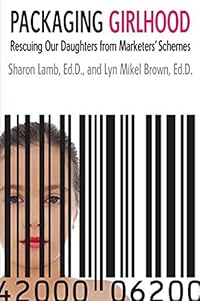
Packaging Girlhood: Rescuing Our Daughters from Marketers' Schemes
by Sharon Lamb, Lyn Mikel Brown
On This Page
Description
"The stereotype-laden message, delivered through clothes, music, books, and TV, is essentially a continuous plea for girls to put their energies into beauty products, shopping, fashion, and boys. This constant marketing, cheapening of relationships, absence of good women role models, and stereotyping and sexualization of girls is something that parents need to first understand before they can take action. Lamb and Brown teach parents how to understand these influences, give them guidance on show more how to talk to their daughters about these negative images, and provide the tools to help girls make positive choices about the way they are in the world."--Publisher description. show lessTags
Recommendations









Member Recommendations
Member Reviews
This book should be required reading for anyone who has a daughter, plans to someday have a daughter, or is at all concerned with the well-being of girls. It gives a detailed and insightful breakdown of all the things that can mess with girls' heads, both the obvious (Barbie, teen magazines) and the things you might not pay attention to (boxes for board games, the lack of girl central characters in picture books). What I really love about the book, though, is it doesn't just say "All these awful things are happening to girls oh no oh no!", it describes ways parents can actively engage their daughters, even really little ones, in conversations about this stuff and teach them to be critical consumers. It made me excited to have smart, show more self-confident, savvy girls one day. show less
From the preface: "we've been told our world empowers girls by offering them anyting they want, including infinite sights and endless ports of call. In reality, it's a world designed by media and marketing executives that targets children as consumers, channels girls' desires, and entices them into predictable types: 'pretty pink dolls,' 'cute little shoppers,' and 'hott teens'."
Packaging Girlhood covers the influences on girls from roughly ages 3 through 17. The chapters cover shopping (the products available and how they are marketed), TV and film, music, books and extra-curricular activities. The final chapter gives sample conversations for parents when discussing culture with their daughters.
Although I was familiar with a lot of the show more authors' concerns, and they did repeat themselves quite a bit, I found this to be an extremely interesting and inspiring read. I think what made this book different from others that I've read on this topic is that there was always a psychological POV involved (including what it is about these products that appeals to the girls, but also the psychology of the marketers and of parents). I especially enjoyed the chapter on books, and the literary critique from a psychological approach.
I borrowed this book from the library, but I am ordering my own copy to keep as a reference.
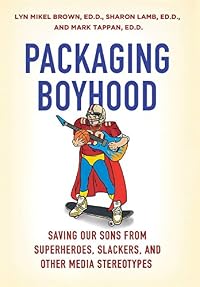
Recommended for: obviously the parents of girls, but also anyone who works with girls, and anyone interested in cultural studies or consumerism. The authors have also written Packaging Boyhood: Saving Our Sons from Superheroes, Slackers, and Other Media Stereotypes. show less
Packaging Girlhood covers the influences on girls from roughly ages 3 through 17. The chapters cover shopping (the products available and how they are marketed), TV and film, music, books and extra-curricular activities. The final chapter gives sample conversations for parents when discussing culture with their daughters.
Although I was familiar with a lot of the show more authors' concerns, and they did repeat themselves quite a bit, I found this to be an extremely interesting and inspiring read. I think what made this book different from others that I've read on this topic is that there was always a psychological POV involved (including what it is about these products that appeals to the girls, but also the psychology of the marketers and of parents). I especially enjoyed the chapter on books, and the literary critique from a psychological approach.
I borrowed this book from the library, but I am ordering my own copy to keep as a reference.
Recommended for: obviously the parents of girls, but also anyone who works with girls, and anyone interested in cultural studies or consumerism. The authors have also written Packaging Boyhood: Saving Our Sons from Superheroes, Slackers, and Other Media Stereotypes. show less
Lamb and Brown, both psychologists, came to harsh conclusions after they surveyed girls; sat through hours of Rugrats and Kim Possible television programming; scoured stores such as Hot Topic and Claire's; watched Hilary Duff movies; listened to Eminem and Beyoncé; visited MySpace.com; and read Caldecott books. The idea of "girl power was snapped up by the media," and "what it sells is an image of being empowered," argue the authors. Girls are offered two choices by the marketers: they are "either for the boys or one of the boys." Even rebellion is being packaged, "the resistance, that edginess and irreverence that once gave girls a pathway out of the magic kingdom." The book is incredibly readable and rises above others in the genre show more by giving parents concrete tools to help battle stereotypes. Lamb and Brown include lists of books and movies with positive role models and talking points to help your daughter recognize how she is being manipulated. The authors aren't trying to deny anyone princesses or pink; they just want girls to be knowledgeable enough to choose what will truly interest them. show less
This is one of the less handwringy books I've come across addressing the media's influence on children and teenagers. The authors give concrete examples of how parents can promote critical analysis in their children's lives as they navigate a media-saturated world. I would have liked to see more from them on this front in place of the sometimes-repetitive catalogs of various products marketing one of a set number of messages or identities. To their credit, their section addressing sexuality in music and media was the best I've read so far. Instead of taking a protectionist approach (we must defend our innocent daughters from any hint of sexuality!), they acknowledge that girls and women are sexual beings.
I am sort of torn on this book. I really like the information presented and have been reading other books in this same genre. Since I've read a couple of similar books to this in the recent past, I'm pretty sure that's why I found it sort of difficult to read through. It was much drier than the other books.
I do like the information that was presented and agree that the media and large corporations are really messing people up, especially girls. I have started to really notice things more after reading this and others, but that I think can also be attributed to being pregnant. You don't notice a lot of things until it'll somehow effect you.
This book was nice because I think it allows for better dialogue between parents and their show more children. This particular book has some really good resources and suggestions on how to approach conversations. Overall, I like it although it can have some really tedious sections if you are familiar with the subject. show less
I do like the information that was presented and agree that the media and large corporations are really messing people up, especially girls. I have started to really notice things more after reading this and others, but that I think can also be attributed to being pregnant. You don't notice a lot of things until it'll somehow effect you.
This book was nice because I think it allows for better dialogue between parents and their show more children. This particular book has some really good resources and suggestions on how to approach conversations. Overall, I like it although it can have some really tedious sections if you are familiar with the subject. show less
I appreciated the intent of this book but not the execution. I definitely want my two daughters to grow up questioning and defying the limiting messages and images media and marketers are feeding them, but after about 70 pages of this repetitive and sometimes abrasive read, I felt like I had gotten the gist. Some of the authors' findings were debatable and others, completely obvious. I think they could also stand to give parents and even very young daughters a little more credit, too. Many of us are already reading culture with a critical eye and, at least in my opinion, this book didn't provide many helpful new tools for doing that.
Summary:
This book concentrates on the effects of media and pop culture on girls. It specifically analyses how media and consumerism affects what they see, hear, read, and play. It looks at popular movies, songs, books, magazines, and games. This gave it a unique perspective. The goal is to teach girls how to reflect on their world and see how society is affecting them.
The majority of movies and programs girls watch promote gender stereotypes.
Personal Reaction:
I like how it incorporates pop culture into the lives of girls and explains the images and perceptions it feeds to girls and describes the effect this has on them. This book has a lot of great information and statistics.
Classroom Extension Ideas:
1. I would use this book for an show more "all about me" day where the students are able to share the kinda things they like.
2. I would use this book to teach lessons on stereotypes. show less
This book concentrates on the effects of media and pop culture on girls. It specifically analyses how media and consumerism affects what they see, hear, read, and play. It looks at popular movies, songs, books, magazines, and games. This gave it a unique perspective. The goal is to teach girls how to reflect on their world and see how society is affecting them.
The majority of movies and programs girls watch promote gender stereotypes.
Personal Reaction:
I like how it incorporates pop culture into the lives of girls and explains the images and perceptions it feeds to girls and describes the effect this has on them. This book has a lot of great information and statistics.
Classroom Extension Ideas:
1. I would use this book for an show more "all about me" day where the students are able to share the kinda things they like.
2. I would use this book to teach lessons on stereotypes. show less
Members
- Recently Added By
Author Information

11 Works 406 Members
Sharon Lamb is a licensed psychologist, and chair and professor in the Department of Counseling and School Psychology in the College of Education and Human Development at the University of Massachusetts Boston.

7 Works 341 Members
Lyn Mikel Brown has been studying and working with girls for more than twenty-five years. A professor of education and human development at Colby College, she is the author of five previous books about gender and girlhood, and is the cofounder of three grassroots organizations.
Classifications
- Genres
- Nonfiction, General Nonfiction, Sexuality and Gender Studies, Business, Sociology
- DDC/MDS
- 306.3 — Society, government, & culture Social sciences, sociology & anthropology Social Behavior - Dating, Marriage, Divorce Economic institutions
- LCC
- HD9970.5 .C483 .U655 — Social sciences Industries. Land use. Labor Industries. Land use. Labor Special industries and trades Manufacturing industries
- BISAC
Statistics
- Members
- 197
- Popularity
- 165,648
- Reviews
- 9
- Rating
- (3.65)
- Languages
- English
- Media
- Paper
- ISBNs
- 2
- ASINs
- 2