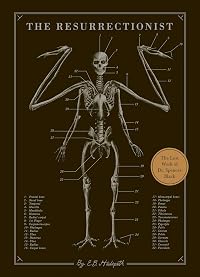
The Resurrectionist: The Lost Work of Dr. Spencer Black
by E. B. Hudspeth
On This Page
Description
Philadelphia, the late 1870s. A city of gas lamps, cobblestone streets, and horse-drawn carriages and home to the controversial surgeon Dr. Spencer Black. The son of a grave robber, young Dr. Black studies at Philadelphia's esteemed Academy of Medicine, where he develops an unconventional hypothesis: What if the world's most celebrated mythological beasts, mermaids, minotaurs, and satyrs, were in fact the evolutionary ancestors of humankind? The Resurrectionist offers two extraordinary books show more in one. The first is a fictional biography of Dr. Spencer Black, from a childhood spent exhuming corpses through his medical training, his travels with carnivals, and the mysterious disappearance at the end of his life. The second book is Black's magnum opus: The Codex Extinct Animalia, a Gray's Anatomy for mythological beasts, dragons, centaurs, Pegasus, Cerberus. all rendered in meticulously detailed anatomical illustrations. You need only look at these images to realize they are the work of a madman. show lessTags
Recommendations








Member Recommendations
MyriadBooks For inquiry into anatomy.
Member Reviews
Geniale.
Grottesco e disturbante, affascinante ed fiabesco.
Weird e gotico.
Mary Shelley incontra Lovecraft e si mettono a parlare di Darwin praticamente...
La biografia di un folle scienziato che mette in discussione gli assiomi della scienza medica alla ricerca di una verità forse folle, forse incredibile ma decisamente possibile.
Letto per la ReadingTheDark Challenge per gennaio si merita 5 stelle a mani basse.
Grottesco e disturbante, affascinante ed fiabesco.
Weird e gotico.
Mary Shelley incontra Lovecraft e si mettono a parlare di Darwin praticamente...
La biografia di un folle scienziato che mette in discussione gli assiomi della scienza medica alla ricerca di una verità forse folle, forse incredibile ma decisamente possibile.
Letto per la ReadingTheDark Challenge per gennaio si merita 5 stelle a mani basse.
There's no doubt that this book is fantastically put together. It's a gorgeous, high-quality book with impressive art and impeccable detail. Hudspeth's talent as an artist is on full display, as is Quirk Books' commitment to interesting, out-of-the-box books that require a different type of commitment from mainstream fiction. (I've loved every Quirk Books book I've picked up by the way...until...uh...this one.) So.
The thing is, this book reads and feels like more of an experiment than a novel or fully grown story by the end. It's as if the biography--the written part of the text--is just an excuse to show off the gorgeous drawings of Hudspeth, but the problem is that it reads like a biography, and leaves so many threads show more unanswered/unfollowed that, in the end, the book feels like an experiment vs a completed experience with real power and follow-through/impact. Part of me thinks that, put simply, the book needed a third part where some of those early threads could have been followed, but realistically, I'm not sure that would be possible. Because, looking back on the whole read, it does feel as if the biography is simply a way to justify putting all of the art into play without dealing with the burden of creating a full narrative that would really develop any sort of character and/or story arcs that could deliver emotional impact on top of more detached horror.
And perhaps the book was never meant to deliver a fuller story--it certainly reads as more of an art display, justified by lengthy text to develop horror behind the art--but at least for this reader, I ended up feeling less-than-satisfied with the book as a whole. It's possible I should be thankful for the brevity of the biography, though--if I hadn't flipped pages forward to know that the art was coming, and to know that there was very little biography left, I'd likely have given up on the book. The writing is fine, and interesting, but the story itself is so anchored into the tone of being a biography, and so summary-based and often vague, without the details of character to make the characters come to life in moments of non-horror, I had trouble getting through it, particularly at the end.
I'm not sure who I'd recommend this book to, beyond readers who want a non-traditional horror read. show less
The thing is, this book reads and feels like more of an experiment than a novel or fully grown story by the end. It's as if the biography--the written part of the text--is just an excuse to show off the gorgeous drawings of Hudspeth, but the problem is that it reads like a biography, and leaves so many threads show more unanswered/unfollowed that, in the end, the book feels like an experiment vs a completed experience with real power and follow-through/impact. Part of me thinks that, put simply, the book needed a third part where some of those early threads could have been followed, but realistically, I'm not sure that would be possible. Because, looking back on the whole read, it does feel as if the biography is simply a way to justify putting all of the art into play without dealing with the burden of creating a full narrative that would really develop any sort of character and/or story arcs that could deliver emotional impact on top of more detached horror.
And perhaps the book was never meant to deliver a fuller story--it certainly reads as more of an art display, justified by lengthy text to develop horror behind the art--but at least for this reader, I ended up feeling less-than-satisfied with the book as a whole. It's possible I should be thankful for the brevity of the biography, though--if I hadn't flipped pages forward to know that the art was coming, and to know that there was very little biography left, I'd likely have given up on the book. The writing is fine, and interesting, but the story itself is so anchored into the tone of being a biography, and so summary-based and often vague, without the details of character to make the characters come to life in moments of non-horror, I had trouble getting through it, particularly at the end.
I'm not sure who I'd recommend this book to, beyond readers who want a non-traditional horror read. show less
I was surprised by how much I loved this.
The first part of this book was written like a biography of the titular Spencer Black, a Victorian era doctor/scientist and his experiments. The second part are scientific plates of his creatures.
I'm not a big fan of horror, but I liked how this blended real taxonomy with disturbing Victorian imagination. With all the gothic horror and dubious scientific discoveries that the real Victorian era produced, a man like Dr. Black is not too far fetched.
The old writing style. The cold, wikipedia-style summary of Dr. Black's life. The use of real medical terms and taxonomy. The paragraphs and letters inserted into the text. The use of exact years. All of it makes for an immersive book about a mad scientist.
The first part of this book was written like a biography of the titular Spencer Black, a Victorian era doctor/scientist and his experiments. The second part are scientific plates of his creatures.
I'm not a big fan of horror, but I liked how this blended real taxonomy with disturbing Victorian imagination. With all the gothic horror and dubious scientific discoveries that the real Victorian era produced, a man like Dr. Black is not too far fetched.
The old writing style. The cold, wikipedia-style summary of Dr. Black's life. The use of real medical terms and taxonomy. The paragraphs and letters inserted into the text. The use of exact years. All of it makes for an immersive book about a mad scientist.
??he entire body is the soul, and my knife cuts deep into the flesh; I vow to be always reverent with the edge of my scalpel.??/i>
?? have butchered many men. All are innocent and equaled when they are on the table. All are exquisite and grotesque."
Thus writes the passionate, deeply troubled and fanatical subject of The Resurrectionist - a man who lives up to such a title in every way, and is now ironically on display himself, the available fragments of who he is served up to the reader for dissection and analysis. And the story that unfolds is morbid yet fascinating. Dr. Spencer Black is the product of a time where medical knowledge was still in its youth, death had lost its sacredness and disabilities were popular shock-value show more entertainment. On the one hand, it might be said that these various influences combined to make him who he was; but on the other, how much was he predisposed to follow in his father's footsteps, the latter also being a resurrectionist with no thought of how his youngest child might be affected by nightly grave robberies? It's a nature-vs-nurture question that also comes up in Black's quest to prove the existence of mythical creatures, going so far as to construct them from human and animal components in a manner reminiscent of Frankenstein. And in doing so, he neglects to answer other important questions: Does the end justify the means? Do we have the right to manipulate nature and introduce things that don't exist? Where should the lines be drawn when your studies and/or experiments involve living creatures?
Unfortunately, though this is a work of fiction, these questions still remain highly relevant today. The history of ethics violations is almost as long as the history of science itself. And given the popularity of grave-robbing, "freak shows" and cabinets of curiosities in the 1800s, it's chilling yet not surprising to consider that someone like Spencer Black might actually have existed. I was thus impressed with the way this book was written - half a biography and half a codex of Black's "specimens" - because in my opinion no other format could have driven home how real this type of mindset was in our recent history.
Full disclosure, I normally avoid anything resembling a biography, but this one gives you the impression of piecing together a mysterious person's life from a variety of sources - and I love that amateur detective feeling that comes with it. A novel would have perhaps taken the vein of Frankenstein, with more insight into each of the characters, but I would have read it with the underlying knowledge that it was fiction, and perhaps wouldn't have sought out as much of the historical background it's based on. Also, the drawings of mythical animals in the Codex are done with such attention to detail, both aesthetic and biological, that I was struck by the author/artist's skill.
The only thing I wanted more of (despite it being a deliberate and necessary choice for the story) was more clues to the fates of Bernard, Elise and Alphonse, Spencer being a bit low on the list. And, perhaps, whether any of Black's "creations" managed to survive and make their own way in the world. Lots of unanswered questions, in keeping with any true historical personage you try to research, but I really hope there will be more to come in this creepy little slice of the late 1800s / early 1900s. A good reminder that even though every generation thinks they've reached the pinnacle of civilization, we are usually farther from that point than we think we are, and perhaps we're doomed never to reach it.
Some other quotes that struck me:
"It's clear throughout Black's writings that he thought of death as an abstract concept; he often calls death 'the phenomenon of the living' and even regarded the passing of his own father as more of a curiosity than a tragedy."
"He leapt into my father's grave with all his heart, chasing after death to seek out its hiding place."
"When one dies they neither ascend to the heavens nor descend to hell, they instead become cured - freed from an illness and healed from the suffering of mortality. Our consciousness, our awareness, is a symptom of our body and it is secondary to the mystery of our physical chemistry."
?? must know why five fingers are intended before I can discover the cause of six.??br/>
??ur consciousness, our awareness, is a symptom of our body and it is secondary to the mystery of our physical chemistry.??br/>
"Such evanescence; to emerge from the ground after such a long time and then transform, gaining wings. They are born once again from the womb of their own body, which is abandoned as an empty shell, and then they leave the world... After such a long time in darkness, we can live for only a short while." show less
?? have butchered many men. All are innocent and equaled when they are on the table. All are exquisite and grotesque."
Thus writes the passionate, deeply troubled and fanatical subject of The Resurrectionist - a man who lives up to such a title in every way, and is now ironically on display himself, the available fragments of who he is served up to the reader for dissection and analysis. And the story that unfolds is morbid yet fascinating. Dr. Spencer Black is the product of a time where medical knowledge was still in its youth, death had lost its sacredness and disabilities were popular shock-value show more entertainment. On the one hand, it might be said that these various influences combined to make him who he was; but on the other, how much was he predisposed to follow in his father's footsteps, the latter also being a resurrectionist with no thought of how his youngest child might be affected by nightly grave robberies? It's a nature-vs-nurture question that also comes up in Black's quest to prove the existence of mythical creatures, going so far as to construct them from human and animal components in a manner reminiscent of Frankenstein. And in doing so, he neglects to answer other important questions: Does the end justify the means? Do we have the right to manipulate nature and introduce things that don't exist? Where should the lines be drawn when your studies and/or experiments involve living creatures?
Unfortunately, though this is a work of fiction, these questions still remain highly relevant today. The history of ethics violations is almost as long as the history of science itself. And given the popularity of grave-robbing, "freak shows" and cabinets of curiosities in the 1800s, it's chilling yet not surprising to consider that someone like Spencer Black might actually have existed. I was thus impressed with the way this book was written - half a biography and half a codex of Black's "specimens" - because in my opinion no other format could have driven home how real this type of mindset was in our recent history.
Full disclosure, I normally avoid anything resembling a biography, but this one gives you the impression of piecing together a mysterious person's life from a variety of sources - and I love that amateur detective feeling that comes with it. A novel would have perhaps taken the vein of Frankenstein, with more insight into each of the characters, but I would have read it with the underlying knowledge that it was fiction, and perhaps wouldn't have sought out as much of the historical background it's based on. Also, the drawings of mythical animals in the Codex are done with such attention to detail, both aesthetic and biological, that I was struck by the author/artist's skill.
The only thing I wanted more of (despite it being a deliberate and necessary choice for the story) was more clues to the fates of Bernard, Elise and Alphonse, Spencer being a bit low on the list. And, perhaps, whether any of Black's "creations" managed to survive and make their own way in the world. Lots of unanswered questions, in keeping with any true historical personage you try to research, but I really hope there will be more to come in this creepy little slice of the late 1800s / early 1900s. A good reminder that even though every generation thinks they've reached the pinnacle of civilization, we are usually farther from that point than we think we are, and perhaps we're doomed never to reach it.
Some other quotes that struck me:
"It's clear throughout Black's writings that he thought of death as an abstract concept; he often calls death 'the phenomenon of the living' and even regarded the passing of his own father as more of a curiosity than a tragedy."
"He leapt into my father's grave with all his heart, chasing after death to seek out its hiding place."
"When one dies they neither ascend to the heavens nor descend to hell, they instead become cured - freed from an illness and healed from the suffering of mortality. Our consciousness, our awareness, is a symptom of our body and it is secondary to the mystery of our physical chemistry."
?? must know why five fingers are intended before I can discover the cause of six.??br/>
??ur consciousness, our awareness, is a symptom of our body and it is secondary to the mystery of our physical chemistry.??br/>
"Such evanescence; to emerge from the ground after such a long time and then transform, gaining wings. They are born once again from the womb of their own body, which is abandoned as an empty shell, and then they leave the world... After such a long time in darkness, we can live for only a short while." show less
The first 65 pages of The Resurrectionist: The Lost Work of Dr. Spencer Black by E.B. Hudspeth is a fascinating “biography” of the titular doctor, a man who believed that the creatures of mythology actually existed at one time and could be reborn into our world with the proper surgical technique. It’s a tragic tale of a medical prodigy who had already completed medical school with high honors at the age of 20. Black was a man of intense curiosity who reveled in dissecting every type of animal, including humans (which he had dug up from their graves for his father’s scientific work when he was a child, hence the “resurrectionist” label). But his curiosity took a tragic turn when he began his work of recreating mythological show more creatures, starting with the grafting of wings onto his beagle. His brother describes the scene in his journal, making one remarkable note that passes without acknowledgement: “The animal flinched in response to Spencer’s voice; its wings flapped as it tried to stand.” The wings were functional? Wow.
I could have used much more of this story, in much greater detail; that is, I’d have loved a fully-fledged novel. But Hudspeth’s imagination apparently tends more toward images than the written word. The bulk of this book is a copy of a fictional Codex Extinct Animalia, allegedly written and drawn by Black. Only six copies were ever printed, Black’s “biography” explains, because for some reason Black withdrew it at that point. This is a copy of one of those six extant volumes, we are told. It is full of remarkable artwork, with drawings of the bones and musculature of various types of mythological creatures, from the sphinx to the harpy. I would have liked more explanation of how the animals worked, anatomically. For instance, how does the centaur’s musculature work to support the human portion of the body? The drawings lead me to believe that the animals would always suffer from severe back pain, and that remaining upright would be excruciating. Similarly, how can the back of a cerberus support three heads without upper back and neck aches? It seems to me that if an artist is going to draw the musculature of these creatures, there should be some narrative that explains them.
Still, this oversized volume (not a coffee table book, but larger than the average) is a worthy addition to the libraries of those who enjoy fantastical artwork. It brings to mind the early work of Wayne Barlowe (particularly his Guide to Extraterrestrials and Guide to Fantasy), and similarly rewards plenty of gazing.
Originally published at http://www.fantasyliterature.com/reviews/the-resurrectionist-the-lost-work-of-dr... show less
I could have used much more of this story, in much greater detail; that is, I’d have loved a fully-fledged novel. But Hudspeth’s imagination apparently tends more toward images than the written word. The bulk of this book is a copy of a fictional Codex Extinct Animalia, allegedly written and drawn by Black. Only six copies were ever printed, Black’s “biography” explains, because for some reason Black withdrew it at that point. This is a copy of one of those six extant volumes, we are told. It is full of remarkable artwork, with drawings of the bones and musculature of various types of mythological creatures, from the sphinx to the harpy. I would have liked more explanation of how the animals worked, anatomically. For instance, how does the centaur’s musculature work to support the human portion of the body? The drawings lead me to believe that the animals would always suffer from severe back pain, and that remaining upright would be excruciating. Similarly, how can the back of a cerberus support three heads without upper back and neck aches? It seems to me that if an artist is going to draw the musculature of these creatures, there should be some narrative that explains them.
Still, this oversized volume (not a coffee table book, but larger than the average) is a worthy addition to the libraries of those who enjoy fantastical artwork. It brings to mind the early work of Wayne Barlowe (particularly his Guide to Extraterrestrials and Guide to Fantasy), and similarly rewards plenty of gazing.
Originally published at http://www.fantasyliterature.com/reviews/the-resurrectionist-the-lost-work-of-dr... show less
I got a copy of this book to review from Quirk Books in exchange for an honest review. It was a very creative and well done fictional biography of Dr. Spencer Black. The drawings in it are fantastic and the story itself comes off as absolutely believable, fascinating, and disturbing.
This book is actually two books in one. The first book is called The Life and Writings of Dr. Spencer Black. This is a biography of the fictional Dr. Spencer Black. It starts with his childhood as the son of a brilliant surgeon, proceeds to tell of his own early successes as a surgeon, and then finishes with his increasingly disturbing ravings and experiments. The second book is The Codex Extinct Animalia. This book covers Dr. Black’s notes of various show more fantastic species and includes incredibly detailed diagrams of their musculature and bone structure.
This is a very well put together book. The quality is amazing, the pages are thick and high quality, the drawings within are amazingly detailed.
This book reads as an incredibly convincing biography of Dr. Black. Dr. Black starts out on a quest to cure human deformities. This story is told from a narrator’s perspective but also includes large sections of excerpts from Dr. Black’s journal. It is a fascinating story that is fairly believable.
I was impressed that the author comes up with a very reasonable theory on why Dr. Black descends into to the madness he does. It is an absolutely engaging and very persuasive argument for the theory of human evolution. Of course the whole thing has a bit of a fantasy twist to it. The book also gets fairly disturbing as Dr. Black descends into madness and reminds a bit of The Island of Dr. Moreau.
The Codex Extinct Animalia has brief, yet well done, summaries of the various fantastic animals Dr. Black supposedly found. The drawings are stunningly detailed and beautiful. The diagrams of bone and muscle just as intricate with scientific naming of all of the bones and muscles included.
Overall this was a fascinating and unique book. I enjoyed the story of Dr. Black and found it to be engaging and engrossing. The Codex was full of amazingly detailed drawings that were fascinating to look at. This book is one of those wonderful curiosities and would make an excellent coffee table book. I will definitely be checking out future works by Hudspeth. show less
This book is actually two books in one. The first book is called The Life and Writings of Dr. Spencer Black. This is a biography of the fictional Dr. Spencer Black. It starts with his childhood as the son of a brilliant surgeon, proceeds to tell of his own early successes as a surgeon, and then finishes with his increasingly disturbing ravings and experiments. The second book is The Codex Extinct Animalia. This book covers Dr. Black’s notes of various show more fantastic species and includes incredibly detailed diagrams of their musculature and bone structure.
This is a very well put together book. The quality is amazing, the pages are thick and high quality, the drawings within are amazingly detailed.
This book reads as an incredibly convincing biography of Dr. Black. Dr. Black starts out on a quest to cure human deformities. This story is told from a narrator’s perspective but also includes large sections of excerpts from Dr. Black’s journal. It is a fascinating story that is fairly believable.
I was impressed that the author comes up with a very reasonable theory on why Dr. Black descends into to the madness he does. It is an absolutely engaging and very persuasive argument for the theory of human evolution. Of course the whole thing has a bit of a fantasy twist to it. The book also gets fairly disturbing as Dr. Black descends into madness and reminds a bit of The Island of Dr. Moreau.
The Codex Extinct Animalia has brief, yet well done, summaries of the various fantastic animals Dr. Black supposedly found. The drawings are stunningly detailed and beautiful. The diagrams of bone and muscle just as intricate with scientific naming of all of the bones and muscles included.
Overall this was a fascinating and unique book. I enjoyed the story of Dr. Black and found it to be engaging and engrossing. The Codex was full of amazingly detailed drawings that were fascinating to look at. This book is one of those wonderful curiosities and would make an excellent coffee table book. I will definitely be checking out future works by Hudspeth. show less
The biography of a fictional Victorian anatomist who slips from a successful research career into madness (making stops at the carnival circuit on the way) is appropriately chilling in its brevity. We have only the sources that can be reconstructed from documents left after Spencer Black's disappearance, and their very scantness provides a sense of verisimilitude. Black's theory, that the human body cannot attempt what it does not know possible, suggests to him that the conjoined twins and humans with extra parts are not mistakes, but throwbacks to an earlier form of being, leads him to believe that mythological beings are an earlier stage on the evolutionary ladder. He begins to construct specimens to show his theories are possible, show more but when dead specimens are no longer enough, the trouble begins.
I visited the Mutter Museum in Philadelphia for the first time last summer, and the book seems steeped in that atmosphere, especially the teratogenic specimens for which the museum is famous, as well as its Victorian cabinet-of-curiosities feel. There's a feel that echoes the science of the day, and the post-Darwinian anxiety is palpable. The book contains a fairly obvious tribute to Mary Shelley in naming two of Black's children Victor and Elizabeth, and one of the sons who survives to adulthood, Alphonse (Alphonse Frankenstein was Victor's father in Shelley's book).
The ARC I had, from the LibraryThing Early Reviewers' program, had many pages of "illustration TK" which saddens me, because what was present was amazing. I may have to wishlist this just to see the rest. show less
I visited the Mutter Museum in Philadelphia for the first time last summer, and the book seems steeped in that atmosphere, especially the teratogenic specimens for which the museum is famous, as well as its Victorian cabinet-of-curiosities feel. There's a feel that echoes the science of the day, and the post-Darwinian anxiety is palpable. The book contains a fairly obvious tribute to Mary Shelley in naming two of Black's children Victor and Elizabeth, and one of the sons who survives to adulthood, Alphonse (Alphonse Frankenstein was Victor's father in Shelley's book).
The ARC I had, from the LibraryThing Early Reviewers' program, had many pages of "illustration TK" which saddens me, because what was present was amazing. I may have to wishlist this just to see the rest. show less
 This review was written for LibraryThing Early Reviewers.
Members
- Recently Added By
Lists

Books discovered on LibraryThing
256 works; 36 members

Authors from uncertain country
14 works; 1 member

Spooky United States: The Scariest Books Set in Each State
50 works; 3 members
Author Information

3 Works 1,185 Members
Some Editions
Common Knowledge
- Original title
- The Resurrectionist: The Lost Work of Dr. Spencer Black
- Original publication date
- 2013-04-23
- People/Characters
- Dr. Spencer Black (younger son of Dr. Gregory & Meredith); Elise Chardelle Black (Mrs. Spencer); Alphonse Edward Black (son of Spencer & Elise); Dr. Bernard Black (elder son of Gregory & Meredith Black); Dr. Jolab A. Holace (Spencer's former mentor & later detractor); Victor Black (2nd son of Spencer & Elise) (show all 9); Samuel Black (3rd son of Spencer & Elise); Emma Werstone Black (Mrs. Bernard); Elizabeth Black (daughter of Spencer & Elise)
- Important places
- Philadelphia, Pennsylvania, USA
- First words
- Dr. Spencer Black and his older brother, Bernard, were born in Boston, Massachusetts, in 1851, and 1848, respectively.
- Last words
- (Click to show. Warning: May contain spoilers.)[of the biographical section] Bernard never returned to his wife, Emma, in New York.
- Blurbers
- Morgenstern, Erin; Novak, Chase
Classifications
Statistics
- Members
- 1,182
- Popularity
- 21,191
- Reviews
- 88
- Rating
- (3.28)
- Languages
- English, Italian, Spanish
- Media
- Paper, Ebook
- ISBNs
- 6
- ASINs
- 3
