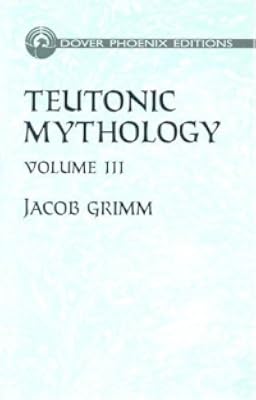
Teutonic Mythology {set}
by Jacob Grimm
126 Members (3.40)
On This Page
Description
Purchase of this book includes free trial access to www.million-books.com where you can read more than a million books for free. This is an OCR edition with typos. Excerpt from book: CHAPTER III. WOESHIP. The simplest actions by which man expressed his reverence1 for the gods (see Suppl.), and kept up a permanent connexion with them, were Prayer and Sacrifice. Sacrifice is a prayer offered up with gifts. And wherever there was occasion for prayer, there was also for sacrifice (see Suppl.). show more Prayer.?When we consider the word employed by Ulphilas to express adoration, we at once come upon a correspondence with the Norse phraseology again. For irpoo-Kuveco the Goth. equivalent is inveita, invait, invitum, Matt. 8, 2. 9, 18. Mk. 5, 6. 15, 19. Lu. 4, 7-8. John 9, 38. 12, 20. 1 Cor. 14, 25; and once for ocrTrafo/iai, Mk. 9, 15 (see Suppl.). Whether in using this word the exact sense of irpoa-Kvvrjcris was caught, may be doubted, if only because it is invariably followed by an acc., instead of the Greek dat. In Mod. Greek popular songs, irpocricvveiv is used of a vanquished enemy's act of falling to the ground in token of surrender. We do not know by what gesture inveitan was accompanied, whether a bowing of the head, a motion of the hand, or a bending of the knee. As we read, 1 Cor. 14, 25: driusands ana anda- vleizn (=antlitz), inveitiS guS; a suppliant prostration like irpor- Kvvrjcris is not at variance vith the sense of the word. An OS. giwitan, AS. gewitan, means abire; could inveitan also have signified merely going up to, approaching ? Paul. Diac. 1, 8 twice uses accedere. Fraveitan is vindicare. Now let us compare the ON. vita inclinare,2 which Biorn quotes under veit, and spells, erroneously, Ithink, vita. From it is derived veita (Goth. vaitjan ?); veita heiSr, honorem peragere; veita tioir, sacra peragere; veitsla, epulum, Goth. vaitislo ?1 1 Verehrung, O.H.G. Sra, Goth. prob. aiza. The O.H.G. $rdn is not merely our ehren, to honour, but also ve... show lessTags
Recommendations



































Member Reviews
Members
- Recently Added By
Author Information

1,890+ Works 49,674 Members
Jacob W. Grimm (1785-1863) and his brother Wilhelm K. Grimm (1786-1859) pioneered the study of German philosophy, law, mythology and folklore, but they are best known for their collection of fairy tales. These include such popular stories as Red Riding Hood, Sleeping Beauty and The Frog Prince. Commonly referred to now as Grimm's Fairy Tales, show more their collection was published as Kinder-und-Hausmarchen (Children's and Household Tales, 1812-15). The brothers were born thirteen months apart in the German province of Hesse, and were inseparable from childhood. Throughout their lives they showed a marked lack of sibling rivalry. Most of their works were written together, a practice begun in childhood when they shared a desk and sustained throughout their adult lives. Since their lives and work were so collaborative, it is difficult now to differentiate between them, but of course there were differences.- Jacob, who studied for a time in Paris, was fascinated with variant spellings of older words. He articulated "Grimm's Law," the rules of which are still used today to determine correspondences between the consonants of German and languages in the Indo-European family. Jacob was bolder and more experimental than Wilhelm, and was rumored to be a lively dancer. Throughout his life, Jacob kept rigidly to schedule and could be extremely focused on work that demanded close attention to detail. He never married, but was a loving uncle to Wilhelm's children. Jacob and Wilhelm Grimm are buried side by side in Berlin. (Bowker Author Biography) show less
Some Editions
Work Relationships
Common Knowledge
- Canonical title
- Teutonic Mythology {set}
- First words*
- Wiederum unternimmt es der Verlag, ein umfangreiches Werk des frühen 19. Jahrhunderts, das freilich in keiner germanistischen, sprachwissenschaftlichen oder volkskundlichen, auf Religionswissenschaft, Altertumskunde und Kult... (show all)urwissenschaft im breitesten Sinne ausgerichteten Bibliothek fehlen darf, vorzulegen.
- Disambiguation notice
- This work is for the complete set, usually found in English 4 volumes and 2 volumes in German. Please do not combine with individual volumes.
*Some information comes from Common Knowledge in other languages. Click "Edit" for more information.
Classifications
Statistics
- Members
- 126
- Popularity
- 258,741
- Rating
- (3.40)
- Languages
- English, German
- Media
- Paper
- ISBNs
- 16
- ASINs
- 2