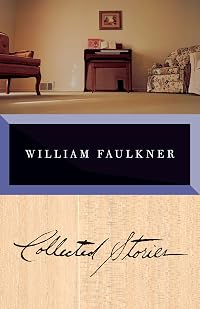
Collected Stories of William Faulkner
by William Faulkner
On This Page
Description
A selection of short stories by William Faulkner.Tags
Recommendations





Member Recommendations
Member Reviews
At one point I was reading two long difficult books at the time I was reading this long difficult collection. I got overwhelmed by it all. I was tired at the end here.
What's the most important thing a reader need to know before reading this book? hmm. Probably that it's not Faulkner's best stuff. He wrote a lot of stories, many very sophisticated. But I never felt the sense of invention brought to completion here in these as I have in his novels. These are often light or feel light. They often read as sketches or wishful fantasies romanticizing Native Americans or the trauma of World War I pilots. They often feel like magazine entertainment. What you will gain is some insight in the Faulkner's Mississippi, his Yoknapatawpha county show more history that he carried here back to Choctaw natives. You will sample many of his narrative and character voices. And, if you make it to the end, you will finally find some of diversity of styles Faulkner dabbled with along the way. There is a lot of Mississippi here. But he's interesting when he leaves the state.
Nine hundred pages of Faulkner stories is a lot. It's unfortunate the book doesn't come with composition dates, because Faulkner's writing evolved over time and it would be helpful to track what he was wrote when. Whether in the 1920's, when he was aggressively experimenting with form and developing a style, or the 1930's when desperate for cash, writing in Hollywood and at home, or the 1940's when he seemed to have settled into a confident style, perhaps less ambitious. (My main lesson reading Faulkner is the closer to the year 1929, the better)
Instead, the stories are grouped thematically - The Country, The Village, The Wilderness, The Wasteland, The Middle Ground and Beyond. If you read through from beginning to end, you begin with more juvenile stories, told through the eyes of children, that make up the Country section. The Village is more adult social commentary. The Wilderness is means Native American stories, The Wasteland are World War I stories that are probably written in the 1920's, and where we finally leave Mississippi. The Middle Ground is at last a refreshing set of stories, as each story strikes new territory, and much if it unfamiliar from Faulkner's novels. This was the first section I felt the book offered me something really new about the author. The last section, Beyond, has, I think, some of the most sophisticated stories in the collection. My only problem was I was exhausted by the time I got to them, and too tired to see the way wind or other strains were woven into these narratives with unspoken key points. The Beyond section is where I started finally googling explanations. I should have done that sooner.
I would not advise anyone to begin Faulkner here. (Consider starting with The Unvanquished, or just dive right into the wonderful As I lay Dying.) I might be careless in suggesting this 1951 National Book Award winner is really only a book for Faulkner completists, but I do suggest that.
2025
https://www.librarything.com/topic/375106#9013373 show less
What's the most important thing a reader need to know before reading this book? hmm. Probably that it's not Faulkner's best stuff. He wrote a lot of stories, many very sophisticated. But I never felt the sense of invention brought to completion here in these as I have in his novels. These are often light or feel light. They often read as sketches or wishful fantasies romanticizing Native Americans or the trauma of World War I pilots. They often feel like magazine entertainment. What you will gain is some insight in the Faulkner's Mississippi, his Yoknapatawpha county show more history that he carried here back to Choctaw natives. You will sample many of his narrative and character voices. And, if you make it to the end, you will finally find some of diversity of styles Faulkner dabbled with along the way. There is a lot of Mississippi here. But he's interesting when he leaves the state.
Nine hundred pages of Faulkner stories is a lot. It's unfortunate the book doesn't come with composition dates, because Faulkner's writing evolved over time and it would be helpful to track what he was wrote when. Whether in the 1920's, when he was aggressively experimenting with form and developing a style, or the 1930's when desperate for cash, writing in Hollywood and at home, or the 1940's when he seemed to have settled into a confident style, perhaps less ambitious. (My main lesson reading Faulkner is the closer to the year 1929, the better)
Instead, the stories are grouped thematically - The Country, The Village, The Wilderness, The Wasteland, The Middle Ground and Beyond. If you read through from beginning to end, you begin with more juvenile stories, told through the eyes of children, that make up the Country section. The Village is more adult social commentary. The Wilderness is means Native American stories, The Wasteland are World War I stories that are probably written in the 1920's, and where we finally leave Mississippi. The Middle Ground is at last a refreshing set of stories, as each story strikes new territory, and much if it unfamiliar from Faulkner's novels. This was the first section I felt the book offered me something really new about the author. The last section, Beyond, has, I think, some of the most sophisticated stories in the collection. My only problem was I was exhausted by the time I got to them, and too tired to see the way wind or other strains were woven into these narratives with unspoken key points. The Beyond section is where I started finally googling explanations. I should have done that sooner.
I would not advise anyone to begin Faulkner here. (Consider starting with The Unvanquished, or just dive right into the wonderful As I lay Dying.) I might be careless in suggesting this 1951 National Book Award winner is really only a book for Faulkner completists, but I do suggest that.
2025
https://www.librarything.com/topic/375106#9013373 show less
This collection of stories dates to 1950, that is, it is unchanged since it was first issued at that date. Faulkner's stories are indispensable. Some overlap with the more episodic novels, like Go Down, Moses. Having collected many of Faulkner's novels in the Library of America series, I'm wondering what prevents Library of America from finally issuing a definitive collection of the stories, which is still likely to be based on this 1950 collection [edited to add: and Library of America has finally done so, in 2023]. People who say they have never been able to read a Faulkner novel--so they have tried reading some stories--are at a disadvantage, in my opinion. You have to read some of the novels to get his mythic worldview situated in show more the Old South. Faulkner famously said that for many people in the South, the past is "not even past." show less
I tried - and failed - to read a Faulkner novel, so thought his short stories would be a more accessible introduction to his work. Be advised, this is a pretty mammoth tome: 42 stories over 900 pages, and by no means all the stories are easily comprehensible. I found myself numerous times on Google, trying to check out the interpretation of a particular tale.
Faulkner writes in a 'blokey' style: his stories feature war, American Indians, the racial divide, drink, revenge. I don't ever see myself reading anything else by him, but I absolutely appreciate the quality of his writing. The final story, for example, 'Carcassonne', describing rats:
"It was dark, a darkness filled with a fairy pattering of small feet, stealthy and intent. show more Sometimes the cold patter of them on his face waked him in the night, and at his movement they scurried invisibly like an abrupt disintegration of dead leaves in a wind, in whispering arpeggios of minute sound, leaving a thin but definite effluvium of furtiveness and voracity."
My favourite stories were : 'Two Soldiers', narrated by a child whose beloved elder brother is off to War; 'Red Leaves' (once I figured what's going on) where two American Indians are in pursuit of a slave, who is destined to die with his dead master; 'Turnabout' (where two arrogant American soldiers come to realise the courage of the young English marine who they initially despise). I also liked 'Elly' and 'Carcassonne' (I may not have correctly understood the latter, but it's intensely moving.)
Would give this 3.5. I'm glad I've finished it, but glad too that I read it show less
Faulkner writes in a 'blokey' style: his stories feature war, American Indians, the racial divide, drink, revenge. I don't ever see myself reading anything else by him, but I absolutely appreciate the quality of his writing. The final story, for example, 'Carcassonne', describing rats:
"It was dark, a darkness filled with a fairy pattering of small feet, stealthy and intent. show more Sometimes the cold patter of them on his face waked him in the night, and at his movement they scurried invisibly like an abrupt disintegration of dead leaves in a wind, in whispering arpeggios of minute sound, leaving a thin but definite effluvium of furtiveness and voracity."
My favourite stories were : 'Two Soldiers', narrated by a child whose beloved elder brother is off to War; 'Red Leaves' (once I figured what's going on) where two American Indians are in pursuit of a slave, who is destined to die with his dead master; 'Turnabout' (where two arrogant American soldiers come to realise the courage of the young English marine who they initially despise). I also liked 'Elly' and 'Carcassonne' (I may not have correctly understood the latter, but it's intensely moving.)
Would give this 3.5. I'm glad I've finished it, but glad too that I read it show less
This collection of Faulkner's short fiction is divided into geographical settings, starting in the familiar land of Yoknapatawpha County and extending outward to encompass the rest of the country and beyond, with the final section involving elements outside of this world. I personally found the stories in the first few sections the most compelling. They involve many of the characters and settings familiar from his novels and provide us with a variety of viewpoints of life in the county. Of the latter stories, many involve military service and utilize unexplained lingo and events I was unfamiliar with, so that may have colored my perception. A few favorites for their unique narration and/or unexpected plot: "A Rose for Emily", "Dry show more September", "Elly", "That Will Be Fine", "Turnabout" and "Beyond". show less
Some of his stories are real gems with fascinating characters and quirky plots. Others made no sense to me. The group of stories set in Italy were especially difficult to comprehend.
I was blown away by this collection. I've never come across a better collection of stories than this one. His WWI stories, I don't particularly care for, but I was mesmerized by almost everything in this book. Faulkner is my ultimate hero.
3443. Collected Stories of William Faulkner (read May 11, 2001) I saw that I had read every National Book Award fiction winner from the institution of the award in 1950 till 1968 except this book. So I thought I would read this since it was at the library. There are 42 stories and I found it a chore to read one after another for 900 pages. Some of the stories are very good, but some are poor and dull. Many have the defect common in modern-day short stories--not telling what happened and kind of leaving the reader up in the air. "A Rose for Emily"--which I believe has been anthologized quite a bit is, I thought, probably the best story in the book, if I had to choose one.
Members
- Recently Added By
Published Reviews
ThingScore 100
Faulkner is no longer known for his short stories, except perhaps for “The Bear,” which appeared both as a stand-alone and as part of Go Down, Moses, but the collection for which he won the National Book Award is really a stunning achievement, and as unsettling as they come.
added by Shortride
Lists

National Book Award - Fiction
78 works; 10 members

20th Century Literature
1,161 works; 55 members

Harold Bloom - The Western Canon: D. The Chaotic Age
833 works; 24 members

Short Story Collections and Anthologies
261 works; 40 members
Author Information

465+ Works 99,313 Members
Born in an old Mississippi family, William Faulkner made his home in Oxford, seat of the University of Mississippi. After the fifth grade he went to school only off and on-lived, read, and wrote much as he pleased. In 1918, refusing to enlist with the "Yankees," he joined the Canadian Air Force, and was transferred to the British Royal Air Force. show more After the war he studied a little at the University, did house painting, worked as a night superintendent at a power plant, went to New Orleans and became a friend of Sherwood Anderson, then to Europe and back home to Oxford. By this time he had written two novels. The Sound and the Fury followed in 1929. Financial success came with Sanctuary in 1931, which he assisted in filming. Faulkner 's novels are intense in their character portrayals of disintegrating Southern aristocrats, poor whites, and African Americans. A complex stream-of-consciousness rhetoric often involves Faulkner in lengthy sentences of anguished power. Most of his tales are set in the mythical Yoknapatawpha County, Mississippi, and are characterized by the use of many recurring characters from families of different social levels spanning more than a century. His best subjects are the old, dying South and the newer materialistic South. As I Lay Dying (1930), is a grotesquely tragicomic story about a family of poor southern whites. With Absalom, Absalom! (1936); the difficult parts of his famous short novel "The Bear" (published in Go Down, Moses, 1942); and the allegorical A Fable (1954), a non-Yoknapatawpha novel set in France during World War I; Faulkner returned to an innovative and difficult style that most readers have trouble with. Yet, interspersed among such works are collections of easily read stories originally published in popular magazines. There seems to be a growing sentiment among critics that the Snopes trilogy-The Hamlet (1940), The Town (1957), and The Mansion (1959)-for the most part an example of Faulkner's "moderate" style, could well be among his most important works. Faulkner was awarded the 1949 Nobel Prize for literature "for his powerful and artistically independent contribution to the new American novel," but it would appear now that he also deserved to win that honor for his contribution to world literature. When reporting his death, the Boston Globe quoted Faulkner's having once told an interviewer: "Since man is mortal, the only immortality for him is to leave something behind him that is immortal since it will always move. That is the artist's way of scribbling "Kilroy was here" on the wall of the final and irrevocable oblivion through which he must some day pass." In addition to the Nobel Prize, Faulkner received the Howells Medal of the American Academy of Arts and Letters in 1950, and in 1951 he was given the National Book Award for his Collected Stories Collected Stories. For his novel A Fable he received the National Book Award for the second time, as well as the Pulitzer Prize in 1955. The Reivers (1962) was awarded the Pulitzer Prize in 1963. In 1957 and 1958, he was the University of Virginia's first writer-in-residence, and in January 1959 he accepted an appointment as consultant on contemporary literature to the Alderman Library of that university. Although Faulkner was not without honors in his lifetime and has received world recognition since then, it is surprising to learn that, when Malcolm Cowley edited The Portable Faulkner in 1946, he found that almost all of Faulkner's books were out of print. By arranging selections from the works to form a continuous chronicle, Cowley deserves much of the credit for making readers aware of the way in which Faulkner was creating a fictive world on a scale grander than that of any novelist since Balzac. William Faulkner died in Oxford, Mississippi, in 1962. (Bowker Author Biography) show less
Awards and Honors
Awards
Distinctions
Series
Belongs to Publisher Series
Work Relationships
Is contained in
Contains
Has as a student's study guide
Common Knowledge
- Original title
- Collected Stories of William Faulkner
- Original publication date
- 1950
- Important places
- Mississippi, USA
- Related movies
- Tomorrow (1972 | IMDb); Barn Burning (1980 | IMDb); Two Soldiers (2003 | IMDb)
- First words
- The store in which the Justice of the Peace's court was sitting smelled of cheese.
- Quotations
- There's not any such thing as a woman born bad, because they are all born bad, born with the badness in them. The thing is, to get them married before the badness comes to a natural head. [Hair]
- Last words
- (Click to show. Warning: May contain spoilers.)Steed and rider thunder on, thunder punily diminishing: a dying star upon the immensity of darkness and of silence within which, steadfast, fading, deepbreasted and grave of flank, muses the dark and tragic figure of the Earth, his mother.
- Original language
- English
Classifications
Statistics
- Members
- 2,174
- Popularity
- 9,346
- Reviews
- 10
- Rating
- (4.14)
- Languages
- English, German, Russian, Spanish
- Media
- Paper, Audiobook, Ebook
- ISBNs
- 30
- ASINs
- 31