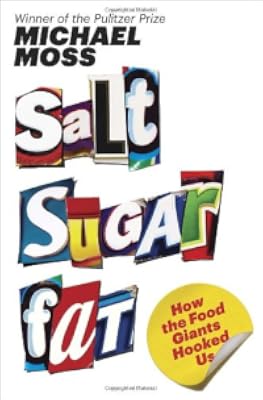
Salt Sugar Fat: How the Food Giants Hooked Us
by Michael Moss
On This Page
Description
NAMED ONE OF THE BEST BOOKS OF THE YEAR BYThe Atlantic • The Huffington Post • Men’s Journal • MSN (U.K.) • Kirkus Reviews • Publishers Weekly
#1 NEW YORK TIMES BESTSELLER • WINNER OF THE JAMES BEARD FOUNDATION AWARD FOR WRITING AND LITERATURE
Every year, the average American eats thirty-three pounds of cheese and seventy pounds of sugar. Every day, we ingest 8,500 milligrams of salt, double the recommended amount, almost none of which comes from the shakers on our table. It show more comes from processed food, an industry that hauls in $1 trillion in annual sales. In Salt Sugar Fat, Pulitzer Prize–winning investigative reporter Michael Moss shows how we ended up here. Featuring examples from Kraft, Coca-Cola, Lunchables, Frito-Lay, Nestlé, Oreos, Capri Sun, and many more, Moss’s explosive, empowering narrative is grounded in meticulous, eye-opening research. He takes us into labs where scientists calculate the “bliss point” of sugary beverages, unearths marketing techniques taken straight from tobacco company playbooks, and talks to concerned insiders who make startling confessions. Just as millions of “heavy users” are addicted to salt, sugar, and fat, so too are the companies that peddle them. You will never look at a nutrition label the same way again.
Praise for Salt Sugar Fat
“[Michael] Moss has written a Fast Food Nation for the processed food industry. Burrowing deep inside the big food manufacturers, he discovered how junk food is formulated to make us eat more of it and, he argues persuasively, actually to addict us.”—Michael Pollan
“If you had any doubt as to the food industry’s complicity in our obesity epidemic, it will evaporate when you read this book.”—The Washington Post
“Vital reading for the discerning food consumer.”—The Wall Street Journal
“The chilling story of how the food giants have seduced everyone in this country . . . Michael Moss understands a vital and terrifying truth: that we are not just eating fast food when we succumb to the siren song of sugar, fat, and salt. We are fundamentally changing our lives—and the world around us.”—Alice Waters
“Propulsively written [and] persuasively argued . . . an exactingly researched, deeply reported work of advocacy journalism.”—The Boston Globe
“A remarkable accomplishment.”—The New York Times Book Review. show less
Tags
Recommendations





Member Recommendations
Member Reviews
A revealing and very readable look into the food industry and the ways in which it relies on the three titular ingredients to create products that are as physically and psychologically irresistible as possible... and also really bad for us. Also includes a lot of discussion of the rising rates of obesity in the US and other countries and the things the food industry does and doesn't do to address their part in it. This was published in 2013, so it's not exactly current on the latest food trends or research into obesity, but I don't think there is anything in it whatsoever that isn't still deeply relevant.
It's all interesting, informative, even-handed, and deeply depressing. Mostly, I'm left thinking about how if, in your one-on-one show more interactions with other human beings, you relentlessly manipulate them into doing things that are in your own interest but bad for them, you're a toxic jerk at best and possibly even a flat-out criminal, but if you do it on a massive scale with an industrial laboratory and a marketing department, then, hey, you're a great businessperson! The fruits of late-stage capitalism, ladies and gentlemen. Or should I say, the sugary fruit-flavored drink that's deceptively packaged in such a way as to fool you into thinking it's healthy and is aggressively marketed to your kids? show less
It's all interesting, informative, even-handed, and deeply depressing. Mostly, I'm left thinking about how if, in your one-on-one show more interactions with other human beings, you relentlessly manipulate them into doing things that are in your own interest but bad for them, you're a toxic jerk at best and possibly even a flat-out criminal, but if you do it on a massive scale with an industrial laboratory and a marketing department, then, hey, you're a great businessperson! The fruits of late-stage capitalism, ladies and gentlemen. Or should I say, the sugary fruit-flavored drink that's deceptively packaged in such a way as to fool you into thinking it's healthy and is aggressively marketed to your kids? show less
Capitalism is not your friend. It wants you to eat lots and lots of cheap food whose otherwise bad taste is disguised by lots of salt, sugar, and fat, each of which disguise many sins; and then ideally it wants you to turn to expensive treatments for the resulting problems, often offered by the very same companies that sold you the terrible food in the first place. This book, which focuses on the food producers who fill the middle aisles in supermarkets, is full of really depressing facts about what the food industry has done to make its products worse and tastier, from testing on three-year-olds (who can’t even properly use language and have to be coaxed with Big Bird) to using “fruit concentrate” that has been reduced to just show more another form of sugar, but whose presence on the label gives an impression of healthfulness. One sad anecdote involves Philadelphia parents trying to get local store owners to refuse to sell junk to kids before breakfast; one of the parents doesn’t have time to cook, so chooses “fruit and yogurt” breakfast bars because they have calcium. But they also have more sugar and less fiber than Oreos. The most crucial point, Moss emphasizes, is that there is nothing accidental in the grocery store. It is all designed, and not with your interests in mind. Individual willpower isn’t enough as long as Wall Street demands ever greater profits, which can only be attained with ever greater consumption of ever sweeter, saltier, and fattier food. show less
To begin with my by-now rote preamble, I received this book from a GoodReads drawing. Despite that kind and generous and typical consideration I give my candid opinions below.
The premise of this book can be summed up very simply. Food companies are creating products that while not intended to kills us, nevertheless are doing so. By using science and marketing (in some cases derived from research done by that purest of evils, cigarette companies) big foods can manipulate us into eating more and more of their products until we drop dead. While we think the government is trying to protect us from such evils, in fact most of the time the feds are helping and subsidizing the efforts of food companies to shove more and unhealthier food down show more our throats to line their pockets. I’d say that about covers it.
Michael Moss’s definitive tome on food marketing is exhaustive, at times daunting and the best book on this topic I’ve read since “Fast Food Nation” so many years ago. Moss has covered the basics with a wealth of detail and reasoning that should be abundantly terrifying to those who find themselves putting frozen pizzas and Hot Pockets into their cart at the grocery store. He paints a picture that is stark and, sadly, a bit hopeless. While our author does spend a tiny bit of time on the efforts of food companies to stop killing us softly with salt, sugar and fat, he doesn’t really seem to hold out much hope. He closes with a chunk on liquid foods designed for people after they have bariatric surgery. The image of people tube-feeding themselves from a plastic container is pretty haunting but that seems to be what we’re coming to.
This book is wonderfully researched, eruditely and well written and I hope against hope that it’s somehow unbalanced. Moss’s picture is grim indeed but his arguments are so well constructed that one doesn’t really have the heart to argue with them. As a book it can sometimes be a bit daunting and is best taken, I think, in 1-hour chunks. On one level this lets the argument settle in over the course of several days and make you subconsciously examine what YOU’RE eating. The book is very helpful and specific in the foods and products it chooses to excoriate. A conscientious reader will find themselves at least slightly changed for the better. On another level, taking the book in small pieces dampens a bit the somewhat repetitive cadence of the whole thing. Here’s a type of food. Here’s why it’s bad. Here’s the history of it. Here’s who I talked to about it and what they had to say. Lather, rinse, repeat. Taken in long sittings this is probably much less effective. I stretched this one out over a week and felt myself well served and well-educated.
In summary, this is the sort of book that leaves you changed at a fundamental level. Like books before it, you never quite see the world the same way again. On the whole, I feel pretty good about my diet even before, relative to how Moss describes the typical American diet but there’s always room for improvement and this book is one that gives a not so gentle nudge in the right direction. It’s also the sort of book you want to pass around to everyone you know; it should be subtitled, “Read this before the next time you open your mouth.” show less
The premise of this book can be summed up very simply. Food companies are creating products that while not intended to kills us, nevertheless are doing so. By using science and marketing (in some cases derived from research done by that purest of evils, cigarette companies) big foods can manipulate us into eating more and more of their products until we drop dead. While we think the government is trying to protect us from such evils, in fact most of the time the feds are helping and subsidizing the efforts of food companies to shove more and unhealthier food down show more our throats to line their pockets. I’d say that about covers it.
Michael Moss’s definitive tome on food marketing is exhaustive, at times daunting and the best book on this topic I’ve read since “Fast Food Nation” so many years ago. Moss has covered the basics with a wealth of detail and reasoning that should be abundantly terrifying to those who find themselves putting frozen pizzas and Hot Pockets into their cart at the grocery store. He paints a picture that is stark and, sadly, a bit hopeless. While our author does spend a tiny bit of time on the efforts of food companies to stop killing us softly with salt, sugar and fat, he doesn’t really seem to hold out much hope. He closes with a chunk on liquid foods designed for people after they have bariatric surgery. The image of people tube-feeding themselves from a plastic container is pretty haunting but that seems to be what we’re coming to.
This book is wonderfully researched, eruditely and well written and I hope against hope that it’s somehow unbalanced. Moss’s picture is grim indeed but his arguments are so well constructed that one doesn’t really have the heart to argue with them. As a book it can sometimes be a bit daunting and is best taken, I think, in 1-hour chunks. On one level this lets the argument settle in over the course of several days and make you subconsciously examine what YOU’RE eating. The book is very helpful and specific in the foods and products it chooses to excoriate. A conscientious reader will find themselves at least slightly changed for the better. On another level, taking the book in small pieces dampens a bit the somewhat repetitive cadence of the whole thing. Here’s a type of food. Here’s why it’s bad. Here’s the history of it. Here’s who I talked to about it and what they had to say. Lather, rinse, repeat. Taken in long sittings this is probably much less effective. I stretched this one out over a week and felt myself well served and well-educated.
In summary, this is the sort of book that leaves you changed at a fundamental level. Like books before it, you never quite see the world the same way again. On the whole, I feel pretty good about my diet even before, relative to how Moss describes the typical American diet but there’s always room for improvement and this book is one that gives a not so gentle nudge in the right direction. It’s also the sort of book you want to pass around to everyone you know; it should be subtitled, “Read this before the next time you open your mouth.” show less
Sure, nobody thinks processed food is actually good for them, but how bad is it, exactly? In this book, Moss interviews scientists, advertisers, and former employees of processed food giants such as Kraft, Nestle, Coke, and Frito-Lay to get the real story behind the junk food that America can't seem to do without. It's eye-opening to learn about how these companies manipulate their products to hit the perfect "bliss point" that will keep consumers coming back for more. This book originally came out in 2013, and while I'd love to see an updated version that talks about what's happened with processed food in the interim, I'm pretty sure that the answer is "more of the same," since my grocery store shelves are still packed with many of the show more products Moss mentions. If you want a book to make you think more carefully about what you're putting in your shopping cart, this one is solidly helpful. show less
“We rarely get in the situation where our body and brain are depleted of nutrients and are actually in need of replenishment. Rather, he discovered, we are driven to eat by other forces in our lives. Some of these are emotional needs, while others reflect the pillars of processed food: first and foremost taste, followed by aroma, appearance, and texture."
If you eat food, you should read this book. Sugar Salt Fat: How the Food Giants Hooked Us caused a very conflicted reaction in me, because although American capitalism is founded on the principle of caveat emptor, the vast majority of people have never been given the tools and information to make informed decisions. And when the government, and by extension, public schools, align show more themselves with the food giants, surely it is unfair to put all the responsibility on the consumer. Yes, it is up to us what we eat–how we fuel our bodies. But without labels that reflect a real serving size, classes for every student on nutrition and cooking, and foods that a create repeat buyers, not daily nutrition, it seems like we are doomed. Moss gives the reader a crash course in modern packaged food development and the three cardinal points of salt, sugar and fat, its strong connection with marketing and consumerism, and its somewhat ethically challenged science (hello, Oppenheimer) that connects it with biology and craving.
The science
Starting with the best of intentions, scientists in the 1970s were trying to improve Meals, Ready-To-Eat (MREs) for the military, experimenting with enticing soldiers to eat enough calories on foods packaged to last three years. A pivotal scientist, Moskowitz, discovered two important taste guidelines. One, although soldiers would say they liked flavorful foods, they quickly grew tired of them, while a more neutrally flavored white bread they could eat every day. In other words, distinct flavors overwhelm the brain and make us feel full fast.
Secondly, Moskowitz discovered that while we liked foods more as more sugar was added, that only worked until a specific point when it became 'too sweet' and more unpalatable. Coined 'the bliss point,' it set off a revolution in taste research. Research done by Drewnowski, an epidemiology professor, made similar progress with fat by devising a study using mixtures of milk, cream and sugar. He discovered there was no bliss point in his mixtures for fat, no point in which the participants would refuse to eat a high-fat mixture. Furthermore, adding a little sugar to the fatty mixes made them taste better. Even worse, when the sugar was added to the fat combinations, the participants thought fat had been reduced. Thematically, this will come up again and again, a central tenant of Moss’ research: our biology is being researched and identified not to benefit us, but to sell us more product.
The marketing
One of the more interesting points about Salt Sugar Fat is how well Moss humanizes people in the food industry, showing how individuals trying to make a living or pursue their own intellectual bliss contributed to the growth of addictive foods. For instance, he demonstrates how Kellogg was attempting to make the health food of his time, and how it eventually lost market share when other sugar-promoting cereals were created. When Kraft’s co-CEO started championing an anti-obesity initiative, and stocks started to slump as competitors gained, she was removed from her position and eventually left the company. When Campbell’s tried to cut back on salt in their soups, they lost enough market share that a new CEO announced they would be starting a new line–with even more salt. Sadly, a number of his sources are people who have come to regret their professional contributions as they’ve seen the effects of the rising obesity epidemic. But some really are out to just make the most money, and they blame you for your addiction to Cheesy-Poofs.
“The prevailing attitude among the company’s food managers… was one of supply and demand. ‘People could point to these things and say, ‘They’ve got too much sugar, they’ve got too much salt,’ he said. ‘Well, that’s what the consumer wants, and we’re not putting a gun to their head to eat it. That’s what they want. If we given them less, they’ll buy less, and the competitor will get our market. So you’re sort of trapped."
So you see, people, its your own fault that we have Fudge-Covered Oreos, and Hungry Man dinners with enough salt for two people’s recommended daily allowance–you wouldn’t buy the low-fat versions. However, it does give me a faint sort of hope that by continued advocacy, consumers have a shot at actually getting products that appeal–and are actually healthy.
The government
Far from the nanny state protecting the citizen against herself, the government has played an active role in encouraging certain unhealthy foods as part of supporting America’s economic health. In 1985, the Department of Agriculture had a problem on its hands–Reagan wanted to decrease milk subsidies, which mean shrinking the cow herds, which meant a glut of beef at the market. Congress tried to help by creating two marketing programs, one for beef and one for milk and put Ag in charge of them. Remember the “Beef: It’s what’s for dinner” campaign? Yeah, if you are over thirty, no doubt you do. Or the dairy mustache that’s still making the magazine rounds? Those weren’t about our health, people.
There was a moment in the Salt section that mentioned processing, nitrites and cancer–I believe Moss might have even said leukemia. I started to feel sick–I work in that city with the Oscar Meyer plant and had noticed three or four patients with leukemia who worked there. It got even worse when Moss wrote about a report in 2007 by the American Institute for Cancer Research. A research review of over 7000 studies, the researchers felt confident that meats increased the risk of cancer, especially charred and processed meats. In fact, research showed no amount of processed meat was safe. Even more disturbing–using those government funds, the cattle associations fought back, attempting to discredit and spin away the report. They, like the food giant CEOs, blamed it on us–on our alcohol, our obesity, our inactivity, our lack of vegetables. Processed meat was only one tiny part of the cancer problem.
My conclusion
What I especially liked is that near the end, Moss snuck in a loaded tidbit in the discussion of Oscar Meyer’s Lunchables line: “There is a class issue at work in processed foods, in which the inventors and company executives don’t generally partake in their own creations. Thus the heavy reliance on focus groups.” Processed foods are generally convenience foods, and are geared particularly towards busy parents who want to provide appealing meals with low preparation time, which generally means working-class parents, not people with the time to research recipes, watch Rachel Ray, shop at Whole Foods and spend an hour preparing and cooking dinner, even if it does make leftovers for the next day. So I appreciate the nod to the economics.
So you see, our biology is being exploited. As a nurse, and a sugar-aholic (you know how often I’ve referenced chocolate in these reviews!), I have to say I believe that the closer we eat to real food, the better off our bodies are. You want to prevent cancer? Exercise. Eat a diet low in processed foods, low in meats, and high in raw fruits and vegetables. Processed foods are not only bad for our bodies, they are bad for our psychology and our taste buds, because they teach us to tolerate high levels of salt and to crave high levels of sugar–so much so that real, unadulterated food starts to seem ‘boooooring!’ We’ve set our sweet and salt taste points so high, we wouldn’t recognize a naturally sweet orange when we tried it (did you ever wonder why they used to be put in Christmas stockings as a treat?). But clearly it is up to you, dear consumer, so educate yourself.
https://clsiewert.wordpress.com/2014/06/30/salt-sugar-fat-by-michael-moss-read-i... show less
If you eat food, you should read this book. Sugar Salt Fat: How the Food Giants Hooked Us caused a very conflicted reaction in me, because although American capitalism is founded on the principle of caveat emptor, the vast majority of people have never been given the tools and information to make informed decisions. And when the government, and by extension, public schools, align show more themselves with the food giants, surely it is unfair to put all the responsibility on the consumer. Yes, it is up to us what we eat–how we fuel our bodies. But without labels that reflect a real serving size, classes for every student on nutrition and cooking, and foods that a create repeat buyers, not daily nutrition, it seems like we are doomed. Moss gives the reader a crash course in modern packaged food development and the three cardinal points of salt, sugar and fat, its strong connection with marketing and consumerism, and its somewhat ethically challenged science (hello, Oppenheimer) that connects it with biology and craving.
The science
Starting with the best of intentions, scientists in the 1970s were trying to improve Meals, Ready-To-Eat (MREs) for the military, experimenting with enticing soldiers to eat enough calories on foods packaged to last three years. A pivotal scientist, Moskowitz, discovered two important taste guidelines. One, although soldiers would say they liked flavorful foods, they quickly grew tired of them, while a more neutrally flavored white bread they could eat every day. In other words, distinct flavors overwhelm the brain and make us feel full fast.
Secondly, Moskowitz discovered that while we liked foods more as more sugar was added, that only worked until a specific point when it became 'too sweet' and more unpalatable. Coined 'the bliss point,' it set off a revolution in taste research. Research done by Drewnowski, an epidemiology professor, made similar progress with fat by devising a study using mixtures of milk, cream and sugar. He discovered there was no bliss point in his mixtures for fat, no point in which the participants would refuse to eat a high-fat mixture. Furthermore, adding a little sugar to the fatty mixes made them taste better. Even worse, when the sugar was added to the fat combinations, the participants thought fat had been reduced. Thematically, this will come up again and again, a central tenant of Moss’ research: our biology is being researched and identified not to benefit us, but to sell us more product.
The marketing
One of the more interesting points about Salt Sugar Fat is how well Moss humanizes people in the food industry, showing how individuals trying to make a living or pursue their own intellectual bliss contributed to the growth of addictive foods. For instance, he demonstrates how Kellogg was attempting to make the health food of his time, and how it eventually lost market share when other sugar-promoting cereals were created. When Kraft’s co-CEO started championing an anti-obesity initiative, and stocks started to slump as competitors gained, she was removed from her position and eventually left the company. When Campbell’s tried to cut back on salt in their soups, they lost enough market share that a new CEO announced they would be starting a new line–with even more salt. Sadly, a number of his sources are people who have come to regret their professional contributions as they’ve seen the effects of the rising obesity epidemic. But some really are out to just make the most money, and they blame you for your addiction to Cheesy-Poofs.
“The prevailing attitude among the company’s food managers… was one of supply and demand. ‘People could point to these things and say, ‘They’ve got too much sugar, they’ve got too much salt,’ he said. ‘Well, that’s what the consumer wants, and we’re not putting a gun to their head to eat it. That’s what they want. If we given them less, they’ll buy less, and the competitor will get our market. So you’re sort of trapped."
So you see, people, its your own fault that we have Fudge-Covered Oreos, and Hungry Man dinners with enough salt for two people’s recommended daily allowance–you wouldn’t buy the low-fat versions. However, it does give me a faint sort of hope that by continued advocacy, consumers have a shot at actually getting products that appeal–and are actually healthy.
The government
Far from the nanny state protecting the citizen against herself, the government has played an active role in encouraging certain unhealthy foods as part of supporting America’s economic health. In 1985, the Department of Agriculture had a problem on its hands–Reagan wanted to decrease milk subsidies, which mean shrinking the cow herds, which meant a glut of beef at the market. Congress tried to help by creating two marketing programs, one for beef and one for milk and put Ag in charge of them. Remember the “Beef: It’s what’s for dinner” campaign? Yeah, if you are over thirty, no doubt you do. Or the dairy mustache that’s still making the magazine rounds? Those weren’t about our health, people.
There was a moment in the Salt section that mentioned processing, nitrites and cancer–I believe Moss might have even said leukemia. I started to feel sick–I work in that city with the Oscar Meyer plant and had noticed three or four patients with leukemia who worked there. It got even worse when Moss wrote about a report in 2007 by the American Institute for Cancer Research. A research review of over 7000 studies, the researchers felt confident that meats increased the risk of cancer, especially charred and processed meats. In fact, research showed no amount of processed meat was safe. Even more disturbing–using those government funds, the cattle associations fought back, attempting to discredit and spin away the report. They, like the food giant CEOs, blamed it on us–on our alcohol, our obesity, our inactivity, our lack of vegetables. Processed meat was only one tiny part of the cancer problem.
My conclusion
What I especially liked is that near the end, Moss snuck in a loaded tidbit in the discussion of Oscar Meyer’s Lunchables line: “There is a class issue at work in processed foods, in which the inventors and company executives don’t generally partake in their own creations. Thus the heavy reliance on focus groups.” Processed foods are generally convenience foods, and are geared particularly towards busy parents who want to provide appealing meals with low preparation time, which generally means working-class parents, not people with the time to research recipes, watch Rachel Ray, shop at Whole Foods and spend an hour preparing and cooking dinner, even if it does make leftovers for the next day. So I appreciate the nod to the economics.
So you see, our biology is being exploited. As a nurse, and a sugar-aholic (you know how often I’ve referenced chocolate in these reviews!), I have to say I believe that the closer we eat to real food, the better off our bodies are. You want to prevent cancer? Exercise. Eat a diet low in processed foods, low in meats, and high in raw fruits and vegetables. Processed foods are not only bad for our bodies, they are bad for our psychology and our taste buds, because they teach us to tolerate high levels of salt and to crave high levels of sugar–so much so that real, unadulterated food starts to seem ‘boooooring!’ We’ve set our sweet and salt taste points so high, we wouldn’t recognize a naturally sweet orange when we tried it (did you ever wonder why they used to be put in Christmas stockings as a treat?). But clearly it is up to you, dear consumer, so educate yourself.
https://clsiewert.wordpress.com/2014/06/30/salt-sugar-fat-by-michael-moss-read-i... show less
A grim and frankly terrifying look at the way modern processed food has been designed to entice the human taste buds while ignoring the recommended amount of salt, sugar, and fat a healthy human should ingest. The author examines all the industry research that goes into making potato chips, cookies, candy etc. taste compulsively good and yet seem to occupy no room in the stomach. Why is it possible to eat an entire family sized bag containing a week's worth of saturated fat and yet still feel hungry? These aren't accidents, but the result of the labor of a dedicated team of food chemists.
Although it might feel like it, this isn't a book about some grand conspiracy by the food company to fatten us all up like hogs. Rather, it is the show more expected outcome of a competitive food economy. Each company is trying to engineer the cheapest, tastiest, and most habit-forming food possible. Luckily for them, salt, sugar, and fat happen to be both very cheap and very crave-able. These three components drive our evolutionary desire to consume. The body loves this trio of flavors because they promise dense calories which in turn promises survival through another winter.
With all the power of science, these flavors have been genetically engineered to inhabit snack foods in surprising quantities. Shocking amounts of these items are in most popular processed foods, usually all at once. These foods were created to entice consumer demand and they have succeeded. Now America is obese, and the food companies have set their sights on the rest of the world. show less
Although it might feel like it, this isn't a book about some grand conspiracy by the food company to fatten us all up like hogs. Rather, it is the show more expected outcome of a competitive food economy. Each company is trying to engineer the cheapest, tastiest, and most habit-forming food possible. Luckily for them, salt, sugar, and fat happen to be both very cheap and very crave-able. These three components drive our evolutionary desire to consume. The body loves this trio of flavors because they promise dense calories which in turn promises survival through another winter.
With all the power of science, these flavors have been genetically engineered to inhabit snack foods in surprising quantities. Shocking amounts of these items are in most popular processed foods, usually all at once. These foods were created to entice consumer demand and they have succeeded. Now America is obese, and the food companies have set their sights on the rest of the world. show less
A bit rudimentary and repetitive. The subject here is Big Processed Food. They make stuff that's really bad for you. If one company tries to do the right thing and stop selling such salt-sugar-fat-laden bombs, they will simply lose market share to other companies that still sell the junk. The prevailing attitude is, therefore, that they offer healthy options alongside the traditional bombs; the consumer may pick what she likes; and people like the bombs. So whaddaya gonna do?
None of this is earth-shattering, so Moss bases his book on the quality of his reporting and the stories he unearths. My favorites are about instant pudding and Cheez Whiz. Instant pudding: I always pass this in the supermarket aisle and think to myself "maybe I show more want to make pudding sometime." I know instant pudding isn't a nutritional powerhouse, but it's always felt to me like pudding mix, cake mix, etc. were one cut better than buying products already pre-made. At least you're making the thing. You have a bit more control and knowledge about its inputs and freshness. OK, so maybe the kind of pudding you cook has something going for it in that regard, but when I read Moss' historical bit about instant pudding, and about the chemicals they have to add to allow milk to turn into pudding without applying heat, I was entirely put off forever.
Cheez Whiz: created in the 1950s, Moss interviewed one of its creators, who has stayed a lifelong fan - almost. He and his wife would put it on everything, often ending the day with a glass of wine and a few crackers slathered in Cheez Whiz. One day this gentleman opened a new jar to make one of his usual Whizzy snacks, and pthththt! It tasted like axle grease! What had they done to it? He scanned the ingredients list, no mean feat, as the Whiz had always sported something like 27 different ingredients, and then discovered, they had taken the dang cheese out! Yes, Cheez Whiz originally could legally have gone by the name of Cheese Whiz, because it actually used to have cheese. Now... just whiz.
Moss explains everything and gets a bit too rudimentary at times, as noted. For example, in the salt chapter, we get a brief introduction to the history of salt, and as I quickly read through it, I thought, "I sure hope he doesn't tell us how golly gee whiz did you know Romans were paid in salt and that's where the word salary comes from??" D'oh! Yes, he did feel obliged to inform us of that.
And repetitive. Those 100-calorie snack packs of Bad Foods like chips & cookies - they don't work! People just open more packs! We had to hear about this multiple times. I think this is a bit of a sweeping condemnation, by the way. For all the people who litter the ground with multiple wrappers of 100-calorie packs, I'm sure many instead have benefited greatly from being able to indulge in moderation. I'm a big fan of moderation myself.
I'm still giving this three stars, cause hell, who doesn't like to curl up with some good food readin'. show less
None of this is earth-shattering, so Moss bases his book on the quality of his reporting and the stories he unearths. My favorites are about instant pudding and Cheez Whiz. Instant pudding: I always pass this in the supermarket aisle and think to myself "maybe I show more want to make pudding sometime." I know instant pudding isn't a nutritional powerhouse, but it's always felt to me like pudding mix, cake mix, etc. were one cut better than buying products already pre-made. At least you're making the thing. You have a bit more control and knowledge about its inputs and freshness. OK, so maybe the kind of pudding you cook has something going for it in that regard, but when I read Moss' historical bit about instant pudding, and about the chemicals they have to add to allow milk to turn into pudding without applying heat, I was entirely put off forever.
Cheez Whiz: created in the 1950s, Moss interviewed one of its creators, who has stayed a lifelong fan - almost. He and his wife would put it on everything, often ending the day with a glass of wine and a few crackers slathered in Cheez Whiz. One day this gentleman opened a new jar to make one of his usual Whizzy snacks, and pthththt! It tasted like axle grease! What had they done to it? He scanned the ingredients list, no mean feat, as the Whiz had always sported something like 27 different ingredients, and then discovered, they had taken the dang cheese out! Yes, Cheez Whiz originally could legally have gone by the name of Cheese Whiz, because it actually used to have cheese. Now... just whiz.
Moss explains everything and gets a bit too rudimentary at times, as noted. For example, in the salt chapter, we get a brief introduction to the history of salt, and as I quickly read through it, I thought, "I sure hope he doesn't tell us how golly gee whiz did you know Romans were paid in salt and that's where the word salary comes from??" D'oh! Yes, he did feel obliged to inform us of that.
And repetitive. Those 100-calorie snack packs of Bad Foods like chips & cookies - they don't work! People just open more packs! We had to hear about this multiple times. I think this is a bit of a sweeping condemnation, by the way. For all the people who litter the ground with multiple wrappers of 100-calorie packs, I'm sure many instead have benefited greatly from being able to indulge in moderation. I'm a big fan of moderation myself.
I'm still giving this three stars, cause hell, who doesn't like to curl up with some good food readin'. show less
Members
- Recently Added By
Published Reviews
ThingScore 75
There is a certain enlightened segment of America that relishes a good gastro-scolding, whether delivered gently by a Michael Pollan (“Eat food. Not too much. Mostly plants”) or more vituperatively by a Mark Bittman (“In the time it takes to go into a McDonald’s, stand in line, order, wait, pay and leave, you could make oatmeal for four while taking your vitamins, brushing your teeth show more and half-unloading the dishwasher”). But there is a much larger segment of America whose members heedlessly eat processed foods that make them overweight and unwell. Michael Moss, a dogged investigative reporter who neither scolds nor proselytizes, is here for them. show less
added by lorax
Lists

Best "Foodie" Books
114 works; 40 members

Top Five Books of 2014
1,064 works; 398 members

Perspectives Book Club Picks
49 works; 3 members

Books Read in 2014
2,343 works; 89 members
Author Information

5 Works 2,099 Members
Some Editions
Awards and Honors
Awards
Common Knowledge
- Canonical title*
- Grassi, dolci, salati. Come l'industria alimentare ci ha ingannato e continua a farlo
- Original title
- Salt Sugar Fat: How the Food Giants Hooked Us
- Original publication date
- 2013
- First words
- The first thing to know about sugar is this: Our bodies are hard-wired for sweets.
- Last words
- (Click to show. Warning: May contain spoilers.)They may have salt, sugar, and fat on their side, but we, ultimately, have the power to make choices. After all, we decide what to buy. We decide how much to eat.
- Publisher's editor
- Kay, Christine
- Blurbers
- Suskind, Ron; Waters, Alice; Nestle, Marion
*Some information comes from Common Knowledge in other languages. Click "Edit" for more information.
Classifications
- Genres
- General Nonfiction, Nonfiction, Business, Science & Nature, Health & Wellness, Food & Cooking
- DDC/MDS
- 613.2 — Applied science & technology Medicine & health Personal health and Fitness Dietetics
- LCC
- RA784 .M638 — Medicine Public aspects of medicine Public aspects of medicine Public health. Hygiene. Preventive medicine Personal health and hygiene
- BISAC
Statistics
- Members
- 1,835
- Popularity
- 11,844
- Reviews
- 95
- Rating
- (4.02)
- Languages
- 7 — Chinese, Dutch, English, French, German, Italian, Portuguese
- Media
- Paper, Audiobook, Ebook
- ISBNs
- 26
- ASINs
- 15
