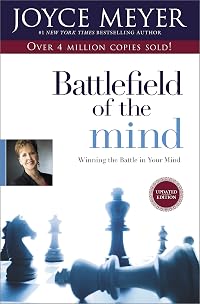
Battlefield of the Mind: Winning the Battle in Your Mind
by Joyce Meyer
On This Page
Description
Explains how people can change their lives by changing the way they think, revealing the impact negative emotions have on mental and physical health and providing strategies to help overcome feelings of anger, worry, doubt, and depression.Tags
Recommendations






Member Reviews
Book 157 - Joyce Meyer - Battlefield of the Mind
Now this was interesting…I have heard many views about this so-called charismatic controversial Christian author. After reading this book…I begin to see why and my worry about this type of book is the almost magic wand approach she gives to prayer and that disturbs me.
With enough prayer…with enough faith…with enough belief all our failings can be solved…just like that.
I’m sorry…but no…life doesn’t work like that…we can’t wish away our wills. We can pray…we can hope…we can continue to strive…but sometimes God says no…sometimes God says yes…sometimes he says…not yet.
I think there is a certain arrogance in this book and I’m sorry to say in the author’s show more rose-tinted glasses…it is just wrong….this book angered me in places..too many places…way too many. I will not be reading any more by her. show less
Now this was interesting…I have heard many views about this so-called charismatic controversial Christian author. After reading this book…I begin to see why and my worry about this type of book is the almost magic wand approach she gives to prayer and that disturbs me.
With enough prayer…with enough faith…with enough belief all our failings can be solved…just like that.
I’m sorry…but no…life doesn’t work like that…we can’t wish away our wills. We can pray…we can hope…we can continue to strive…but sometimes God says no…sometimes God says yes…sometimes he says…not yet.
I think there is a certain arrogance in this book and I’m sorry to say in the author’s show more rose-tinted glasses…it is just wrong….this book angered me in places..too many places…way too many. I will not be reading any more by her. show less
I really needed this book. After the birth of my first child, I suffered from severe post partum depression, and a spiritual element was clearly involved. A close friend of mine loaned me this book, and I couldn't believe what I was reading. Nearly every chapter applied to me, in one way or another. The purpose of this book is very pointed: to help Christians (well, all people, but the concepts in the book are based on Christian principles and beliefs) reclaim their minds from all the lies, attacks, and insecurities that clutter it. The book begins with an introduction to why the mind is so important, what kinds of attacks we are subjected to from the world around us and from the enemy, what problems we ourselves cultivate, and why God show more wants us to reclaim our minds. The next section focuses on common mindsets, and ends with the mind of Jesus. The final section explores ten "wilderness mentalities" which keep us from progressing to the mind of Jesus.
My rating of this book is highly subjective and personal, I freely admit. So many of the verses and ideas in this book were healing for me. God did need to reclaim my mind, it was a clear battlefield, and this book aided in my recuperation. Other factors were definitely at play, but this book was a huge help, even if it was extremely convicting. In fact, I was so pleased with Meyer's God-inspired wisdom that I bought the book to have a copy on hand, should I ever need it again. show less
My rating of this book is highly subjective and personal, I freely admit. So many of the verses and ideas in this book were healing for me. God did need to reclaim my mind, it was a clear battlefield, and this book aided in my recuperation. Other factors were definitely at play, but this book was a huge help, even if it was extremely convicting. In fact, I was so pleased with Meyer's God-inspired wisdom that I bought the book to have a copy on hand, should I ever need it again. show less
It took me a few chapters to get into this book. I am not a fan of Joyce Meyer, and at first the book seemed a bit academic and wordy. But by the third chapter either the author changed her tone or I felt more comfortable with her style, but in any case the rest of the book was surprisingly helpful. I have actually recommended it to a few people.
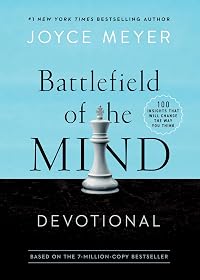
A drawing point for me to this book was that chess pieces were on the front cover. I find it odd that someone chose to have the white king submitted, while the black king stands victorious over him. What is this symbolic of? Before I get lost in this, I'll move on.
Joyce Meyer is either loved or hated, as are many TV evangelists - there are not many inbetweens. I guess I fall inbetween.
This book is very simply written. It is double-spaced and comes in at 278 pages. The bibliography consists of the "Random House Unabridged Dictionary", "Strong's The New Exhaustive Concordance of the Bible", "Vine's An Expository Dictionary of New Testament Words", and "Webster's II New Riverside University Dictionary". "Battle Field of the Mind" has sold show more over 2 million copies. People are essentially simple-minded. Isaac Asimov stated that his objective in writing, was to write as simply as possible, being as clear as possible. Well done then, Joyce, good and faithful servant.
The contents of "Battle Field of the Mind" are broken into three parts: "The Importance of the Mind", "Conditions of the Mind", and "Wilderness Mentalities".
The main message found here is to "think about what you are thinking about". Various scriptures taken from the Amplified Bible, as well as King James, are spread throughout the book, validating Meyer's teachings on the mind.
Though I was not impressed with Joyce's writing style, I appreciated her insights, and her knowledge of the Bible. Certainly, there are things here to think about, and think deeply about.
Confessing not only covers our sin, but also helps us to recognize and analyze where it is that we are habitually falling into sin. Socrates tells us "A life unexamined is not worth living." The writer of Proverbs tells us "For as he thinks in his heart, so is he." By examining our thinking, our minds, we are better able to examine our lives. As Joyce states more than once: "The mind is the battlefield."
All was well with Joyce and I until I came to chapter 10, within which she argues that reason is an abnormal way of thinking, and that reason leads to confusion. I believe she takes Matthew 16.8, James 1:22, Proverbs 3:5, and 1 Corinthians 2:1,2 completely out of context. Paul said he resolved to know nothing among us except Jesus Christ. Without reason, we could not recognize Paul as being paradoxical - he is truly one of the most logical and intellectual writers in the bible! Joyce's book here was written using reason, which, in the image of God, we were gifted with (granted she used a smaller portion of reason in her writing than say, Charles Spurgeon). So, this chapter, in my opinion, needs to be completely trashed and rewritten. Reason is not abnormal thinking. It is a wonderful tool without which we would only have religion.
Myer Pearlman states that "theology literally means 'a treatise or reasoned discourse about God'. Theology, or doctrine, may be described as a science which deals with our knowledge of God and His relations to man. We call theology a science because science is the systematic and logical arrangement of certified facts. Theology consists of facts relating to God and Divine things, presented in an orderly and logical manner.
Religion comes from a Latin word meaning 'to bind'; religion represents those activities which bind man to God in a certain relationship. Theology is knowledge about God. Thus religion is practice, while theology is knowledge. Religion and theology should go together in the balanced experience; but in practice they are sometimes separated so that one may be a theologian without being truly religious and on the other hand one may be truly religious without possessing a systematic knowledge of doctrinal truth. 'If ye know these things, happy are ye if ye do them," is God's message to the theologian. 'Study to shew thyself approved unto God, a workman that needeth not to be ashamed, rightly dividing the word of truth' (2 Tim. 2:15), is God's message for the spiritual man."
Is that not brilliant? Bravo!, Mr. Pearlman, Bravo!
Joyce Meyer, we do not need to fear reason - it will not lead to atheism, unless applied in earnest to atheism (which should then, if the logician is honest, in the very least, lead the atheist to agnosticism).
We are to apply our Godly ratiocination to his Word. I don't know how Joyce reasoned herself into such an unreasonable reasoning of reason. I don't think it's just her. I think that the Body of Christ is terrified of logic, and sees it as cold and terrible. This is why they are called "religious folk".
After Chapter 10 of "Battle Field of the Mind" I truly began to appreciate the depth of Meyer, which at first appearance, to me, seemed shallow. This is the beauty of the book - and the same beauty can be found in the gospel. It seemed to me too, that by the end of the book, Joyce's vocabulary was expanding, and her prose growing sharper (I realize that she has written over 70 published books).
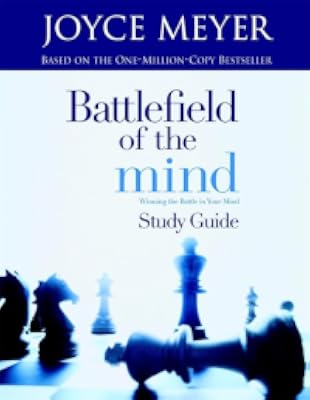
There is a lot of information covered in the book that I'd like to get into. Reading it once seems a shame, therefore, in this case, unlike the cases of many other books, a workbook would be preferable—I'll be keeping my eye out for one.
Joyce points out many historical facts of the bible, including that it was an 11-day journey the Jews had to cross over into the promised land - God kept them in the wilderness for 40 years; in turn, her "Wilderness Mentalities" section was quite insightful. I think her favorite word at the time of writing this was "exhortative" — she used it much. I too enjoyed the little tales of trials in her personal life, and the wisdom she gleaned from them. I hear she is writing fiction now - which I'd be interested in reading.
I might point out another oddity in the book, which I found highly entertaining. In Chapter 15, under "Meditate and Be Healed", Joyce states that:
"My appearance has been changed during the past 18 years. People tell me that I actually look at least 15 years younger today than I did when I first began to diligently study the Word and make it the central focus of my entire life."
It is quite common knowledge now that Joyce Meyer has gone under the knife (I thought she was hotter before, as a friend told me I was the type that would always choose the before pictures on those infomercials, and he's right)... show less
Joyce Meyer is either loved or hated, as are many TV evangelists - there are not many inbetweens. I guess I fall inbetween.
This book is very simply written. It is double-spaced and comes in at 278 pages. The bibliography consists of the "Random House Unabridged Dictionary", "Strong's The New Exhaustive Concordance of the Bible", "Vine's An Expository Dictionary of New Testament Words", and "Webster's II New Riverside University Dictionary". "Battle Field of the Mind" has sold show more over 2 million copies. People are essentially simple-minded. Isaac Asimov stated that his objective in writing, was to write as simply as possible, being as clear as possible. Well done then, Joyce, good and faithful servant.
The contents of "Battle Field of the Mind" are broken into three parts: "The Importance of the Mind", "Conditions of the Mind", and "Wilderness Mentalities".
The main message found here is to "think about what you are thinking about". Various scriptures taken from the Amplified Bible, as well as King James, are spread throughout the book, validating Meyer's teachings on the mind.
Though I was not impressed with Joyce's writing style, I appreciated her insights, and her knowledge of the Bible. Certainly, there are things here to think about, and think deeply about.
Confessing not only covers our sin, but also helps us to recognize and analyze where it is that we are habitually falling into sin. Socrates tells us "A life unexamined is not worth living." The writer of Proverbs tells us "For as he thinks in his heart, so is he." By examining our thinking, our minds, we are better able to examine our lives. As Joyce states more than once: "The mind is the battlefield."
All was well with Joyce and I until I came to chapter 10, within which she argues that reason is an abnormal way of thinking, and that reason leads to confusion. I believe she takes Matthew 16.8, James 1:22, Proverbs 3:5, and 1 Corinthians 2:1,2 completely out of context. Paul said he resolved to know nothing among us except Jesus Christ. Without reason, we could not recognize Paul as being paradoxical - he is truly one of the most logical and intellectual writers in the bible! Joyce's book here was written using reason, which, in the image of God, we were gifted with (granted she used a smaller portion of reason in her writing than say, Charles Spurgeon). So, this chapter, in my opinion, needs to be completely trashed and rewritten. Reason is not abnormal thinking. It is a wonderful tool without which we would only have religion.
Myer Pearlman states that "theology literally means 'a treatise or reasoned discourse about God'. Theology, or doctrine, may be described as a science which deals with our knowledge of God and His relations to man. We call theology a science because science is the systematic and logical arrangement of certified facts. Theology consists of facts relating to God and Divine things, presented in an orderly and logical manner.
Religion comes from a Latin word meaning 'to bind'; religion represents those activities which bind man to God in a certain relationship. Theology is knowledge about God. Thus religion is practice, while theology is knowledge. Religion and theology should go together in the balanced experience; but in practice they are sometimes separated so that one may be a theologian without being truly religious and on the other hand one may be truly religious without possessing a systematic knowledge of doctrinal truth. 'If ye know these things, happy are ye if ye do them," is God's message to the theologian. 'Study to shew thyself approved unto God, a workman that needeth not to be ashamed, rightly dividing the word of truth' (2 Tim. 2:15), is God's message for the spiritual man."
Is that not brilliant? Bravo!, Mr. Pearlman, Bravo!
Joyce Meyer, we do not need to fear reason - it will not lead to atheism, unless applied in earnest to atheism (which should then, if the logician is honest, in the very least, lead the atheist to agnosticism).
We are to apply our Godly ratiocination to his Word. I don't know how Joyce reasoned herself into such an unreasonable reasoning of reason. I don't think it's just her. I think that the Body of Christ is terrified of logic, and sees it as cold and terrible. This is why they are called "religious folk".
After Chapter 10 of "Battle Field of the Mind" I truly began to appreciate the depth of Meyer, which at first appearance, to me, seemed shallow. This is the beauty of the book - and the same beauty can be found in the gospel. It seemed to me too, that by the end of the book, Joyce's vocabulary was expanding, and her prose growing sharper (I realize that she has written over 70 published books).
There is a lot of information covered in the book that I'd like to get into. Reading it once seems a shame, therefore, in this case, unlike the cases of many other books, a workbook would be preferable—I'll be keeping my eye out for one.
Joyce points out many historical facts of the bible, including that it was an 11-day journey the Jews had to cross over into the promised land - God kept them in the wilderness for 40 years; in turn, her "Wilderness Mentalities" section was quite insightful. I think her favorite word at the time of writing this was "exhortative" — she used it much. I too enjoyed the little tales of trials in her personal life, and the wisdom she gleaned from them. I hear she is writing fiction now - which I'd be interested in reading.
I might point out another oddity in the book, which I found highly entertaining. In Chapter 15, under "Meditate and Be Healed", Joyce states that:
"My appearance has been changed during the past 18 years. People tell me that I actually look at least 15 years younger today than I did when I first began to diligently study the Word and make it the central focus of my entire life."
It is quite common knowledge now that Joyce Meyer has gone under the knife (I thought she was hotter before, as a friend told me I was the type that would always choose the before pictures on those infomercials, and he's right)... show less
Even if religious perspective is not your deal there are loads and loads of wisdom in this book. It was simple to read and very fast. I'd recommend it because it did help me be more aware of my thoughts and the downward spirals of negativity that are so easy to drift into. I did not believe the phrase "Happiness is a choice" before but I know it to be true now.
Battlefield of The Mind also reminded me that common sense perhaps is not so common, especially in a stressed life. This is common sense with a Christian face that heals the universal soul.
Battlefield of The Mind also reminded me that common sense perhaps is not so common, especially in a stressed life. This is common sense with a Christian face that heals the universal soul.
This is the first title by Joyce Meyer that I have read. I always enjoy hearing her speak through my local radio station but never thought to read one of her books. I was given this title to create a detailed book discussion for college kids. I divided the book into three sections - #1 The Goal - An Authentic Personal Relationship with God -- #2 The Enemy's (devil's) Playback and #3 Huddle Up to Building an Unstoppable Defense.
Since reading this book, I have been recommending it to as many people as I can - because it applies to everyone no matter what their stage in life. - I only gave it four stars because it was a little wordy in places.
...right thinking has nothing to do with salvation. (p60)
Our minds are not born again with the New show more Birth experience - they have to be renewed (see Romans 12:2)
Keep your mind on God and not the problem. (Psalm 143:3-10)
"If" and "but" are two of the most deceptive words that Satan ever plants in our minds. (p230)
...as long as he refused to face truth, he could not truly repent. And as long as he could not truly repent, God could not forgive him. (p231)
Our actions are a direct result of our thoughts. (p3)
So, our weapons are the Word used in various ways. We can pray the Word, speak the Word, sing the Word, and study the Word...We need spirit weapons because we are fighting master spirits, yes, even the devil himself. (p12)
...we will get from the Word of God what we put into it. (p55) show less
Since reading this book, I have been recommending it to as many people as I can - because it applies to everyone no matter what their stage in life. - I only gave it four stars because it was a little wordy in places.
...right thinking has nothing to do with salvation. (p60)
Our minds are not born again with the New show more Birth experience - they have to be renewed (see Romans 12:2)
Keep your mind on God and not the problem. (Psalm 143:3-10)
"If" and "but" are two of the most deceptive words that Satan ever plants in our minds. (p230)
...as long as he refused to face truth, he could not truly repent. And as long as he could not truly repent, God could not forgive him. (p231)
Our actions are a direct result of our thoughts. (p3)
So, our weapons are the Word used in various ways. We can pray the Word, speak the Word, sing the Word, and study the Word...We need spirit weapons because we are fighting master spirits, yes, even the devil himself. (p12)
...we will get from the Word of God what we put into it. (p55) show less
The general idea of the book is that there are forces at work to take away your joy - the general way that they work is through bad mindsets. Lessons can be learned through the scripture that can set you into a correct mindset.
I found this book incredibly informative and deeply helpful. Just reading the book set me at a greater ease, and I feel that I took a lot out of it. Repeated readings will probably further help me, but in general, I would gladly recommend this book to anyone.
The only annoying part of the book were the annotations to the scripture that Joyce Meyer placed. It made it harder to read at times.
I found this book incredibly informative and deeply helpful. Just reading the book set me at a greater ease, and I feel that I took a lot out of it. Repeated readings will probably further help me, but in general, I would gladly recommend this book to anyone.
The only annoying part of the book were the annotations to the scripture that Joyce Meyer placed. It made it harder to read at times.
Members
- Recently Added By
Author Information

934+ Works 22,963 Members
Pauline Joyce Hutchinson Meyer was born on June 4, 1943 in St.Louis, Missouri. She was briefly a member of Our Savior's Lutheran Church in St Louis. She started leading a Bible class at a local cafeteria and became active in Life Christian Center, a charismatic church. Joyce Meyer received a PhD in theology from Life Christian University in Tampa, show more Florida. She is one of the world's leading practical Bible teachers. She has written over 80 books including The Secret to True Happiness; 100 Ways to Simplify Your Life; the entire Battlefield of the Mind series; and the novel The Penny. She has released thousands of audio teachings, as well as a complete video library. She also has a television and radio program, Enjoying Everyday Life. Her title Do Yourself a Favor... Forgive: Learn How to Take Control of Your Life Through Forgiveness made The New York Times Best Seller List for 2012 and in 2013 her titles Making Good Habits, Breaking Bad Habits and God Is Not Mad at You made The New York Times Best Seller List. You Can Begin Again: No Matter What, It's Never Too Late made The New York Times Best Seller List in 2014. The Mind Connection, published in 2015, is a bestseller. Her current book, Worry-Free Living: Trading Anxiety for Peace, is on the 2016 New York Times Bestsellers List. (Bowker Author Biography) show less
Work Relationships
Is contained in
Common Knowledge
- Original publication date
- 1995; Warner Books Ed., c2000
- Dedication
- I would like to dedicate Battlefield of the Mind to my oldest son, David. I know your personality is enough like mine that you have had your share of struggles in the mental realm. I see you growing continually, and I know ... (show all)that you are experiencing the victories that come from the renewal of the mind. I love you, David, and I am proud of you. Keep pressing on!
- First words
- From this Scripture we see that we are in a war.
- Last words
- (Click to show. Warning: May contain spoilers.)It is my heartfelt prayer that this book will assist you in casting down imaginations, and every high and lofty thing that exalts itself against the knowledge of God, bringing every thought into captivity, into obedience to Jesus
Christ.
Classifications
- Genres
- Religion & Spirituality, Nonfiction, General Nonfiction
- DDC/MDS
- 248.4 — Religion Christian practice & observance Christian experience, practice, life Christian Living
- LCC
- BV4598.4 .M48 — Philosophy, Psychology and Religion Practical Theology Practical Theology Practical religion. The Christian life
- BISAC
Statistics
- Members
- 2,441
- Popularity
- 7,990
- Reviews
- 25
- Rating
- (4.05)
- Languages
- 10 — Afrikaans, Chinese, Dutch, English, Finnish, French, German, Portuguese, Spanish, Swedish
- Media
- Paper, Audiobook, Ebook
- ISBNs
- 49
- UPCs
- 1
- ASINs
- 23