On This Page
Description
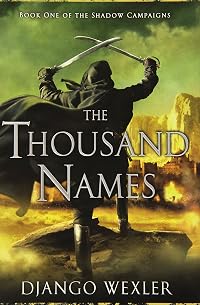
With this stunning series opener, Django Wexler leaps to the upper echelon of today's best fantasy authors. The Thousand Names opens his Shadow Campaigns series with a tale of bloody rebellion that will reshape an empire-and a world. Captain Marcus d'Ivoire and Winter Ihernglass see their fortunes rise under the command of military genius Janus bet Vhalnich. But Janus' obsession with the supernatural portends a dire fate for the realm.Tags
Recommendations




Member Reviews
What would a young Napoleon have done to get his hands on magical weapons?
That’s essentially the question Django Wexler explores in his flintlock fantasy The Thousand Names. But he uses an alternate universe to run his literary simulation.
The story is set in Khandar, an arid colony of the Vordanai empire. A local religious movement known as the Redemption has overthrown the Khandarai prince and chased the Vordanai garrison from the capital. Things look grim for the evicted troops until an eccentric and uncommonly intelligent colonel arrives with orders to crush the rebellion. More covertly, he’s also seeking a Khandarai artifact imbued with arcane power.
The early parts of the novel are light on magic, though. Much of the book reads show more like military fiction, focusing on the campaign the Vordanai wage against the acolytes and allies of the Redemption. Muskets figure heavily into the fighting, as do cannon, cavalry, and Napoleonic-era infantry formations. At times, I felt as if I were revisiting one of Bernard Cornwell’s Richard Sharpe novels. (Not a bad thing!)
I also enjoyed the protagonists. Wexler primarily tells the story through the eyes of two Vordanai officers, one a senior captain and the other a “ranker” on the climb. They’re both easy to root for. So are the majority of the supporting characters.
But I wish we’d gotten more of the Khandarai perspective.
In the book’s acknowledgments, Wexler writes that, “This is not, in any sense, a historical novel. At best it was inspired by history, in the loosest Hollywood sense of the word.” The Thousand Name’s imperial dynamics feel like more than a loose parallel to reality, however. The Vordanai, no matter how sympathetically drawn, are ultimately pale-skinned invaders; the indigenous Khandarai have darker complexions, ranging in hue from “pale ash” to “brown-black.” Given that the colonel is modeled after Napoleon and possesses similar military genius, it makes sense that the Vordanai often have a tactical advantage. Yet some of their victories made me wince; I didn’t always appreciate being expected to cheer for the occupying force. Replacing one of the Vordanai officers with a Khandarai point of view might have complicated the reader’s loyalties in more compelling ways.
To be fair, we do get a few chapters featuring native characters. Wexler also generally depicts the Khandarai as a complex people composed of multiple subcultures and factions. And the Vordanai don’t come off as morally superior; there are plenty of bad apples serving under (and opposing) the colonel. The book isn’t an apology for colonialism—I’d still recommend The Thousand Names to anyone who enjoys historical fantasy with a martial bent.
But the story could have been even better if it were more balanced.
(For more reviews like this one, see www.nickwisseman.com) show less
That’s essentially the question Django Wexler explores in his flintlock fantasy The Thousand Names. But he uses an alternate universe to run his literary simulation.
The story is set in Khandar, an arid colony of the Vordanai empire. A local religious movement known as the Redemption has overthrown the Khandarai prince and chased the Vordanai garrison from the capital. Things look grim for the evicted troops until an eccentric and uncommonly intelligent colonel arrives with orders to crush the rebellion. More covertly, he’s also seeking a Khandarai artifact imbued with arcane power.
The early parts of the novel are light on magic, though. Much of the book reads show more like military fiction, focusing on the campaign the Vordanai wage against the acolytes and allies of the Redemption. Muskets figure heavily into the fighting, as do cannon, cavalry, and Napoleonic-era infantry formations. At times, I felt as if I were revisiting one of Bernard Cornwell’s Richard Sharpe novels. (Not a bad thing!)
I also enjoyed the protagonists. Wexler primarily tells the story through the eyes of two Vordanai officers, one a senior captain and the other a “ranker” on the climb. They’re both easy to root for. So are the majority of the supporting characters.
But I wish we’d gotten more of the Khandarai perspective.
In the book’s acknowledgments, Wexler writes that, “This is not, in any sense, a historical novel. At best it was inspired by history, in the loosest Hollywood sense of the word.” The Thousand Name’s imperial dynamics feel like more than a loose parallel to reality, however. The Vordanai, no matter how sympathetically drawn, are ultimately pale-skinned invaders; the indigenous Khandarai have darker complexions, ranging in hue from “pale ash” to “brown-black.” Given that the colonel is modeled after Napoleon and possesses similar military genius, it makes sense that the Vordanai often have a tactical advantage. Yet some of their victories made me wince; I didn’t always appreciate being expected to cheer for the occupying force. Replacing one of the Vordanai officers with a Khandarai point of view might have complicated the reader’s loyalties in more compelling ways.
To be fair, we do get a few chapters featuring native characters. Wexler also generally depicts the Khandarai as a complex people composed of multiple subcultures and factions. And the Vordanai don’t come off as morally superior; there are plenty of bad apples serving under (and opposing) the colonel. The book isn’t an apology for colonialism—I’d still recommend The Thousand Names to anyone who enjoys historical fantasy with a martial bent.
But the story could have been even better if it were more balanced.
(For more reviews like this one, see www.nickwisseman.com) show less
A really good book is one that, even when you're in abject misery, allows you to completely escape. That's what this one did as I had dental work done this week. I was actually happy to sit there and have a full excuse to read for a prolonged period.
Wexler creates a fantasy world with Napoleonic influences. It's a military with bayonets and muskets, where magic is regarded as a lost or demonic art. The military strategy is sound. The characters are complex, and the governments are not portrayed in clear black or white. What really made this book for me is the character of Winter. I adored her. I've always deeply admired women who bind their breasts and live as men to fight for their country.
I will definitely continue with this series, show more hopefully under more pleasant reading conditions. show less
Wexler creates a fantasy world with Napoleonic influences. It's a military with bayonets and muskets, where magic is regarded as a lost or demonic art. The military strategy is sound. The characters are complex, and the governments are not portrayed in clear black or white. What really made this book for me is the character of Winter. I adored her. I've always deeply admired women who bind their breasts and live as men to fight for their country.
I will definitely continue with this series, show more hopefully under more pleasant reading conditions. show less
Everyone's right: this is great. It's military fantasy set in a replica colonial Egypt, the former of which is not my favourite thing, but the latter of which I dug. However, the simplicity and repetition of the military-campaign plot structure was balanced out for me by the complexity of the characters. We only had a couple of viewpoints, which really enabled us to dig into them deeply and get comfortable with them. (I can't wait to see how they go returning to their demons in the second book.) It's not quite "epic patchwork" fantasy, but there's enough of that going on in the background that I enjoyed it tremendously and am looking forward to more.
Apparently, I love "flintlock fantasy". The phrase, which according to Wikipedia has been around since the 1990s to describe a sub-genre of fantasy "set in a Regency or Napoleonic-era period", admittedly only entered my lexicon just this year. But all this time, I knew deep in my gut that there simply had to be a term out there for this incredible and distinctly unique brand of fantasy with the musket-era setting that I so adore; I just never knew the name for it until now.
There's just something so attractive to me about fantasy inspired by this period, mostly because of the fascinating historical ideas and imagery that immediately come to mind, themes like revolution and war, battles waged with gunpowder weaponry, discovering new show more worlds and colonialism, etc. That's what first drew me to Django Wexler's The Thousand Names. Just the first sentence in the blurb was enough to make me add this to my must-read list, and the positive reviews it received only made me bump it up to the top.
The book is mostly told through the perspectives of two soldiers, assigned to a sleepy desert colonial fort out in the fringes of the Vordanai empire. However, a recent uprising and subsequent takeover of the city of Ashe-Katarion by a local sect called the Redeemers has resulted in the outpost not being so sleepy anymore. Now the king of Vordan has sent reinforcements, and Captain Marcus d'Ivoire finds himself welcoming a whole new garrison of inexperienced recruits to join his Old Colonial troops. Then there's Winter Ihernglass, a low ranking soldier who unexpectedly earns a promotion and comes into command -- except getting more attention is the last thing Winter wants, given the fact she is actually a woman who masqueraded as a man in order to enlist and flee her past.
With the Colonials on the march to take back the city, both Marcus' and Winter's lives are in the hands of the newly arrived Colonel Janus bet Vhalnich, a military genius whose demeanor and tactics are unlike anything anyone has ever seen before. But despite the confidence and aptitude Janus exudes, it soon becomes clear there is a lot more to the mysterious commander. Marcus begins to suspect that his colonel's objectives -- and ambitions -- may extend beyond simply defeating the Redeemers, encroaching into the realm of magic and the supernatural.
My experience with this book pretty much played out like a fast-paced and passionate relationship. The Thousand Names practically came out of nowhere for me; I'd probably only heard about it around a month before its release, leaving me not much time to anticipate it. Nevertheless, I went into this with higher-than-high expectations, and ultimately I have to say even those were met and exceeded. I fell in love with this book really quickly, probably within the first few chapters, especially after the two main characters were established. This might make me sound silly, but I won't deny after turning the last page I actually couldn't help but feel slightly lost and a bit melancholy, finding myself caught in a sort of "oh crap, I'm finished, what the heck do I do with myself now?" kind of fugue. I was just that addicted to this book.
Obviously, I loved the setting and the world-building. The writing had a way of putting you right there with the colonial garrison, so it wasn't hard to sympathize with the characters and the foreignness of their situation or the awkwardness of being strangers in a strange land. I was also fascinated with the idea of this ragtag colonial army that's made up of one-part green recruits and one-part jaded-and-couldn't-care-less old veterans, and all the rules of warfare go out the window. The Redeemer forces may vastly outnumber the Vordanai, but the fact that the former is made up of mostly militia and over-confident Auxiliary troops gave their clashes plenty of suspense, and the detailed battle scenes in the desert are worthy of any military fantasy.
But the highlight of this book had to be the characters. I absolutely adored Winter; she was probably my favorite character, but Marcus wasn't far behind either. What's great about these two characters is that they feel deep and real, and are immediately the kind of people you want to like and to see succeed. Beyond that, everyone in this book also has secrets and mysteries, and so you just want to keep reading to find out more.
This even applies to the supporting cast. Most of them are pretty well fleshed out too, and I think the fact that Colonel Janus is my second favorite character in this book despite him not being a point-of-view character is a testament to that. The author also focuses briefly here and there on Jaffa, a character inside the city of Ashe-Katarion, giving insights into what's happening on the side of the Redeemers. I felt this was important, as it gives us a look at the opposition, or else it's easy just to think of them as a faceless enemy army.
All told, this book was hard to put down. For its length, I finished it in really good time, and it was one of those rare gems where I knew it would go straight onto my shelf of favorites even before I had reached the quarter-way point. Easily one of the best books I've read this year so far. show less
There's just something so attractive to me about fantasy inspired by this period, mostly because of the fascinating historical ideas and imagery that immediately come to mind, themes like revolution and war, battles waged with gunpowder weaponry, discovering new show more worlds and colonialism, etc. That's what first drew me to Django Wexler's The Thousand Names. Just the first sentence in the blurb was enough to make me add this to my must-read list, and the positive reviews it received only made me bump it up to the top.
The book is mostly told through the perspectives of two soldiers, assigned to a sleepy desert colonial fort out in the fringes of the Vordanai empire. However, a recent uprising and subsequent takeover of the city of Ashe-Katarion by a local sect called the Redeemers has resulted in the outpost not being so sleepy anymore. Now the king of Vordan has sent reinforcements, and Captain Marcus d'Ivoire finds himself welcoming a whole new garrison of inexperienced recruits to join his Old Colonial troops. Then there's Winter Ihernglass, a low ranking soldier who unexpectedly earns a promotion and comes into command -- except getting more attention is the last thing Winter wants, given the fact she is actually a woman who masqueraded as a man in order to enlist and flee her past.
With the Colonials on the march to take back the city, both Marcus' and Winter's lives are in the hands of the newly arrived Colonel Janus bet Vhalnich, a military genius whose demeanor and tactics are unlike anything anyone has ever seen before. But despite the confidence and aptitude Janus exudes, it soon becomes clear there is a lot more to the mysterious commander. Marcus begins to suspect that his colonel's objectives -- and ambitions -- may extend beyond simply defeating the Redeemers, encroaching into the realm of magic and the supernatural.
My experience with this book pretty much played out like a fast-paced and passionate relationship. The Thousand Names practically came out of nowhere for me; I'd probably only heard about it around a month before its release, leaving me not much time to anticipate it. Nevertheless, I went into this with higher-than-high expectations, and ultimately I have to say even those were met and exceeded. I fell in love with this book really quickly, probably within the first few chapters, especially after the two main characters were established. This might make me sound silly, but I won't deny after turning the last page I actually couldn't help but feel slightly lost and a bit melancholy, finding myself caught in a sort of "oh crap, I'm finished, what the heck do I do with myself now?" kind of fugue. I was just that addicted to this book.
Obviously, I loved the setting and the world-building. The writing had a way of putting you right there with the colonial garrison, so it wasn't hard to sympathize with the characters and the foreignness of their situation or the awkwardness of being strangers in a strange land. I was also fascinated with the idea of this ragtag colonial army that's made up of one-part green recruits and one-part jaded-and-couldn't-care-less old veterans, and all the rules of warfare go out the window. The Redeemer forces may vastly outnumber the Vordanai, but the fact that the former is made up of mostly militia and over-confident Auxiliary troops gave their clashes plenty of suspense, and the detailed battle scenes in the desert are worthy of any military fantasy.
But the highlight of this book had to be the characters. I absolutely adored Winter; she was probably my favorite character, but Marcus wasn't far behind either. What's great about these two characters is that they feel deep and real, and are immediately the kind of people you want to like and to see succeed. Beyond that, everyone in this book also has secrets and mysteries, and so you just want to keep reading to find out more.
This even applies to the supporting cast. Most of them are pretty well fleshed out too, and I think the fact that Colonel Janus is my second favorite character in this book despite him not being a point-of-view character is a testament to that. The author also focuses briefly here and there on Jaffa, a character inside the city of Ashe-Katarion, giving insights into what's happening on the side of the Redeemers. I felt this was important, as it gives us a look at the opposition, or else it's easy just to think of them as a faceless enemy army.
All told, this book was hard to put down. For its length, I finished it in really good time, and it was one of those rare gems where I knew it would go straight onto my shelf of favorites even before I had reached the quarter-way point. Easily one of the best books I've read this year so far. show less
I read this book in 2013 and remembered only a whiff of 1 non-essential side discussion. Which is why, fresh from reading it I cannot give it more than 3/5 where if I had reviewed it in 2013 I might have ranked it as high as 4/5 but 3.5 is more likely. While some scenes are absorbing and Wexler keeps the battles fairly brief, I was too often wanting the current bit to finish up to get to the more interesting stuff. The characters aren't bad, but not quite top notch, the most interesting being Colonel Janus. Winter, the woman in disguise as a soldier never convinces me, but isn't otherwise annoying.
The Thousand Names is the first book in a fantasy series by Django Wexler, The Shadow Campaigns. It’s set in a fictional world with both gunpowder and magic. Flintlock fantasy is the term for it, but I was only vaguely familiar with that term before reading this. I can’t (yet) speak for the rest of the series, but this book focuses heavily on military action while the magic only makes an occasional appearance. Most of the characters don’t really believe in magic.
When the book begins, the foreign Vordanai army that has been occupying Ashe-Katarion, along with the rightful local prince, have been forced to retreat to an isolated fort after being run out of the city by a rebel faction. Fresh troops arrive by ship, but everybody who show more was already there expects to be taken home as soon as the new arrivals realize how hopelessly outnumbered they are. Instead, the newly arrived Colonel Janus seems to be mad enough to think they can actually retake the city.
The story is mostly told from the POV of two members of the Vordanai army: Marcus, the senior captain, and Winter, a woman who escaped a bad situation by pretending to be a man and joining the army. The characters are pretty well-developed and likeable. Marcus is a bit typical maybe, the “noble, loyal fighter guy who always tries to do the right thing”, but I have a soft spot for that character type. Winter took a chapter or two to grow on me, but her side of the story quickly engrossed me. Colonel Janus was also a fun character with a bit of ambiguity; I enjoyed it whenever he showed up in a scene.
I haven't read a lot of military-based fiction. When I do run across it, I can go either way with it. Sometimes I really like it, and sometimes I find it repetitive and tedious. This was a case where I really liked it. The action was written well. I easily visualized what was happening and usually felt the tension of the moment along with the characters. The story focused on the characters even during the action, so that helped keep things interesting. There isn't a ton of humor in this book, but there is some and I enjoyed what was there.
I would have liked the political backdrop and the magic system to have both been fleshed out a little better, but we do get enough pieces by the end to put together a pretty solid picture and I expect there will be more development in those areas as the series progresses.
This first book told a complete story without any cliff hangers, although there is clearly more story to be told about what will happen next. I enjoyed this and plan to continue straight on to the next book. show less
When the book begins, the foreign Vordanai army that has been occupying Ashe-Katarion, along with the rightful local prince, have been forced to retreat to an isolated fort after being run out of the city by a rebel faction. Fresh troops arrive by ship, but everybody who show more was already there expects to be taken home as soon as the new arrivals realize how hopelessly outnumbered they are. Instead, the newly arrived Colonel Janus seems to be mad enough to think they can actually retake the city.
The story is mostly told from the POV of two members of the Vordanai army: Marcus, the senior captain, and Winter, a woman who escaped a bad situation by pretending to be a man and joining the army. The characters are pretty well-developed and likeable. Marcus is a bit typical maybe, the “noble, loyal fighter guy who always tries to do the right thing”, but I have a soft spot for that character type. Winter took a chapter or two to grow on me, but her side of the story quickly engrossed me. Colonel Janus was also a fun character with a bit of ambiguity; I enjoyed it whenever he showed up in a scene.
I haven't read a lot of military-based fiction. When I do run across it, I can go either way with it. Sometimes I really like it, and sometimes I find it repetitive and tedious. This was a case where I really liked it. The action was written well. I easily visualized what was happening and usually felt the tension of the moment along with the characters. The story focused on the characters even during the action, so that helped keep things interesting. There isn't a ton of humor in this book, but there is some and I enjoyed what was there.
I would have liked the political backdrop and the magic system to have both been fleshed out a little better, but we do get enough pieces by the end to put together a pretty solid picture and I expect there will be more development in those areas as the series progresses.
This first book told a complete story without any cliff hangers, although there is clearly more story to be told about what will happen next. I enjoyed this and plan to continue straight on to the next book. show less
almost non stop-action of various kinds, memorable characters (the colonel and Winter), some nice, original magic ideas (I loved the idea behind the last magic confrontation), good, fast writing style, good twists (great even, towards the end), never boring, always catchy.
The world is very well shaped - a fantasy mixture of the French colonial wars in Algeria with the French (Napoleon) campaign to Egypt (Khandarai here), with hints of a France similar to that in the Dumas novels (kind of a Richelieu against the interests of the king, in this book only suggested, perhaps developed in the sequels). It is not actually a gunpowder fantasy, but a gunpowder novel with added fantasy elements - and a captivating one at that.
The opposite of many show more other reviewers here on GR, I absolutely loved the first 2 thirds of the book, which could be summarized as march-battle-march-battle and so on, or manly men doing manly stuff while being soldierly and, well, very manly, and also some women doing... manly stuff? I did not enjoy that much the last third, an Indiana Jones style adventure with a tint of YA for girls - but it compensated with some good twists. So this volume is 2/3 military fantasy and 1/3 adventure fantasy (actually the fantasy elements are quite low, generally).
In the military part, the author proves a very good understanding of tactics (though also some typical civilian misunderstanding of the actual military life, even hilariously wrong - like the trick pulled by Winter on the training field - it could not have worked, since the second officer was NOT in her chain of command) - helped by enemies that oblige to mostly be dumb and tactically ridiculous (which is not a mistake, there were plenty of such examples in wars). The battles themselves are very captivating and exhilarating - great reads, congrats on that! (since battles are very hard to describe realistically, I could only think at Abercrombie as another author that gets those right).
To summarize: a very entertaining read, having no flaws as a fantasy (just a few as a military, but even those only noticeable to actual military readers) - I look forward to read the rest of the series! Also, one of the very few books that provided me with a believable ”strong woman” character that I actually ended up rooting for - congrats on that, too!
Bonus: you could get a taste of the Shadow Campaigns universe with a free story available here:
https://io9.gizmodo.com/the-coolest-fantasy-story-youll-read-this-week-514117561
No gunpowder or military fantasy there, but at least 3 major characters from the books. show less
The world is very well shaped - a fantasy mixture of the French colonial wars in Algeria with the French (Napoleon) campaign to Egypt (Khandarai here), with hints of a France similar to that in the Dumas novels (kind of a Richelieu against the interests of the king, in this book only suggested, perhaps developed in the sequels). It is not actually a gunpowder fantasy, but a gunpowder novel with added fantasy elements - and a captivating one at that.
The opposite of many show more other reviewers here on GR, I absolutely loved the first 2 thirds of the book, which could be summarized as march-battle-march-battle and so on, or manly men doing manly stuff while being soldierly and, well, very manly, and also some women doing... manly stuff? I did not enjoy that much the last third, an Indiana Jones style adventure with a tint of YA for girls - but it compensated with some good twists. So this volume is 2/3 military fantasy and 1/3 adventure fantasy (actually the fantasy elements are quite low, generally).
In the military part, the author proves a very good understanding of tactics (though also some typical civilian misunderstanding of the actual military life, even hilariously wrong - like the trick pulled by Winter on the training field - it could not have worked, since the second officer was NOT in her chain of command) - helped by enemies that oblige to mostly be dumb and tactically ridiculous (which is not a mistake, there were plenty of such examples in wars). The battles themselves are very captivating and exhilarating - great reads, congrats on that! (since battles are very hard to describe realistically, I could only think at Abercrombie as another author that gets those right).
To summarize: a very entertaining read, having no flaws as a fantasy (just a few as a military, but even those only noticeable to actual military readers) - I look forward to read the rest of the series! Also, one of the very few books that provided me with a believable ”strong woman” character that I actually ended up rooting for - congrats on that, too!
Bonus: you could get a taste of the Shadow Campaigns universe with a free story available here:
https://io9.gizmodo.com/the-coolest-fantasy-story-youll-read-this-week-514117561
No gunpowder or military fantasy there, but at least 3 major characters from the books. show less
Members
- Recently Added By
Lists

LGBTQ+ Speculative Fiction
821 works; 51 members

Read-alike - Year one by Nora Roberts
19 works; 1 member

Reading Glasses Podcast
410 works; 3 members
Author Information

36+ Works 6,169 Members
Some Editions
Awards and Honors
Notable Lists
Series

Belongs to Publisher Series
Science Fiction Book Club (1377521)
Common Knowledge
- Canonical title
- The Thousand Names
- Original title
- The Thousand Names
- Original publication date
- 2013-07-02
- People/Characters
- Marcus d'Ivoire; Winter Ihernglass; Janus bet Vhalnich Mieran
- Important places
- Khandar
- Dedication
- For Rachel and Stanley, who believed
- First words
- Prologue
The new supreme rulers of Khandar met in the old common room of the Justices, the cudgel-bearing peacekeepers and constabulary who were now the closest thing the city of Ashe-Katarion had to a civil a... (show all)uthority. - Last words
- (Click to show. Warning: May contain spoilers.)"First," she said, "you must find us a ship."
- Blurbers
- Anderson, Taylor; Stirling, S.M.
Classifications
Statistics
- Members
- 1,167
- Popularity
- 21,502
- Reviews
- 49
- Rating
- (3.85)
- Languages
- 7 — English, French, German, Hungarian, Italian, Polish, Russian
- Media
- Paper, Audiobook, Ebook
- ISBNs
- 16
- ASINs
- 6