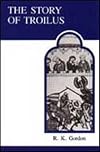
The Story of Troilus
by R. K. Gordon (Editor)
On This Page
Description
Originally published by J.M. Dent and Sons Ltd., 1934. In this volume Gordon presents the four great medieval versions of the love of Troilus and Criseida: Benoît de Sainte-Maure's Roman de Troie, written in approximately 1160 and the earliest surviving version of the story; Giovanni Boccaccio's It Filostrato (c 1338), which drew on Benoît's tale for one of its two main sources; Georffrey Chaucer's Troilus and Criseyde c 1385), for centuries considered his best work; and Robert Henryson's show more Testament of Cresseid (c 1490), which functions as a continuation of the story Chaucer tells. show lessTags
Recommendations
























Member Reviews
A very convenient compendium of Benoit de Sainte-Maure, Boccaccio, Chaucer, and Henryson. The glossing of Chaucer and Henryson is inconveniently in the rear of the book rather than marginal or bottom-of-the-page, but some teachers using the book for academic reading may prefer that students "guess" at the vocabulary from context. Henryson's Middle Scots (a lowlands dialect of English, in contrast with the Gaelic of the highlands) is, incidentally, really no more difficult reading than Shakespeare's Early Modern English.
Another reviewer considers these works to be useful comparisons with Chaucer. Personally, I consider Henryson's Testament a particularly valuable work in its own right (and so must have Seamus Heaney, who translated The show more Testament of Cresseid and Seven Fables). Henryson is particularly intriguing for his use of astrological imagery, and his portrayal of Cresseid as a whore is an interesting transition from Chaucer to Shakespeare. show less
Another reviewer considers these works to be useful comparisons with Chaucer. Personally, I consider Henryson's Testament a particularly valuable work in its own right (and so must have Seamus Heaney, who translated The show more Testament of Cresseid and Seven Fables). Henryson is particularly intriguing for his use of astrological imagery, and his portrayal of Cresseid as a whore is an interesting transition from Chaucer to Shakespeare. show less
An anthology assembled for teaching by R. K. Gordon. The tale is present in 3 versions, and a poem by a scots poet, Robert Henryson is included as an example of using such a story for a sermon in verse. The Earliest version is by Benoit de Sainte-Maure run up about 1160, and the other versions are an Italian version by Boccaccio and the longest is a Middle English poem by Chaucer in the 1380's.
Useful for giving texts of several different versions of the story
to compare with Chaucer
to compare with Chaucer
Ratings
Members
- Recently Added By
Author Information

Some Editions
Series
Belongs to Publisher Series
Work Relationships
Contains
Common Knowledge
- Canonical title
- The Story of Troilus
- People/Characters
- Troilus; Cressida; Pandar; Benoît de Sainte-Maure; Giovanni Boccaccio; Geoffrey Chaucer (show all 7); Robert Henryson
- Important places
- Troy
- First words
- High on iron pillars in Chaucer's House of Fame stand those who bear up the story of Troy: Homer, Dares, Dictys, Lollius, Guido, Geoffrey of Monmouth, and Virgil.
Classifications
Statistics
- Members
- 105
- Popularity
- 307,029
- Reviews
- 3
- Rating
- (3.81)
- Languages
- English
- Media
- Paper
- ISBNs
- 1
- ASINs
- 5