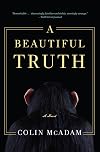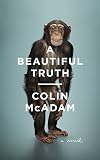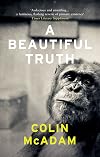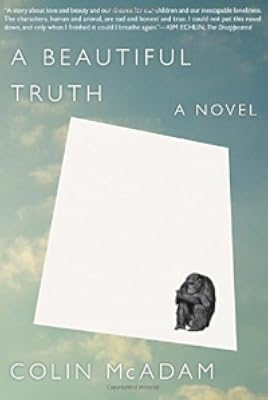
A Beautiful Truth
by Colin McAdam
On This Page
Description
"Told simultaneously from the perspective of humans and chimpanzees, set in a Vermont home and a Florida primate research facility, A Beautiful Truth--at times brutal, other times deeply moving--is about the simple truths that transcend species, the meaning of family, the lure of belonging, and the capacity for survival. A powerful and haunting meditation on human nature told from the dual perspectives of a Vermont family that has adopted a chimp as a surrogate son, and a group of show more chimpanzees in a Florida research institute. Looee, a chimp raised by a well-meaning and compassionate human couple who cannot conceive a baby of their own, is forever set apart. He's not human, but with his peculiar upbringing he is no longer like other chimps. One tragic night Looee's two natures collide and their unique family is forever changed. At the Girdish Institute in Florida, a group of chimpanzees has been studied for decades. The work at Girdish has proven that chimps have memories and solve problems, that they can learn language and need friends, and that they build complex cultures. They are political, altruistic, get angry, and forgive. When Looee is moved to the Institute, he is forced to try to find a place in their world. A Beautiful Truth is an epic and heartfelt story about parenthood, friendship, loneliness, fear and conflict, about the things we hold sacred as humans and how much we have in common with our animal relatives. A novel of great heart and wisdom from a literary master, it exposes the yearnings, cruelty, and resilience of all great apes"-- "A powerful and haunting meditation on human nature told from the dual perspectives of a Vermont family that has adopted a chimp as a surrogate son, and a group of chimpanzees in a Florida research institute. Looee, a chimp raised by a well-meaning and compassionate human couple who cannot conceive a baby of their own, is forever set apart. He's not human, but with his peculiar upbringing he is no longer like other chimps. One tragic night Looee's two natures collide and their unique family is forever changed. At the Girdish Institute in Florida, a group of chimpanzees has been studied for decades. The work at Girdish has proven that chimps have memories and solve problems, that they can learn language and need friends, and that they build complex cultures. They are political, altruistic, get angry, and forgive. When Looee is moved to the Institute, he is forced to try to find a place in their world. A Beautiful Truth is an epic and heartfelt story about parenthood, friendship, loneliness, fear and conflict, about the things we hold sacred as humans and how much we have in common with our animal relatives. A novel of great heart and wisdom from a literary master, it exposes the yearnings, cruelty, and resilience of all great apes"-- show lessTags
Recommendations














Member Recommendations
fountainoverflows Though a young adult story, the writing is superior, the story compelling and provocative. Read it; I think you'll find more beautiful truth there by a long shot.
Member Reviews
Looee, a chimp raised by a well-meaning and compassionate human couple who cannot conceive a baby of their own, is forever set apart. He's not human, but with his peculiar upbringing he is no longer like other chimps. One tragic night Looee's two natures collide and their unique family is forever changed. At the Girdish Institute in Florida, a group of chimpanzees has been studied for decades. The work at Girdish has proven that chimps have memories and solve problems, that they can learn language and need friends, and that they build complex cultures. They are political, altruistic, get angry, and forgive. When Looee is moved to the Institute, he is forced to try to find a place in their world. " A Beautiful Truth " exposes the show more yearnings, cruelty, and resilience of all great apes. Summary HPL
Having listened to the audiobook version and then read the hard copy, I would have to say that only the audio can deliver the full impact of A BEAUTIFUL TRUTH. McAdam, like Hemingway, fills the white space between the period of one sentence and the capital of the next--with meaning, intent, shifts of mood and unspoken thoughts. I needed the narrator's brief pauses to cue me to the elisions of a story not found in print.
As it narrates the life of the chimpanzee, Looee, A BEAUTIFUL TRUTH reins in the storytelling with a taut, stringy syntax. Terse and unemotional, again like Hemingway and featuring more scientific data than is usually found in a novel.
I think McAdam wants the reader to recognize him/herself in the apes' behaviour and to realize that human society is founded on ape society. We still follow the same rules: the strongest/most powerful gets the food, the girls and the territory; when the alpha weakens, we are there to take his/her place. But if I've made A BEAUTIFUL TRUTH sound like a treatise, you have only to read the quote posted earlier. It is humorous, poignant, at times painful and sad, but masterfully told.
It would be interesting for a book club to read and discuss A BEAUTIFUL TRUTH and WE ARE ALL COMPLETELY BESIDE OURSELVES.
8 out 10 Highly recommended to readers interested in animals and their rights, and to fans of good writing. show less
Having listened to the audiobook version and then read the hard copy, I would have to say that only the audio can deliver the full impact of A BEAUTIFUL TRUTH. McAdam, like Hemingway, fills the white space between the period of one sentence and the capital of the next--with meaning, intent, shifts of mood and unspoken thoughts. I needed the narrator's brief pauses to cue me to the elisions of a story not found in print.
As it narrates the life of the chimpanzee, Looee, A BEAUTIFUL TRUTH reins in the storytelling with a taut, stringy syntax. Terse and unemotional, again like Hemingway and featuring more scientific data than is usually found in a novel.
I think McAdam wants the reader to recognize him/herself in the apes' behaviour and to realize that human society is founded on ape society. We still follow the same rules: the strongest/most powerful gets the food, the girls and the territory; when the alpha weakens, we are there to take his/her place. But if I've made A BEAUTIFUL TRUTH sound like a treatise, you have only to read the quote posted earlier. It is humorous, poignant, at times painful and sad, but masterfully told.
It would be interesting for a book club to read and discuss A BEAUTIFUL TRUTH and WE ARE ALL COMPLETELY BESIDE OURSELVES.
8 out 10 Highly recommended to readers interested in animals and their rights, and to fans of good writing. show less
“A Beautiful Truth,” by Colin McAdam, is an entirely unique fictional experience: it is a poignant literary character study and an uplifting tale of redemption…but the character at the heart of this story is not a human, he is Looee, a chimpanzee. The author takes extraordinary pains not to indulge in anthropomorphisms. In fact, this is the farthest thing imaginable from a genre animal story! Instead, McAdam strives to force the reader to experience life through Looee’s eyes in a completely authentic fashion. By repeatedly interspersing chapters throughout the book told from the point of view of other individual chimpanzees in a group that Looee eventually becomes part of, we get to learn more about, and intimately experience, show more chimpanzee social culture…albeit in a captive group setting under the watchful eye of primate psychological and social research experts. In the end, we, the readers are transformed by our experience living with and through Looee’s mind as well as the minds of these other chimpanzees.
The book covers 28 years in Looee’s life. We follow him from his traumatic capture as an infant in Africa; through the first 14 years of his life in Vermont being raised like a human child by an affluent childless couple; and eventually, through another 14 years as property of the Florida-based Girdish Institute, a scientific primate research facility. Midway through the two halves of Looee’s life—as a fully-grown, 180-pound adult, with extraordinary chimpanzee strength—we witness him do something horrifically violent. What he does is so terrible, it causes his human parents to send him away to the Institute in Florida rather than have him euthanized. At the Institute, Looee endures extreme pain and suffering as a research subject leased out for various pharmaceutical studies. Finally, when funding for medical research using primates dissolves, Looee is transferred to a psychological research study within the same facility. In this new phase of Looee’s life, we observed him being slowly introduced and absorbed into the same group of chimpanzees that we have been reading about in interspersed chapters since the beginning of the book. These chimpanzees, although captive, live with minimal interference from human researchers and caretakers. They are part of a psychological experiment to learn more about chimpanzee behavior and society. In their company, Looee finally learns what it means to let the chimpanzee part of his character develop. Eventually, we readers discover resolution and understanding about Looee’s horrific crimes in Vermont…it is poignantly problematic whether or not Looee has the mental capacity to understand his own redemption and overcome his long lingering guilt.
So, did I like this book? Was I happy that I read it? Frankly, the answer is no, I did not like this book, but I am very happy I read it. I hope I can help you understand that contradiction with a few a few more brief paragraphs.
First, let me say that this was an extraordinarily difficult, often unpleasant, and sometimes tedious book to read. It was never compelling, but always fascinating. Why do I say these things? Oh my! I could write many pages of reasons, but I do’nt have that kind of space in this review.
This is an odd work of (dare I say, experimental) literature by an author who loves to put words together in an unusual fashion for special effect. Often, I had no idea what effect he was trying to elicit. [Overall and in retrospect, the effect was beautiful, but in the moment, the effect was frustrating.] In this book, he ignores some of the regular rules of grammar and punctuation; this interferes with understanding and makes the book difficult to comprehend. [But in his defense, it also forces the reader to reassess the lack of differences between human and simian characters.] I was constantly annoyed by my inability to understand fully what was being communicated on each page. I trudged through the book, reading it carefully and closely, but only comprehending about 90%. I found that annoying and unsettling. [But again, in defense of the author, isn’t that what I’d be feeling if I were a scientific researcher watching a group of chimpanzees and trying to understand their individual and group behavior? And, would’nt it be tedious doing all that observing?] The author invented many words for his simian character; he explains none of them. Readers must infer their meaning from the text and action. I was successful in figuring out only 50% of them.
It is obvious that the author has done a great deal of scientific reading, observations, and consulting with chimpanzee behavioral experts and other research personnel. I am a polymath who loves science as much as literature, I’ve read books by most of the expert primatologists he mentions in his acknowledgements and many others he has not mentioned. I’ve always been keenly curious about primate behavior and have probably read more nonfiction and fiction books about this particular subject than most readers. That being said, I believe this book achieves what it sets out to do and I applaud the author for his vision. [I just wish the author had achieved his goal by writing a more pleasant and less frustrating book.]
Obviously, this book will not appeal to the general reading public. But, I definitely recommend it to any serious reader who wants to take on the challenge, unique beauty, and frustration of reading it. For me, the book was a transformative experience. If you are interested in animal rights, chimpanzee social and psychological behavior, or experimental literary fiction, this may be your book. show less
The book covers 28 years in Looee’s life. We follow him from his traumatic capture as an infant in Africa; through the first 14 years of his life in Vermont being raised like a human child by an affluent childless couple; and eventually, through another 14 years as property of the Florida-based Girdish Institute, a scientific primate research facility. Midway through the two halves of Looee’s life—as a fully-grown, 180-pound adult, with extraordinary chimpanzee strength—we witness him do something horrifically violent. What he does is so terrible, it causes his human parents to send him away to the Institute in Florida rather than have him euthanized. At the Institute, Looee endures extreme pain and suffering as a research subject leased out for various pharmaceutical studies. Finally, when funding for medical research using primates dissolves, Looee is transferred to a psychological research study within the same facility. In this new phase of Looee’s life, we observed him being slowly introduced and absorbed into the same group of chimpanzees that we have been reading about in interspersed chapters since the beginning of the book. These chimpanzees, although captive, live with minimal interference from human researchers and caretakers. They are part of a psychological experiment to learn more about chimpanzee behavior and society. In their company, Looee finally learns what it means to let the chimpanzee part of his character develop. Eventually, we readers discover resolution and understanding about Looee’s horrific crimes in Vermont…it is poignantly problematic whether or not Looee has the mental capacity to understand his own redemption and overcome his long lingering guilt.
So, did I like this book? Was I happy that I read it? Frankly, the answer is no, I did not like this book, but I am very happy I read it. I hope I can help you understand that contradiction with a few a few more brief paragraphs.
First, let me say that this was an extraordinarily difficult, often unpleasant, and sometimes tedious book to read. It was never compelling, but always fascinating. Why do I say these things? Oh my! I could write many pages of reasons, but I do’nt have that kind of space in this review.
This is an odd work of (dare I say, experimental) literature by an author who loves to put words together in an unusual fashion for special effect. Often, I had no idea what effect he was trying to elicit. [Overall and in retrospect, the effect was beautiful, but in the moment, the effect was frustrating.] In this book, he ignores some of the regular rules of grammar and punctuation; this interferes with understanding and makes the book difficult to comprehend. [But in his defense, it also forces the reader to reassess the lack of differences between human and simian characters.] I was constantly annoyed by my inability to understand fully what was being communicated on each page. I trudged through the book, reading it carefully and closely, but only comprehending about 90%. I found that annoying and unsettling. [But again, in defense of the author, isn’t that what I’d be feeling if I were a scientific researcher watching a group of chimpanzees and trying to understand their individual and group behavior? And, would’nt it be tedious doing all that observing?] The author invented many words for his simian character; he explains none of them. Readers must infer their meaning from the text and action. I was successful in figuring out only 50% of them.
It is obvious that the author has done a great deal of scientific reading, observations, and consulting with chimpanzee behavioral experts and other research personnel. I am a polymath who loves science as much as literature, I’ve read books by most of the expert primatologists he mentions in his acknowledgements and many others he has not mentioned. I’ve always been keenly curious about primate behavior and have probably read more nonfiction and fiction books about this particular subject than most readers. That being said, I believe this book achieves what it sets out to do and I applaud the author for his vision. [I just wish the author had achieved his goal by writing a more pleasant and less frustrating book.]
Obviously, this book will not appeal to the general reading public. But, I definitely recommend it to any serious reader who wants to take on the challenge, unique beauty, and frustration of reading it. For me, the book was a transformative experience. If you are interested in animal rights, chimpanzee social and psychological behavior, or experimental literary fiction, this may be your book. show less
I received an advanced copy of A Beautiful Truth by Colin McAdam and I've recently finished reading it. While I've never heard of Colin McAdam before now, I am adding his other novels to my never-ending list of books I need to read. McAdam is the author of two other novels: Fall and Some Great Thing (a finalist for the 2004 Governor General's Literary Award For Fiction). This is an author who can tell a story so riveting that you'll never want to put the book down!
A Beautiful Truth is a wonderful story about a couple who adopts a young chimpanzee after finding out that they are unable to have children. Told in alternating points of view, A Beautiful Truth is about a chimpanzee named Looee's life as an adopted son and as a member of the show more Girdish Institute, where he eventually ends up after a devastating incident.
McAdam uses both human and chimpanzee perspectives, managing to capture a realistic experience of the chimps in a human world, as well as their humanlike existence both in a family setting and in a scientific facility. I was touched by the story and quickly fell in love with Looee, whose love for his parents and his struggle to fit into a human world is both tragic and heartwarming. McAdam does a wonderful job of writing the narratives of the chimps; it feels very primal and realistic.
The book does contain some violence and has a graphic nature, but these scenes are so important to the readers' understanding of the chimpanzees that the shock factor of some of the scenes and horrifying treatment of the chimps at Girdish does not detract from the narrative. Animal lovers will find this book illuminating and interesting, sad, but also beautiful and heartwarming. The narrative pulls you into the complicated lives of these intelligent creatures and explores the love between family and friends, and human and beast. The book feels well-researched and is [without question] well-written.
My only complaint is that I wanted a little more closure on the lives of Walt and Judy (Looee's adoptive human parents) after Looee is moved to Girdish. I really enjoyed reading this book from Penguin Canada and I strongly recommend that you pick up a copy come March 19th! McAdam's novel is different from a lot of animal-centered stories and is unique in its narrative and plot. It's edgy, captivating, and insightful. This is truly a reading experience that you do not want to miss.
A Beautiful Truth is a story about beautiful, yet sometimes uncomfortable truths about the relationship between humans and chimps; how we're different, how we're the same, and how we both crave love, friendship and acceptance. show less
A Beautiful Truth is a wonderful story about a couple who adopts a young chimpanzee after finding out that they are unable to have children. Told in alternating points of view, A Beautiful Truth is about a chimpanzee named Looee's life as an adopted son and as a member of the show more Girdish Institute, where he eventually ends up after a devastating incident.
McAdam uses both human and chimpanzee perspectives, managing to capture a realistic experience of the chimps in a human world, as well as their humanlike existence both in a family setting and in a scientific facility. I was touched by the story and quickly fell in love with Looee, whose love for his parents and his struggle to fit into a human world is both tragic and heartwarming. McAdam does a wonderful job of writing the narratives of the chimps; it feels very primal and realistic.
The book does contain some violence and has a graphic nature, but these scenes are so important to the readers' understanding of the chimpanzees that the shock factor of some of the scenes and horrifying treatment of the chimps at Girdish does not detract from the narrative. Animal lovers will find this book illuminating and interesting, sad, but also beautiful and heartwarming. The narrative pulls you into the complicated lives of these intelligent creatures and explores the love between family and friends, and human and beast. The book feels well-researched and is [without question] well-written.
My only complaint is that I wanted a little more closure on the lives of Walt and Judy (Looee's adoptive human parents) after Looee is moved to Girdish. I really enjoyed reading this book from Penguin Canada and I strongly recommend that you pick up a copy come March 19th! McAdam's novel is different from a lot of animal-centered stories and is unique in its narrative and plot. It's edgy, captivating, and insightful. This is truly a reading experience that you do not want to miss.
A Beautiful Truth is a story about beautiful, yet sometimes uncomfortable truths about the relationship between humans and chimps; how we're different, how we're the same, and how we both crave love, friendship and acceptance. show less
3.5 stars
Walt and Judy want children, but are unable to have any. When Walt sees a chimpanzee at a circus, he decides he will get one for his wife, in place of a child. They love Looee very much, like a son, but as with all wild animals, as he ages, he is too much to handle.
There is a chimpanzee sanctuary where people are studying the chimps’ behaviour. In the story, we alternate between Walt/Judy/Looee’s perspectives, and the perspectives of the people and chimps at the sanctuary.
I listened to the audio and at first, particularly when we switched to the sanctuary, I had some trouble initially figuring out what was going on. It was interesting to see things from the chimps’ perspectives at times, though. And heartbreaking. I show more also had trouble getting “into” the book at the start knowing Walt and Judy had done a terrible thing treating a wild animal as a child; There was no way it was going to end well for Looee. I felt like the book didn’t fully end, but it’s possible I missed something (audio), or maybe the author wanted “life” to just sort of continue on. show less
Walt and Judy want children, but are unable to have any. When Walt sees a chimpanzee at a circus, he decides he will get one for his wife, in place of a child. They love Looee very much, like a son, but as with all wild animals, as he ages, he is too much to handle.
There is a chimpanzee sanctuary where people are studying the chimps’ behaviour. In the story, we alternate between Walt/Judy/Looee’s perspectives, and the perspectives of the people and chimps at the sanctuary.
I listened to the audio and at first, particularly when we switched to the sanctuary, I had some trouble initially figuring out what was going on. It was interesting to see things from the chimps’ perspectives at times, though. And heartbreaking. I show more also had trouble getting “into” the book at the start knowing Walt and Judy had done a terrible thing treating a wild animal as a child; There was no way it was going to end well for Looee. I felt like the book didn’t fully end, but it’s possible I missed something (audio), or maybe the author wanted “life” to just sort of continue on. show less
So I am not even really sure where to start with A Beautiful Truth. I feel I must have missed something important, something that would have revealed McAdam’s novel as a work of brilliance rather than an awkwardly written take on the movie Rise of The Planet of the Apes.
At times I admired a well written phrase or keen observation but mostly I felt the narrative, which is shared between humans and chimps, was cold, distant and arrogant.
I thought the plot disjointed, focusing first on Louee’s life with Walter and Judy Ribke, interspersed with the first point of view of a group of chimps housed in a nearby research institute, which then shifts to a biomedical testing facility where Looee is later exiled. McAdams also detours randomly show more to introduce characters which add little to the story – a politician, a neighbour, a researcher’s girlfriend and then drops them unceremoniously.
While I recognise McAdams does make some thoughtful observations about love, communication, and the characteristics of humanity, I feel that substance was sacrificed on the altar of ‘literary’ style.
A Beautiful Truth didn’t work for me but reviews are mixed. I would only recommend it to reader’s who have the patience for literary pretension. show less
At times I admired a well written phrase or keen observation but mostly I felt the narrative, which is shared between humans and chimps, was cold, distant and arrogant.
I thought the plot disjointed, focusing first on Louee’s life with Walter and Judy Ribke, interspersed with the first point of view of a group of chimps housed in a nearby research institute, which then shifts to a biomedical testing facility where Looee is later exiled. McAdams also detours randomly show more to introduce characters which add little to the story – a politician, a neighbour, a researcher’s girlfriend and then drops them unceremoniously.
While I recognise McAdams does make some thoughtful observations about love, communication, and the characteristics of humanity, I feel that substance was sacrificed on the altar of ‘literary’ style.
A Beautiful Truth didn’t work for me but reviews are mixed. I would only recommend it to reader’s who have the patience for literary pretension. show less
(Fiction, Literary)
Set in Vermont and in a Florida primate research facility, this story is told alternately from the point of view of humans, and chimpanzees.
A wealthy young couple Walt and Judy, unable to conceive children, adopt a young chimpanzee who enjoys a pampered life with them. Meanwhile, in Florida, chimps have been studied (and more) for decades. These two stories tragically intersect.
This is an extremely powerful book that continues to haunt me, though I read it nearly three years ago.
I can’t recommend this highly enough.
5 stars
Set in Vermont and in a Florida primate research facility, this story is told alternately from the point of view of humans, and chimpanzees.
A wealthy young couple Walt and Judy, unable to conceive children, adopt a young chimpanzee who enjoys a pampered life with them. Meanwhile, in Florida, chimps have been studied (and more) for decades. These two stories tragically intersect.
This is an extremely powerful book that continues to haunt me, though I read it nearly three years ago.
I can’t recommend this highly enough.
5 stars
The relationship of Looee with Walt and Judith is interesting, but weird from the perspective that they enjoy a relationship for most of his chimpanzee years, as their "son". McAdam pursues two themes - chimpanzees used in social experiments and for pharmaceutical testing; and chimpanzees as primates who have very human capacities and intelligence. Somehow it did not come together for me, especially the animal research sections and the last days with Looee at this centre after he is taken from the home after hurting Judy and their friend Larry. Perhaps the beautiful truth is that chimpanzees are not humans, even though they share many characteristics - or that we humans attribute capabilities and feelings to animals/pets in our life show more because of our love for them, which may not be as reciprocal as we presuppose - Who knows? McAdam did not enlighten me on this point. show less
Members
- Recently Added By
Lists

Books about Animals
86 works; 4 members
Author Information

6+ Works 454 Members
Awards and Honors
Awards
Distinctions
Classifications
Statistics
- Members
- 108
- Popularity
- 286,019
- Reviews
- 11
- Rating
- (3.67)
- Languages
- English
- Media
- Paper, Audiobook, Ebook
- ISBNs
- 18
- ASINs
- 1