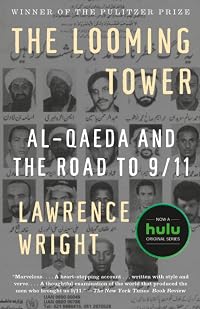
The Looming Tower: Al-Qaeda and the Road to 9/11
by Lawrence Wright
On This Page
Description
A sweeping narrative history of the events leading to 9/11, a groundbreaking look at the people and ideas, the terrorist plans and the Western intelligence failures that culminated in the assault on America. Lawrence Wright's remarkable book is based on five years of research and hundreds of interviews that he conducted in Egypt, Saudi Arabia, Pakistan, Afghanistan, Sudan, England, France, Germany, Spain, and the United States. The Looming Tower achieves an unprecedented level of intimacy show more and insight by telling the story through the interweaving lives of four men: the two leaders of al-Qaeda, Osama bin Laden and Ayman al-Zawahiri; the FBI's counterterrorism chief, John O'Neill; and the former head of Saudi intelligence, Prince Turki al-Faisal. As these lives unfold, we see revealed: the crosscurrents of modern Islam that helped to radicalize Zawahiri and bin Laden . . . the birth of al-Qaeda and its unsteady development into an organization capable of the American embassy bombings in Kenya and Tanzania and the attack on the USS Cole . . . O'Neill's heroic efforts to track al-Qaeda before 9/11, and his tragic death in the World Trade towers . . . Prince Turki's transformation from bin Laden's ally to his enemy . . . the failures of the FBI, CIA, and NSA to share intelligence that might have prevented the 9/11 attacks. The Looming Tower broadens and deepens our knowledge of these signal events by taking us behind the scenes. Here is Sayyid Qutb, founder of the modern Islamist movement, lonely and despairing as he meets Western culture up close in 1940s America; the privileged childhoods of bin Laden and Zawahiri; family life in the al-Qaeda compounds of Sudan and Afghanistan; O'Neill's high-wire act in balancing his all-consuming career with his equally entangling personal life-he was living with three women, each of them unaware of the others' existence-and the nitty-gritty of turf battles among U.S. intelligence agencies. show lessTags
Recommendations



Member Reviews
This book has been sitting on my shelf since it was published, but the memory of the events was still too raw for me to read it. I finally decided to read it this week. Wright does a very good job of reporting the lead-up, tracing two parallel stories: one of them the world of radical Islam, the other the halting US efforts to thwart terrorism.
Part of that second strand is the woeful tale of how inter-agency rivalry led to compartmentalizing the few indications that US agents had.
But the big takeaway from the book for me is the degree to which Bin Laden achieved his goal. His aim was to inflict a big, symbolic wound that would cause the US to overreact, invade Afghanistan, and get bogged down in a long, costly war. The US followed his show more playbook to the letter.
But there the fulfillment stopped. In Bin Laden's simplistic view, the sole cause of the break-up of the Soviet Union was its invasion of Afghanistan. For the moment, it appears that US resources are deep enough to avoid a similar dissolution. I hope. show less
Part of that second strand is the woeful tale of how inter-agency rivalry led to compartmentalizing the few indications that US agents had.
But the big takeaway from the book for me is the degree to which Bin Laden achieved his goal. His aim was to inflict a big, symbolic wound that would cause the US to overreact, invade Afghanistan, and get bogged down in a long, costly war. The US followed his show more playbook to the letter.
But there the fulfillment stopped. In Bin Laden's simplistic view, the sole cause of the break-up of the Soviet Union was its invasion of Afghanistan. For the moment, it appears that US resources are deep enough to avoid a similar dissolution. I hope. show less
If you are looking for a book about 9/11 The Looming Tower is not the right one — but if you are looking for a book about why and how 9/11 happened, read on. Author Lawrence Wright begins with Osama bin Laden, delving into his family history and then his upbringing and influences, while also looking at other Muslim groups and their places in the Middle East. Once the narrative reaches the 1980s, Wright picks up the story of the FBI agents investigating terrorism, focusing on special agent John O’Neill who attempted to lead the chase of bin Laden and al-Qaeda. Meticulous and sometimes even mind-boggling details fill the book, but somehow Wright never loses the movement forward toward the inevitable conclusion of September 11th. The show more Looming Tower is a fantastic work of nonfiction for anyone interested in trying to understand the roots of Muslim terror movements and how it led to the World Trade Center bombings. show less
The Looming Tower definitely deserved its Pulitzer Prize. I have read a few post 9/11 histories and some are better than others. Lawrence Wright has put together a very solid piece, with what was, for me, new information.
Wright does a great job of puling biographies of four men together to really paint a picture the evolution and eventual fact of the 9/11 disaster. He starts with Sayyid Qatb, a repressed Egyptian Muslim who is the philosophical underpinning of one of the key figures in 9/11, Ayman al-Zawahiri. He also does a great job of telling the life story Zawahiri, another repressed fanatic, who was tortured in jail after his organization, the Muslim Brotherhood, was involved in the assassination of Anwar Sadat for this secular show more government and repression of religious fanatics. And finally, John O’Neill, the obsessed playboy FBI agent who was the lead investigator in the Cole explosion and knew something big was going to happen with Al Qaeda and Osama Bin Laden.
This work is a crucifixion of the internecine warfare among American law enforcement and intelligence agencies tasked with protecting America with their turf warfare and lack of information sharing. It is beyond painfully clear that bureaucracy, jealously, and ineptitude not only contributed to 9/11, but ensured that it would happen. And it also paints a dim psychological portrait of the men behind the 9/11 attack and their perversion of the Muslim religion to suit their own warped worldview. The mostly subtle psychology of terrorism, at least terrorism among this group, is believable and frightening. Frightening, because such previsions can be so successfully persuasive among those who would follow their lead.
This is a solid work on some of the background the root factors leading up the 9/11 and highly recommended. show less
Wright does a great job of puling biographies of four men together to really paint a picture the evolution and eventual fact of the 9/11 disaster. He starts with Sayyid Qatb, a repressed Egyptian Muslim who is the philosophical underpinning of one of the key figures in 9/11, Ayman al-Zawahiri. He also does a great job of telling the life story Zawahiri, another repressed fanatic, who was tortured in jail after his organization, the Muslim Brotherhood, was involved in the assassination of Anwar Sadat for this secular show more government and repression of religious fanatics. And finally, John O’Neill, the obsessed playboy FBI agent who was the lead investigator in the Cole explosion and knew something big was going to happen with Al Qaeda and Osama Bin Laden.
This work is a crucifixion of the internecine warfare among American law enforcement and intelligence agencies tasked with protecting America with their turf warfare and lack of information sharing. It is beyond painfully clear that bureaucracy, jealously, and ineptitude not only contributed to 9/11, but ensured that it would happen. And it also paints a dim psychological portrait of the men behind the 9/11 attack and their perversion of the Muslim religion to suit their own warped worldview. The mostly subtle psychology of terrorism, at least terrorism among this group, is believable and frightening. Frightening, because such previsions can be so successfully persuasive among those who would follow their lead.
This is a solid work on some of the background the root factors leading up the 9/11 and highly recommended. show less
It has taken me this long to read any non-fiction books at all about 9/11, because I needed the distance from my memories of the actual event. I knew from living through it the basic facts of what happened on that day, but this book filled in a lot of holes about the months and years leading up to it. Well written and engaging, this book follows the history of al-Qaeda from its earliest days, explaining well the motivations and beliefs of both the leaders and the footsoldiers. It’s really terrifying to read about how much hate some people can hold inside of them for an entire lifetime, and even scarier because Trump has engaged similar people in the US today. Though disturbing, upsetting and at times heart-wrenching, this is a very show more good book. show less
This is a very impressive work of investigative journalism. While it may be first viewed as a story about Al-Qaeda and America's 9/11 event, especially the twin towers collapse, it is most emphatically more than that. Roughly the first two-thirds of the book is really an intriguing history and dissection of what we now regard as the jihadist Muslim movement. The reader will be astounded by how small and incompetent a player Osama bin Laden was, depending overwhelmingly on his inherited income for most of his success. The great diversity of philosophies between the various sources of the jihadist movements will also be a revelation. Moreover, Americans will be shame-faced at the level of petty bickering and incompetence that took place show more between key players in its top security agencies, eventually overwhelming serious, conscientious work that some carried out, only to culminate in a very avoidable 9/11 event. In finishing the book, I realized it was written ten years ago, and we still have American politicians making policy without any regard for why the American-Muslim relationship is where it is today. I recommend readers use the updated 2011 edition with its Afterword addition. Even then, it doesn't account for the ISIS/ISIL/Daesh extension of today, but after reading the book, it's much easier to foresee how we got to where we are today. Recommended for any American reader who doesn't just take on faith whatever their favorite politician tells them about America's relationship with the Muslim world. show less
This book was first published in 2006 following a five year research project beginning in the aftermath of the disasters of September 11th, 2001. I purchased the paperback version in 2012 and it occupied a place on my bookshelves for nine years before I committed to finally read it on the occasion of the 20th anniversary of 9/11. When the first plane hit the north tower I was in a meeting at the Boston Park Plaza hotel. The purpose of the meeting was to begin the process of building a joint plan between the insurance company I worked for and another company that had completed the purchase of a large book of our business. During one of the breakout sessions a second plane hit the south tower and my instant reaction was that we were at show more war and I told the group I was with that bin Laden was behind this. I couldn't recall the name al Qaeda at the time. When we went back to the plenary meeting, the project manager who was running the meeting encouraged everyone to focus on the task at hand. We were meeting in a hotel that was a block or two away from the John Hancock tower. The gravity of the situation finally got through and it was agreed to postpone the meeting and everyone headed for the parking garages to get back to their respective offices. When we got to the garage where I was parked we encountered a frantic woman whose sister worked at the Pentagon which had just been hit by a third plane.
It was commonplace to note that the events of that day "changed everything". I wondered about that. About a week later I was browsing magazines at a Barnes & Noble and noted that the theme of the covers of both Time and Newsweek was "why do they hate us". My gut reaction then was "why don't they fear us". Twenty years later we have effectively declared "mission accomplished" and terminated our presence in Afghanistan (except for some imprecise number of Americans who haven't gotten out yet and thousands of Afghans who assisted our twenty year war and who will have to pay the forfeit).
Lawrence Wright won a Pulitzer for the The Looming Tower and for a change this was a work that deserved the prize and Wright deserves our gratitude for a wonderfully written, objective work of narrative history that gets to the "root causes" that the scribbling and chattering classes are always concerned with.
He provides detailed biographical sketches of notables such Sayyid Qutb, member of the Muslim Brotherhood, whose book "Milestones" was a seminal work in the development of Islamic fundamentalism in the second half of the 20th century. Qutb, like many of the lead figures in this story, spent some time in the West, specifically the Colorado State College of Education, now known as the University of Northern Colorado in Greeley, CO. His first impression of Greeley is quoted by Wright. "The small city of that I now reside in is beautiful, beautiful...Every house is like a flowering plant and the streets are like garden pathways. One observes the owners of these homes toiling away in their leisure time, watering their yards and manicuring their gardens. This is all they appear to do." As time went on Qutb had less flattering observations regarding such mainstays of American culture as jazz, football and racism. By the time he returned to Cairo in August, 1950 following a twenty month stay in the US , Qutb's radicalism was reinforced by his encounter with the West and its mores. "The white man in Europe or America is our number-one enemy...The white man crushes us underfoot while we teach our children about his civilization, his universal principles and noble objectives...We are endowing our children with amazement and respect for the master who tramples our honor and enslaves us. Let us instead plant the seeds of hatred, disgust, and revenge in the souls of these children. Let us teach these children from the time their nails are soft that the white man is the enemy of humanity, and that they should destroy him at the first opportunity". Twenty years after 9/11 that quotation comes pretty close to describing the conventional wisdom in the American academy, much of the media, traditional and social, and a not insignificant number of the nation's political elite. Qutb eventually was hanged by Nasser's regime in Eqypt following his conviction of a conspiracy to overthrow the Egyptian government and assassinate its leaders.
In his second chapter, "The Sporting Club", Wright provides the background biographical sketch of one Ayman al-Zawahiri, founder of the Islamist terrorist group al-Jihad which eventually merged with al-Qaeda. Zawahiri's organization was dedicated to what one could call with a nod to Joe Stalin, "jihad in one country", specifically Egypt. By 1998 his al-Jihad was on the ropes due to defections, arrests and revulsion against a terrorist attack on a party of tourists at an ancient Egyptian temple at Luxor. They were also on the verge of bankruptcy. So Zawahiri executed a merger with bin Laden and refocused the strategic target to be the United States as opposed to Mubarak's Egyptian regime. So who was (or is) Ayman al Zawahiri?
Unlike Sayyid Qutb, who came from modest circumstances, Zawahiri was the offspring of two of the most prominent families in Egypt. His father was a university professor of pharmacology. His brother was a dermatologist and "expert" in venereal diseases. An obituary for one member of the family, an engineer by trade, referenced 46 family members, 31 of whom were medical doctors, chemists or pharmacists. Among the others were an ambassador, judge and member of Parliament. An uncle of Zawahiri's father was appointed rector at al-Azhar University in Cairo, the consensus center of Islamic theology in the Middle East. Ironically, this ancestor was considered to be a great modernizer and was eventually driven from office as a result of faculty and student strikes protesting his modernist policies. Zawahiri's maternal grandfather had been president of the University of Cairo as well as the founder of King Saud University in Riyadh. He also served as Egypt's ambassador to Pakistan, Yemen and Saudi Arabia and a founder and first secretary-general of the Arab League.
Zawahiri's connection to Islamic fundamentalism came via an uncle on his mother's side, Mahfouz Azzam, who had been a student of Sayyid Qutb's in 1936 when Azzam was a third grader. As an adult Azzam became Qutb's personal attorney and was granted power of attorney by Qutb before his execution. He also was bequeathed Qutb's personal Quran. From his high school days Zawahiri belonged to dissident groups that opposed the secular regime of Nasser. He also supported the restoration of the caliphate which had been formally dissolved in 1924 following the demise of the Ottoman empire. It was intended that Egypt would take the lead role in conduct of an Islamic jihad against the West.
Zawahiri became a medical doctor, served as a surgeon the Egyptian army for three years and eventually landed in Afghanistan volunteering his services to the mujahideen. He regarded the war against the Russians as providing a training ground for the real enemy, the United States. Prior to his Afghanistan sojourn Zawahiri had founded al-Jihad which was a splinter group that broke off from the Muslim Brotherhood due to his rejection of the Brotherhood's willingness to use political methods to achieve its goals. His group was responsible for the assassination of Sadat and Zawahiri was among those arrested in the aftermath, subjected to torture while imprisoned. His trial lasted three years which was the same length as the sentence he eventually received on a conviction for arms dealing. By the time he was released in 1984 he was in Wright's judgement a "hardened radical whose beliefs had been hammered into a brilliant resolve".
The story of Osama bin Laden is more widely familiar than most of the other prominent jihadists associated with the events of 9/11. It is less well known that his father Mohammed bin Laden was a self-made man of Yemeni origins who became the most prominent construction tycoon in Saudi Arabia after serving his apprenticeship working for Aramco who sponsored his fledgling construction company. He built hotels, embassies, and roads for the new capital city of Riyadh. He constructed a highway linking Jeddah with Medina and renovated the most sacred mosques in Mecca and Medina, tripling the size of the Prophet's mosque in Medina. Other than becoming fabulously wealthy Mohammed seems to have spent his waking hours siring offspring. He is supposed to have had 54 children born from 22 wives (only four at a time of course). He also kept concubines who occasionally lived with the family if they had his children. Osama came into the world in January of 1958 the only child of Mohammed's fourth wife, Alia, whom Mohammed had married when was fourteen. When he was still in his early childhood his father divorced his mother and married her off to one of his subordinates. When he was 17 and still in high school he married for the first time. His new bride was, like his mother, just fourteen.
The point of highlighting the backgrounds of Qutb, Zawahiri and bin Laden is to underscore the fatuousness of trying to explain away Islamic jihadism (or sharia supremacy in the phrase favored by Andrew McCarthy) in terms of poverty, lack of education and lack of opportunity. No doubt that payment of a stipend or salary to recruits to the jihad plays a role, but the animating spirit of jihad is fidelity to the fundamental texts of Islam and the belief that Islam is destined to rule the world. The leaders of the jihad are disproportionately drawn from the educated elite. They are medical doctors, engineers, university professors. The reason "they hate us" is that "we are not them". They hate the United States because it is the present world headquarters of "The West". They hate us for our Christianity, our Judaism, our atheism, our skepticism. They hate us for our liberalism, our equality of the sexes, our materialism, our rationalism.
Wright follows the progress of al Jihad (Zawahiri) and al Qaeda (bin Laden) over the course of decades from the 70's right through 9/11. The story takes us to Pakistan, Afghanistan, Saudi Arabia, the Sudan, back to Afghanistan. He covers in detail the personalities, planning and execution of the assassination of Sadat, the first attack on the World Trade Center in 1993 by Ramzi Yousef, the nephew of Khalid Sheikh Mohammed, plots to assassinate Pope John Paul II and Bill Clinton, the bombing of the our embassies in Nairobi (Kenya) and Dar es Salaam (Tanzania) and the attack on the USS Cole that nearly succeeded in sinking her.
Wright also devotes chapters to the efforts of the White House, CIA and FBI to track and frustrate the jihad, led respectively by Richard Clarke, Michael Scheuer and John O'Neill. O'Neill was eased out of his position at the FBI just in time to take a job in private security at the World Trade Center just a few weeks before he died in the collapse of the south tower on 9/11. Wright details the familiar problems of lack of coordination between the CIA and FBI with more of the blame falling on the CIA's unwillingness to share what turned out to be critical information regarding the participants in a planning meeting held by al Qaeda in Malaysia.
Among the more chilling and infuriating descriptions of the events of 9/11 is a recounting of bin Laden holding up three fingers after reports are received of the second plane hitting the south tower, and four fingers after the reports came through of the plane crash into the Pentagon. The fourth finger was a reference to the plane that would target the Capitol building which was saved due to the heroism of the passengers on Flight 93,
So twenty years have come and gone since the day that changed everything. It took ten years to finally run bin Laden to ground. Zawahiri was rumored to be dead but resurfaced in a video released on the 20th anniversary of 9/11. Mullah Omar who declared the original Islamic Emirate of Afghanistan in 1996 and was wanted for providing sanctuary for al Qaeda (the raison d'etre for the Afghanistan invasion) died from tuberculosis in 2013. Omar Abdel Rahman, the "blind sheikh", who headed the Islamic Group responsible for the terrorist massacre of tourists at Luxor as well as the 1993 attack on the World Trade Center died in prison in 2017 in North Carolina from diabetes and coronary artery disease. Ramzi Youssef who planned the 1993 World Trade Center bombing is serving two life sentences in a prison near Florence, CO. His uncle, Khalid Sheikh Mohammed, North Carolina A&T class of '86 (B.S. Mechanical Engineering) is still with us. He was captured in 2003, charged with war crimes in 2008 and his trial began on September 7th, 2021, four days before the 20th anniversary of his most spectacular deed on this earth. On August 31st of this year the US ended its military engagement in Afghanistan and the Taliban celebrated the re-establishment of the Islamic Emirate of Afghanistan. show less
It was commonplace to note that the events of that day "changed everything". I wondered about that. About a week later I was browsing magazines at a Barnes & Noble and noted that the theme of the covers of both Time and Newsweek was "why do they hate us". My gut reaction then was "why don't they fear us". Twenty years later we have effectively declared "mission accomplished" and terminated our presence in Afghanistan (except for some imprecise number of Americans who haven't gotten out yet and thousands of Afghans who assisted our twenty year war and who will have to pay the forfeit).
Lawrence Wright won a Pulitzer for the The Looming Tower and for a change this was a work that deserved the prize and Wright deserves our gratitude for a wonderfully written, objective work of narrative history that gets to the "root causes" that the scribbling and chattering classes are always concerned with.
He provides detailed biographical sketches of notables such Sayyid Qutb, member of the Muslim Brotherhood, whose book "Milestones" was a seminal work in the development of Islamic fundamentalism in the second half of the 20th century. Qutb, like many of the lead figures in this story, spent some time in the West, specifically the Colorado State College of Education, now known as the University of Northern Colorado in Greeley, CO. His first impression of Greeley is quoted by Wright. "The small city of that I now reside in is beautiful, beautiful...Every house is like a flowering plant and the streets are like garden pathways. One observes the owners of these homes toiling away in their leisure time, watering their yards and manicuring their gardens. This is all they appear to do." As time went on Qutb had less flattering observations regarding such mainstays of American culture as jazz, football and racism. By the time he returned to Cairo in August, 1950 following a twenty month stay in the US , Qutb's radicalism was reinforced by his encounter with the West and its mores. "The white man in Europe or America is our number-one enemy...The white man crushes us underfoot while we teach our children about his civilization, his universal principles and noble objectives...We are endowing our children with amazement and respect for the master who tramples our honor and enslaves us. Let us instead plant the seeds of hatred, disgust, and revenge in the souls of these children. Let us teach these children from the time their nails are soft that the white man is the enemy of humanity, and that they should destroy him at the first opportunity". Twenty years after 9/11 that quotation comes pretty close to describing the conventional wisdom in the American academy, much of the media, traditional and social, and a not insignificant number of the nation's political elite. Qutb eventually was hanged by Nasser's regime in Eqypt following his conviction of a conspiracy to overthrow the Egyptian government and assassinate its leaders.
In his second chapter, "The Sporting Club", Wright provides the background biographical sketch of one Ayman al-Zawahiri, founder of the Islamist terrorist group al-Jihad which eventually merged with al-Qaeda. Zawahiri's organization was dedicated to what one could call with a nod to Joe Stalin, "jihad in one country", specifically Egypt. By 1998 his al-Jihad was on the ropes due to defections, arrests and revulsion against a terrorist attack on a party of tourists at an ancient Egyptian temple at Luxor. They were also on the verge of bankruptcy. So Zawahiri executed a merger with bin Laden and refocused the strategic target to be the United States as opposed to Mubarak's Egyptian regime. So who was (or is) Ayman al Zawahiri?
Unlike Sayyid Qutb, who came from modest circumstances, Zawahiri was the offspring of two of the most prominent families in Egypt. His father was a university professor of pharmacology. His brother was a dermatologist and "expert" in venereal diseases. An obituary for one member of the family, an engineer by trade, referenced 46 family members, 31 of whom were medical doctors, chemists or pharmacists. Among the others were an ambassador, judge and member of Parliament. An uncle of Zawahiri's father was appointed rector at al-Azhar University in Cairo, the consensus center of Islamic theology in the Middle East. Ironically, this ancestor was considered to be a great modernizer and was eventually driven from office as a result of faculty and student strikes protesting his modernist policies. Zawahiri's maternal grandfather had been president of the University of Cairo as well as the founder of King Saud University in Riyadh. He also served as Egypt's ambassador to Pakistan, Yemen and Saudi Arabia and a founder and first secretary-general of the Arab League.
Zawahiri's connection to Islamic fundamentalism came via an uncle on his mother's side, Mahfouz Azzam, who had been a student of Sayyid Qutb's in 1936 when Azzam was a third grader. As an adult Azzam became Qutb's personal attorney and was granted power of attorney by Qutb before his execution. He also was bequeathed Qutb's personal Quran. From his high school days Zawahiri belonged to dissident groups that opposed the secular regime of Nasser. He also supported the restoration of the caliphate which had been formally dissolved in 1924 following the demise of the Ottoman empire. It was intended that Egypt would take the lead role in conduct of an Islamic jihad against the West.
Zawahiri became a medical doctor, served as a surgeon the Egyptian army for three years and eventually landed in Afghanistan volunteering his services to the mujahideen. He regarded the war against the Russians as providing a training ground for the real enemy, the United States. Prior to his Afghanistan sojourn Zawahiri had founded al-Jihad which was a splinter group that broke off from the Muslim Brotherhood due to his rejection of the Brotherhood's willingness to use political methods to achieve its goals. His group was responsible for the assassination of Sadat and Zawahiri was among those arrested in the aftermath, subjected to torture while imprisoned. His trial lasted three years which was the same length as the sentence he eventually received on a conviction for arms dealing. By the time he was released in 1984 he was in Wright's judgement a "hardened radical whose beliefs had been hammered into a brilliant resolve".
The story of Osama bin Laden is more widely familiar than most of the other prominent jihadists associated with the events of 9/11. It is less well known that his father Mohammed bin Laden was a self-made man of Yemeni origins who became the most prominent construction tycoon in Saudi Arabia after serving his apprenticeship working for Aramco who sponsored his fledgling construction company. He built hotels, embassies, and roads for the new capital city of Riyadh. He constructed a highway linking Jeddah with Medina and renovated the most sacred mosques in Mecca and Medina, tripling the size of the Prophet's mosque in Medina. Other than becoming fabulously wealthy Mohammed seems to have spent his waking hours siring offspring. He is supposed to have had 54 children born from 22 wives (only four at a time of course). He also kept concubines who occasionally lived with the family if they had his children. Osama came into the world in January of 1958 the only child of Mohammed's fourth wife, Alia, whom Mohammed had married when was fourteen. When he was still in his early childhood his father divorced his mother and married her off to one of his subordinates. When he was 17 and still in high school he married for the first time. His new bride was, like his mother, just fourteen.
The point of highlighting the backgrounds of Qutb, Zawahiri and bin Laden is to underscore the fatuousness of trying to explain away Islamic jihadism (or sharia supremacy in the phrase favored by Andrew McCarthy) in terms of poverty, lack of education and lack of opportunity. No doubt that payment of a stipend or salary to recruits to the jihad plays a role, but the animating spirit of jihad is fidelity to the fundamental texts of Islam and the belief that Islam is destined to rule the world. The leaders of the jihad are disproportionately drawn from the educated elite. They are medical doctors, engineers, university professors. The reason "they hate us" is that "we are not them". They hate the United States because it is the present world headquarters of "The West". They hate us for our Christianity, our Judaism, our atheism, our skepticism. They hate us for our liberalism, our equality of the sexes, our materialism, our rationalism.
Wright follows the progress of al Jihad (Zawahiri) and al Qaeda (bin Laden) over the course of decades from the 70's right through 9/11. The story takes us to Pakistan, Afghanistan, Saudi Arabia, the Sudan, back to Afghanistan. He covers in detail the personalities, planning and execution of the assassination of Sadat, the first attack on the World Trade Center in 1993 by Ramzi Yousef, the nephew of Khalid Sheikh Mohammed, plots to assassinate Pope John Paul II and Bill Clinton, the bombing of the our embassies in Nairobi (Kenya) and Dar es Salaam (Tanzania) and the attack on the USS Cole that nearly succeeded in sinking her.
Wright also devotes chapters to the efforts of the White House, CIA and FBI to track and frustrate the jihad, led respectively by Richard Clarke, Michael Scheuer and John O'Neill. O'Neill was eased out of his position at the FBI just in time to take a job in private security at the World Trade Center just a few weeks before he died in the collapse of the south tower on 9/11. Wright details the familiar problems of lack of coordination between the CIA and FBI with more of the blame falling on the CIA's unwillingness to share what turned out to be critical information regarding the participants in a planning meeting held by al Qaeda in Malaysia.
Among the more chilling and infuriating descriptions of the events of 9/11 is a recounting of bin Laden holding up three fingers after reports are received of the second plane hitting the south tower, and four fingers after the reports came through of the plane crash into the Pentagon. The fourth finger was a reference to the plane that would target the Capitol building which was saved due to the heroism of the passengers on Flight 93,
So twenty years have come and gone since the day that changed everything. It took ten years to finally run bin Laden to ground. Zawahiri was rumored to be dead but resurfaced in a video released on the 20th anniversary of 9/11. Mullah Omar who declared the original Islamic Emirate of Afghanistan in 1996 and was wanted for providing sanctuary for al Qaeda (the raison d'etre for the Afghanistan invasion) died from tuberculosis in 2013. Omar Abdel Rahman, the "blind sheikh", who headed the Islamic Group responsible for the terrorist massacre of tourists at Luxor as well as the 1993 attack on the World Trade Center died in prison in 2017 in North Carolina from diabetes and coronary artery disease. Ramzi Youssef who planned the 1993 World Trade Center bombing is serving two life sentences in a prison near Florence, CO. His uncle, Khalid Sheikh Mohammed, North Carolina A&T class of '86 (B.S. Mechanical Engineering) is still with us. He was captured in 2003, charged with war crimes in 2008 and his trial began on September 7th, 2021, four days before the 20th anniversary of his most spectacular deed on this earth. On August 31st of this year the US ended its military engagement in Afghanistan and the Taliban celebrated the re-establishment of the Islamic Emirate of Afghanistan. show less
This was a fascinating, riveting account that crosses five decades and several countries to tell the story of "the growth of Islamic Fundamentalism, the rise of Al-Qaeda, and the intelligence failures that culminated" in the 9/11 attacks on the World Trade Center and the Pentagon. I first ran across this title when reading a column by a conservative, Hugh Hewitt, praising it as a "good and important book." What particularly intrigued me is that the writer, Lawrence Wright, was described as a liberal. When you have a book that crosses political divides like that, I pay attention. Looking the book up I learned it was both a popular bestseller and critically praised--a Pulitzer Prize winner. And that Wright had personally spent time in the show more Middle East, including "two years teaching at the American University in Cairo, Egypt." At the back of the book there are not only extensive notes and a bibliography, but a list of over five hundred people Wright personally interviewed for the book.
I thought I knew this story, but this had lots of details I didn't know and drew connections and included insights that after all I've read still seemed fresh. For instance, I had never heard of Sayyid Qutb, whose manifesto, Milestones, Wright compares to Lenin's "What Is To Be Done?" in terms of its influence on Islamic Fundamentalism. Qutb was one of the founders of the Muslim Brotherhood in Egypt we've been hearing so much about since the Arab Spring. He spent years in the United States--which he hated for its modernity, its freedom. Almost as much as he hated the newly established Israel. His definition of religious freedom? It would come when Sharia (Islamic law) was imposed worldwide because as Wright put it then "there would be no compulsion in religion because there would be only one choice: Islam." Those are threads that run and again and again through this book. Egypt also produced Ayman al-Zawari who together with Osama bin Ladin of Saudi Arabia founded Al-Qaeda. Saudi Arabia is a country with a monarchy that ties their regime to the fundamentalist Wahhabi sect and allows muttawas (religious police) to patrol the streets with the power to flog women who show a strand of hair peeking out from their head scarf. Wright claims the "vector of these two forces, one Egyptian and one Saudi" would result in Al-Qaeda.
Another factor in the rise of Al-Qaeda according to Wright was the use of torture, particularly by the Egyptians. The key to torture, Wright wrote, is humiliation--a humiliation which breeds rage, radicalized the victims and filled them with a passion for revenge. And well before 9/11, America would use surrogates such as Egypt to conduct such illicit interrogations while they kept their hands clean. Wright further noted that "The usual object of terror is to draw one's opponent into repressive blunders." Bin Laden wanted the 9/11 attacks to result in the invasion of Afghanistan--he hoped it would draw us into a war that would destroy our international power--even our country--in the same way it had destroyed the Soviets. Not that it turned out the way he planed--nor do I feel we had much choice with the Taliban harboring the man responsible for thousands of American deaths. But those are sobering aspects of this tale when we consider that in invading Afghanistan and Iraq, cracking down on civil liberties at home and using torture, America has fallen precisely into the trap Bin Laden laid for us. I was also struck anew by the colossal waste of life and talent caused by groups such as Al-Qaeda--not simply from the 9/11 attacks, but all the damage it has done right in Muslim countries and toll its taken in Muslim lives. Hewitt is right--this is a good and important book anyone wanting to come to grips with Islamic Fundamentalism and terrorism and the world 9/11 created should read. show less
I thought I knew this story, but this had lots of details I didn't know and drew connections and included insights that after all I've read still seemed fresh. For instance, I had never heard of Sayyid Qutb, whose manifesto, Milestones, Wright compares to Lenin's "What Is To Be Done?" in terms of its influence on Islamic Fundamentalism. Qutb was one of the founders of the Muslim Brotherhood in Egypt we've been hearing so much about since the Arab Spring. He spent years in the United States--which he hated for its modernity, its freedom. Almost as much as he hated the newly established Israel. His definition of religious freedom? It would come when Sharia (Islamic law) was imposed worldwide because as Wright put it then "there would be no compulsion in religion because there would be only one choice: Islam." Those are threads that run and again and again through this book. Egypt also produced Ayman al-Zawari who together with Osama bin Ladin of Saudi Arabia founded Al-Qaeda. Saudi Arabia is a country with a monarchy that ties their regime to the fundamentalist Wahhabi sect and allows muttawas (religious police) to patrol the streets with the power to flog women who show a strand of hair peeking out from their head scarf. Wright claims the "vector of these two forces, one Egyptian and one Saudi" would result in Al-Qaeda.
Another factor in the rise of Al-Qaeda according to Wright was the use of torture, particularly by the Egyptians. The key to torture, Wright wrote, is humiliation--a humiliation which breeds rage, radicalized the victims and filled them with a passion for revenge. And well before 9/11, America would use surrogates such as Egypt to conduct such illicit interrogations while they kept their hands clean. Wright further noted that "The usual object of terror is to draw one's opponent into repressive blunders." Bin Laden wanted the 9/11 attacks to result in the invasion of Afghanistan--he hoped it would draw us into a war that would destroy our international power--even our country--in the same way it had destroyed the Soviets. Not that it turned out the way he planed--nor do I feel we had much choice with the Taliban harboring the man responsible for thousands of American deaths. But those are sobering aspects of this tale when we consider that in invading Afghanistan and Iraq, cracking down on civil liberties at home and using torture, America has fallen precisely into the trap Bin Laden laid for us. I was also struck anew by the colossal waste of life and talent caused by groups such as Al-Qaeda--not simply from the 9/11 attacks, but all the damage it has done right in Muslim countries and toll its taken in Muslim lives. Hewitt is right--this is a good and important book anyone wanting to come to grips with Islamic Fundamentalism and terrorism and the world 9/11 created should read. show less
Members
- Recently Added By
Published Reviews
ThingScore 100
A narrator doesn’t just tell a story; he keeps the listener company. Alan Sklar is good company—with a voice so distinctive that a blind man could pick him out from across the room.
added by readysetgo
Wright, a New Yorker writer, brings exhaustive research and delightful prose to one of the best books yet on the history of terrorism.
added by readysetgo
In the nearly five years since the attacks, we’ve heard oceans of commentary on the whys and how-comes and what-it-means and what’s nexts. Wright, a staff writer for The New Yorker — where portions of this book have appeared — has put his boots on the ground in the hard places, conducted the interviews and done the sleuthing. Others talked, he listened. And so he has unearthed an show more astonishing amount of detail about Osama bin Laden, Ayman al-Zawahiri, Mullah Muhammad Omar and all the rest of them. They come alive. show less
added by readysetgo
Lists

100 books to read in a lifetime
102 works; 37 members

Radical Islam/Islamism
75 works; 6 members

The Emergence of the Modern Middle East
289 works; 13 members

Pulitzer Prize for General Non-Fiction
16 works; 3 members

Books read in 2016
5 works; 1 member

2000s decade
85 works; 6 members

Books To Get From The Library
115 works; 5 members

Blue Pyramid 1,276 Best Books of All Time
1,248 works; 32 members

r/AskHistorians' Recommended Books
1,068 works; 18 members

NYT 100 best books of 21st C
100 works; 31 members

.
184 works; 1 member

Terrorism
17 works; 1 member
Author Information

22+ Works 9,287 Members
Lawrence Wright (born August 2, 1947), Pulitzer Prize winning author, graduated from Tulane University and spent two years teaching at the American University in Cairo, Egypt. Wright is a staff writer for The New Yorker and a fellow at the Center on Law and Security at New York University School of Law. Wright is the author of the books God Save show more Texas: A Journey into the Soul of the Lone Star State (2018), Going Clear: Scientology, Hollywood, and the Prison of Belief (2013), Pulitzer Prize winning non-fiction The Looming Tower: Al-Qaeda and the Road to 9/11 (2006), Noriega: God's Favorite (2000), Twins: And What They Tell Us About Who We Are (1999), Remembering Satan (1994), Saints & Sinners (1993), In the New World: Growing Up in America, 1964-1984 (1987), and City Children, Country Summer: A Story of Ghetto Children Among the Amish (1979). (Bowker Author Biography) show less
Some Editions
Awards and Honors
Awards
Distinctions
Notable Lists
Series
Belongs to Publisher Series
Common Knowledge
- Canonical title*
- Le altissime torri. Come Al-Qaeda giunse all'11 settembre
- Original title
- The Looming Tower: Al-Qaeda and the Road to 9/11
- Original publication date
- 2006
- People/Characters
- Osama bin Laden; Richard Clark; John O'Neill; Ayman al-Zawahiri; Prince Turki al-Faisal; Sayyid Qutb
- Important places
- Afghanistan; Kabul, Afghanistan; Kandahar, Afghanistan; Jeddah, Saudi Arabia; New York, USA; New York, New York, USA (show all 9); Riyadh, Saudi Arabia; World Trade Center, New York, New York, USA; Yemen
- Important events
- U.S. Embassy Bombings in Kenya and Tanzania; USS Cole Bombing in Yemen; September 11 Attacks
- Related movies
- The Looming Tower (2018 | IMDb)
- First words
- On Saint Patrick's Day, Daniel Coleman, an agent in the New York office of the Federal Bureau of Investigation handling foreign intelligence cases, drove down to Tysons Corner, Virginia, to report for a new posting. The sidew... (show all)alks were still buried under gray banks of snow from the blizzard of 1996 a few weeks before. Coleman entered an undistinguished government office tower called the Gloucester Building and got off the elevator at the fifth floor. This was AlecStation.
Other stations of the Central Intelligence Agency are located in the various countries that they cover. Alec was the first "virtual" station, situated only a few miles from the headquarters building in Langley. On an organization chart it was labeled "Terrorist Financial Links," a subsection of the CIA's Counterterrorist Center, but in practice it was devoted to tracking the activities of a single man, Osama Bin Laden, whose name had arisen as the master financier of terror. -Prologue
In a first-class stateroom on a cruise ship bound for New York from Alexandria, Egypt, a frail, middle-aged writer and educator named Sayyid Qutb experienced a crisis of faith. "Should I go to America as any normal student on... (show all) a scholarship, who only eats and sleeps, or should I be special?" he wondered. "Should I hold on to my Islamic beliefs, facing the many sinful temptations, or should I indulge those temptations all around me?" It was November 1948. The new world loomed over the horizon, victorious, rich, and free. Behind him was Egypt in rags and tears. The traveler had never been out of his native country. Not had he willingly left now. -Chapter 1, The Martyr - Canonical DDC/MDS
- 320.557
- Canonical LCC
- HV6432.W75
*Some information comes from Common Knowledge in other languages. Click "Edit" for more information.
Classifications
- Genres
- General Nonfiction, History, Nonfiction, Religion & Spirituality
- DDC/MDS
- 320.557 — Society, government, & culture Political science Types of Government Political ideologies Religiously oriented ideologies Islamic ideologies
- LCC
- HV6432 .W75 — Social sciences Social pathology. Social and public welfare. Criminology Social pathology. Social and public welfare. Criminology Crimes and offenses
- BISAC
Statistics
- Members
- 3,941
- Popularity
- 3,978
- Reviews
- 85
- Rating
- (4.29)
- Languages
- 12 — Catalan, Danish, Dutch, English, French, German, Hungarian, Italian, Polish, Portuguese, Spanish, Swedish
- Media
- Paper, Audiobook, Ebook
- ISBNs
- 44
- ASINs
- 19