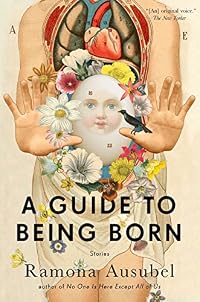
A Guide to Being Born: Stories
by Ramona Ausubel
On This Page
Description
A Guide to Being Born is organized around the stages of life—love, conception, gestation, birth—and the transformations that happen as people experience deeply altering life events, falling in love, becoming parents, looking toward the end of life. In each of these eleven stories Ausubel's stunning imagination and humor are moving, entertaining, and provocative, leading readers to see the familiar world in a new way. In "Atria," a pregnant teenager believes she will give birth to any show more number of strange animals rather than a human baby; in "Catch and Release," a girl discovers the ghost of a Civil War hero living in the woods behind her house; and in "Tributaries," people grow a new arm each time they fall in love.. show less
Tags
Recommendations


Member Reviews
Who is this wild writer named Ramona Ausubel?
I oohed. I gasped. I shook my head. I re-read frequently. And I was absolutely engaged in every page of these bizarre stories!
This collection is nearly impossible to classify, but let me give you a small example. In "Chest of Drawers" a man whose wife is pregnant, suddenly develops little drawers in his chest. They try to get help but the medical field is baffled and curious, and offers no treatment. Thus the couple decide to live with it. While waiting for his wife's doctor's appointment, the husband sees a brochure and likes a photo of the smiling male model. He tears it out, folds it up and puts it in one of his drawers. That is the first of odds and ends that he puts in there.
Does that show more sound weird? It is weird! And all the stories are bizarre like that, usually to do with odd, highly imaginative alterations of the human body. Is it science fiction? Is it fantasy or magic realism? All? Or none? None of those genres fit perfectly, really. She might have invented a new one because these are normal human beings where each story is at its heart emotional, emotions that we can connect with given the circumstances.
There are a couple less interesting stories, but the others are absolutely fantastic--fantastic as in "fantastically good" and "fantastical."
I don't know a thing about Ramona Ausubel but would I read her again? I WOULD! show less
I oohed. I gasped. I shook my head. I re-read frequently. And I was absolutely engaged in every page of these bizarre stories!
This collection is nearly impossible to classify, but let me give you a small example. In "Chest of Drawers" a man whose wife is pregnant, suddenly develops little drawers in his chest. They try to get help but the medical field is baffled and curious, and offers no treatment. Thus the couple decide to live with it. While waiting for his wife's doctor's appointment, the husband sees a brochure and likes a photo of the smiling male model. He tears it out, folds it up and puts it in one of his drawers. That is the first of odds and ends that he puts in there.
Does that show more sound weird? It is weird! And all the stories are bizarre like that, usually to do with odd, highly imaginative alterations of the human body. Is it science fiction? Is it fantasy or magic realism? All? Or none? None of those genres fit perfectly, really. She might have invented a new one because these are normal human beings where each story is at its heart emotional, emotions that we can connect with given the circumstances.
There are a couple less interesting stories, but the others are absolutely fantastic--fantastic as in "fantastically good" and "fantastical."
I don't know a thing about Ramona Ausubel but would I read her again? I WOULD! show less
I don't always read a short story collection straight through; if fun titles catch my attention I'm liable to begin with those stories. Ausubel's titles didn't seduce me, so I read this book straight through. And though I admired some of the writing in the first few stories, I can't say I actually liked them. But then things started getting weird in a wonderful way, and I liked every story thereafter. I wonder if I'd read the stories in a different order if I'd have appreciated the early ones more.
I love the surreal stories here--a man's chest becomes a "chest of drawers" during his wife's pregnancy; a girl plays catch with a long-dead Confederate general--but I think my favorite story here might be the one that makes magic out of show more ingredients as workaday as a grocery clerk-turned-dental assistant and another grocery clerk ready to turn into herself.
The eleven stories in this collection are divided into sections: Birth, Gestation, Conception and Love. This added another dimension to some of the stories that weren't obvious fits in their categories and inspired me to think about them in a way that made my reading experience richer. show less
I love the surreal stories here--a man's chest becomes a "chest of drawers" during his wife's pregnancy; a girl plays catch with a long-dead Confederate general--but I think my favorite story here might be the one that makes magic out of show more ingredients as workaday as a grocery clerk-turned-dental assistant and another grocery clerk ready to turn into herself.
The eleven stories in this collection are divided into sections: Birth, Gestation, Conception and Love. This added another dimension to some of the stories that weren't obvious fits in their categories and inspired me to think about them in a way that made my reading experience richer. show less
 This review was written for LibraryThing Early Reviewers.
Ausubel offers up a variant of Expressionism, setting her stories in pleasantly recognisable yet indefinite surroundings (across town? other side of the country?), then interjecting the grotesque as a means of drawing attention to familiar yet unplumbed experience. Grotesque in that usage of Sherwood Anderson rather than any trope of horror fiction, though there is some semblance of the weird tale. I'm uncertain Ausubel would acquiesce to Expressionism as descriptive, but I take as hallmark of that tradition the outward manifestation of inner states, and a strong influence of that approach underlies every one of the stories here.
It's tempting to frame each story as a thought experiment in which Ausubel ponders a situation -- for show more instance, the ways adults react to the death of a loved one -- and then refines her thoughts into a very specific scenario -- to pursue this example: the ways middle-class Americans react to loss on the part of someone else, as when someone we love experiences a dear loss, but when the death itself isn't directly personal for us -- and then pivots ninety degrees in her choice of setting or mise-en-scene, evoking the emotions and social dynamics of that central situation but clothing them in the absurd, the whimsical, even the repugnant.
Put this way it sounds far too clever and abstract: Ausubel's storytelling is anything but that, these stories are crystalline, the dialogue and description flow smoothly and the reading experience is almost effortless. This is where the Expressionism helps to pause the reader, slow the forward progress, for the events or situations described so languidly and fondly are often in fact jarring and uncomfortable. I think the effect is deliberate, but is only that, effect: the intent to draw attention to something either ineffable, or if described directly, too easily passed over as overly familiar.
The example of adults reacting to the loss on the part of someone they love, but which loss is only dimly felt themselves, is the basis for "Welcome to Your Life and Congratulations". A boy grieves the sudden death of his beloved cat, and grieves more keenly the unsatisfactory support on the part of his parents. It's as though Ausubel observed the myriad ways we simultaneously support those we love who are dealing with loss ... and inexplicably and perhaps unavoidably make things worse (without knowing it, even to shockingly callous extremes). Suggesting it is universal, this tension, and is often rooted in the fact that life goes on, both for those grieving and those who love them, if in different ways and at different tempi. These are commonplace questions, important ones even, but I think their emotional impact would be deadened if asked in so direct and flat a manner. Ausubel's evocation of that dilemma is memorable and metaphorically apt, itself disturbing without being obscene.
A similar silver thread traces through the other ten stories collected in A Guide to Being Born, leaving an impression of distillation: inner emotion and social dynamics captured in diorama, and a curious key provided for each miniature door. show less
It's tempting to frame each story as a thought experiment in which Ausubel ponders a situation -- for show more instance, the ways adults react to the death of a loved one -- and then refines her thoughts into a very specific scenario -- to pursue this example: the ways middle-class Americans react to loss on the part of someone else, as when someone we love experiences a dear loss, but when the death itself isn't directly personal for us -- and then pivots ninety degrees in her choice of setting or mise-en-scene, evoking the emotions and social dynamics of that central situation but clothing them in the absurd, the whimsical, even the repugnant.
Put this way it sounds far too clever and abstract: Ausubel's storytelling is anything but that, these stories are crystalline, the dialogue and description flow smoothly and the reading experience is almost effortless. This is where the Expressionism helps to pause the reader, slow the forward progress, for the events or situations described so languidly and fondly are often in fact jarring and uncomfortable. I think the effect is deliberate, but is only that, effect: the intent to draw attention to something either ineffable, or if described directly, too easily passed over as overly familiar.
The example of adults reacting to the loss on the part of someone they love, but which loss is only dimly felt themselves, is the basis for "Welcome to Your Life and Congratulations". A boy grieves the sudden death of his beloved cat, and grieves more keenly the unsatisfactory support on the part of his parents. It's as though Ausubel observed the myriad ways we simultaneously support those we love who are dealing with loss ... and inexplicably and perhaps unavoidably make things worse (without knowing it, even to shockingly callous extremes). Suggesting it is universal, this tension, and is often rooted in the fact that life goes on, both for those grieving and those who love them, if in different ways and at different tempi. These are commonplace questions, important ones even, but I think their emotional impact would be deadened if asked in so direct and flat a manner. Ausubel's evocation of that dilemma is memorable and metaphorically apt, itself disturbing without being obscene.
A similar silver thread traces through the other ten stories collected in A Guide to Being Born, leaving an impression of distillation: inner emotion and social dynamics captured in diorama, and a curious key provided for each miniature door. show less
This review was written for LibraryThing Early Reviewers.Very funny and almost a poem rather than a group of stories, this collection is fresh and delicately written but in no way fragile. While I enjoyed the weird spaces that she explores narratively, I found myself continuously going back to lines and images that Ausubel created, like I would in a long poetic piece, and even reading them aloud to other people. What a compact treat this book proved to be.
This review was written for LibraryThing Early Reviewers.http://wineandabook.com/2013/10/28/review-a-guide-to-being-born-by-ramona-ausube...
I received my copy of A Guide to Being Born back in April, and I am KICKING myself it took me so long to crack it open. Ramona Ausubel’s collection of thematically linked short stories is delightfully bizarre and unlike anything I’ve ever read. Each piece was distinct and struck its own unique chord, yet cohesive with the rest of the collection. Hauntingly, achingly beautiful, these stories stayed with me long after I finished the final page. A few of my favorite pieces:
Atria: A young girl becomes pregnant and is convinced that the child growing inside of her is any number of animals, but decidedly not human. Disturbing, but at the same time deeply show more relatable.
Tributaries: Ausubel imagines a world in which, every time you fall in love, you grow an additional arm. Talk about wearing your heart on your sleeve (Go ahead. Groan! I can’t resist a pun when it’s HANDED to me!)! Joking aside, think of how many people you know who enter into or remain in a relationship with someone they’re not in love with…and think about all the hopeless romantics you know who fall in love far too quickly…how many arms would they have? What if we couldn’t hide how we felt, if we were literally forced to carry our feelings on the outside? How would it change the way we interacted with the world?
Welcome to Your Life and Congratulations: A young boy’s cat, Houdini, is hit by a car, and the bizarre burial arrangements consume most of the day. Ausubel’s depiction of the way each member of the family handles grief and death is incredibly affecting, as well as a bit disturbing.
Poppyseed: The most heartbreaking piece in the collection, IMHO. The story follows a husband and wife raising a child with a rare genetic developmental disorder that renders their daughter completely dependent upon them, an infant trapped in the body of an eight-year-old. Written as alternating narrative passages from the father’s perspective and as letters from the mother’s, this story left me weeping during my morning commute…thank goodness I usually have the train car to myself that early in the morning!
Rubric rating: 8.5 No One is Here Except All of Us just shot up closer to the top of my to read pile. show less
I received my copy of A Guide to Being Born back in April, and I am KICKING myself it took me so long to crack it open. Ramona Ausubel’s collection of thematically linked short stories is delightfully bizarre and unlike anything I’ve ever read. Each piece was distinct and struck its own unique chord, yet cohesive with the rest of the collection. Hauntingly, achingly beautiful, these stories stayed with me long after I finished the final page. A few of my favorite pieces:
Atria: A young girl becomes pregnant and is convinced that the child growing inside of her is any number of animals, but decidedly not human. Disturbing, but at the same time deeply show more relatable.
Tributaries: Ausubel imagines a world in which, every time you fall in love, you grow an additional arm. Talk about wearing your heart on your sleeve (Go ahead. Groan! I can’t resist a pun when it’s HANDED to me!)! Joking aside, think of how many people you know who enter into or remain in a relationship with someone they’re not in love with…and think about all the hopeless romantics you know who fall in love far too quickly…how many arms would they have? What if we couldn’t hide how we felt, if we were literally forced to carry our feelings on the outside? How would it change the way we interacted with the world?
Welcome to Your Life and Congratulations: A young boy’s cat, Houdini, is hit by a car, and the bizarre burial arrangements consume most of the day. Ausubel’s depiction of the way each member of the family handles grief and death is incredibly affecting, as well as a bit disturbing.
Poppyseed: The most heartbreaking piece in the collection, IMHO. The story follows a husband and wife raising a child with a rare genetic developmental disorder that renders their daughter completely dependent upon them, an infant trapped in the body of an eight-year-old. Written as alternating narrative passages from the father’s perspective and as letters from the mother’s, this story left me weeping during my morning commute…thank goodness I usually have the train car to myself that early in the morning!
Rubric rating: 8.5 No One is Here Except All of Us just shot up closer to the top of my to read pile. show less
This review was written for LibraryThing Early Reviewers.You CAN judge a book by its cover. Perhaps that's not fair to Ausubel, whose book stands on merits far beyond its colorful, fantastic cover. But that's what first attracted me to this book, and happily, the contents within proved to be every bit as fantastic and engaging.
I was enchanted by the opening tale of a ship carrying a cargo of puzzled grandmothers. Where were they? How had they gotten there? Where were they going? The dream haze of the story slowly clears as one of the grandmothers recognizes and embraces her journey.
I also loved Magniloquence, which features an auditorium of professors waiting for a speaker to arrive. They wait and wait, and as they wait, inhibitions are shed and speeches are improvised and many cookies are show more surreptitiously eaten.
Love is at the core of each of these stories, and in most cases, that love is sure and calm and gentle. And sometimes it is odd, and sometimes oddly compelling, as in Poppyseed, when two parents employ unorthodox means to honor their disabled daughter.
Ausubel's writing is exquisite. Enter this book with an open mind and enjoy the strange and moving beauty.
I received a copy of this book through GoodReads First Reads. show less
I was enchanted by the opening tale of a ship carrying a cargo of puzzled grandmothers. Where were they? How had they gotten there? Where were they going? The dream haze of the story slowly clears as one of the grandmothers recognizes and embraces her journey.
I also loved Magniloquence, which features an auditorium of professors waiting for a speaker to arrive. They wait and wait, and as they wait, inhibitions are shed and speeches are improvised and many cookies are show more surreptitiously eaten.
Love is at the core of each of these stories, and in most cases, that love is sure and calm and gentle. And sometimes it is odd, and sometimes oddly compelling, as in Poppyseed, when two parents employ unorthodox means to honor their disabled daughter.
Ausubel's writing is exquisite. Enter this book with an open mind and enjoy the strange and moving beauty.
I received a copy of this book through GoodReads First Reads. show less
There are certainly collections of short stories out there that are more mystical, more magical, but few of them hit me with such clarity as Ausubel's do. Her characters are real people, with both very real and very unreal conflicts, and her attention to words make it more and more difficult for me to determine the difference between them. This is a compliment unlike any I have ever been able to give before.
:
The classifications of stories: Birth, Gestation, Conception, and Love will likely want to make me reread this collection from time to time, to pick up new subtleties in the stories surrounding what I consider to be a backward timeline.
"Catch and Release," "Poppyseed," and "Saver" are my favorites, for incredibly different reasons.
:
The classifications of stories: Birth, Gestation, Conception, and Love will likely want to make me reread this collection from time to time, to pick up new subtleties in the stories surrounding what I consider to be a backward timeline.
"Catch and Release," "Poppyseed," and "Saver" are my favorites, for incredibly different reasons.
This review was written for LibraryThing Early Reviewers.Members
- Recently Added By
Author Information

11+ Works 1,402 Members
Awards and Honors
Classifications
Statistics
- Members
- 285
- Popularity
- 112,614
- Reviews
- 32
- Rating
- (3.95)
- Languages
- English
- Media
- Paper, Audiobook, Ebook
- ISBNs
- 6
- ASINs
- 2