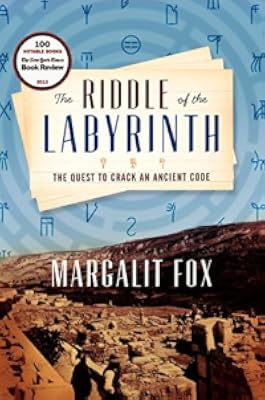
The Riddle of the Labyrinth: The Quest to Crack an Ancient Code
by Margalit Fox
On This Page
Description
An intellectual detective story follows the quest to unlock one of the great secrets of human history--the decipherment of Linear B, an unknown script from the Aegean Bronze Age.Tags
Recommendations













Member Reviews
I, academically speaking, basically grew up on tales of Linear B. I mean I distinguished myself on the residency interview trail by being the only medical student to have spent several semesters TAing cryptography; meeting Simon Singh is one of the highlights of my life. And Linear B is basically the epitome of a code-breaking story: elegant statistics, linguistic analysis and finally, a successful decryption.
And at the same time, there is something so deep in the human experience about decrypting a language, rather than just a code. I am a deep believer in the idea that written language, more so even than DNA, is the heritable code of humanity, and Linear B is one of the very first written human languages. This is a beautiful portal to show more 3,500 years ago. It turns out that people 3,500 years ago were people. They recorded things, they thought, they counted, the preserved themselves for us -- how freaking amazing is that?
I've never read anything by Margalit Fox before, but she really does justice to these compelling ideas. She never walks away from the "riddle" part of Linear B -- she drops tantalizing hints. Nothing compels reading like hearing: "and this tablet would be the key to solving the puzzle, 20 years later." Her narrative really reads like a mystery.
Finally, Fox is the first author to give Alice Kober her full due in the decryption and Fox does not give short shrift to the gender issues that have prevented Kober from being fully recognized until now. Fox obviously feels deeply for Kober, who died prematurely, likely of cancer -- she tells the story as a tragedy, and certainly that adds another layer of this story about learning of the humanity of our ancestors. show less
And at the same time, there is something so deep in the human experience about decrypting a language, rather than just a code. I am a deep believer in the idea that written language, more so even than DNA, is the heritable code of humanity, and Linear B is one of the very first written human languages. This is a beautiful portal to show more 3,500 years ago. It turns out that people 3,500 years ago were people. They recorded things, they thought, they counted, the preserved themselves for us -- how freaking amazing is that?
I've never read anything by Margalit Fox before, but she really does justice to these compelling ideas. She never walks away from the "riddle" part of Linear B -- she drops tantalizing hints. Nothing compels reading like hearing: "and this tablet would be the key to solving the puzzle, 20 years later." Her narrative really reads like a mystery.
Finally, Fox is the first author to give Alice Kober her full due in the decryption and Fox does not give short shrift to the gender issues that have prevented Kober from being fully recognized until now. Fox obviously feels deeply for Kober, who died prematurely, likely of cancer -- she tells the story as a tragedy, and certainly that adds another layer of this story about learning of the humanity of our ancestors. show less
Quick, fun read for those, like me, have always viewed mysterious scripts as the ultimate "secret codes" — so much more interesting than the simple alphabetic ciphers that I could see no challenge in even as an 8-year-old. Now, an unknown script recording an unknown language — that's a challenge! Fox does a great job of breaking down the strategies and the staggeringly immense amount of painstaking work necessary to solving such a puzzle, perhaps the greatest puzzle possible in cryptography. She makes it readable and does a great job of bringing in the human characters (eccentrics all, as they probably have to be) who take on these puzzles as their life task.
A fascinating account of how an ancient script was cracked, to a large part thanks to the plodding, incredibly labor-intensive, and unacknowledged work of one woman, Alice Kober.
I had never even imagined that there would be a way to crack an unknown script of an unknown language; yet she quietly worked away at it on her free time in the days where there were no computers, doing everything manually. It's simply mind-boggling. And heartbreaking that she didn't live to complete it; rather (on retrospect) having her precious remaining time wasted by an older scholar who didn't even appreciate her contributions or her genius.
It was also a glimpse of how difficult it was for women to break into the academic word in that era...although I'm show more sure it's still challenging for women today.
The only thing that i didn't like was the rambling beginning chapter, which was repetitive and didn't get anywhere.
An eye-opening read, recommended! show less
I had never even imagined that there would be a way to crack an unknown script of an unknown language; yet she quietly worked away at it on her free time in the days where there were no computers, doing everything manually. It's simply mind-boggling. And heartbreaking that she didn't live to complete it; rather (on retrospect) having her precious remaining time wasted by an older scholar who didn't even appreciate her contributions or her genius.
It was also a glimpse of how difficult it was for women to break into the academic word in that era...although I'm show more sure it's still challenging for women today.
The only thing that i didn't like was the rambling beginning chapter, which was repetitive and didn't get anywhere.
An eye-opening read, recommended! show less
[The Riddle of the Labyrinth: The Quest to Crack an Ancient Code] by [[Margalit Fox]]. This book was fabulous! I devoured it like savory cupcake and was sad when it was over. Fox tells the story of the discovery and eventual decipherment of Linear B (spoiler alert:
Two of these people -- Arthur Evans, the archaeologist who in 1900 discovered tablets containing this strange script, and Michael Ventris, a British architect who was credited with the script's eventual decipherment -- are famous (relatively speaking), while the third, an American (female!) classics professor named Alice Kobler, has never been given the appropriate credit for her role in the decipherment. It is show more Kobler's story that Fox most wants to focus on, but she begins at the beginning with the tablets' discovery in Knossos, Crete. Other than knowing that Linear B was a mysterious script that had bedeviled scholars for decades, I was not familiar with any of the story, so I enjoyed even the portions that might be old ground for those who've read about Linear B before.
For being a relatively short book, Fox packs in tons of detail about Victorian archaeology practices and beliefs about the ancient world (who knew a proper English gentleman could just purchase an ancient ruin in those days!), ancient Greek prehistory, the findings of the excavations at Knossos, the personal lives of her three main figures, and of course, the features and structures of the Linear B script itself. Most fascinatingly for me as a language nerd, she spends a lot of time talking about the process of deciphering an unknown language in an unknown script (Linear B being both and having no "Rosetta Stone" with which to work against, it presented the most challenging type of decipherment.
She also talks about the types of writing systems (alphabetical, syllabic, logographic) and grammars of ancient languages, all along tying it back to the ways that scholars tried to approach deciphering Linear B and how their biases and approaches sometimes led them down a dead alley. She brings in several techniques and lessons from codebreaking (including a Sherlock Holmes "Dancing Man" code in which all of the letters are human-shaped) to further illustrate these lessons. She also holds back a lot of information from the reader about what was eventually discovered about Linear B, so that the reader feels like she is going on a process of discovery with the scholars being discussed. I liked this way of telling the story very much.
This book was a huge hit with me. Fox has one other book, on sign language, which I am definitely checking out. show less
The pull of an undeciphered ancient script comes not only from the fact that its discoverer cannot read it, but also from the knowledge that once long ago, someone could.
As someone who had no previous knowledge of the discovery of Linear B and the eventual deciphering of it, this book was absolutely fascinating. I decided to read this after seeing a positive review of the book. I was wary that the book was going to be dry and somewhat boring but I needn't have worried because this was a vibrant yet informative book.
Margalit Fox covers not only Alice Kober but also Sir Arthur Evans and Michael Ventris. All three played critical roles in the discovery or eventual deciphering of Linear B. I liked that while Fox tended to focus on Kober, show more she also spent plenty of time discussing Evans and Ventris. The author shows a clear disdain for Evans and I feel like her disdain really overtakes her section on Evans. Fox also shows a sort of disdain towards Ventris and really drives home her point that he would never have been able to decipher Linear B without Kober's previous work on the subject. While Fox clearly admires the work that Kober has done I was glad that that her section on Kober didn't turn into hero worship.
Reading this book has made me want to know more about Linear B and also the still undeciphered Linear A. Fox mentions other books that have discussed these topics and they all seem so fascinating and I look forward to one day reading those as well. show less
As someone who had no previous knowledge of the discovery of Linear B and the eventual deciphering of it, this book was absolutely fascinating. I decided to read this after seeing a positive review of the book. I was wary that the book was going to be dry and somewhat boring but I needn't have worried because this was a vibrant yet informative book.
Margalit Fox covers not only Alice Kober but also Sir Arthur Evans and Michael Ventris. All three played critical roles in the discovery or eventual deciphering of Linear B. I liked that while Fox tended to focus on Kober, show more she also spent plenty of time discussing Evans and Ventris. The author shows a clear disdain for Evans and I feel like her disdain really overtakes her section on Evans. Fox also shows a sort of disdain towards Ventris and really drives home her point that he would never have been able to decipher Linear B without Kober's previous work on the subject. While Fox clearly admires the work that Kober has done I was glad that that her section on Kober didn't turn into hero worship.
Reading this book has made me want to know more about Linear B and also the still undeciphered Linear A. Fox mentions other books that have discussed these topics and they all seem so fascinating and I look forward to one day reading those as well. show less
When, in 1900, Arthur Evans dug up a load of clay tablets stashed in a bathtub under a field in Crete, there didn't seem much hope that the writing on them would ever be understood. The people who wrote it had been ancient history by Homer's time, and the characters on the tablets looked nothing like any other writing system known in the Mediterranean, or elsewhere – stylised symbols, some of them clearly iconographic, and others resembling bizarre geometric shapes or obscure implements.
Evans, who was familiar with the cuneiform script used by ancient Sumerians, called the Cretan writing ‘linear’ in contrast – meaning just that it consisted of lines rather than wedges. There were two main classes of this writing, which became show more known, unimaginatively, as Linear A and Linear B, the latter of which constituted the vast majority of what turned up in Evans's digs.
Deciphering unknown writing is hard. Sometimes you know the writing is being used to represent a known language, which helps; other times, you might have an idea what the characters sound like, but no idea what the sounds mean. The ‘Minoan’ writing of Crete was the worst of both worlds – no one knew what the characters sounded like, and no one knew what language they were trying to represent. It was a holy grail of linguistics – and OK, the French had cracked Egyptian hieroglyphs in the nineteenth century, but that was a parlour game by comparison: they had the Rosetta Stone to work from.
It took half a century, but Linear B was finally deciphered in 1952 by a quite remarkable armchair linguist – then working as an architect – called Michael Ventris. This book celebrates his achievement, but it also argues that much of the credit for the solution should really go to the American academic Alice Kobler, whose role in the story has previously been somewhat under-appreciated. (Well, I had never heard of her at any rate.)
Kobler spent years and years meticulously categorising every character used in Linear B – not just listing them all, but recording which characters were most likely to appear together, whether they were more likely to appear at the front of words or at the back of them, what variant forms they might have – and all of this while holding down a full-time teaching job and working with the extremely meagre resources that Evans had allowed to be released publicly.
It was by analysing this home-assembled mass data that Kobler eventually realised that Linear B must show an inflected language. She spotted recurring patterns in the endings of words such as:
𐀬𐀑𐀴𐀊
𐀬𐀑𐀴𐀍
𐀬𐀑𐀵
or
𐀒𐀜𐀯𐀊
𐀒𐀜𐀯𐀍
𐀒𐀜𐀰
which, she thought, could well be the equivalent to related forms in a language like Latin: dominus, dominum, domini. These patterns were the key to how the language was eventually deciphered. From the number of symbols used, everyone knew that Linear B was a syllabary rather than an alphabet – each character represented a syllable like "ba" or "lo" rather than an individual ‘letter’. If the words did indeed show inflectional endings, then this was a clue about which characters were linked. Consider if the Linear B examples were coding the Latin words I mentioned, with each character representing a different syllable:
𐀬𐀑𐀴𐀊 — do-mi-nu-suh
𐀬𐀑𐀴𐀍 — do-mi-nu-muh
𐀬𐀑𐀵 — do-mi-ni
Well, this would explain why the Linear B shows an alternation between 𐀴 and 𐀵 in the third character, and it would strongly suggest that those two characters represent the same initial consonant but with different vowels.
Using a combination of such inferences, Kobler put together a grid of related syllables, without ever speculating on what the actual phonetic values might be. This was in itself rather an inspirational idea, since everyone else working on the problem began by postulating sound values (usually based on some theory about how Linear B must be related to Etruscan or Basque or something), and then came up with a grid later. That was the wrong way round; and when Ventris finally made his own breakthrough, it was firmly based on what he called ‘Kobler's triplets’.
The author of this book reckons that, had Kobler lived a little longer (she died at 43, while deeply involved in the problem), she may well have got the solution first. That's debatable, but it's nice to read a summary of this story that has an argument to make, and the case for Kobler is very well put here, based on a cache of her private papers which, apparently, no one had really looked into before.
The big leap that Ventris himself made came when he realised that some of the words in Linear B appeared only on the tablets from Crete, and were not found in any of the writing that had been dug up subsequently on the Greek mainland. Perhaps, he reasoned, that was because they were local place-names. This turned out to be the case, and after some trial-and-error guesswork he eventually found the sound values that would make this work. (𐀬𐀑𐀵, in fact, is ru-ki-to or Lyktos, while 𐀒𐀜𐀰, ko-no-so, is Knossos itself.)
Working with these sounds, it soon became clear that the Linear B material was an extremely archaic form of Ancient Greek, now known as Mycenaean Greek. This was a shock to everyone, not least Michael Ventris, who was convinced that the Greeks had come to the area centuries later.
Most of what is on the tablets is objectively fairly dry – bureaucratic records of crop storage, taxation, censuses. But that's for the ethnologists and historians to worry about. From a linguistic point of view, the whole story is a phenomenal example of how ruthless logic and leaps of inspiration can combine to produce solutions that seemed almost miraculous. Cracking Linear B must be one of the most amazing intellectual achievements of the century, and it sounds silly, but my heart was racing in parts of this like I was reading a detective story. Not so much whodunnit, but howthehelltheydunnit. show less
Evans, who was familiar with the cuneiform script used by ancient Sumerians, called the Cretan writing ‘linear’ in contrast – meaning just that it consisted of lines rather than wedges. There were two main classes of this writing, which became show more known, unimaginatively, as Linear A and Linear B, the latter of which constituted the vast majority of what turned up in Evans's digs.
Deciphering unknown writing is hard. Sometimes you know the writing is being used to represent a known language, which helps; other times, you might have an idea what the characters sound like, but no idea what the sounds mean. The ‘Minoan’ writing of Crete was the worst of both worlds – no one knew what the characters sounded like, and no one knew what language they were trying to represent. It was a holy grail of linguistics – and OK, the French had cracked Egyptian hieroglyphs in the nineteenth century, but that was a parlour game by comparison: they had the Rosetta Stone to work from.
It took half a century, but Linear B was finally deciphered in 1952 by a quite remarkable armchair linguist – then working as an architect – called Michael Ventris. This book celebrates his achievement, but it also argues that much of the credit for the solution should really go to the American academic Alice Kobler, whose role in the story has previously been somewhat under-appreciated. (Well, I had never heard of her at any rate.)
Kobler spent years and years meticulously categorising every character used in Linear B – not just listing them all, but recording which characters were most likely to appear together, whether they were more likely to appear at the front of words or at the back of them, what variant forms they might have – and all of this while holding down a full-time teaching job and working with the extremely meagre resources that Evans had allowed to be released publicly.
It was by analysing this home-assembled mass data that Kobler eventually realised that Linear B must show an inflected language. She spotted recurring patterns in the endings of words such as:
𐀬𐀑𐀴𐀊
𐀬𐀑𐀴𐀍
𐀬𐀑𐀵
or
𐀒𐀜𐀯𐀊
𐀒𐀜𐀯𐀍
𐀒𐀜𐀰
which, she thought, could well be the equivalent to related forms in a language like Latin: dominus, dominum, domini. These patterns were the key to how the language was eventually deciphered. From the number of symbols used, everyone knew that Linear B was a syllabary rather than an alphabet – each character represented a syllable like "ba" or "lo" rather than an individual ‘letter’. If the words did indeed show inflectional endings, then this was a clue about which characters were linked. Consider if the Linear B examples were coding the Latin words I mentioned, with each character representing a different syllable:
𐀬𐀑𐀴𐀊 — do-mi-nu-suh
𐀬𐀑𐀴𐀍 — do-mi-nu-muh
𐀬𐀑𐀵 — do-mi-ni
Well, this would explain why the Linear B shows an alternation between 𐀴 and 𐀵 in the third character, and it would strongly suggest that those two characters represent the same initial consonant but with different vowels.
Using a combination of such inferences, Kobler put together a grid of related syllables, without ever speculating on what the actual phonetic values might be. This was in itself rather an inspirational idea, since everyone else working on the problem began by postulating sound values (usually based on some theory about how Linear B must be related to Etruscan or Basque or something), and then came up with a grid later. That was the wrong way round; and when Ventris finally made his own breakthrough, it was firmly based on what he called ‘Kobler's triplets’.
The author of this book reckons that, had Kobler lived a little longer (she died at 43, while deeply involved in the problem), she may well have got the solution first. That's debatable, but it's nice to read a summary of this story that has an argument to make, and the case for Kobler is very well put here, based on a cache of her private papers which, apparently, no one had really looked into before.
The big leap that Ventris himself made came when he realised that some of the words in Linear B appeared only on the tablets from Crete, and were not found in any of the writing that had been dug up subsequently on the Greek mainland. Perhaps, he reasoned, that was because they were local place-names. This turned out to be the case, and after some trial-and-error guesswork he eventually found the sound values that would make this work. (𐀬𐀑𐀵, in fact, is ru-ki-to or Lyktos, while 𐀒𐀜𐀰, ko-no-so, is Knossos itself.)
Working with these sounds, it soon became clear that the Linear B material was an extremely archaic form of Ancient Greek, now known as Mycenaean Greek. This was a shock to everyone, not least Michael Ventris, who was convinced that the Greeks had come to the area centuries later.
Most of what is on the tablets is objectively fairly dry – bureaucratic records of crop storage, taxation, censuses. But that's for the ethnologists and historians to worry about. From a linguistic point of view, the whole story is a phenomenal example of how ruthless logic and leaps of inspiration can combine to produce solutions that seemed almost miraculous. Cracking Linear B must be one of the most amazing intellectual achievements of the century, and it sounds silly, but my heart was racing in parts of this like I was reading a detective story. Not so much whodunnit, but howthehelltheydunnit. show less
Margalit Fox’s Riddle of the Labyrinth is a wonderful book about two triumphant nerds whose lives are cut short. In her day job, obituaries editor at the New York Times, Margalit Fox is familiar with the life and death of the famous and the not so famous. Alice Kober and Michael Ventris are without doubt part of the second category despite their important contribution to the knowledge of ancient history. Outsiders both, they deciphered Linear B as Mycenaean Greek. The actual deciphering was achieved by the English architect Michael Ventris, while much of the methodological approach was developed by the chain-smoking New Yorker Alice Kober, a classics teacher version of Helene Hanff. Both Kober and Ventris were extreme introverts, show more living in and for their archaeological dream.
Both were hampered in their undertaking by bureaucracy and ignorant professionals who jealously guarded “their” materiel, sometimes for decades. British archaeologist Arthur Evans who discovered the tablets sat on his discovery far too long and prevented others from doing what he himself had neither interest nor aptitude. The book is thus an indirect plea for open access and crowd-sourcing: All bugs are shallow if one throws sufficient eyeballs on a problem. Grants should be structured that they require early and full online access to the material, so that others can join (and surpass) the grantees. All too often, institutions hinder progress by cutting off access and preventing especially unorthodox approaches.
While the book is somewhat biased against the amateur Michael Ventris, it is a nice tribute to Alice Kober who deserves to be better known. The early tragic deaths of both protagonists will probably prevent the book from reaching the wide circulation it deserves. The names of Kober and Ventris will join the ranks of the deciphered but unknown listed in the Linear B tablets. show less
Both were hampered in their undertaking by bureaucracy and ignorant professionals who jealously guarded “their” materiel, sometimes for decades. British archaeologist Arthur Evans who discovered the tablets sat on his discovery far too long and prevented others from doing what he himself had neither interest nor aptitude. The book is thus an indirect plea for open access and crowd-sourcing: All bugs are shallow if one throws sufficient eyeballs on a problem. Grants should be structured that they require early and full online access to the material, so that others can join (and surpass) the grantees. All too often, institutions hinder progress by cutting off access and preventing especially unorthodox approaches.
While the book is somewhat biased against the amateur Michael Ventris, it is a nice tribute to Alice Kober who deserves to be better known. The early tragic deaths of both protagonists will probably prevent the book from reaching the wide circulation it deserves. The names of Kober and Ventris will join the ranks of the deciphered but unknown listed in the Linear B tablets. show less
Members
- Recently Added By
Lists

Great Books About Language
73 works; 48 members

Top Five Books of 2013
1,562 works; 721 members

Top Five Books of 2014
1,064 works; 398 members

MBL's Top 5 of 2014
5 works; 1 member

historical biographies : great lives, well told
64 works; 4 members

2014 Notable Books for Adults
26 works; 5 members

Club Read's Recommended Nonfiction Written by Women
618 works; 30 members

Best Science Books for Non-Scientists
113 works; 57 members
Author Information

6 Works 1,815 Members
Margalit Fox is a reporter for The New York Times. She holds bachelor's and master's degrees in linguistics from Stony Brook University and a master's degree from the Columbia University Graduate School of Journalism
Some Editions
Awards and Honors
Common Knowledge
- Canonical title
- The Riddle of the Labyrinth: The Quest to Crack an Ancient Code
- Original title
- The Riddle of the Labyrinth
- Original publication date
- 2013-05-14
- People/Characters
- Arthur Evans; Alice Kober; Michael Ventris
- Important places
- Crete; Knossos, Crete, Greece
- Epigraph
- The mental features discoursed of as the analytical are, in themselves, but little susceptible of analysis. We appreciate them only in their effects. We know of them, among other things, that they are always to their possesso... (show all)r, when inordinately possessed, a source of the liveliest enjoyment. As the strong man exults in his physical ability, delighting in such exercises as call his muscles into action, so glories the analyst in that moral activity which disentangles. . . . He is fond of enigmas, of conundrums, of hieroglyphics; exhibiting in his solutions of each a degree of acumen which appears to the ordinary apprehension praeternatural. His results, brought about by the very soul and essence of method, have, in truth, the whole air of intuition.
—Edgar Allan Poe, "The Murders in the Rue Morgue," 1841 - First words
- This is the true story of one of the most mesmerizing riddles in Western history and, in particular, of the unsung American woman who would very likely have solved it had she only lived a little longer.
- Last words
- (Click to show. Warning: May contain spoilers.)Had the ancient palaces not burned to the ground; had Schiemann not dug at Mycenae; had Arthur Evans not been so very determined (and so very nearsighted); had Alice Kober not painstakingly scissored 180,000 index cards from odd scraps of paper; had Michael Ventris not been such a woeful boy, in deep need of intellectual distraction, we would know nothing of the written records of these early Greeks—the Bronze Age heroes of whom Homer would sing—unearthed, unlocked, and readable once more.
- Publisher's editor
- Redmon, Hilary
- Blurbers
- Lester, Toby; Mitchell, Stephen; Winchester, Simon
Classifications
- Genres
- Anthropology, General Nonfiction, History, Nonfiction, Biography & Memoir
- DDC/MDS
- 487.1 — Language Classical Greek and related Hellenic languages Preclassical and postclassical Greek Preclassical Greek; Mycenaean Greek, Linear B
- LCC
- P1038 .F69 — Language and Literature Philology. Linguistics Extinct ancient or medieval languages
- BISAC
Statistics
- Members
- 785
- Popularity
- 35,571
- Reviews
- 39
- Rating
- (4.10)
- Languages
- English, Greek, Russian
- Media
- Paper, Audiobook, Ebook
- ISBNs
- 15
- ASINs
- 6