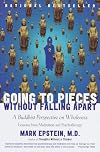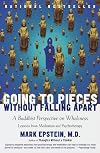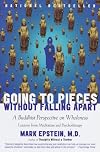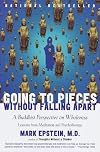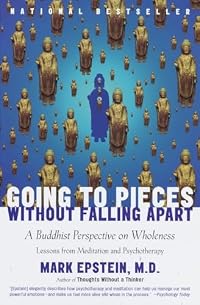
Going to Pieces without Falling Apart: A Buddhist Perspective on Wholeness
by Mark Epstein
On This Page
Description
Religion & Spirituality. Nonfiction. Going to Pieces Without Falling Apart shows us that happiness doesn't come from any kind of acquisitiveness, be it material or psychological. Happiness comes from letting go. Weaving together the accumulated wisdom of his two worlds-Buddhism and Western psychotherapy-Mark Epstein shows how "the happiness that we seek depends on our ability to balance the ego's need to do with our inherent capacity to be." He encourages us to relax the ever-vigilant mind show more in order to experience the freedom that comes only from relinquishing control. Drawing on events in Epstein's own life and stories from his patients, Going to Pieces Without Falling Apart teaches us that only by letting go can we start on the path to a more peaceful and spiritually satisfying life. show lessTags
Recommendations















Member Reviews
For decades, Western psychology has promised fulfillment through building and strengthening the ego. We are taught that the ideal is a strong, individuated self, constructed and reinforced over a lifetime. But Buddhist psychiatrist Mark Epstein has found a different way. Going to Pieces Without Falling Apart shows us that happiness doesn't come from any kind of acquisitiveness, be it material or psychological. Happiness comes from letting go. Weaving together the accumulated wisdom of his two worlds--Buddhism and Western psychotherapy--Epstein shows how "the happiness that we seek depends on our ability to balance the ego's need to do with our inherent capacity to be." He encourages us to relax the ever-vigilant mind in order to show more experience the freedom that comes only from relinquishing control. Drawing on events in his own life and stories from his patients, Going to Pieces Without Falling Apart teaches us that only by letting go can we start on the path to a more peaceful and spiritually satisfying life. show less
This book is divided into four parts.
Having completed the first part, I must say that I am confused about Epstein's argument. On the one hand he seems to say that while the objective is strengthening the ego, this is best achieved indirectly, by focusing on feelings of emptiness and dissatisfaction and letting those feelings breathe. A stronger ego and restful mind result when not being directly sought. Kind of like a spiritual Obliquity ( https://en.wikipedia.org/wiki/Obliquity_(book) ).
On the other hand, Epstein seems to be arguing for a jump from thesis to synthesis, with no antithesis in between. He cites Ken Wilber's "you have to be somebody before you can be nobody," and characterises Wilber as follows: "The ego must be formed show more before it can be dismantled; the self must be consolidated before it can be transcended." But all of this is written disapprovingly - he is setting Wilber up so he can knock him down. "Somebody and nobody are interdependent," he writes, criticising Wilber's framework; "they feed off each other rather than succeeding one another."
In this way, Epstein seems to be arguing for a jump directly from pre-ego to post-ego, with no ego stage whatsoever. I'm not sure I agree with him. I'm not convinced that is how things work. What's more, this seems to contradict his earlier writing in the book that advocates for indirect strengthening of the ego.
Lets see if Epstein can bring further clarity and, perhaps, change my mind in the rest of the book.
--
Confusingly written. Self-contradictory. I tried and tried and tried again. Yet this book is so bad that I have added it to my otherwise very small shelf of abandoned books - books willingly left incompletely read. The literary equivalent of walking out of the cinema. show less
Having completed the first part, I must say that I am confused about Epstein's argument. On the one hand he seems to say that while the objective is strengthening the ego, this is best achieved indirectly, by focusing on feelings of emptiness and dissatisfaction and letting those feelings breathe. A stronger ego and restful mind result when not being directly sought. Kind of like a spiritual Obliquity ( https://en.wikipedia.org/wiki/Obliquity_(book) ).
On the other hand, Epstein seems to be arguing for a jump from thesis to synthesis, with no antithesis in between. He cites Ken Wilber's "you have to be somebody before you can be nobody," and characterises Wilber as follows: "The ego must be formed show more before it can be dismantled; the self must be consolidated before it can be transcended." But all of this is written disapprovingly - he is setting Wilber up so he can knock him down. "Somebody and nobody are interdependent," he writes, criticising Wilber's framework; "they feed off each other rather than succeeding one another."
In this way, Epstein seems to be arguing for a jump directly from pre-ego to post-ego, with no ego stage whatsoever. I'm not sure I agree with him. I'm not convinced that is how things work. What's more, this seems to contradict his earlier writing in the book that advocates for indirect strengthening of the ego.
Lets see if Epstein can bring further clarity and, perhaps, change my mind in the rest of the book.
--
Confusingly written. Self-contradictory. I tried and tried and tried again. Yet this book is so bad that I have added it to my otherwise very small shelf of abandoned books - books willingly left incompletely read. The literary equivalent of walking out of the cinema. show less
Genuinely not sure what to make of this - it seems simultaneously very slight and incredibly profound. Good to be reminded that meditation/spiritual traditions are useful tools. Interesting synthesis of psychoanalytic theory and mindfulness/Buddhism- and the ‘pain comes from your own defences’ feels like a useful lesson. But feel like I’ve missed a lot in it, perhaps.
As someone that has failed time and again at psychotherapy and someone who has recently been studying Buddhism, I figured this was the perfect book for me to transition into a new mindset. About this, I was wrong.
When it comes to the Buddhist side of the spectrum, nothing was mentioned in this book that couldn't be found in a beginner's guide or "Buddhism for Dummies". Alongside this basic knowledge was enough psychobabble to make me put the book down for weeks at a time, uninspiring as it was. I have no doubt that Epstein has become enlightened in the ways he makes mention of, but the tactics and analysis he used do not come across clear in this book, and are not at all helpful.
When it comes to the Buddhist side of the spectrum, nothing was mentioned in this book that couldn't be found in a beginner's guide or "Buddhism for Dummies". Alongside this basic knowledge was enough psychobabble to make me put the book down for weeks at a time, uninspiring as it was. I have no doubt that Epstein has become enlightened in the ways he makes mention of, but the tactics and analysis he used do not come across clear in this book, and are not at all helpful.
n the 70s self help books had a we’re-all-in-this-together feeling and clustered around themes such as I’m Ok, You’re OK. In the 80s, decade of money-making, self help moved onto managing time and handling the people--either at home or in the workplace--who made you angry or got in your way: think One Minute Manager and 7 Habits of Highly Effective People. In the 90s, books such as Listening to Prozac pondered pharmaceutical possibilities for being comfortable with the self and remaking the self. Move on to the first decade of the 2000s and we find popular self-help and transformational books combine Buddhism with notions of happiness and letting go of ego. Going to Pieces Without Falling Apart is of that genre.
I saw this book on show more the coffee table of a friend who had just gone through a difficult divorce. She said the book helped her get through it. Since, my adult child is having a difficult time right now, I thought I would check out the book.
Going to Piece... is very formularific. For some readers, that may be comforting. The self-help genre is predictable in its presentation of material. After the writer introduces his/her theme and presents what is coming in subsequent chapters, the formula begins: idea, examples, summary; idea, examples, summary; idea, examples, summary. You get the picture.
Going to Pieces Without Falling Apart: A Buddhist Perspective on Wholeness: Lessons from Meditation and Psychotherapy ( two subtitles!) follows the pattern. Writer Mark Epstein presents a deck of themes, themes such as Emptiness, Surrender, Tolerance. He provides examples. First, from his practice: usually how his patients achieved an epiphany that relates to a Buddhist principle that relates to the title of the chapter. Second, an example from his personal or family life. Third, he tells a story about Buddha or Buddhist monk. Support in the summary (sometimes in examples, too) he cites Harvard--either his experience at Harvard, his medical training at Harvard, a Harvard study that he participated in or was carried out by others.
By the third chapter, the genre’s transparency became awfully tedious. Just another self-help/transformational book. The books are like carosels,and the horses that rotate around the center are different.
I suppose relating Buddhist philosophy to feeling lonely, to passion, to relationships and telling people it is OK to fall apart can be helpful to people, such as it was to my friend who was going through a divorce. And the book keeps in mind the twistaroonee in Buddhism, as I have been taught (and I am a beginner at it): abandon any hope for fruition. In other words, whatever you do, don’t expect results. Epstein upholds this teaching as the core of his commentary.
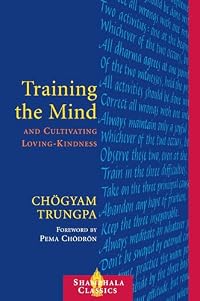
For those interested in Buddhism and transformation,in all its playfulness and irony, I recommend a book that is not so formularific: Training the Mind and Cultivating Loving-Kindness by Chogyam Trungpa. show less
I saw this book on show more the coffee table of a friend who had just gone through a difficult divorce. She said the book helped her get through it. Since, my adult child is having a difficult time right now, I thought I would check out the book.
Going to Piece... is very formularific. For some readers, that may be comforting. The self-help genre is predictable in its presentation of material. After the writer introduces his/her theme and presents what is coming in subsequent chapters, the formula begins: idea, examples, summary; idea, examples, summary; idea, examples, summary. You get the picture.
Going to Pieces Without Falling Apart: A Buddhist Perspective on Wholeness: Lessons from Meditation and Psychotherapy ( two subtitles!) follows the pattern. Writer Mark Epstein presents a deck of themes, themes such as Emptiness, Surrender, Tolerance. He provides examples. First, from his practice: usually how his patients achieved an epiphany that relates to a Buddhist principle that relates to the title of the chapter. Second, an example from his personal or family life. Third, he tells a story about Buddha or Buddhist monk. Support in the summary (sometimes in examples, too) he cites Harvard--either his experience at Harvard, his medical training at Harvard, a Harvard study that he participated in or was carried out by others.
By the third chapter, the genre’s transparency became awfully tedious. Just another self-help/transformational book. The books are like carosels,and the horses that rotate around the center are different.
I suppose relating Buddhist philosophy to feeling lonely, to passion, to relationships and telling people it is OK to fall apart can be helpful to people, such as it was to my friend who was going through a divorce. And the book keeps in mind the twistaroonee in Buddhism, as I have been taught (and I am a beginner at it): abandon any hope for fruition. In other words, whatever you do, don’t expect results. Epstein upholds this teaching as the core of his commentary.
For those interested in Buddhism and transformation,in all its playfulness and irony, I recommend a book that is not so formularific: Training the Mind and Cultivating Loving-Kindness by Chogyam Trungpa. show less
This is a good book for those interested equally in psychotherapy and meditation. I was looking more for the latter and did find a lot of good insights on the benefits of meditation. But didn't care too much for lengthy descriptions of psychotherapy cases.
I wanted to like this but he lost me in the first few pages when the psychology jargon started to pile up and I really had no idea what he was driving at. Then the meditation got folded in and I totally lost my way. I had no idea what he was driving at most of the time except the "add some meditation concepts in your therapy", which seemed a reasonable idea but is that a whole book?
Members
- Recently Added By
Author Information

12 Works 2,979 Members
Mark Epstein, M.D., is also the author of "Thoughts Without a Thinker: Psychotherapy from a Buddhist Perspective". A psychiatrist & consulting editor to "Tricycle: The Buddhist Review", he lives in New York City. (Bowker Author Biography)
Common Knowledge
- Canonical title*
- Barsten zonder te breken
- Original title
- Going to pieces without falling apart : a buddhist perspective on wholeness : lessons from meditation and psychotherapy
- Original publication date
- 1998 (1999 Nederlandse vertaling) (1999 Nederlandse vertaling)
- Epigraph
- Men are afraid to forget their minds, fearing to fall through the Void with nothing to stay their fall. They do not know that the Voic is not really void, but the realm of the real Dharma. --Huang Po
- Dedication*
- voor Arlene
- Original language
- English
*Some information comes from Common Knowledge in other languages. Click "Edit" for more information.
Classifications
- Genres
- Religion & Spirituality, Nonfiction, General Nonfiction
- DDC/MDS
- 294.3444 — Religion Other religions Religions of Indic origin Buddhism Buddhism - practice Religious experience, life, practice Religious life and practice
- LCC
- BQ4310 .E66 — Philosophy, Psychology and Religion Buddhism Buddhism Doctrinal and systematic Buddhism Special doctrines
- BISAC
Statistics
- Members
- 787
- Popularity
- 35,139
- Reviews
- 12
- Rating
- (3.56)
- Languages
- Danish, Dutch, English
- Media
- Paper, Audiobook, Ebook
- ISBNs
- 14
- ASINs
- 5