On This Page
Description
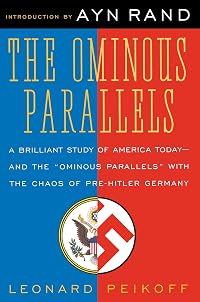
Ayn Rand chose Leonard Peikoff to be her successor as the spokesman for Objectivism. And in this brilliantly reasoned, thought-provoking work we learn why, as he demonstrates how far America has been detoured from its original path and led down the same road that Germany followed to Nazism. Self-sacrifice, Oriental mysticism, racial "truth," the public good, doing one's duty--these are among the seductive catch-phrases that Leonard Peikoff dissects, examining the kind of philosophy they show more symbolize, the type of thinking that lured Germany to its doom and that he says is now prevalent in the United States. Here is a frightening look at where America may be heading, a clarion call for all who are concerned about preserving our right to individual freedom. show lessTags
Recommendations




























Member Reviews
I am currently about 2/3 of the way through the book and find it fascinating reading. Though I am a fan of Romanticism (at least the literary movement) I cannot help but be intrigued by the argument that Romanticism, as the "enemy of Reason," is dangerous. Certainly I could always see the danger in losing oneself in sublime fantasy, but not until being introduced to Ayn Rand, and subsequently Peikoff, had I ever considered the the possibility of Romanticism being "Nazi Dangerous."
Though aware of the Nazi's use (or perversion) of the romantic and the spiritual, it had never occurred to me to see such an explicit connection between Romanticism and dictatorship before discovering the works of Ayn Rand. Peikoff writes like he must be show more Rand's star pupil (or disciple). Both of them are very persuasive, logically impeccable writers. The fact that I don't necessarily buy into their masterfully crafted arguments, but absolutely love reading them, and even getting caught up in the message, is testament to the respect I have for their take- no-prisoners, rhetorically utilitarian writing style -and yes, there is definitely a style, just not for its own sake.
Something I would like to thank Peikoff for in particular is the crash course in philosophy through which "The Ominous Parallels" takes the reader. Not having been a Philosophy major (but still something of an enthusiast) I am able to appreciate this book in part as a bibliographic essay in the major schools of Western Philosophy (particularly German).
In pursuing the works of Plato-Kant-Hegel, Aristotle, etc., I may find that I do not necessarily agree with Peikoff's assessment of their worth, but having such a concrete starting point from which to venture towards my own conclusions is immensely helpful.
Most "Intro to..." philosophy books are so noncommittal in terms of assessment or evaluation that it is difficult for the lay philosophy student to come away with anything more than a list of vague bullet points about their subject that might be helpful on the matching section of a class quiz, but not particularly useful in acquainting the student with the philosophers or philosophies themselves. show less
Though aware of the Nazi's use (or perversion) of the romantic and the spiritual, it had never occurred to me to see such an explicit connection between Romanticism and dictatorship before discovering the works of Ayn Rand. Peikoff writes like he must be show more Rand's star pupil (or disciple). Both of them are very persuasive, logically impeccable writers. The fact that I don't necessarily buy into their masterfully crafted arguments, but absolutely love reading them, and even getting caught up in the message, is testament to the respect I have for their take- no-prisoners, rhetorically utilitarian writing style -and yes, there is definitely a style, just not for its own sake.
Something I would like to thank Peikoff for in particular is the crash course in philosophy through which "The Ominous Parallels" takes the reader. Not having been a Philosophy major (but still something of an enthusiast) I am able to appreciate this book in part as a bibliographic essay in the major schools of Western Philosophy (particularly German).
In pursuing the works of Plato-Kant-Hegel, Aristotle, etc., I may find that I do not necessarily agree with Peikoff's assessment of their worth, but having such a concrete starting point from which to venture towards my own conclusions is immensely helpful.
Most "Intro to..." philosophy books are so noncommittal in terms of assessment or evaluation that it is difficult for the lay philosophy student to come away with anything more than a list of vague bullet points about their subject that might be helpful on the matching section of a class quiz, but not particularly useful in acquainting the student with the philosophers or philosophies themselves. show less
Subtitle: The End of Freedom in America
Nazism, Dr. Peikoff argues, was made possible by the German philosophers who advocated unreason and self-sacrifice—and whose ideas now rule American universities.
"The Ominous Parallels offers a truly revolutionary idea in the field of the philosophy of history. (It) is clear, tight, disciplined, beautifully structured and brilliantly reasoned."—AynRand
Nazism, Dr. Peikoff argues, was made possible by the German philosophers who advocated unreason and self-sacrifice—and whose ideas now rule American universities.
"The Ominous Parallels offers a truly revolutionary idea in the field of the philosophy of history. (It) is clear, tight, disciplined, beautifully structured and brilliantly reasoned."—AynRand
Ratings
Members
- Recently Added By
Author Information

42+ Works 1,202 Members
Leonard Peikoff is the preeminent Rand scholar writing today. He worked closely with Ayn Rand in New York City for thirty years and was designated by her as heir to her estate. He has taught philosophy at several places, including Hunter College and New York University. Dr. Peikoff is the author of The DIM Hypothesis, The Ominous Parallels, and show more Objectivism: The Philosophy of Ayn Rand. He grew up in Western Canada and now lives in Southern California. show less
Series

Belongs to Publisher Series
Common Knowledge
- Canonical title
- The Ominous Parallels: The End of Freedom in America
- Original publication date
- 1982
- First words
- Here is the theory:
- Last words
- (Click to show. Warning: May contain spoilers.)He was not asked what is required to keep it, but the answer to that now would be: "A philosophy -- if you can get one."
- Blurbers
- Greenspan, Alan; Rand, Ayn
Classifications
Statistics
- Members
- 321
- Popularity
- 99,699
- Reviews
- 4
- Rating
- (4.08)
- Languages
- English
- Media
- Paper, Ebook
- ISBNs
- 6
- ASINs
- 1